Hoof rehab help

Michen

Well-Known Member
Joined
22 January 2014
Messages
12,808
Visit site
Hi guys, once again reverting to HHO as I can't work out what to do here!

Without going in to too much detail, Boggles shoes came off about a week ago. In shoes at the point of them coming off he was landing heel first LF and outside heel first RF (not new for him, we've never managed to find a problem higher up to indicate why but we have greatly improved it by trimming him "unlevel", in the same way he used to wear his feet without shoes, rather than trimming him level").

He's now landing just about flat LF and toe first RF since coming out of shoes. His frogs are good, no thrush though I'm treating anyway. His feet are long and chipping, we VERY lightly trimmed him but I was aiming to get him out on the roads ASAP and to let him self trim, to see what he did with his own balance. He's fine on all surfaces inc stones.

However I'm unsure whether to do roadwork/miles with him when he's landing toe first? Would this not start damaging the structures in the hoof- if he works whilst landing this way? I could boot him but I have no idea what to boot him with as his feet are longer than norm so any measurements would soon be out of whack.

Should I work him on the roads despite the toe first landing, in the hope that his toe will come back which may help a heel first landing come back again? He's already started bringing it back himself.

As I said he's comfortable, sound etc.. but the landing says otherwise. He's had about 6 weeks off now from some initial bruising, has remained sound since being turned out etc, but very happy to give him longer off (though he is getting porky which isn't ideal), I'm not sure what else to do to promote the HF landing. Trim, work, leave in the field...?
 
I'd trim. I know self trimming is supposed to be the goal but it never seems to work for me and always causes issues! The last one was almost there and had next to nothing taken off but he still had to be done to keep the balance right. Current one I have trimmed now, having tried and failed with self trimming earlier this year. I just ended up with a really crappy set of feet that took the trimmer a couple of trimming cycles to get back right.
 
I have never found self trimming to work that well with a toe that has run forward. It may be helpful if you could post pics and possibly measurements.
 
I have never found self trimming to work that well with a toe that has run forward. It may be helpful if you could post pics and possibly measurements.

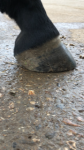
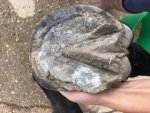
Only have these ones, literally just as the shoes had been removed
A1EBAE00-B219-4507-9B8F-D3AD0D88BBB4.png6251A7DF-B775-4991-B112-FA549041C4E4.jpeg
 
If those were mine I would trim, boot and get on with riding. I would also stick a cotton bud in the central sulchus crack (if you haven't already) just to make sure it is clean. I cannot see that would be a very difficult foot to boot.
 
I have never found that walking on roads in hand does anything but improve that landing of a toe first horse. I would not ride the horse until it lands flat.

I wouldn't trim, and I would boot only if he is sore.

I've done a few rehabs that way Michen, I hope that helps.
 
I agree with ycbm.

I'd approach it the way Rockley farm do. No trimming and work the horse within his comfort levels over surfaces that are abrasive enough to remove the hoof that the horse no longer needs. The heel first landing will come when he's ready

I know you have things that, to a certain extent, remain unanswered with him so I'd allow him to have whatever shaped hoof he needs even if it went through a really fugly stage in the hope that 'the unanswereds' heal as his hoof improves. I think you may need to be quite brave as fugly could be a look that neither you or your farrier will be happy with

Since no one else has said it, and this is a barefoot thread. What are you feeding?:D
 
I agree with ycbm.

I'd approach it the way Rockley farm do. No trimming and work the horse within his comfort levels over surfaces that are abrasive enough to remove the hoof that the horse no longer needs. The heel first landing will come when he's ready

I don't disagree with either of you in theory but on the other thread Michen said she did not envisage remaining BF longterm and was planning to shoe mid -end Aug. So I don't see this as a longterm rehab. but just better to keep the horse exercised.
 
I have never found that walking on roads in hand does anything but improve that landing of a toe first horse. I would not ride the horse until it lands flat.

I wouldn't trim, and I would boot only if he is sore.

I've done a few rehabs that way Michen, I hope that helps.

Thanks ycbm yes it does.

I am not entirely sure I like the idea of leading or long reining Boggle on the roads at the moment though.. fiery and full of it.


I don't disagree with either of you in theory but on the other thread Michen said she did not envisage remaining BF longterm and was planning to shoe mid -end Aug. So I don't see this as a longterm rehab. but just better to keep the horse exercised.

True, but tbh although he is sound etc I am more concerned with those feet being healthy (shoe or unshod) so if he needs longer for the foreseeable future out of shoes then that’ll be what happens. Really eventing/hunting are the only reasons to shoe and I have no intention of doing either with a horse there landing toe first on a fore as that to me is a big red flag.

I’m really hoping a good landing comes quickly!
 
I agree with ycbm.

I'd approach it the way Rockley farm do. No trimming and work the horse within his comfort levels over surfaces that are abrasive enough to remove the hoof that the horse no longer needs. The heel first landing will come when he's ready

I know you have things that, to a certain extent, remain unanswered with him so I'd allow him to have whatever shaped hoof he needs even if it went through a really fugly stage in the hope that 'the unanswereds' heal as his hoof improves. I think you may need to be quite brave as fugly could be a look that neither you or your farrier will be happy with

Since no one else has said it, and this is a barefoot thread. What are you feeding?:D


Just grass, hay (stabled half the day) and a handful of pony nuts to carry some salt and equimins advance
 
Thanks ycbm yes it does.

I am not entirely sure I like the idea of leading or long reining Boggle on the roads at the moment though.. fiery and full of it.


I can't long rein, roads aren't safe. Long rope, bit (shifney if necessary) good boots, long whip for conrolling the quarters, smothered in high Vis both of you.

..
 
Trying to organise my thoughts and hopefully answer coherently (first time for everything!)

1- movement is key but you are right in that it has to be comfortable loading otherwise they compensate. With that in mind personally and I'd pad and boot for uncomfortable surfaces (ie whatever he's landing toe first on just now) and leave him bare in the school if hes comfortable. You want to do "the right thing" ie get him moving and loading correctly so his steps need to be comfortable. Horses can only land heel first once the heel is strong enough and thay takes time and conditioning as shoeing has a very negative impact in heels and digital cushion.

2- rockley, yip that's the ideal to have different terrain and surfaces with pea gravel loading areas where horses can be turned away to pick and choose what ground they cover and develop the hoof they need and "self trim". That's generally not the set up that most people have access to and in this circumstance not looking to turn the horse away. The horse lays down the hoof that it needs and that's why you condition a barefoot hoof so that the body can adjust and increase growth rate to match wear. That's why "big" trims set the horse back and then they grow a tonne of hoof. So yes rockley say leave them but rockley also have acres of turnout in exmoor and have developed a purpose made facility with some tracks and different options for the horse

3- trimming. It just shows you how deceptive the hoof can be. Your first pic he looks fine and maybe just a bit of a bevel/roll needed but underside tells a different story. I would trim but I'd do bit by bit, maybe a run around with a radial rasp every day instead of devoting a day to do a "proper" trim. This book was a relevation to me https://smile.amazon.co.uk/Natural-...oot+hoof+book&qid=1561664632&s=gateway&sr=8-3

I've read and studied lots about the hoof but this just resonated and made a lot of sense. It talks about how we need the heels to get healthy before we can load them whereas as some trims want horses heel first before they are strong enough to cope with it.

So yeah in short I'd start trimming ge tly every day, keep treating as thrush, pad and boot to get correct steps and keep up with physio/massage (look at the Masterson book for things you can do yourself to save pennies) as his muscles will change as his way of going does
 
Paddy555. Yes absolutely. As much exercise as possible. I think improvement will be much faster if he's working correctly rather than just dossing in the field with his mates.

Michen Great that his diet is already sorted so he's getting all the ingredients for healthy hooves. I do sympathise, I wouldn't be able to longline mine on the road either. It's not easy, I'd love a Rockley set up but it'll never happen as livery is poor in my area. Overgrazed, over fertilised fields are the norm round here. You can only do your best within the confines of what's available and take it a step at a time. You've spotted the problem and your doing everything you can to resolve it that's so much more than a lot of horses get.
 
I think I'd start some light roadwork and see what happens - you are obviously pretty on the ball with monitoring how he is doing so while yes there is the possibility that road work won't help he's not going to self trim very well mooching in the field getting tubby. Just my opinion and I'm no experienced barefoot rehab person though
 
i would get him on the road for half an hour a day IN HAND, then return when he is warmed up and lunge GENTLY 5 days a week on good surface , in squares circles anything to keep him moving to rehab the foot and control the weight which go hand in hand, less weight is better for the feet, and the movement will stimulate the frog and foot to move and expand in a natural way promoting change.

add salt to diet grass and put on seaweed for a few months, and get easyboot gloves if boots are needed

and moisturize feet as needed
 
i would get him on the road for half an hour a day IN HAND, then return when he is warmed up and lunge GENTLY 5 days a week on good surface , in squares circles anything to keep him moving to rehab the foot and control the weight which go hand in hand, less weight is better for the feet, and the movement will stimulate the frog and foot to move and expand in a natural way promoting change.

add salt to diet grass and put on seaweed for a few months, and get easyboot gloves if boots are needed

and moisturize feet as needed

I would not be lunging a horse that has been out of work for nearly 6 weeks now. In fact nor would I be having him in the school.

Tbh, leading this horse in hand or even long reining on roads is not an option for me at the moment. He is sharp, reactive and will take consistent work to get him mellow, the only safe way to be on the roads is, in my view, on his back where I can control him effectively from my seat and leg.

He will find any kind of in hand work out hacking even more exciting, if he's not able to carry my 9.5 stone on the road then really he probably shouldn't be doing any form of work!
 
i would get him on the road for half an hour a day IN HAND, then return when he is warmed up and lunge GENTLY 5 days a week on good surface , in squares circles anything to keep him moving to rehab the foot and control the weight which go hand in hand, less weight is better for the feet, and the movement will stimulate the frog and foot to move and expand in a natural way promoting change.

add salt to diet grass and put on seaweed for a few months, and get easyboot gloves if boots are needed

and moisturize feet as needed

No seaweed; it's too high in iron for UK soils unless a deficiency has been identified via soil testing. UK soils are generally low in copper and high/excess iron also inhibits the uptake of copper increasing the issue.

It used to be the go to for barefooters but that info is now outdated.
 
Paddy555. Yes absolutely. As much exercise as possible. I think improvement will be much faster if he's working correctly rather than just dossing in the field with his mates.

Michen Great that his diet is already sorted so he's getting all the ingredients for healthy hooves. I do sympathise, I wouldn't be able to longline mine on the road either. It's not easy, I'd love a Rockley set up but it'll never happen as livery is poor in my area. Overgrazed, over fertilised fields are the norm round here. You can only do your best within the confines of what's available and take it a step at a time. You've spotted the problem and your doing everything you can to resolve it that's so much more than a lot of horses get.

Nope and nor would I be leading him in hand, regardless of a chifney/whip/long rope. When I am on board I can control both sides of him instantly and pre empt any sideways, sharp movement.. plus I can keep him more relaxed through the use of my seat. I am certainly not about to head out on the roads with a buzzy, sharp horse on the end of a leadrope frankly!
 
You're out of options then Michen. You will risk damage riding a horse landing toe first. So the only 'safe' option you have left is to turn him away and hope it sorts out the landing. It often does, but not always.

.
 
You're out of options then Michen. You will risk damage riding a horse landing toe first. So the only 'safe' option you have left is to turn him away and hope it sorts out the landing. It often does, but not always.

.

My options as I see them are to boot and pad if he’s toe first?
Looking at the landing this am he looks to be almost flat now, so I’m really hoping this is just a “immediately out of shoes” blip and that the landing comes quickly.


The clumpy “rehab” type boots like cavallo/equine fusion, I’m not sure how you can tell if they are landing HF in those though..
 
If walking out on the roads is not an option, can you walk him out round the fields/ livery yard? I feel for you that it is so awkward to walk this horse out. This might be an opportunity to address that by starting somewhere safe. It is pretty important in my experience to be able to lead a horse on the roads - you never know when you may need to do that and as others have said it can also be a very beneficial element of any foot/hoof rehab.
 
If walking out on the roads is not an option, can you walk him out round the fields/ livery yard? I feel for you that it is so awkward to walk this horse out. This might be an opportunity to address that by starting somewhere safe. It is pretty important in my experience to be able to lead a horse on the roads - you never know when you may need to do that and as others have said it can also be a very beneficial element of any foot/hoof rehab.

It's not about not being able to lead him on the road, it's about what I feel is safe. He is a sharp horse that's been out of work for a good chunk of time. I personally don't like the idea of leading a horse down a road on the left, them potentially spooking at something into oncoming traffic with you having no way of quickly controlling their right hand side (as you would when on board, with your leg). I'm sure there's plenty of different opinions on it, and I'm sure I'd feel comfortable doing it (or long reining) in a couple of weeks when he wasn't so fresh back in to work, but certainly not at the moment.

Have just ordered a scoot boot fit kit, so will see how that goes. As I said above, his landing actually looks like it's improved today, and I'm trying to remind myself he's 7 days out of shoes having been shod for 15 months, so I'm really hoping that this time next week this will be a different situation...

We shall see :)
 
  • Like
Reactions: TPO
If you have quiet roads/lanes then a bit of sleepy juice to lead him short term might be an option, depends on what you have available to you. Adding a roller and side reins can help too. I’ve done my time with the prats and I agree you don’t want to be leading the sharp ones in hand, in traffic without extra ‘help’.

Once you are back in the saddle and walking I have found valerian very useful to take the edge off. I refuse to ride under acp though.
 
I would not be lunging a horse that has been out of work for nearly 6 weeks now. In fact nor would I be having him in the school.

Tbh, leading this horse in hand or even long reining on roads is not an option for me at the moment. He is sharp, reactive and will take consistent work to get him mellow, the only safe way to be on the roads is, in my view, on his back where I can control him effectively from my seat and leg.

He will find any kind of in hand work out hacking even more exciting, if he's not able to carry my 9.5 stone on the road then really he probably shouldn't be doing any form of work!

i lunge horses that have never worked in their lives before all the time,! as part of the breaking process i start somewhere and introduce going out in hand gradually, on the road and they end up learning because the effort is put into them and i am talking about highly explosive big strong 16, 2 3 horses, high value horses, because if they cant go out on their own they are no good to us, and it makes it easy to walk out in hand as and when and if we need to, its part of their education, and very good for their feet

in one work session they will lunge on surface then go on the road then on stoney tracks then canter in the field,, it all very good for their feet

it is often underestimated how gentle work every day can alter a horse beyond belief, mentally and physically, i do it all the time,but i make the effort to succeed, but if you think you cant then you are right

i use seaweed because it has proven itself on many occasions to actually work, i dont use it all the time, just a needed, i have seen the proof, if others think differently thats great by me!


i guess we are all different
 
If you have access to some sort of EVA matting (e.g. children's play mats, exercise mats) you could tape some pads on with duct tape to see if that helps with the landing. Cheaper than buying boots, only to find they don't actually make a difference to his landing. I think of boots as "strapping a comfortable surface to the hoof", if you don't have comfortable surfaces to ride on. So I'd probably ride on suitable surfaces if you have them, and if boots make him land better, ride in boots. If the boots don't improve his landing I'd be worried there's something else going on and might give it more time without the rider's weight.
 
My options as I see them are to boot and pad if he’s toe first?

I'm comfortable with the idea of strapping a flat surface to the bottom of the foot to protect from uneven surfaces. But padding up, in my view, is likely to prevent the horse building up the foot it needs to build up by dampening the stimulus needed to make it happen.
 
just to say michen,i absolutely understand why you would not want to lead/long rein on the road at the moment. my old mare was very lively but could be led safely on the road normally...., when she needed road work after an injury and time off i tried to lead her as the vet suggested ,and although the lanes were very quiet, she was a looney. after talking to my vet, she agreed to my riding instead.. my mare did more leaping about when not ridden but as soon as i was in the saddle we could walk nice and quietly..so IMO less damage was done..
 
My mare was landing toe first when she came off box rest for lammi. She was also newly barefoot. This improved over a couple of weeks. She is fine now, had two weeks in hand grazing and walking on the yard.
 
I have always led on the road as I find this changes the foot more quickly than anything else, but I do have quiet roads.

I lead from the offside, so I am between the horse and traffic, and if necessary to start with I have OH following in a car or on a bike. In a car he will take up a lot of road on a 2 way street so oncoming traffic has to slow down, and overtaking traffic has to go wide. On a single track road he can block it so traffic has to stop rather than try to squeeze through.

I seem to recollect you have transport, maybe you could travel 3 X a week to somewhere with a safe tarmac surface t lead on? Can't see that leading him to improve his feet is any less important than a lesson or competition as far as travel goes.
 
Top