Horse bars

Scarolina

New User
Joined
16 November 2024
Messages
6
Visit site
Hey everyone,

I have a 10 yo polo pony. I removed his shoes 2 days ago because we’re not playing much polo these days because of the weather. Our arenas are soft sand.

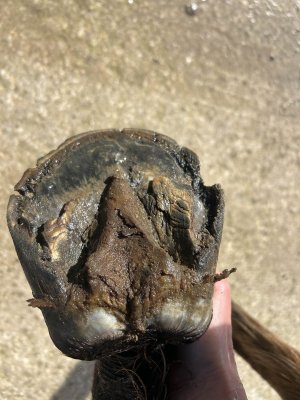
Within the past few months I’ve noticed these hard bits protruding from his soles.

Now I’ve removed the shoes you can really see them. Are they bars? Can anyone give me advice about what to do with them? My farrier told me to leave them but where I live we don’t have the best farriers. The always trim too short and they don’t shoe very accurately (hence taking off the shoes).

Any advice would be appreciated, I’m I relatively new horse owner (1 year!).
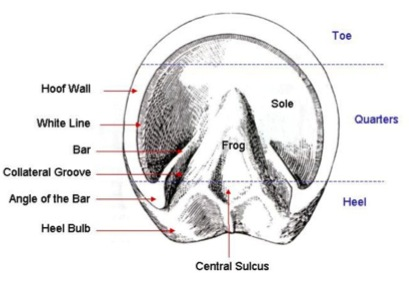
 
They are the same material as the hoof wall so will grow and be worn in the same way - as you can see from the picture they are an extension of the wall forward from the heel. They need trimming if the horse isn't self-trimming them, particularly because they can fold over and fill the space between the frog and the wall, and will then put (painful) pressure on the sole. Welcome to the forum, BTW!
1769689361785.png
 
I've seen a lot worse for a horse just coming out of shoes, especially the frogs, which look quite healthy.

For the moment, I would just run a rasp around the ragged edges, so they are smooth. I would do an angle, so the corner is rounded.

I would start road walking, starting at just 100 yds a day and increasing as your horse is comfortable.

I find that bars generally break off, especially with road walking, but I will trim protruding bits if they are causing a pressure point or folding over. You can use a knife for this, or I bought a very curved rasp where I could grind off enough to make the pressure less. I make sure I don't remove actual sole. If you can leave it though, I find that the natural shedding will be more true than any trimming I could do.
 
Agree with Red, but personally I would trim the bars now. Admittedly it's not the best angle, but they look as if they're starting to fold over and if you can get ahead of that it will mean you are sure they are not causing any discomfort if you exercise on a hard surface. I use a hoof knife and trim flush to the sole.

Useful video if you want to take more pictures to monitor progress:
 
Agree with Red, but personally I would trim the bars now. Admittedly it's not the best angle, but they look as if they're starting to fold over and if you can get ahead of that it will mean you are sure they are not causing any discomfort if you exercise on a hard surface. I use a hoof knife and trim flush to the sole.

Useful video if you want to take more pictures to monitor progress:
Agree with this, because once hoof bars do start folding over, can trap small bits of gravel and cause other problems / lameness. Once he’s ’got going’ walking out barefoot, will probably pare them down naturally, but not always, and you don’t want to cause extra pressure points, so keep an eye on them.
Good luck😀
 
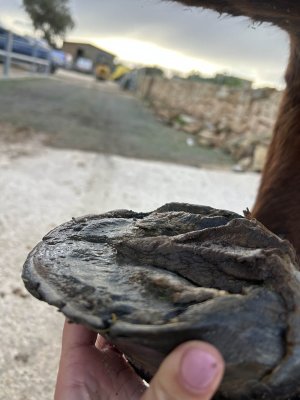
An update on the hoofs:
I'm getting a lot of mixed recommendations at the farm I keep my horse at.
1. Hoofs are too short to be barefoot
2. he is flat footed - I should put shoes back on
3. Bars are definitely too long. I need to trim them.

Any thoughts?

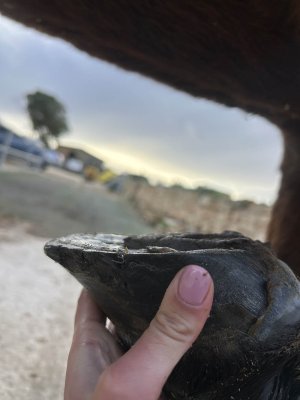
AE3D1E4B-1DED-43F4-9B01-DB3999A11ED6 copy.jpgCA6B8A9E-62FF-4835-8804-9FC3CDABF680 copy.jpg7D1DE5BB-6C01-4D79-BEF5-C2C88B6CCCE0 copy.jpg
 
No bad feet, considering they've only just had shoes pulled. I would definitely trim those bars back a bit and the toe looks a bit on the long side. They do tend to get more concave with use, but I find they do get flatter at certain times of the year. Probably due to changes in ground conditions.
 
The frog still looks good and there looks to be a fair bit of sole on the foot.

I would trim the part of the bar that looks to be protruding.

How does the horse feel? Is he sound? It is normal for them to be sound for a month or so, then feel a little sore.

The feet are still very vulnerable, and weak in a way, but that is also normal for feet that have had shoes on for long periods.

The weakness is why I said to only start with 100yds on tarmac and only work up to what they are comfortable with.

Transitioning to barefoot takes a long time. The stage your horse is at is the stage I feel I have to sit on my hands. Yes, the toe needs to be shorter, and more shaping is needed, eventually, but not right now IMO. The reason being that your horse's foot has developed to work with shoes and now the shoes are removed, the frog is very prominent. I only trim the minimum until the foot has started to re-shape.

Concavity cannot be trimmed in. It is from the foot adapting over time to not having the shoe lifting the sides of the feet, which is a sort of artificial concavity. They look flat now, but if the walls are trimmed even more, the frog will stand out even more and will likely get too much pressure.

When the shoes come off, I trim the scrappy bits so they don't crack further, as you have done. I take them out of work to make the transition un pressured. I have them on soft bedding/ground while they start to change, for their comfort. I walk 100yds at first and gradually increase. I think of this time as time for the feet to relax after being bound to one position over a long time. Like if your leg had been in a cast, and it comes off. The structures are used to external support and need time to start to support the new movement in the foot.

Once you start walking, I find the shape changes daily! Once the first few weeks are up, I find I want to run a rasp round pretty much daily too, as they change so quickly.

Make sure the horse is on a mainly fibre based diet, and has low iron and a good supplement such as Progressive Earth Pro Hoof Platinum.

ETA - I doo hoof photos regularly. One from the side, one of the sole and one from in front.

The front one will help you to see if the hoof goes off balance left to right.

The side helps see balance front to back, and toe length, and heel length, as well as wall health/ line/angle of coronet (useful for low level lami).

The sole one helps with frog health, see discrepancies in heel height/development, see width of the wall, see bars and see health of the sole.
 
Last edited:
Basically exactly what @Red-1 said. Lameness was my reason for transitioning, I walked in hand morning and night starting with 100 metres twice a day and working up to a mile or so twice daily. By that time he was sound so I hopped back onboard and started with around 15 minutes walk hack and gradually built up from there.

I also took loads of photos. It's great for checking progress/balance and a great moral boost when you start to see the new better angle growing down the hoof capsule. I also took the view looking down the base of the hoof from the heel bulbs down. I found that useful to check the heels were balanced.
 
Agree with all of the above, the hoof will go through an ugly stage while it is getting used to having no shoe, the transformation can be drastic but for the better but I found the best results are once the whole hoof has grown out.

It is a proper rehab to get the hooves how they should be it just takes time and effort no 2 horses are the same.
 
Just to add both my Arab's are barefoot have been for years, Arabi has quite a prominent sole which we struggled with for about the first 9 months he had to wear boots for riding, he only really feels very stony hard ground in summer I often use a hardener on just the sole and his fine.
 
You've got some really solid advice here, stick with it and his feet should improve with time - you're obviously conscientious and careful so you should manage just fine. Don't let people on your yard put you off just because the feet don't look perfect immediately and they're not used to newly barefoot feet. Unless your horse has other significant problems going on elsewhere a period out of shoes will probably be beneficial to the horse, particularly if you don't think your farrier is brilliant (although in this case his advice to leave them probably isn't the worst advice you could get!).

Sorry, I'm no expert but just wanted to give you some moral support as you seem to be making a sensible decision.
 
He’s definitely not comfortable on the tarmac yet. I’ve been walking him very slowly, at his own pace, for about 100 yards to the field where we work the horses. The ground there is soft sand, and he seems much more comfortable, so I keep him walking for around 25 minutes in the arena.

I’m glad I’m sticking to your advice. Today, some bits of the bars were breaking off naturally while I was cleaning his hooves after our walk. Some progress to them looking nice and neat.

Gosh, it’s really daunting when people are giving you their opinions left, right, and centre. The truth is, they’re all very valid opinions from people I genuinely believe know what they’re talking about.

Just to give you a bit more context on his health at the moment: exactly a month ago we did blood tests, and he had a low red blood cell count. We gave him Red Cell supplement for four weeks and repeated the test. I live in Malta, so we don’t have grazing land for horses. Unfortunately, the repeat test from yesterday came back even lower than four weeks ago, and I completely freaked out.

Everyone suspects he may have a tick-borne disease. Two other horses had the same thing last November. The test results should be back next week, so I’m really hoping we can get a diagnosis and treat it as soon as possible.

He’s been feeling very sluggish when I was riding him. Poor thing. Definitely will be resting and taking him out on relaxed walks until we sort this out.

I suppose with him being out of action for the next few weeks, I figured it's a good time to work on his hooves.

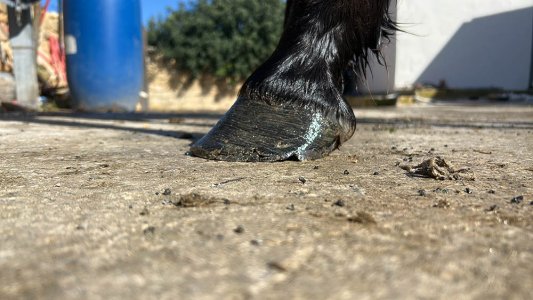
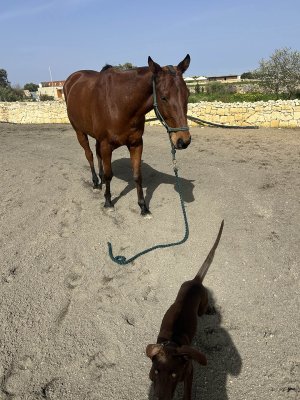
Here's my beloved patient 😍:

IMG_8334 copy.jpg
 
Just one last important thing I forgot to mention:

One person who recommended shoeing him, because he appears a bit on the flat-footed side, is a vet, although she works with small animals, not horses. Her own horse previously had laminitis, so she’s understandably very cautious about it.

Her concern is that my horse might develop laminitis because his frog protrudes more than the hoof wall.

What do you all think?
 
It is because of the frog protruding that I recommend keeping on the soft surfaces for a period until the feet start to change, only using tarmac to the point that they are still comfortable.

Barefoot and lami can be a double edged sword. I have been reliably informed that they may be slightly more inclined to get it, because of the increase in blood flow. However, shoeing can mask lami, so when barefoot you will likely learn of it earlier than if shod, so can take steps to stop it being a full blown attack.

Rigs was shod when I first got him. He had recent lami and rotation in 3 out of 4. In the fronts, the sole was bulging, so he had shoes to facilitate comfort but I kept him on soft surfaces so he was supported. He'd already done 3 months of box rest on a soft bed when I bought him, and was sound.

The issue is that I would not like to disagree with a vet, especially one who has seen the horse. What I will say is that many vets have not done much training on barefoot function and are likely to recommend shoeing at any issue, as it immediately makes the horse comfortable, and they is their aim, to help horses be comfortable. I am lucky to have been able to source barefoot friendly vets, but I know of others who are not and will prefer bar shoes or pads to barefoot.

If you are worried, you could boot for the time he is on the hard, with soft pads inside the boots. Neither of mine was ever lame when transitioning, and had they been, I would have used boots and pads. They have both used boots when upping exercise levels beyond what they were currently capable of, but then have benefitted from returning from exercise and returning to barefoot on more forgiving surfaces.

I had a client get old carpet and carpet the tarmac between stable and field, as the livery yard didn't want to faff with boots 2 X a day. It was only temporary during transition and worked. The carpet was then disposed of.
 
Top