
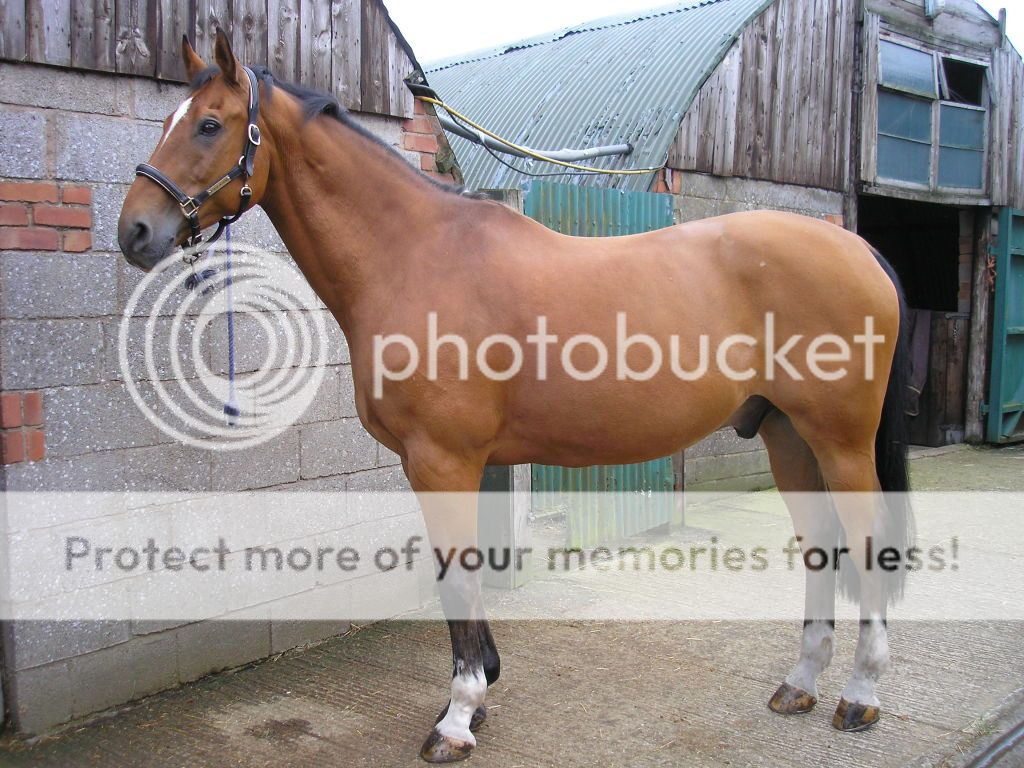
How is he looking? CC please.

Looking at horses stance and movement tells us such a lot. If only I had noticed my horse's slight change in stance. The first picture is hinting at a problem that I failed to notice or bring to my brilliant vet's attention, a few weeks later he suffered a career ending injury. After the injury I studied lots of pictures taken over a 12 month period prior to the injury and sure enough there were very subtle signs that all was not well, yet he was scoring 80% on a regular basis.

The second picture was taken after 11 months on box rest and at the beginning of what resulted in a failed rehab programme.

001-3.jpg


Leoretirestoday772012004.jpg
 
Hi,
I find this thread really interesting as I am a 'feet' person before anything else whan I look at a horse.

Might I suggest...and please don't anyone think I am having a go or being nasty...that is not the case.....in all of the photos where the feet can be seen......in my opinion...and I am not a farrier or a barefootist....they all appear to be badly 'farriered'.

The first pic is ...to me...like the horses' feet are way too small for the size of the horse they are intending to carry....especially the hinds.

In the next pic.....the one who had the kissing spine I think....his feet in the first photo are not the same as in the second photo and ditto the career ending pics.

What frightens me the most is none of these horses have the same farrier.....and all the farriers will have been to farrier school.

I am in no way having a go at owners...because just as when I take my car for it's MOT....I trust my garage to do the right thing by my car .....because I am not a mechanic.....

I really hope everyones' horse pulls/pulled through their injuries.

Best wishes
Bryndu
 
I have a horse who stands like this for a completely different reason. She's a mare and obviously won't be the same problem as yours! But she is a retired (mid teens) broodmare (not back to back) who has ovary problems - nothing major but retired after throwing a foal and problems found. Vets said that she would be fine to put in foal again but we would probably be disappointed. We retired as didn't think this was fair for her. Once or twice a year will take on this stance for an hour or so. Vets have been out to watch (that was a very expensive 15 minutes!) And said that it's minor discomfort rather than pain and she is still happy to hoon around if the youngsters start up and have dinner so we monitor it.

Just as a pointer that if feet are fine there may still be a reason for the stance worth looking into.
 
The fronts on OP horse look ok. Heels are a bit long but they're not underrun (although they'll prob collapse over time), ok size (they look smaller as picture taken from eye level) and matching angle.The back are very bullnosed and a broken forwards axis: the angle is much more upright that the pattern. Not usually a farrier issue but a diet issue. Can be caused by pain higher up or rotated pedal bone.

JHC's horse has flat, under run fronts and the backs show the same bullnose as OP's horse. In the 'before' pic the feet are much less underrun (although still long) and the backs much less bullnosed.

Both horse's feet could be cause OR effect of issues higher up.

AA's horse's feet are a good shape and angle but small for the horses size: that's what happens after years of shoeing since a youngster. The feet don't/can't grow to match the horse.
 
AA - the problem occurred in the near hind?

Yes, hind check ligament. A rare injury apparently. He did not take a lame step, no heat, no change in performance (he was a top end dressage and show horse). He was kept fit and turned out daily. He came in from the field slightly sore behind was xrayed and scanned the next day, both inconclusive.

Into horse hospital and I remember standing there and hearing the vet say it was the worst he had ever seen and the check ligament was a 'mush'. That was 18 months ago. Rehab started at the 12 month stage but the heel did not drop and a further scan revealed the scar tissue had degraded. He remains on barn/small paddock/swamp rest and will be scanned again in the spring.

Interested in Bryndu's comment - enlighten me on my horse's poor shoeing.
 
Yes, hind check ligament. A rare injury apparently. He did not take a lame step, no heat, no change in performance (he was a top end dressage and show horse). He was kept fit and turned out daily. He came in from the field slightly sore behind was xrayed and scanned the next day, both inconclusive.

Into horse hospital and I remember standing there and hearing the vet say it was the worst he had ever seen and the check ligament was a 'mush'. That was 18 months ago. Rehab started at the 12 month stage but the heel did not drop and a further scan revealed the scar tissue had degraded. He remains on barn/small paddock/swamp rest and will be scanned again in the spring.

Interested in Bryndu's comment - enlighten me on my horse's poor shoeing.

Adorable Alice.....have I upset you? It was never my intention.....if I have and there was a way to remove my post I would if you would find that acceptable.
Bryndu
 
OP some foot photos would be really interesting.

His condition is very like mine was a year ago, ok but lacking muscle. If that is all then he'll build the muscle with correct work, include lots of long and low and lots of hill work.

But the stance shouted heel pain to me too. My farrier says that there is loads of it around this year with the unusual weather etc. I've had to have the shoes off mine while she recovers.
 
Adorable Alice.....have I upset you? It was never my intention.....if I have and there was a way to remove my post I would if you would find that acceptable.
Bryndu

Of course not !!! don't be daft. His feet did crumble after 12 months stood on shavings though.
 
Of course not !!! don't be daft. His feet did crumble after 12 months stood on shavings though.

Phew....thanks.
Well regarding your horses' feet...who by the way is georgeous....
In the first pic....his front feet are toe long and down on the heels and for me are not a pair...and the backs down on the heels.....
In the second pic.....what a transformation.....super matching front feet....and back feet with way more heel...

All I was trying to point out was there was a marked difference in the two photos of the same horse.....who may well have benefitted from photo two feet all along....

Good luck and fingers crossed he makes a full recovery....

Bryndu
 
OP some foot photos would be really interesting.

His condition is very like mine was a year ago, ok but lacking muscle. If that is all then he'll build the muscle with correct work, include lots of long and low and lots of hill work.

But the stance shouted heel pain to me too. My farrier says that there is loads of it around this year with the unusual weather etc. I've had to have the shoes off mine while she recovers.


I am going to call my farrier tomorrow to have a chat about this, and his hind feet as well. I feel like I've failed my horse for not doing anything about this sooner, people always tell me how good I am with him as well, and he is not my first horse either. I am not a complete numpty. I have had a long stressful day at work and I'm knackered now, but will post some foot pics tomorrow and feed back to you all properly, since my last post anyway.

I have to say that I am really worried now, but I really appreciate all your advice and PMs. Some of you have clearly taken a long time to respond and try to help my horse and I, and it is actually quite touching. So lots to think about and work on, and hopefully I will get to the bottom of this and be able to help my lovely boy.

Tash x
 
Before you speak you your farrier, go and do some research on barefeet, diet etc etc. Many farrier are old fashioned and not open to ideas. Wouldn't surprise me in the slightest if he says there's nothing at all wrong with his feet and the bullnose (rounding) of the backs is perfectly normal.:( Alternatively, and far worse, he might suggest remedial shoeing which is a route you do NOT want to go down.
 
My 21year old ex eventer started to stand like this last winter. I got the vet to check him out as I thought it looked like painful feet and he put it down to general stiffness from wear and tear. To be fair he stood more normally on that day; they do like to make you look like fibbers /overanxious owners.

He was put on Danilon which did not seem to change his stance or stiffness. Gradually it worsened and he began to lose weight.

Another vet saw him as the weight loss became very dramatic and to cut a long story short he was diagnosed with hind gut problems. As in Philamena's case he was very tender and sensitive over his back end.

The Danilon was stopped, his diet changed etc and he improved dramatically. Not photo savvy to show you the pics but could try once I have cooked tea and pretended to do some housework!

Just thought there were some interesting similarities to Philamena's symptoms/diagnosis to share.

I'd be really interested to see pics if you have them and can battle with the confuser to try to upload them?
 
Before you speak you your farrier, go and do some research on barefeet, diet etc etc. Many farrier are old fashioned and not open to ideas. Wouldn't surprise me in the slightest if he says there's nothing at all wrong with his feet and the bullnose (rounding) of the backs is perfectly normal.:( Alternatively, and far worse, he might suggest remedial shoeing which is a route you do NOT want to go down.

Thanks for the advice - I have thought about going barefoot (on hinds anyway) but was concerned that wouldn't be a good idea as when he was vetted it was recommended that he was shod regularly due to the dished near-fore. I also do quite a lot of road work and there are a lot of stones in his field, so although I will do the research I'm not sure whether it would be a good idea. But then I have no experience with keeping a barefoot horse either.
 
Try not to worry Tash, and CERTAINLY don't feel guilty. You can tell from the passion with which everyone has tried to pass on the lessons they've learned that everyone feels guilty if they discover a prob with their horse they *could* have spotted sooner... that's why they're all so evangelical about trying to help others get there quicker! The fact is you've asked and you've listened, and your horse couldn't ask for a better owner than that.

It sounds brutal, but now I know a bit more about feet, stance, gastro-intestinal issues, I can see myriad signs of potential issues with friends' horses. A really high proportion of horses are dealing with something or other, it's just a matter of whether it's been spotted or become apparent yet.

I would agree about reading up on barefoot stuff before talking to the farrier, though, otherwise you risk coming away unsatisfied that you didn't really know what you should be asking. We've all come away from those conversations with the vet / farrier / whoever where in our heads we asked great questions and got illuminating answers, and we come away feeling like it was a missed opportunity because we didn't really know how to steer the conversation.

And if sugar in the diet is likely to be an issue - ie for bullnosed feet, or for gut discomfort - mine used to be on saracens bio life and when i did the sums I was a bit freaked out by how much starch was in it in the volumes we feed, so there are things you can easily change :D :D

I would say don't panic and do anything rash, spend a bit of time reading up on the various issues so you feel a bit less dizzy with it all. Your horse is really lucky. I see so many with foot / back / gut issues that even my untrained eye can spot now, and the owners are clueless or uninterested in exploring it... you're one of the good guys!
 
Road work is GOOD for feet! It's the common misconception that they need shoes for the roads. My boy does miles barefoot and hunts and common rides.

You don't need to go barefoot but if he does have caudal foot pain, taking the shoes off and rehabing is the easiest and most effective way to fix it.

Regardless of shoes or not, more knowledge is always a good thing and more info on barefoot diet (which basically means no starch or sugar, an obsession with reading the ingredient in feed and a deep dislike of nice green grass ;) ) will help you make decisions. Most vets and farrier have little or no knowledge/interest in how diet truly effects feet (it's not taught in either syllabus) so you need to arm yourself with facts.

I hope you get to the bottom of any issues quickly and they're easy to fix.
 
Try not to worry Tash, and CERTAINLY don't feel guilty. You can tell from the passion with which everyone has tried to pass on the lessons they've learned that everyone feels guilty if they discover a prob with their horse they *could* have spotted sooner... that's why they're all so evangelical about trying to help others get there quicker! The fact is you've asked and you've listened, and your horse couldn't ask for a better owner than that.

It sounds brutal, but now I know a bit more about feet, stance, gastro-intestinal issues, I can see myriad signs of potential issues with friends' horses. A really high proportion of horses are dealing with something or other, it's just a matter of whether it's been spotted or become apparent yet.

I would agree about reading up on barefoot stuff before talking to the farrier, though, otherwise you risk coming away unsatisfied that you didn't really know what you should be asking. We've all come away from those conversations with the vet / farrier / whoever where in our heads we asked great questions and got illuminating answers, and we come away feeling like it was a missed opportunity because we didn't really know how to steer the conversation.

And if sugar in the diet is likely to be an issue - ie for bullnosed feet, or for gut discomfort - mine used to be on saracens bio life and when i did the sums I was a bit freaked out by how much starch was in it in the volumes we feed, so there are things you can easily change :D :D

I would say don't panic and do anything rash, spend a bit of time reading up on the various issues so you feel a bit less dizzy with it all. Your horse is really lucky. I see so many with foot / back / gut issues that even my untrained eye can spot now, and the owners are clueless or uninterested in exploring it... you're one of the good guys!

Couldn't agree more. I do feel sorry for you : you asked a simple 'how's he looking' question and now have a potentially broken horse :o But as Philamena said, so many people just don't realise, much less make an effort to explore issues.

The level of knowledge of horse feet health is utterly shocking and not just at leisure horse level. Most owners trust their farrier implicitly and look no further. There is SOOOO much the horses feet can tell you about the rest of their body if only we educated ourself. Those that have, or have HAD to, are usually desperate to share and help others who are in the same situation as they were not that long ago.
 
It is an old wives tale that roadwork is good for horses feet and tendons. It causes a lot of stress on joints and can do a lot of harm in the long term. Horses were not designed to be ridden for hours on rock solid surfaces, their anatomy is adapted to softer ground. Humans who run a lot on roads tend to suffer joint problems later in life and the same could be said for horses. I very rarely ride on roads.

Sorry Kallibear, just realised I sound a bit confrontational. This is just my opinion based on my own experiences of long distance running on roads.
 
Last edited:
Hard trotting on the roads with shoes on is indeed bad for their joints. Lots of walking without shoes on is excellent for their feet and not damaging for their joints. Barefoot horses almost pad along, their shock absorption is so good. I HATE trotting in roads with a shod horse. You can feel the shock coming up through their legs. Don't notice it at all with my unshod horses.
 
I agree with you I think walking on roads is fine but trotting on roads without shoes must hurt the hurt the joints. I maybe misunderstood your post though.
 
The difference between bare as shod in terms of shock absorption is phenomenal. There was a far video I saw ages ago of a shod horse trotting in slow motion. You could see the shock waves ripple up the leg. The unshod comparison didn't show any, although you could visibly see the digital cushion (fatty fiberous pad at the heel) compress and expand. Id have said trotting an unshod horse on the road is no different from trotting a shod horse on something like a surfaced bridle path.
 
OP send Oberon a PM (gently she's having a hard time) and ask for her barefoot feeding guide.

This time last year I was having a battle to keep weight on my girl and was stuffing her full of conditioning feed. I have switched her to a barefoot diet, at first I thought it wouldn't work and it was all for good doer laminitics but she is looking better than ever and holding weight. She now just has Speedibeet, micronised linseed, salt, pro-hoof and magnesium. It has also helped her stressiness.
 
OP send Oberon a PM (gently she's having a hard time) and ask for her barefoot feeding guide.

This time last year I was having a battle to keep weight on my girl and was stuffing her full of conditioning feed. I have switched her to a barefoot diet, at first I thought it wouldn't work and it was all for good doer laminitics but she is looking better than ever and holding weight. She now just has Speedibeet, micronised linseed, salt, pro-hoof and magnesium. It has also helped her stressiness.

Hi Tash - I've PM'd you Oberon's barefoot feeding guide as she sent it to me a few weeks back :)
 
Top