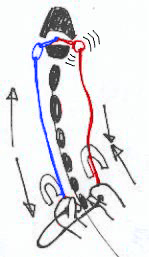
If someone just says 'loose ring snaffle'..

Well if someone said loose ring snaffle to me I would consider that they hadn't finished their sentence as hadn't added the mouthpiece

Then again I think the majority of riders are ignorant about bitting, and wouldn't know the diameter of what they are using either !

As to the action of a single joint (regardless of cheek) I think its a crude mouthpiece, but some horses will like it as horses are a bit weird and also seek what they know.

I would never put a youngster in one or anything that carries its head in a high frame

There is a reason why bitting has evolved and Sprenger, Neue Schule etc have studied conformation, not just to make money out of people but to produce a superior product.
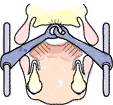
pferdemaul_einfachgebrochen.gif


snaffle_point_palate.gif


stretch_to_outside_rein.gif
 
Evelyn is now backtracking and still making no sense.

How hard is it to see that if the horses head is vertical, the line from elbow to reins to bit makes the joint of the snaffle touch the palate. You can see that very clearly from the x-ray, and the dentists illustrations. It matters not how many wrinkles you put on the lips, the snaffle still folds the same.

The roof of the mouth touches the tongue when the mouth is closed so infact whatever you do, the joint is touching it ALL the time.

I am certainly not back tracking! You seem to have the impression that the bit tips itself upwards when the horse carries itself.

Why would the fact the horse has stretched it's neck over its mouth change the lie of the bit - the horse is still holding it in exactly the same way as he was before. What has changed is the point where the cheek pieces and the reins lie on the bit ring.

If the bit stuck up into the roof of the mouth - do you really think that the majority of horses would go quietly and correctly on the bit - just look at the SRS horses - all go well in a Fulmer snaffle and heaven forbid a drop noseband - they do all the 'haute ecole' work both riden and in hand.
 
Evelyn

If your horse has its head up as a racehorse does, then its less likely to stab the roof, if the horse opens its mouth its less likely to stab the roof of the mouth

I know you use the single jointed fulmer and feels this works for you, but I am never going to agree that using a bit that purposefully squeezes the tongue and if resisted stabs the roof of the mouth is ever going to be an ideal communication tool.

index_clip_image006_0002.jpg
 
Evelyn

If your horse has its head up as a racehorse does, then its less likely to stab the roof, if the horse opens its mouth its less likely to stab the roof of the mouth

I know you use the single jointed fulmer and feels this works for you, but I am never going to agree that using a bit that purposefully squeezes the tongue and if resisted stabs the roof of the mouth is ever going to be an ideal communication tool.

index_clip_image006_0002.jpg

I really cannot fathom where you can come to the conclusion that if a horse puts it's head up the joint doesn't dig in the roof of the mouth - If the rides hands are below the bit then the forse on the rings is downwards, this folds the bit and sticks the joint in the roof of the mouth.

It doesn't really bother me what people put in their horses mouth - what I find tiresome is the the number od sheep that have to follow the 'fashion' and poo poo the bits that have been around for centuries and have proven that they are good bits. In all the years I've worked with horses (hundreds of them) I've only ever used a french link once - and the horse hated it. I've put many in unjointed - mainly horses with no brakes - and own one KK Training bit that my Clydie likes.
 
I need a diagram, but not time

Its to do with angles - horses head + hands location
winning-race-horse2.jpg


When a horse is broken at the poll and giving you his face, the joint is more likely to touch the roof. If hauling in a snaffle, and you must have seen this, the head always generally raises up as the horse has to to escape being clunked in the palate.

(picture of overbent to look at rein & bit angle:-)
dressage-riding-lg.jpg


I'll give you a fulmer with keepers used is going to give you the best result. Also the modern joints like the blue bomber bits is much better
Eggbutt_Loose_Ring_Snaffle_lrg_0.jpg


Sure there are fashions, and I'm no fan of the confused continental faux gags. However you cannot ignore the anatomical work done including xrays and just say it is all rubbish

I understand your method works for you, but have you tried you KK on more horses? I don't link french links, as I think they are often too floppy as a link and prone to causing irritation, a dog bone is better as the link is quieter in the mouth.
 
Jen_Cots, that is what I have been trying to say. Those pictures are the best illustrations yet!
 
I really cannot fathom where you can come to the conclusion that if a horse puts it's head up the joint doesn't dig in the roof of the mouth - If the rides hands are below the bit then the forse on the rings is downwards, this folds the bit and sticks the joint in the roof of the mouth.

It doesn't really bother me what people put in their horses mouth - what I find tiresome is the the number od sheep that have to follow the 'fashion' and poo poo the bits that have been around for centuries and have proven that they are good bits. In all the years I've worked with horses (hundreds of them) I've only ever used a french link once - and the horse hated it. I've put many in unjointed - mainly horses with no brakes - and own one KK Training bit that my Clydie likes.

Well bravo on your amazing achievements. All you have to show for it is a complete misunderstanding of how a snaffle works.
 
Yes , loose ring snaffle will be eggbutt mouthpiece and loose ring cheeks. Be aware , just incase you didnt know , a single joint when you use your reins will push downwards onto the tongue which will be uncomfortable and stop your horse from being able to swallow , so try to go for a frenchlink or mullen mouth so your horse can move his tongue and swallow .... happy horse !

Don't think so :rolleyes:
 
^^ thanks Trina... that rests my case...

Here, have a look at this too if anyone is in doubt. Just think if you were to be doing dressage, with a vertical head carriage... the bit is now being manipulated from "below" and so evelyn is still wrong about it not hitting the roof of the mouth.

http://www.youtube.com/watch?v=msnjZP6Zu8k

I also watched that video last night, and along with being horrified with the riding (which it was pointed out that it was at a normal event taken on one day!) I was saddened by the head shaking of the horse whose nerves were shot to bits by the bit banging them. I realised I have seen this before but not actually known what it was :(:mad:

The dentists video http://www.youtube.com/watch?v=n3V1P7RLTJw also stated that there was a difference between a racehorse carriage and dressage carriage that would affect the action of the bit.

I do agree with Evelyn though that the SRS have used them without problems, but then their hand carriage (and the horses head carriage) is generally a lot higher than most riders (horses). Phillipe Karl uses the snaffle by drawing it up into the corner of the mouth (using very high hands) - which makes the bit act very differently to pressing it down onto the tongue, bars and then nutcrackering it into the palate (as is commonly seen). There are photos in his book that clearly show the bit is not touching the palate (during flexion work).
I don't think he approves of double jointed bits though - i think it has something to do with too mach bar pressure?

Interesting topic - i'm still undecided as to quite where i stand with it :confused::o

Trina x
 
All my snaffles (yes, I've managed to fall for a few different types) are single jointed.
Only because I can't see the point of a beany lozenge mcThingy.

When someone says loose ring snaffle I see in my head a plain ol' racing snaffle with large rings and one joint however, the beany mcthingy's are all the rage nowadays.

setting aside the rest of the minor arguments in this thread (v entertaining), the lozenge/double joint snaffles, are, most importantly, symmetrical. single-joint ones are not and cannot be (other than the Hippus, which has a covered hinge joint rather than a swivel joint, i.e. works like a knee not an ankle joint). if you pick up a single-joint snaffle by one part of the joint and let the bit rings hang down, it's instantly obvious that 1 side is shorter and fatter, the other is longer and thinner. this imho is the main problem with single-joint bits... BUT millions of horses go very well in them.
i think the double-joint bits are kinder, have less of a nutcracker action, but that's from personal experience, i am not setting myself up as a 'bitting expert' here... ;) ;)

btw, "eggbutt" definitely describes the style of bit ring, not the mouthpiece!

oh, and OP, if i heard "goes in a loose-ring snaffle" i'd assume they meant single-joint, personally.
 
well im of the conclusion that yes, ocasionaly the joint hits the pallet ( none of us have said that it definatly doesnt!), more so if the horse has a fleshy tongue or a low pallet, or if the head carriage is very high and the line/angle of the reins and bit are incorect.
If the bit is fitted correctly and used correctly when riding then no it shouldn't, the horse tongue is strong enough to manipulate the bits possition, the pressure will go down on the tongue and the bars of the mouth.

My friend sat on my mare today who i put in a single jointed eggbutt and applied pressure to the reins whist i put my finger over the joint of the bit and the joint did not go upwards into the palate.
 
Really very interesting thread!!

Over the years I guess I've been told (and never really questioned), a very small amount of info on bits.
First of all, the default bit was the single jointed snaffle.
Then we heard it wasn't the soft bit we had been told, it 'nutcrackered' up and hurt the horses pallet.
So then 'everyone' switched to french link.
More recently I have heard a few people voice some really strong dislikes for these double jointed bits.

It's very interesting looking at the diagrams and photos, it really does make you stop and think about exactly what is happening.

Having had my gelding in a mullen mouth for the last 10 years or more, and only recently had to consider bitting again with my new mare, I'm finding the world of bits has moved on hugely!!! But STILL I made a numpty error and have realised I have problems with a loose-ring fulmer french link and had been trying to use it without keepers.... oops. :o
 
I also watched that video last night, and along with being horrified with the riding (which it was pointed out that it was at a normal event taken on one day!) I was saddened by the head shaking of the horse whose nerves were shot to bits by the bit banging them. I realised I have seen this before but not actually known what it was :(:mad:

The dentists video http://www.youtube.com/watch?v=n3V1P7RLTJw also stated that there was a difference between a racehorse carriage and dressage carriage that would affect the action of the bit.

I do agree with Evelyn though that the SRS have used them without problems, but then their hand carriage (and the horses head carriage) is generally a lot higher than most riders (horses). Phillipe Karl uses the snaffle by drawing it up into the corner of the mouth (using very high hands) - which makes the bit act very differently to pressing it down onto the tongue, bars and then nutcrackering it into the palate (as is commonly seen). There are photos in his book that clearly show the bit is not touching the palate (during flexion work).
I don't think he approves of double jointed bits though - i think it has something to do with too mach bar pressure?

Interesting topic - i'm still undecided as to quite where i stand with it :confused::o

Trina x

Just to be absolutely clear. I am not berating the snaffle itself. I am having an argument about the where the SINGLE JOINTED SNAFFLE joint's position in the horses mouth.

I have seen and felt for a long time even today just to be sure, where that joint goes on contact with pressure from the reins. Try it for yourselves - stick a finger in there see where the joint goes. I dont like duble joints as it acts like a tourniquet on the tongue on a strong horse and hurts the bars - seen anough PC ponies with sore gums to ever consider one again!

The SRS have LIGHT hands. They use fingers and are started correctly which I am sure Evelyns horses are or they would too resist the bit. Lots of people nowadays do not understand touch or feel, or how all that is needed is a movement of a single finger to ask for yield.

My argument is that the JOINT DOES point towards the palate and therefore touches it when working in collection, as in dressage.

It's different in racing - this is where the bit was invented - it wasn't meant for high school movements AND INDEED is not used for Haute Ecole - that is for the double/pelham depending WHERE you live.
 
BUT millions of horses go very well in them.

AND millions of horses don't.

FWIW - I think PELHAMS are AWESOME! I ride horses that go in allsorts and TBH, it's more to do with the owner than the horse :)

Light hands = light horse NOT Light BIT= light horse.
 
Top