Insulating outdoor taps? Any good ideas?

maya2008

Well-Known Member
Joined
10 August 2018
Messages
4,306
Visit site
We have insulated the pipe (thick foam sleeve) and have a tap cosy kind of thing over the top. Tap cosy was functionally useless last night though - tap frozen solid this morning. Any better ideas?
 
Last edited:
We need something for locks too. The combination lock to the field was frozen this morning. Took me a while to warm it up whilst holding two impatient horses.
 
We need something for locks too. The combination lock to the field was frozen this morning. Took me a while to warm it up whilst holding two impatient horses.
try a good squirt of wd40

In ye olden days, wrapping a tap up with hessian sacking worked well. The trouble with the cosy tap thing is they don't always fit the tap that well.
 
Any old rugs that are no longer useable for the horses end up being used to cover our yard tap. I usually put some bubble wrap around the pipe and then pop rugs over the top
 
This year, we invested in Trace Heat. It is a cable that you tie wrap around your pipes, and the little thermostat means it only comes on when the temperature drops. You do need a socket to plug it into but I have been so pleased with it as last year we had burst pipes.
 
We remove the hose and let the metal bit drain of water which is helping it to stop freezing at the minute. If it gets colder we might need something else.
 
We have insulated the pipe (thick foam sleeve) and have a tap cosy kind of thing over the top. Tap cosy was functionally useless last night though - tap frozen solid this morning. Any better ideas?
Same as you. I’ve hung a rug over the taps and pipes too tonight….
 
Bubblewrap, held on with vetwrap, balertwine or duck tape.
For padlocks, the secret is to be bubblewrapping them BEFORE it goes cold while they are dry. Once you've got rain inside them and then it freezes, you have to breathe on them to thaw them (which doesn't always work). A bit of wd40 sprayed onto lock when dry will help repel water, then wrap in bubblewrap and fasten it.
 
And 3mm thick neoprene gloves (I bought some for kayakking but this morning tried wearing them on my cycle ride to the horsefield and they were TOASTY WARM and fine for buckets, poopicking, hay, just had to remove them to do buckles on rugs.
 
I’ve detached my hose end tonight and drained it (only a small piece) then turned off at the stop tap and drained the pipes by leaving the tap on for a minute. I’m really hoping that works 🤞
 
Those wine bottle protectors/innsulators , split down one side to wrap around and held on with a bungee cord works for us
 
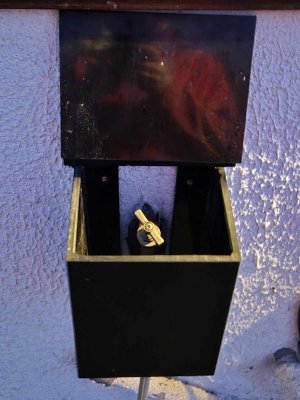
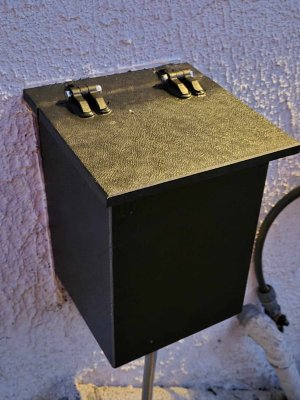
Boyfriend made a set of these for my taps (along with more ambitious/bigger hay feeders and hay soakers)...

View attachment 152804View attachment 152805

I also disconnect the hose and chuck an old dog jacket in there. The water pipe already had insulation.

No issues so far.
I've done that with one tap. Put house insulation in around the tap and a layer of polystyrene on top under the lid and it has worked well.

It won't help anyone with no inside tap but I have learnt to let the outside taps freeze as anything else is hard work and just to keep an inside tap going (well insulated). Then I have a long length of light hose with a hozelock push fit (the water stop one) and connect to the inside tap and walk around outside or inside stables and sheds with the hose filling stuff. Then the hose goes back inside to keep it warm.

Won't help with field troughs but it may help those having to carry buckets or fill yard troughs.

ETA you could also consider either a battery hair dryer or a heat gun (on a low setting) I have used those in the past to defrost a tap and keep one next to the inside tap just in case (providing the pipe to it is insulated) possibly could also use on padlocks.
 
I stuffed a shavings bag with straw and wrapped that round the tap - worked last night, although it didn’t freeze as hard as I was expecting so may not be foolproof for colder nights!
 
This year, we invested in Trace Heat. It is a cable that you tie wrap around your pipes, and the little thermostat means it only comes on when the temperature drops. You do need a socket to plug it into but I have been so pleased with it as last year we had burst pipes.
If you have a socket Trace heating is a life saver. I switched it on 2 nights ago we have been down to -8 and the water is still running. The trace heating heats the stable trough and one field drinker but as the water is being kept tepid is also allows water to flow out to the field troughs as well which are between 300 -400m away.
 
I’ve struggled for a few years with my water bowser tap freezing, tried all sorts but nothings ever worked until this last week! …………I’ve got 5 sheep and because of their breed I have to have them sheared twice a year so I have bags of old fleece stashed in my tack room.

A light bulb moment came to me to use the wool to insulate the tap. Filled an Aldi bag with fleece, put it over the tap and tied it. We’ve got down to minus 5 temperature this week on many nights and my tap hasn’t frozen once! Amazed!
 
Thanks all, for now we’re going to go with a couple of unwanted woolly scarves wound round tightly with bag for life over the top, tied tightly on and hope… Plus another spare water trough filled just in case!

Loving the longer term solutions. No inside water source or electricity available sadly.
 
Top