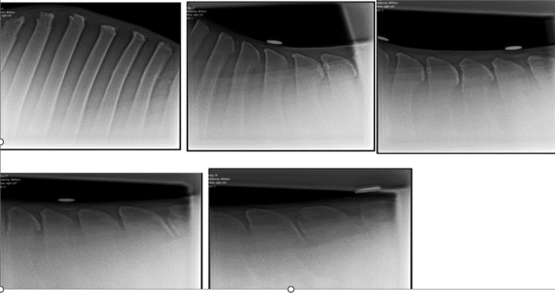
Interesting kissing spine xray

Marigold4

Well-Known Member
Joined
17 May 2017
Messages
2,757
Visit site
7 years ago I bought a beautiful unbacked broodmare aged 7 and backed her. She had had a couple of foals. She started playing up when ridden so we investigated and asked questions of previous owners. It turns out she had had an accident as a yearling and had a rotational fall over a fence. Hence broodmare. On investigation, we found a scarred tendon and two places where spinal process touched with boney remodelling (white bits on xray). We rehabbed her, steroid injections, didn't operate though. She was never happy ridden, so retired 6 years ago. She has recently developed slight lameness in front and after vet investigations, has been diagnosed with navicular. As part of the investigation, I asked the vet to xray her spine. Spine now shows no kissing spine, no touching, no bony remodelling or white! How about that!
 
Last edited:
7 years ago I bought a beautiful unbacked broodmare aged 7 and backed her. She had had a couple of foals. She started playing up when ridden so we investigated and asked questions of previous owners. It turns out she had had an accident as a yearling and had a rotational fall over a fence. Hence broodmare. On investigation, we found a scarred tendon and two places where spinal process touched with boney remodelling (white bits on xray). We rehabbed her, steroid injections, didn't operate though but she was never happy ridden, so retired 6 years ago. She has recently developed slight lameness in front and after vet investigations, has been diagnosed with navicular. As part of the investigation, I asked the vet to xray her spine. Spine now shows no kissing spine, no touching, no bony remodelling or white! How about that!
That is odd! I could believe that there's no touching now but the lack of remodelling is very odd!
 
Many believe bone can be remodelled in both directions, more bone laid down, and some bone taken away, depending on how the animal/person is moving/loaded. My early days of barefoot (20 years ago) were taken in the context readings of actual reversal of P3/navicular arthritic changes.

I'm not scientific enough, nor able to focus long enough lol, to fully read and understand these but pretty sure it shows the mechanisms that COULD do this:

 
Many believe bone can be remodelled in both directions, more bone laid down, and some bone taken away, depending on how the animal/person is moving/loaded. My early days of barefoot (20 years ago) were taken in the context readings of actual reversal of P3/navicular arthritic changes.

I'm not scientific enough, nor able to focus long enough lol, to fully read and understand these but pretty sure it shows the mechanisms that COULD do this:

Spoke to my vet and she says that the white areas are where there is ACTIVE remodelling. So, for whatever reason, the processes are no longer touching and causing damage.
 
Many believe bone can be remodelled in both directions, more bone laid down, and some bone taken away, depending on how the animal/person is moving/loaded. My early days of barefoot (20 years ago) were taken in the context readings of actual reversal of P3/navicular arthritic changes.

I'm not scientific enough, nor able to focus long enough lol, to fully read and understand these but pretty sure it shows the mechanisms that COULD do this:

When my boy was diagnosed with navicular and I was discussing treatments with the vet he explained that one of the treatments was to adjust the natural turnover of bone. The body naturally breaks down and replaces bone continually. The issue in navicular is that it was being broken down quicker than it was being replaced. The drug slowed down the breaking down process so it’s more in balance with the bone building process.
So yes, I could believe that old remodelling could have been broken down and not replaced because the causes of the remodelling had been removed.
 
When my boy was diagnosed with navicular and I was discussing treatments with the vet he explained that one of the treatments was to adjust the natural turnover of bone. The body naturally breaks down and replaces bone continually. The issue in navicular is that it was being broken down quicker than it was being replaced. The drug slowed down the breaking down process so it’s more in balance with the bone building process.
So yes, I could believe that old remodelling could have been broken down and not replaced because the causes of the remodelling had been removed.
Interesting! Thank you for this.
 
Just emphasises why I bang on and on about helping the horse move better, rather than some arbitrary strengthening or even overdoing it with the wrong rehab exercises.
She was hardly ridden at all so I don't think riding her could have caused the bone damage. I think she had learnt to carry herself in an "upside down" frame with her neck in the air as a result of her fall as a youngster. I did loads of work in long lines and two-line lunging teaching her to reach into a contact and to round herself. It must have worked as a long-term strategy. She definitely looks a different horse to the one I bought with a slightly ewe neck and a hollow back. And the new x-rays are proof that it worked - or at least something did! I should open a rehab clinic 😆
 
She was hardly ridden at all so I don't think riding her could have caused the bone damage. I think she had learnt to carry herself in an "upside down" frame with her neck in the air as a result of her fall as a youngster. I did loads of work in long lines and two-line lunging teaching her to reach into a contact and to round herself. It must have worked as a long-term strategy. She definitely looks a different horse to the one I bought with a slightly ewe neck and a hollow back. And the new x-rays are proof that it worked - or at least something did! I should open a rehab clinic 😆

It's compensatory movement patterns that cause the damage and they can stem from all sorts of issues including birth trauma (see the work of Dr Ian Bidstrup).

Riding a horse just makes it more likely the compensations will be more serious, but the problems are often there anyway.
 
It does seem weird, doesn't it. I agree. Doesn't comfort me much to think she no longer has kissing spine though, as she now has navicular!

But it does sound like all the work you put in teaching her to carry herself better has been beneficial overall. So she is more comfortable than she would've been otherwise, and you should be pleased with that - you've done well by her
 
But it does sound like all the work you put in teaching her to carry herself better has been beneficial overall. So she is more comfortable than she would've been otherwise, and you should be pleased with that - you've done well by her
Thank you! I certainly learnt a lot by doing the rehab work. Before I back my youngster, I'm going to do loads of similar work making sure she carries herself as correctly as possible and building up the strength of her back muscles.
 
If she does ever become rideable would you like to compete with her what are you planning to do ? Do you know if any of the foals she gave birth to and the foals dad out there competing and have a fantastic life ?
 
If she does ever become rideable would you like to compete with her what are you planning to do ? Do you know if any of the foals she gave birth to and the foals dad out there competing and have a fantastic life ?
She'll never be rideable, due to her yearling accident. I thought long and hard for years about whether to breed from her - whether her back was genetic or from the injury. I researched her close relatives and spoke to her breeder about close relatives and what they were doing. Her sire has been a top 100 eventing sire for many years, on her dam side she is closely related to Future Gravitas and Olympic horse Winsome Andante. Lots of half brothers and sisters out there eventing. I bought her second foal as a two year old and have x-rayed his back twice - excellent spaces. My yearling's sire is a well-known and very solid performance connemara who has produced loads of useful ponies. I know some will criticise me for breeding from her but I am OK with my decision and so was my very experienced reproductive vet.:)
 
Top