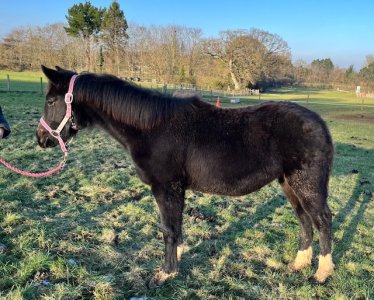
Is my baby too lean?!

She looks okay to me, for this time of year. Personally, I'd see how she fares in spring before doing anything if she seems happy in herself. We're so used to seeing overweight horses 🙈 One of mine always looks terrible at the end of winter, no matter how much hay I put out. Always picks back up in the spring 😁

I'm with you on not having them overweight as they get older, but IMO as a weanling you want a bit more cover and she looks poor rather than just a bit lean- the neck is scrawny, she is ribby with a pot belly and the coat is in poor condition (disclaimer- judging from 1 photo!)

This is mine at the same age/ time of year, living out unrugged so a bit fluffier!
IMG_5602.jpeg
 
I'm with you on not having them overweight as they get older, but IMO as a weanling you want a bit more cover and she looks poor rather than just a bit lean- the neck is scrawny, she is ribby with a pot belly and the coat is in poor condition (disclaimer- judging from 1 photo!)

This is mine at the same age/ time of year, living out unrugged so a bit fluffier!

View attachment 155382

Aw, lovely pony!

I suppose I should qualify my post with teeth, worming and vaccinations should be kept up to date (and more regularly if worried or needed) but the OP seemed to be on top of all that and she did say her pony is happy. Which is why I would personally would wait to see what the spring brings. Dull coat difficult to comment from those photos and the belly is probably from the fact she's eating plenty of forage.

Anyway, wishing the OP best of luck and hope for an update further down the line 🥰
 
Suregrow is a good option for youngsters needing a bit of a boost.
Everyone recommended Suregrow to me so I've been feeding it to my almost-yearling. He doesn't get anything like as much as the bag says (because a) he's a native and b) do they think I am made of money 😆 ) but he's looking really good on it. Shiny fluffy coat, nice feet. I have been quite impressed. Definitely worth adding it in if you can persuade her to eat. Only ever having had cobs and ponies I am not familiar with this problem of horses who won't eat out of a bucket!
 
No harm coming out of winter looking a bit poor. Means they can eat the spring grass and put the weight back on naturally with a lower risk of laminitis and obesity related diseases. I had my vet look at my horse who always comes out of winter looking bad and he said that's fine, that's what they're supposed to do, you'll have an easier rest of the year than everyone else who has to restrict grazing and calorie intake. ...and he's right, my other horses are much more work the rest of the year!
I'm sorry, but I completely disagree. Looking a little light is one thing, poor (or bad 😞) is another.

We should strive for health all year round, and I'm pretty astounded that a vet would advocate for a horse of any age coming out of winter looking poor.
 
I'm sorry, but I completely disagree. Looking a little light is one thing, poor (or bad 😞) is another.

We should strive for health all year round, and I'm pretty astounded that a vet would advocate for a horse of any age coming out of winter looking poor.
I totally agree with you AA and The Mule. She looks dreadful and needs feeding up, poor girl.
 
I'm sorry, but I completely disagree. Looking a little light is one thing, poor (or bad 😞) is another.

We should strive for health all year round, and I'm pretty astounded that a vet would advocate for a horse of any age coming out of winter looking poor.


I think there's maybe a semantics problem going on here. With horses kept so fat these days, the vet being quoted may well have meant "light" but needed to say "poor" to get the message through.

I would far rather see a yearling in late February looking like this one than not to be able to see the ribs for fat. Youngsters carrying too much weight or fed so they grow too fast at that age is a known cause of OCD.

I'd also far rather see any horse come out of winter looking poor than getting laminitis when the grass comes through.
.
 
I think there's maybe a semantics problem going on here. With horses kept so fat these days, the vet being quoted may well have meant "light" but needed to say "poor" to get the message through.

I would far rather see a yearling in late February looking like this one than not to be able to see the ribs for fat. Youngsters carrying too much weight or fed so they grow too fast at that age is a known cause of OCD.

I'd also far rather see any horse come out of winter looking poor than getting laminitis when the grass comes through.
.

I agree, looking poor and looking lean are often used to describe the same thing! The horse above looks lean, she doesn't look poor imo (poor condition would be a rubbish coat with signs of rainscald and lack of muscle, with obvious dips).
 
My warmblood youngster has certainly gone through stages of looking leaner and poorer than I'd like, but I am cautious of over feeding as it can risk growth conditions such as OCD in Warmbloods. I have used an independent equine nutritionist to help ensure he is getting what he needs so I would def recommend that, Equinutrition who I use do virtual visits which is helpful. I have had great results with Equijewel for weight gain.

If it helps mine is a slow maturing warmblood, rising 4yo. And he has been fed D&H Sure Grow, sugarbeet or grassnuts, topped up with Equijewel when needed. The grass is never great this time of year and whilst he always has access to lots of hay, he needs that bucket feed to ensure he is getting what he needs.

Edited to add - be cautious of comparing your horse to others. Horses are like people, some are fatter than others and if you compare toddlers they all grow at different rates. My rising 4 year old looks nothing like a friends horse that is the same age, but I know from his breeding they are a bit slower to fill out.
 
Having read through this I’m probably sitting in between the ‘too poor’ and she’s fine, should be light coming out of winter.

First of all, I’m not sat here aghast at her condition. Babies often go through ribby spells, this shouldn’t cause a panic. Furthermore, when they wear a rug and flatten the coat it often becomes more apparent- fluffy with no rug and can’t see the ribs would often be similar if the coat was flattened.

The thing that strikes me about her, swinging more towards the poor comment is her neck and general shape. Difficult to tell from a photo but I suspect her coat could be better too.

I think the worm testing should be priority.
I’d make sure you are giving a good Youngstock based vit/min supplement.

Spring grass is around the corner so I really wouldn’t rush into feeding much in a way of the starchy Youngstock feeds, if she has had a bit of a growth spurt or is actively growing sometimes it just makes them go up more, which you don’t really want, rather than laying down condition.

If she doesn’t pick up come spring grass I’d get her blood tested. The other thing to consider is stress ulcers either from weaning or being bullied.
 
I think there's maybe a semantics problem going on here. With horses kept so fat these days, the vet being quoted may well have meant "light" but needed to say "poor" to get the message through.

I would far rather see a yearling in late February looking like this one than not to be able to see the ribs for fat. Youngsters carrying too much weight or fed so they grow too fast at that age is a known cause of OCD.

I'd also far rather see any horse come out of winter looking poor than getting laminitis when the grass comes through.
.
Its always in the eye of the beholder, and what people are used to seeing, as to what people see as acceptable, unless you are going to get the conditioning scoring chart out every day and try and score objectively.
I have native or native x youngstock, and when I show them I always know I am not going to be in the top three because no matter how good the pony is the judge will think its too thin for its breed, put the same pony in a sports pony class and its a winner.

Experience has taught me that most equines lose weight after Christmas, I do not know if its the longer days or they just not as interested in hay as they are waiting for grass, and in our recent winters its a lot colder after Christmas, as in the beast from the East. So if the OP horse was mine I would be concerned because it has little fat reserves to cover the next eight weeks until there is proper grass growth, which is OK if its healthy but not if it becomes ill and we have no idea what it will be competing with for food.
As a young teenager I used to be on a low end dealers yard, so I have seen all sorts of thin, and the biggest tell when they are struggling is a long often thin coat, a bit like humans to grow 'fur' when they are anorexic.
 
it may just be me but for me at least the original pic has gone and when I tried to look at when she last looked in the OP seems to have gone as well.
I hope she hasn't been upset about a very genuine question.

OP are you still here?
 
it may just be me but for me at least the original pic has gone and when I tried to look at when she last looked in the OP seems to have gone as well.
I hope she hasn't been upset about a very genuine question.

OP are you still here?

Still there for me Paddy, did your line go slow and fail to load the picture?
 
It's possible people really do just need advice on things and genuinely do not know. There's been useful info put on the thread which will benefit others as well as OP, who seems to have been receptive to suggestions.

I write this as someone who hasn't ever owned youngstock. Will I ever own youngstock? Probably not. Did I read all the responses and absorb all the information anyway? Yes, yes I did 😂
 
No harm coming out of winter looking a bit poor. Means they can eat the spring grass and put the weight back on naturally with a lower risk of laminitis and obesity related diseases. I had my vet look at my horse who always comes out of winter looking bad and he said that's fine, that's what they're supposed to do, you'll have an easier rest of the year than everyone else who has to restrict grazing and calorie intake. ...and he's right, my other horses are much more work the rest of the year!

Plus youngsters, like teenagers, usually go through a gawky, gangly stage before filling out 😁
This is true and they absolutely do go through ugly phases but I wouldn't say the pot belly and lack of interest in hard feed is standard for an awkward bit of growing. Spring grassad lib forage won't do any good if they have s heavy tapeworm burden unfortunately. But tapeworm is not 'got' by a lot of broad spec products.
Nutrition is so critical to future health and soundness when they are young and growing it's surely better to be safe than sorry.
 
Heres my 2 penneth.. she looks to be standing slightly curved, so will look a little more ribby. But her neck, and more so he rump is most definitely lacking muscle /cover. She looks like shes had a tough winter out and could do with a few extra calories. If she where mine, id have her in over night for a a bit and make sure she has some youngstock feed and adlib haylage.
 
OP and photo both still present. Agree with most others that she is tad light, but it is approaching the time of year for a quick turnaround.

It might be the mud dreadlocks, but are her hind legs rather filled? Mud fever?
Phew, glad you said that I didn't dare. I think perhaps the off side back looks a little stocked, not sure if the other one so much. Or it may just be the accumulation of mud (unavoidable in most fields at this time of year unfortunately) giving a false perspective?

OP I don't think anyone wants to hurt your feelings or make you feel bad, well I certainly don't, but I think an older horse that has stopped growing and comes out of the winter a little light is not a problem. However such a baby should not be allowed to drop off at this early age to the extent your youngster has. You want to see a slow steady and healthy growth and increasing in maturity as a constant, not something that picks up and drops off to the degree of being decidedly ribby and light necked in these crucial early days.

This is only my opinion, but I would want to be sure it isn't in an adult only herd without other youngsters and without a matriarch to both keep them in line and protect them when other adults get to aggressive., Out with just a mixed herd of adults is not natural or conducive to healthy behavior and is a recipe for bullying. Possibly only allowed at food source intermittently and maybe not sufficient time to eat enough for its development needs. I would also be getting the baby in every day and by hell or high water coaxing it to eat a light feed with some youngstock supplement. With perseverance and tasty tid bits mixed in she will soon be scoffing away. Do not overfeed either, that is equally damaging.

I think her demeanor if you zoom in is also a little dull of eye. Never believe what a previous owner tells you they have done re worming, just assume no worming done and start a regime recommended on the fecal count you're getting done.

Please, please don't take anything I have written as a criticism of your care, it is good that you are questioning and asking for opinion and I hope you did so in good faith wanting honest answers. She looks very sweet and you both deserve honesty and helpful suggestions going forward.

She is not a shocking case by any stretch of the imagination, but for me, at that tender age I would also be questioning my care regime and what tweaks I can make that might help to pick her up a bit. Do not worry about going onto good spring grass too fat at this early age she needs all the good stud grazing she can get, it will not harm her.

Look forward to new pics in a couple of months, or sooner, we can never see enough pics on here.☺️
 
Horses never look their best at this time of year, the grass is at it's worst, hay has been hanging around for a while, their coats are tired and they're gearing up for a moult. Mine still looks quite shiny ATM (not clipped) but I remember when I used to hunt my horse at the time would be super fit and lean and his clipped coat would be looking tired and I'm sure some people looked at him and were horrified. As soon as his new coat came through, he'd shine like a conker.
 
It's possible people really do just need advice on things and genuinely do not know. There's been useful info put on the thread which will benefit others as well as OP, who seems to have been receptive to suggestions.

I write this as someone who hasn't ever owned youngstock. Will I ever own youngstock? Probably not. Did I read all the responses and absorb all the information anyway? Yes, yes I did 😂
This is so true. Few livery yards have young stock, and there seems to be an idea that young stock can be treated like a habituated trained horse of that have nearly completed its mental and physical development, so in human terms thinking that a toddler will have the same behaviour as a young adult.

Where do you learn this knowledge unless you perhaps go out of your way to work on a stud? When I was learning it was common for a lot of farms to have a back field where a farmer had a couple of brood mares, because after WW2 there was still the knowledge base from when horses worked on farms. These animals were usually bred for hunting, but if you wanted a smart animal there was the HIS travelling stallion. My step father bred TB's for racing, but the main job of the farm was arable, and unless you worked on a TB stud farm most of the knowledge was from basic hands on animal husbandry, I saw a mare covered in the yard by a travelling stallion when I was about twelve.
Unless you breed native ponies no one has the space to store young stock, so are sold and they move on to home where often there is just no facilities that are age appropriate. If you are breeding if you do not sell on as a foal, unless its high end, no one wants anything from about a yearling to four. I buy them in as yearling and sell them at four because I have the space.
I think the OP was brave, admitting you do no know something is now seen as a bad thing, when really that is how we learn. If you are on a livery yard depending on its type the chances are there will be a very small pool of knowledge to access.
 
One of the reasons I get a paranoid about youngsters who look a bit poor but have a belly is because we lost the yearling who lived with my horses when they were younger. It was traumatic and the vet did a quick post mortem at the hunt yard to find a belly full of redworms - I had wormed that youngster alongside mine in Autumn but it's owner didn't do any checks etc in Spring. The vet told me it was a classic case of a young horse without the immunity it needed (livery yard with awful worm / field management)

An FEC & Equisal is less than £40 - so much cheaper than a vet bill!!!
 
It struck me as another of those threads intending to cause sparks and rev people up just like the other recent 2.
not sure why. Just seems a new poster has concerns about their horse and wanted some comments. The youngster does look a bit poor and there have been some good suggestions to check out.
 
not sure why. Just seems a new poster has concerns about their horse and wanted some comments. The youngster does look a bit poor and there have been some good suggestions to check out.
I got the impression it was first time youngster owner wanting a second opinion. It's actually hard to spot changes in your own horses when seeing them every day as well and the forum can be a horsey 'village ' for those that don't have one irl
 
Oh, I doubt she's getting her fair share. She looks a poppet, who may not be holding her ground round the feeder. If she were mine (we have had big, tall youngstock) I would cover a few question marks re worming and teeth with the vet. I would ask the vet to check teeth with a gag and do worm testing, not just ask "how's she looking". I wouldn't expect a young horse to look like that on adlib forage of any quality. Nor would I rely on spring grass to help her. I always remind myself, with puppies and youngstock of any kind "you only get to grow them once".
Exactly this. Youngstock need feeding. I have bred enough foals, and reared plenty of youngstock to know. None of mine got lami.

Odd that the Vet comment has gone !
 
not sure why. Just seems a new poster has concerns about their horse and wanted some comments. The youngster does look a bit poor and there have been some good suggestions to check out.


The poster has also responded really well to all the suggestions made and not got upset about any of the negative ones. She'll be an asset to the forum if she stays. People who are big enough to ask for help and take it should get a pat on the back.
.
 
The poster has also responded really well to all the suggestions made and not got upset about any of the negative ones. She'll be an asset to the forum if she stays. People who are big enough to ask for help and take it should get a pat on the back.
.
totally agree.
The 2nd pic posted to me is telling. There are a lot of big horses with the youngster. Very little hay left in the feeder and they have walked away. The baby is left with what's left. That might be totally wrong but I would be wondering if she is at the bottom of the eating pile. I maybe totally wrong. :)
 
totally agree.
The 2nd pic posted to me is telling. There are a lot of big horses with the youngster. Very little hay left in the feeder and they have walked away. The baby is left with what's left. That might be totally wrong but I would be wondering if she is at the bottom of the eating pile. I maybe totally wrong. :)


But the third picture has her with her entire head buried in fresh hay ....
.
 
Top