Lameness after nerve block

Neddiethefell

New User
Joined
4 February 2026
Messages
6
Visit site
Hi, wondered if anyone has had a similar experience. Our almost 7 year old pony has had a bit of a toe drag on right hind, mostly noticeable in canter since the end of last year. He's never been lame.

Vet advised trying a nerve block to see if we can find the problem. He suspected possible suspensory issue and blocked the right hind. After the block he quickly went lame on left hind, and right hind developed the toe drag in walk and trot.

He remained like this for about a week. Daughter tried riding him again as he looked better, but canter toe drag is lots worse and canter looked like a struggle. He looked lame for a few minutes afterwards.

We've put him.on box rest with 2 x 10 min in hand walks per day (he's not happy!). Vet is coming to do an xray and ultrasound to have a look around, but cant come for almost two weeks.

I feel really sad that we've made things worse and worried that we've highlighted something serious. Has anyone else had this happen with a nerve block?
 
He wasn't lame before the nerve block. He's never been lame before. It was a niggly issue with a slight toe drag in canter that I wanted to check out in case it was something that might develop as he got older, more of a performance issue, which the vet and physio agreed with. We'd spent a year developing his strength and balance but he wasn't quite right in canter.

He seemed completely sound again a week after the nerve block until attempting a canter. He still seems sound now whiel we've been in hand walking but we've put him on box rest just in case, which he's really struggling with.

I'm trying to understand why the nerve block might have made things worse and caused new lameness that stayed after teh block had worn off.
 
It’s almost certainly not the nerve block (especially as the horse is lame in the opposite leg), the horse is bilaterally lame. Unfortunately most likely cause is bilateral PSD, but worth x-raying the hocks too as they’re easier to fix.
A toe drag is a sign of lameness, so you were right to start investigating it. I'd probably push for a referral somewhere that they can do a full work up next week
 
With bilateral lameness it's quite common for the opposite leg to show as quite lame when one is nerve-blocked - if they have been compensating then the blocked leg feeling 'good' means they start weight bearing more evenly and this can show up the lameness in the other leg that was being masked by compensatory movement. As far as staying lame after the examination, I'd suspect the work-up itself has aggravated whatever was going on (assuming you did the full flexions, lunging etc) a work-up is designed to basically put everything under enough strain to highlight an issue so they can be quite intensive on joints and tendons, if there is an issue there it has likely flared it up. I doubt you have made anything worse as far as long-term prognosis, just highlighted whatever the issue is. Hope you get some answers soon.
 
Horses that are
He wasn't lame before the nerve block. He's never been lame before. It was a niggly issue with a slight toe drag in canter that I wanted to check out in case it was something that might develop as he got older, more of a performance issue, which the vet and physio agreed with. We'd spent a year developing his strength and balance but he wasn't quite right in canter.

He seemed completely sound again a week after the nerve block until attempting a canter. He still seems sound now whiel we've been in hand walking but we've put him on box rest just in case, which he's really struggling with.

I'm trying to understand why the nerve block might have made things worse and caused new lameness that stayed after teh block had worn off.
horses that are bilaterally lame often don’t look overtly lame beforehand- though you had a toe drag, they’re just lame on 2 legs instead of 1.

The nerve block showed you he was lame and shouldn’t have been ridden until full diagnostics and treatment plan established.

It’s absolutely wild to me to be cantering a horse that was lame on blocking
 
Out of interest what area was actually blocked which helped the toe drag on the right hind to disappear but appear on the left? Having had 2 horses in 12 months investigated for lameness …which involved many many areas being blocked..each over 2 days…with a particular practice ..it took an MRI to solve one problem and experienced, knowledgeable eyes at other practices to diagnose and fix.
 
Just to reiterate what others have said, it’s likely you have had a bilaterally lame horse for a while but it’s gone undetected (sometimes can be difficult to tell, as the lame legs cancel each other out, so they don’t obviously limp).

Also from experience, it will likely be overall cheaper and you’ll get to a diagnosis quicker if he just gets referred in for an orthopedic work up at local horsepital.
 
agree with others on the bilateral lameness. I take it you didn't do another nerve block to see? I did have this - vet nerve blocked one leg, horse went lame on another; nerve blocked that and horse went lame on a different leg which told us the problem was neuro. Turned out was correct: horse was having an EPM attack
 
Thanks for the replies. The nerve block was above the hock. The vet didn't have xray and ultrasound with him, but we were supposed to have them at the same time.

The vet said as soon as the nerve block and sedative wear off the lameness would go away and to just exercise and ride as normal as the former toe drag problem was so minor. However we obviously didn't do that as he remained lame. The canter was just a circle to see how he looked, as walk and trot were fine.

The reason we've got a long wait is so we can see the ortho specialist who will now come and do the scans. I think we might end up taking him in but I'd hoped to avoid it, depending on the scans as its 1.5 hours away and he's a nervous traveller. We had been working on trailer training and building up the journey length.

Interesting about the neuro issue.
 
Out of interest what area was actually blocked which helped the toe drag on the right hind to disappear but appear on the left? Having had 2 horses in 12 months investigated for lameness …which involved many many areas being blocked..each over 2 days…with a particular practice ..it took an MRI to solve one problem and experienced, knowledgeable eyes at other practices to diagnose and fix.
Just wondering, was it Rainbow you used? We're with them and I hear a real mixed bag, but it seems the ortho specialist has a good reputation. I'm always a bit wary of vets after racking up huge bills with dogs and never really getting to the bottom of issues.
 
agree with others on the bilateral lameness. I take it you didn't do another nerve block to see? I did have this - vet nerve blocked one leg, horse went lame on another; nerve blocked that and horse went lame on a different leg which told us the problem was neuro. Turned out was correct: horse was having an EPM attack
No, additional nerve block wasn't suggested. Not sure of the different vet will want to do another one when he comes to do the scans.

Interesting about the neuro diagnosis. I'll do a bit of research in to that as I'm trying to be educated on all possibilities. I've never had a horse with these issues, only had to deal with vets for stupid injuries.
 
I took a not quite right but seemingly not lame horse for a work up. He wasn't lame troting up or on circles, couldn't have flexion tests done due to behaviour. I gave the vet a detailed history which mainly included uncharacteristic ridden probems and not pushing properly from behind. On a hunch really the vet nerve blocked one hind suspensory and the horse became obviously lame on the other leg. Bilateral lameness can be difficult to observe, but the horse is lame, you just don't see it. My horse had 2 completely disintegrated hind suspensory ligaments at age 6. Two experienced trainers and the vet himself couldn't see a lame horse until he was blocked.

If you're waiting a while for the vet, take some time to observe the horse. Does he naturally stand camped under with the hind legs, try to stand with the hind legs on a bank so that the toes are pointing down, or with hind quarters pressed against a wall. Are the pasterns long, are they in a straight line with the angle of the hoof or is the hoof/pastern angle broken forward (fetlocks appear dropped). These are signs of suspensory problems which often affect both hind legs.
 
I took a not quite right but seemingly not lame horse for a work up. He wasn't lame troting up or on circles, couldn't have flexion tests done due to behaviour. I gave the vet a detailed history which mainly included uncharacteristic ridden probems and not pushing properly from behind. On a hunch really the vet nerve blocked one hind suspensory and the horse became obviously lame on the other leg. Bilateral lameness can be difficult to observe, but the horse is lame, you just don't see it. My horse had 2 completely disintegrated hind suspensory ligaments at age 6. Two experienced trainers and the vet himself couldn't see a lame horse until he was blocked.

If you're waiting a while for the vet, take some time to observe the horse. Does he naturally stand camped under with the hind legs, try to stand with the hind legs on a bank so that the toes are pointing down, or with hind quarters pressed against a wall. Are the pasterns long, are they in a straight line with the angle of the hoof or is the hoof/pastern angle broken forward (fetlocks appear dropped). These are signs of suspensory problems which often affect both hind legs.
I'm so sorry about the diagnosis for your horse at such a young age but at the same time relieved to read about your experience. Same with very experienced trainers and staff on our yard being completely unable to see the issue. I've felt like a total hypochondriac but I watch him all the time and can see the issue a mile off.

We've always had problems with him not pushing from behind, but put a lot down to age so we've worked on strength and balance alongside physio. This has improved. He has slightly straight hocks and tends to stand with quite a wide base.

What was the outcome for your horse?
 

Attachments

  • 20251226_102036.jpg
    20251226_102036.jpg
    448.9 KB · Views: 18
Straight hocks are often associated, unfortunately suspensorys, hocks, SI often all somewhat connected, it’s good you’ve been persisting with the not being convinced he’s fine.

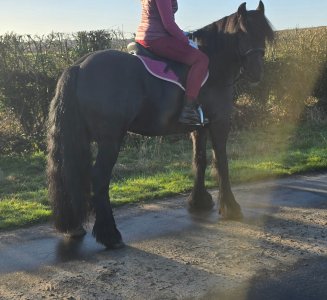
Nice looking chap!

I think it was rainbow that didn’t dx another hhoers horse for a long time but I’d have to do some searching to check (bless her she kept persisting as we were saying no not right)
 
Neddiethefell Rainbow was involved in the first lameness investigation when a bone scan was insisted upon and I have to say I wasn’t impressed as between my vet and them messing me about for over 2 months they used up my vets fee insurance. Rainbow and my vets are owned by the same group and they seem to like to use many diagnostic techniques without ever actually resolving anything.
 
I took one to Rainbow and saw their lameness specialist and they were fab. They did all the tests there and then. Trot up, up and down hill, flexions, lunge on hard and soft. It was really difficult to see anything, so they started with one front leg, from the bottom upwards. When they blocked the suspensory, it was obvious he was a lot better, despite him being all but sound before. It was more obvious in his domeanour, he tossed his many squeaked and moved in a reallty exaggerated and excited way.

I was asked to ride him on the arena and I had my horse back. It seemed the issue wasn't as slight as I had thought.

Because we were in the hospital, he then had an ultrasound to confirm exact place, X ray to make sure the bones were not affected and treatment of PRP and shock therapy.

I can't fault Rainbow that day!

That is why I always say to take the horse to the hospital. We were there most of the day and had to wait for all of the blocks to take effect, but the vet could do other horses in the mean time. They had everything there at hand. Plus, we saw the lameness expert.
 
Top