The way I teach is not one that appears to be advocated in this country
I tie directly onto a ring which is on something very solid (concrete wall or post) and thats it - never had a prob, had a couple of horses pull and worry for all of 2 mins and then realise they are not going anywhere and settle - when they are settled and standing well then I handle them, if they are fighting then they are left to their own devices - not everyones cup of tea but has always worked for me
Have known people use this method effectively. Personally, i use a lunge line through a tie ring, attached to a headcollar. The horse is allowed to move about within reason to start with, them pressure is slowly increased to "normal" tie length, horse left like that to think about it, fussed, then released. this is increased bt by bit, until the horse is happy to stand on a short length, when a rope and normal tying is introduced. Good for "stress heads"!
Start as young as they are handled, expected to be groomed etc. It is not something that needs to be "left" to betaught in my opinion.
My uncle used to work on a stud farm here in Argentina and taught the foals to tie up very young (a few months old I believe) similar method to Weezy, but to protect the delicate cervical bones he used to loop a rope around their bottoms and tie to the ring of headcollar so when they pulled back they were effectively pulling against their bottoms, not necks.
The method Weezy describes is used as standard in Argentina.
That sounds like a good idea to me! Unfortunately Axel learnt at an early age to pull back and break the string
He's not so bad now but he's obviously a lot more mature than he used to be, although he still has the odd moment. Like the other week when he didn't want his feet hosed off
I now just tie him to the metal bar and he's stopped doing it lol
Mine are taught to tie up as foals!
I would just tie her up & groom her. Give her the usual commands to stand etc. Don't be afraid to let her test the boundaries though, Weezys method of tieing straight to the ring has a lot going for it - the last thing you need is her learning that if she throws herself back hard enough the string will break. As she's so well handled, & is used to being led around & therefore accepts the constrainsts of being in a headcollar I doubt you'll have any trouble at all.
Yep' i've been taught this method as well by a good old traditionalist- excellent way to teach a horse IMO! Hes got some great tips.
Another tip he got me to do with my pony was to tie her up for a couple of hours (crossed tied in a corner of a stable on straw), that way she now knows to be patient and i can now leave her in the middle of the yard untied to put her to the cart and she will not move.
I do exactly the same as you Weezy - I tie directly to an immovable object; here I have horseshoes cemented into the wall of one of the barns.
The result? Horses never ever pull back once they are older. I teach tying, depending on the individual youngster, generally around 6 months to 12 months old.
All mine were initially tied up to solid objects with rope halters with no metal parts. This means that the hardware (rings on headcollars) will not break and fly into the horse.
As a result none of mine ever pull back and can now be tied anywhere with baler twine.
I also teach mine to tie up round their necks, which is extremely useful at shows when you are tacking up etc.
When we trained a foal years ago, we passed the leadrope around a telegraph pole and just held it - that way we had the pull to stop him buggering off but didn't risk him hurting himself if he did break away - worked for him......
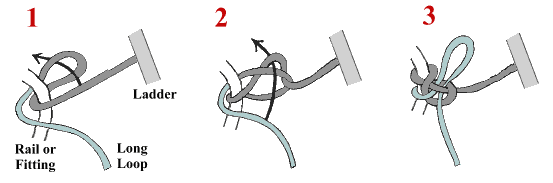
Always start as soon as leading Ok and used to a headcollar. Tie directly to the most solid thing I have, usually a solid wooden gate post, in an environment they are familiar with. Leave them until they do attempt to pull back, if they really go for it I will smack them on the arse to make them step forward as some just don't realise this is what is needed to slacken the rope. I also never loop the rope back through itself and also use a non threaded through knot* so that I can undo it however tight the foal is pulling in an emergency (although I have never yet had to do this).
* By this I mean a quick release knot that only puts a loop through the ring not the whole lead rope, I actually always use this when tying up, but it amazes me that most people don't.
* By this I mean a quick release knot that only puts a loop through the ring not the whole lead rope, I actually always use this when tying up, but it amazes me that most people don't.
[/ QUOTE ]
Ditto!! NO ONE else on my yard does this whch IMO cancels out the fact you have used a quick release!!!!
I think it is actually boating knot, that's where I learnt it from, here is a picture guide. I do it a bit differently but the resulting knot is the same!
I started off by cross tying my girl this basically taught her to stand but she still pulled back and snapped the string. Then I tied her twice to 2 bits of string with 2 ropes. She would pull back and snap the first but still be tied up so I would go back and re tye first rope eventually she realised that it didn't work and she was always tied up and now is fine although a little fidgety. I leave her when she fidgets and paws the floor then when she is standing still I pet her and scratch her seems to be working well.