National Day Is Upon Us

Not enough to stop a lot of horses dying though sadly.

Horses die; they die in paddocks, they die on roads, hunting, eventing and in their own stables. We would all mourn the untimely death of any horse, but at least, as others have said, they're spared the hideous and drawn out end of so many which are, so we're told, in loving homes.

For those who can't cope with the facts of life, perhaps they should look the other way or dissociate themselves from any equine interest.

Yup a lot of.people are now focusing on the 2 that died - on the flat - in the Foxhunters over the big fences. Not mentioning that it wasn't the National itself.

They seem that peeved that no horses died in the National that they missed the one that died in the hurdle at the start of the day. Again broke down on the flat between fences.

So do we then question the soundness of racehorses and what effect in-breeding has on them? Does it affect soundness? Is it because the horses are started too young or.not young enough (and before the anti racers start a lot of jumpers don't start work.til they are 4 as they are too big and weak. They are called store horses.)

At the end of the day you will.never please everyone no matter what walk of life you come from.

A first class post. There are without doubt, a group who focus upon the losses, with each and every loss being used as ammunition and as an aid to point scoring, and curiously (or understandably) from those who generally haven't a clue what they're on about.

Alec.
 
Nothing will ever be good enough to some until the human race is gone. Considering that's unlikely to happen anytime soon, I think we best get used to racing. It's been around since the horse was first created.
 
Great race - did you see Hadrians Approach fly the chair, ears pricked, on his own leading the field?! Bloody shame he made a mistake at the first as certainly looked to be eating up those fences after that and loving it!

I have to unfriend people on fb every year at this time! The classic this year was the horse owner wailing at the cruelty of the GN having let her own pony get grossly fat and end up with laminitis. I do wish people would educate themselves before passing judgement. EKW so glad you posted that stat around fatalities - beat me to it!

The care of racehorses has come so far and it really pi$$es me off when people make assumptions that they're locked in stables 24/7 out of their heads with boredom. In the main, these are valuable animals and someone is paying a lot in training fees in the hope their horse will be successful on the racetrack. It therefore makes sense that trainers and stable staff give those horses the best care possible (including ensuring mental well being) to obtain optimum performance. Very old fashioned view and whilst it may still happen in very few yards, you'll find the same in some dressage yards or show jumping yards .... which never seem to be singled out for criticism

The BHA works closely with great charities such as ROR to ensure welfare after retirement as well - another thing the antis seem to completely ignore! It's true that some sadly fall through the net (and this is more usually further down the line than straight out of training - a lot of trainers make genuine efforts to successfully and responsibly re home) but in far fewer numbers than the poor horses/ponies at the very bottom of the value chain
 
Well said AA

Teamchaser: You are right, some dressage and showjumping yards have hideous practises but they are not under public scrutiny like the GN runners. Neither are the RSPCA consumed by calls to visit racing trainers yards, but instead they go to rescue ponies owned by members of the public.That is where the abuse happens. I can think of two high profile cases recently, one did involve a racehorse but it was an EX racehorse abused by its current owner and the other was a pony foal.
 
tbh I don't get the whole argument of 'there's much worse going on'. I don't see why everything else in the horseworld should be perfect before anyone criticises racing. we know there are problems with lots of things, racing included.

I liked the pictures that someone put up, but I wonder how common the turnout, and the in-and-out stalls are in racing. Are the horses turned out every day? and for how long? I don't think the in and out stalls are particularly common-place, it would be great if they were.

this came up on my facebook feed, in thread where someone said the GN should be banned, and I thought it raised some interesting points, particularly about The Last Samuri and his jockey.

"The point for me is that it is about more than the deaths. No horses died in the actual Grand National this year, which is great - in fact that is the 4th year with no actual fatalities in the race. Maybe some of the jump modifications (that all the hard-core racers complained about) have helped. However, four horses did die at the meeting overall, and seven at Cheltenham a few weeks ago. Last week two horses collapsed and died at a meeting at Doncaster. So that's bad, but a lot of people will come up with the repetitive argument, horses die in all sports, in fields etc all the time and so on. But, the second horse, The Last Samuri, was excused from entering the public unsaddling enclosure after the race as he was suffering from post-race ataxia, and presumably having a horse wobbling about on point of collapse is going to do nothing for the pro-race argument - not to mention that he needed emergency veterinary care. His jockey was pulled before the stewards for using his whip too high - his fifth offence in six months. So this horse, who had already given his all, was unlawfully whipped on the run in, and was in such a state as a result he couldn't even make it to the unsaddling enclosure. Another horse also suffered post-race ataxia, and Many Clouds suffered breathing difficulties on the track and will need an operation before he runs again. So while it may look like no horse was injured, horses were in a bad way after the race. I have to say that the sight of horses, who had already given more than virtually any other horse in the country would be capable of, being whipped on the run in was truly sickening and to my mind totally indefensible. The very least that racing could do is limit whip use for safety reasons only. But of course when the BHA tried to tighten up whip regs after their 2011 investigation into the use of the whip on horses, the jockeys threatened to strike! And then we could talk about all the welfare implications of the way they are managed, the stress of travelling, what happens to the unwanted ones etc ... but that would be a book."
 
Last edited:
But no one is saying that racing shouldn't be criticised at all nor continually strive for improvement ... which it makes a huge effort to do, particularly where equine welfare is concerned

Very unfair to say The Last Samurai was not presented at the winners enclosure to avoid bad publicity. This will have been done purely on welfare grounds which is paramount.

There are strict whip rules ensuring that a horse is not hit more than a maximum number of times in a race .... but that's a whole other debate which will rumble on

No racing fan wants to see a horse pushed beyond it's endurance and many jockeys sensibly pulled up when their mounts flagged. Conditions were very soft on Sat though and the national is run over 4 miles plus - it's a test of endurance. The care the horses get post race is second to none and Many Clouds reacted similarly last year I believe, some do. He also recovered very quickly

I was at a team chase today and the ground was very wet and horses were finishing tired and having a good blow ... so might you if you went for a run in deep mud I suspect!

Again - "way they are kept" "stress of travelling" "unwanted ones" outdated view and not based on today's reality of racehorses in training
 
Last edited:
well, the post did say he needed veterinary attention. and the condition of some of the horses was glossed over by the presenters just saying they were 'very tired'. but I get your drift.

tbh I think quite a few people are saying that we shouldn't be criticising racing or looking for ways to improve - not you, obviously, but others. I think that's the point she was making though, that these horses had given their all, given how many pulled up etc, and it wasn't good to see them hit to the finish, or to know that one jockey over used the whip and the horse had been struggling afterwards. I guess that's the bit to racing that the public aren't made aware of - the whip infringements and the condition of the horses who finish. Everyone focuses on the deaths and just says ban it, but it is not so black and white as that.
 
I don't think it's that outdated, it's admitted by the racing industry itself.

quote - Not every horse coming out of training will have ulcers but it is commonly accepted that over 90% of horses leaving the training environment will have ulcers to some degree,

quote - The racehorse, in general terms, does not tend to be fed the much larger volumes of forages and fibres that its non-racing counterparts do, the ingestion of which produces large volumes of saliva which is a natural acid buffer.

It is also known that stress from travel, competition, environment, etc. can contribute to ulcer formation as can illness, and certain drug therapies.

http://www.ror.org.uk/faq/how-common-are-gastric-ulcers-in-former-racehorses/

and it would be impossible for all racehorses who are retiring to find good homes. there just arent enough good homes out there, although obviously some do get lucky. probably more jump horses than flat ones.
 
Last edited:
You're right and it's always an emotive subject at this time of year given the profile of the race

I so think horses enjoy racing and jumping (mine loves team chasing) but I do think racing has an on going struggle with use of whips - which some of the general public find unsavoury and I get that - balanced against athletes wanting to win and a jockeys job being to attain the best finishing position possible

Aintree, and racing generally, have made huge strides in making racing as safe as possible but it cannot ever be risk free
 
I don't think it's that outdated ... it's admitted by the racing industry itself.

quote - Not every horse coming out of training will have ulcers but it is commonly accepted that over 90% of horses leaving the training environment will have ulcers to some degree,

quote - The racehorse, in general terms, does not tend to be fed the much larger volumes of forages and fibres that its non-racing counterparts do, the ingestion of which produces large volumes of saliva which is a natural acid buffer.

It is also known that stress from travel, competition, environment, etc. can contribute to ulcer formation as can illness, and certain drug therapies.

http://www.ror.org.uk/faq/how-common-are-gastric-ulcers-in-former-racehorses/

All of which can be attributed to any competition animal - not just the racehorse so why is it any worse than dressage/show jumper/hunter/polo pony? Horses kept at grass may not be prone to ulcers and yet vets are constantly warning of laminitis epidemics - which is worse?

Horse on my yard has had worse ulcers you're likely to see .. has never been anywhere near a competition or racecourse!

It's an outdated view to say they're never turned out. Most trainers recognise value of horses at liberty but at the same time, they're athletes, and if you were an Olympians, you wouldn't include ad lib McDonald's in your training regime! !
 
Last edited:
youre right, life can't be risk free. and also I agree that there are some horses that are well-suited to racing. i wouldn't particularly want to see it banned, for one thing it is a completely unrealistic expectation. It annoys me that everyone gets excited about racing and welfare for about three weeks of the year and then forgets all about it, when horses are being killed and jockeys are over-using the whip, and there are lots of other welfare concerns all year round. I think there's loads of areas that racing could try to improve in, in terms of safety, welfare, whip use etc. I just think people should not see it as black and white - a horse died, therefore the race should be banned vs racehorses are the best kept horses there are. neither is true imo.
 
All of which can be attributed to any competition animal - not just the racehorse so why is it any worse than dressage/show jumper/hunter/polo pony? Horses kept at grass may not be prone to ulcers and yet vets are constantly warning of laminitis epidemics - which is worse?

Horse on my yard has had worse ulcers you're likely to see .. has never been anywhere near a competition or racecourse!

It's an outdated view to say they're never turned out. Most trainers recognise value of horses at liberty but at the same time, they're athletes, and if you were an Olympians, you wouldn't include ad lib McDonald's in your training regime! !


Well, it is higher in racehorses - even by RoR 's own figures. but I agree that across the board we should be looking at the welfare of horses in all walks of life, and if we really can't keep them as 'athletes' or 'competition horses' without compromising their welfare, then maybe that's an area that's open to debate. and yes, laminitis is just as bad. however, it then goes back to me saying that it shouldn't be the case that the rest of the equestrian world is perfect before we address the problems with racehorses. As the article says, lots of things can cause ulcers including illness and medication. also stress comes in many forms.

hence why I asked above how common is turnout and in-and-out stabling. I did look at a few trainers websites, and while they talk about gallops and horsewalkers I couldn't see any pictures of in and out stalls or horses in paddocks, so it would be good to know how common that is.
 
We have two ex-racehorses at home, each from opposite ends of the country, both had regular turnout as racehorses. Both are very happy and confident around people, one in particular ADORES human company, neither show any signs of having received harsh treatment in the past.

We also supply haylage to a Northern trainer whose horses also receive regular turnout, his paddocks are always full of horses in training.

What has amazed me most is the interest that has been taken in them by their racing connections. The trainer of one is in regular contact, always asking how he is and what he's up to etc., and emailed his breeder, copying us in, to say this is where Henry is now, his breeder also keeps in touch and loves to hear of his progress.

The other horse's trainer is now sadly deceased but when we tried to trace him we received loads of help from other trainers, being put in touch with his old head lad and even the girl who helped break him in.

I think the days of racehorses being cooped up 24/7 and being treated as machines are long gone, in my experience at least.
 
Just been looking through the Daily Mail's photo page from Ladies' Day. One of the new dresscode rules must be "No real eyebrows".
 
hence why I asked above how common is turnout and in-and-out stabling. I did look at a few trainers websites, and while they talk about gallops and horsewalkers I couldn't see any pictures of in and out stalls or horses in paddocks, so it would be good to know how common that is.

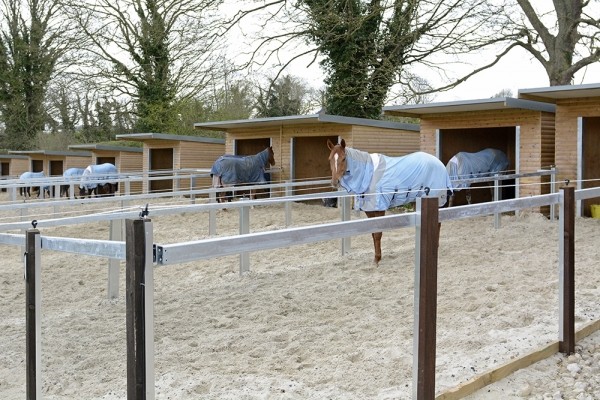
I think its more and more common, even in flat racing. A good example is Brian Ellison - he trains some great horses, including Top Notch Tonto, and he has these stables ( as well as a traditional yard)
Vpq1PM.jpg
 
If it is 'more and more common' can we have more than one example? Given that there are around 600 licensed trainers in the uk? Brian Ellison's yard was the photo someone else posted. I think it *should* be very common. i think the absolute least we should offer these horses is the choice to stand either inside or outside and to see other horses! how many hours a day to the horses get to live like this as opposed to shut in a stable, does anyone know?
 
A day in the life of one of 'my' horses at the moment who is in for summer jumping.

7am 2.5kg of haylage
7.30am 1scoop racehorse cubes and a good handful of Alfa A. All supplements added to breakfast feed, in this lads case cortaflex.
11am ridden out twice up the gallops which is a good mile and a half walk out and back.
12.15pm out in an individual paddock til 2pm.
When in he will get his lunch which is the same as breakfast. This is fed at 1pm but being in the field.means he gets it a bit late. There is also another 2.5kg of hay waiting for him that was put in his box at 12.30pm.
2.30pm groomed, rugged, legs checked and injuries tended to.
4pm fed again, same as earlier.
8.30pm late feed. Scoop of cubes and more haylage.

Another day he may be ridden out at 9.30am and spend 11-1 in the field. Another day he might be ridden at 12pm so he would be I'm the field 8-10am.

We have individual paddocks for horses in training so they are next to each other but not.in with each other to minimise the risk of injury.

When the winter horses are on their holidays they will spend 6-12 weeks (depending on the horse) out in a 10-20 acre field with up to 12 other horses. A couple of bales of haylage are always available and they are out 24/7 being checked on a few times a day. Unturned unless it the weather turns.

The summer horses on their holidays over winter go out at 9am and back in at 3pm. Rugged up.

We try to get the majority of the horses out every day, weather pending though some go out every other day due to not having enough paddocks. The paddocks are big enough to have a roll a buck and a kick but not enough to get some.proper hooley speed up.

The yard up the road turns out for 2-3 hours every day but they have fewer horses.

There have been plenty of pictures put up of racehorses in the fields, and national horses out in the fields over the last few days so there really are loads and loads of yards that turn out.

It is harder when you have a yard of 50 colts and 50 fillies for obvious reasons but jumping rarely has colts. They become too protective of their private parts to jump quick enough and low enough after a while.
 
EKW, such a heartening and excellent post. I do so wish that those who will judge (but only when the accidents occur), would find a way to understand the level of care and commitment which goes in to the daily management of a horse in training. 'Care and commitment' will read from the Trainer down to the Lads and Lasses with everyone focussing on what's right for the horse.

I continue with the belief that racehorses, mostly, couldn't be in better hands.

Alec.
 
EKW, such a heartening and excellent post. I do so wish that those who will judge (but only when the accidents occur), would find a way to understand the level of care and commitment which goes in to the daily management of a horse in training. 'Care and commitment' will read from the Trainer down to the Lads and Lasses with everyone focussing on what's right for the horse.

I continue with the belief that racehorses, mostly, couldn't be in better hands.

Alec.

Agree.

It seems to me that most people involved in racing are always working towards improving things, and are transparent about it. If I could ever afford to buy/train quality horses to send to some form of competition yard, I'd pick racing over anything else.

I occasionally watch dressage, but I usually start to feel uncomfortable with the tail swishing and general demeanour of some horses. I wonder if some tail-swishers would love to just break free for a little while and have a good old gallop. Some horses, if they had a choice, might pick a career in racing for themselves. (I'm positive mine would, anyway. She'd load herself in the lorry if she could for trips to the gallops!)
 
I would rather be a racehorse in England than any type of riding school horse on most yards on the continant. Here there is no turn out,horses are in 23/24 ;some privately owned horses can get some field time, others , turn out is iether some loose play in the indoor school(if it is
free at the time) or half an hour on the horse Walker, which most of the time requires extra pay, so some people simply ignore it.
Race horses have been bred to race, they enjoy racing.
If we make it too easy for them there would be no more competition; which would mean the breed in itself would suffer.Compare the bone structure of the old fashioned tb hunter chaser
we had a few years back, with the leaner flat type chaser we see now a days, you will notice
a huge differance!
The fact we have altered the fences, making them smaller and removing the hazards behind them, have made them alot more Dangerous;horses no longer respect them, they take them at an absurd speed and this accounts for the increase in injuries,speed not the size of the jumps.
 
If it is 'more and more common' can we have more than one example? Given that there are around 600 licensed trainers in the uk? Brian Ellison's yard was the photo someone else posted. I think it *should* be very common. i think the absolute least we should offer these horses is the choice to stand either inside or outside and to see other horses! how many hours a day to the horses get to live like this as opposed to shut in a stable, does anyone know?

Sorry- - didn't realise it had already been posted - my bad!

I think I've misunderstood your argument - do you think horses should never be stables and always have the choice of being in or out? I think most NH trainers turn their horses out ( most that I know of anyway, and certainly when my grandfather was training his all went out most days) - just like 'normal' horses.
 
so for between 9 and 10 and a half months every year, 2 hours a day individual turnout, and not nec every day. thanks for clarifying.

I agree that people shouldn't just complain for cheltenham and the grand national. horses are experiencing welfare issues all year round, and getting killed and injured, and jockeys are over-using the whip and horses finishing exhausted and needing medical care, or even collapsing and dying after the races, or even in the races. this should be spoken about all year round. And i think a lot of people do try to raise awareness of it, and a lot of people do worry about it all year round. it's just going to be more obvious at this time of year when the number of fatalities is more in the public eye and people are going to be openly discussing it.

I don't know why people think that just because someone disagrees with their point of view they don't know what they are talking about. It may be that they know very well what they are talking about, but they have a different set of priorities, or a different opinion. a racehorse may seem to be 'treated like a king' from one person's point of view, but from the horse's point of view it might be very different. horses are social animals who are designed to cover many miles per day at a slow, steady pace, closely interacting with others in the herd, and eat high volumes of low quality roughage. none of these behavioural needs are adequately met in the majority of yards. the fact that over 90% of racehorses leave training with ulcers suggests that they are under considerable stress, be that physical, psychological or a combination. the vast majority of yards are designed entirely for the convenience of the people, not the horses.

I have never said that the people involved in day to day care don't care about the animals. however, on that point I would just question the wisdom of running a horse with a twice fractured pelvis in what is arguably the toughest race in the uk - quote from the trainer: He's fractured his pelvis twice. Before that I always thought he was the best horse I ever had, how good would he be with a proper rear end on him? and another quote:

Because of his injuries, his rear end isn't as strong as it should be muscle-wise and I think the better the ground the better he is.'

so, let's take a horse without the best rear end on him, due to him fracturing his pelvis twice, and stick him in the national - even though he has never even won over fences. that doesn't look like prioritising the horse's welfare and safety to me.

I do agree, the majority of dressage horses look pretty miserable to me as well.


Read more: http://www.dailymail.co.uk/news/art...ely-Grand-National-triumph.html#ixzz45cPAqVi7
Follow us: @MailOnline on Twitter | DailyMail on Facebook


Read more: http://www.dailymail.co.uk/news/art...-jockey-win-Grand-National.html#ixzz45cNlghGs
Follow us: @MailOnline on Twitter | DailyMail on Facebook
 
Sorry- - didn't realise it had already been posted - my bad!

I think I've misunderstood your argument - do you think horses should never be stables and always have the choice of being in or out? I think most NH trainers turn their horses out ( most that I know of anyway, and certainly when my grandfather was training his all went out most days) - just like 'normal' horses.


no, i think it's fine for horses to spend part of their life in stables, so long as they have turnout time as well. I don't like to think of horses spending 22 hours a day in a stable with maybe 2 hours turnout. But 22 is better than 24. The in and out stables you said were more and more common, but so far it seems like only one trainer uses them, and again i was wondering if the horses were in those for a significant portion of the day or just a couple of hours, and that was deemed their 'turnout'. and how common they are.
 
But these behaviour needs you specify are not met for the vast majority of domesticated horses - be they racehorses, competition horses, happy hacks or field ornaments!

You're singling out racing for criticism when the same could be applied to a huge number of leisure horses. I would imagine most horses at livery have had a restriction on turn out this winter it's been so wet

You're very lucky if your horses have the freedom to roam for miles. Most horse owners would struggle to get anywhere near "natural" conditions.

And by the way, filthy here yesterday - mine broke my bloody electric fence down to get in!! Worse things than being in a stable with nice haylage to eat apparently!
 
I would rather be a racehorse in England than any type of riding school horse on most yards on the continant. Here there is no turn out,horses are in 23/24 ;some privately owned horses can get some field time, others , turn out is iether some loose play in the indoor school(if it is
free at the time) or half an hour on the horse Walker, which most of the time requires extra pay, so some people simply ignore it.
Race horses have been bred to race, they enjoy racing.
If we make it too easy for them there would be no more competition; which would mean the breed in itself would suffer.Compare the bone structure of the old fashioned tb hunter chaser
we had a few years back, with the leaner flat type chaser we see now a days, you will notice
a huge differance!
The fact we have altered the fences, making them smaller and removing the hazards behind them, have made them alot more Dangerous;horses no longer respect them, they take them at an absurd speed and this accounts for the increase in injuries,speed not the size of the jumps.

breeding also accounts for the number who break down. surely the speed should be down to the jockeys.

i cant be doing with the 'something is always worse' argument. if we extrapolated that argument to its logical conclusion it would mean that no one was ever allowed to criticise anything ever, as no matter what you discuss someone is always going to say something else is worse. we dont need to fix the problems for horses in riding schools in the continent before we can discuss racing.
 
But these behaviour needs you specify are not met for the vast majority of domesticated horses - be they racehorses, competition horses, happy hacks or field ornaments!

You're singling out racing for criticism when the same could be applied to a huge number of leisure horses. I would imagine most horses at livery have had a restriction on turn out this winter it's been so wet

You're very lucky if your horses have the freedom to roam for miles. Most horse owners would struggle to get anywhere near "natural" conditions.

And by the way, filthy here yesterday - mine broke my bloody electric fence down to get in!! Worse things than being in a stable with nice haylage to eat apparently!

see my other point - in order to be able to discuss racing, i dont need to fix the rest of the entire equestrian world first. if we all took that stance no one could ever criticise anything because someone would always say 'but what about'. likewise if we all turned a blind eye to things we disagreed with we'd probably still have slavery, bear-baiting and burning witches. I do agree that horses struggle in many walks of life. but this thread is about racing. we could discuss those other problems if you want, but it does not take away from the idea that there are problems in racing.

it's also not an either/or argument. nothing wrong with turning your horse out when the weather is good and letting him come in when the weather is poor. or even better give him a field shelter to make his own choice, with his haylage in it. actually my horses do roam over a reasonable acerage all year round and make choices. i would not have horses if i could not meet their basic needs. maybe another problem to discuss at some point is livery yards who take money off owners but provide inadequate facilities for the horses.
 
Last edited:
alliwantforchristmas,

I'm not sure about others, but I'm starting to wonder if you aren't something of a 'campaigner'!

I also wonder if you have a caps button on your keyboard. I'm not that bothered, you understand, it's just out of idle curiosity that I ask. :)

Alec.
 
I think as per every racing thread there are two issues. One, the sport itself, deaths in races/after races; and two, the lifestyle that racehorses have. Moreover threads move from the first to the second as though they're one and the same, they're not. EKW's posts prove that it's not all hideous. Heck, it sounds like her charges have had far more turnout than the horse I'm riding had over the winter!

no, i think it's fine for horses to spend part of their life in stables, so long as they have turnout time as well. I don't like to think of horses spending 22 hours a day in a stable with maybe 2 hours turnout.

That's fine but don't single out racing as the bad guy when the above is happening in generic livery yards, competition yards and riding schools across the country.


I believe the Giffords turnout a fair bit too.
 
Top