Numpty hoof question!

Clodagh

Playing chess with pigeons
Joined
17 August 2005
Messages
29,065
Location
Devon
Visit site
What makes hooves grow at different angles? I have had my horse about 6 months now and the top two inches or so are growing at the right angle and the horn looks good, whereas below they are horribly flat and crumbly. I assume being on a better diet has improved the horn and my farrier has improved the angle, but how does the hoof know, growing from the top, what angle to come out at? I hope that makes sense. There is a big ripple from bad to good.
 
If he is on a better diet than before, that is what you are seeing at the top of the hoof growing down, the ridge is where the change in diet occurred, below that is the not so good a diet. The hoof will take a year to grow out completely, spring grass and autumn flush also create a little ridge on the hoof....Google good hooves and see what you can find, loads out plus piccies to help ( did me!) lol
 
The diet change has caused the improved horn AND angle - the farrier had nothing to do with it ;). An improved diet will cause the laminae which connect the hoof wall to the pedal bone to become stronger. The old laminae are weaker and so have stretched, which causes the angle of the hoof to deteriorate (flare).
 
Ah! Thank you. I think my farrier is fab but I don't see how he could alter the angle of growth from the coronet band!
 
Thank you for that...but I am being thick and can't see the answer!


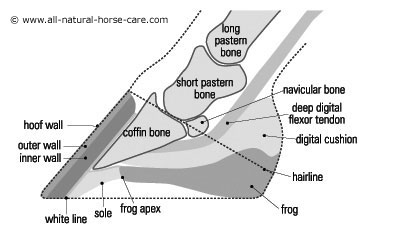
internal-structures.png


'The white line is the connection between the hoof wall and the sole, made up of small tubules called laminae. From the bottom of the hoof it looks like tiny fingers and is more of a yellow color than white.'

The diagram shows a hoof angle that does not match the pedal/coffin bone angle. So a long toe and possibly flare too, if the diagram showed other angles. The white line is stretched/fills the gap between the hoof wall and pedal bone.

There are several things that can cause this to happen (eg poor shoeing, poor diet etc...) and the best way to fix it is to stop the cause. You have to grow out the old hoof capsule and grow in a new, healthier one with a tight white line. Also think how less likely it is for a horse with a tight WL to get abscesses due to grot entering the WL.

RE - the poor shoeing, Enfys had a wonderful, but scary photo of Percheron hooves (IIRC) that had been flared on purpose - they were like dinner plates!

ETA - compare the two diagrams

hoof%20sideview.jpg


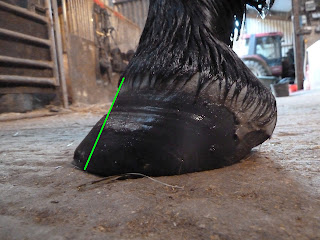
and a hoof that's started to grow a better hoof angle - the green line shows how the front will be once the whole hoof capsule has grown down. The heels will improve too. :)

Buddylateral2.jpg
 
Last edited:
Good post from Faracat :).

Imo its worth noting however, that flaring a foot on purpose with shoes is only possible if the laminae are weakened anyway. Experiments have been done on healthy laminae which show that they are too strong to be pulled apart by force - the hoof wall itself will break down first.

So if you have flare imo removing shoes will not be enough to resolve it; a dietary change is also necessary.
 
Good pics, thank you Faracat. I am not going barefoot with him but I would like better looking hooves out of vanity if nothing else...(joke).
He is on a 'barefoot' diet anyway, as are all of mine and I have just ordered some pro-hoof. I will put them on linseed come the winter but in summer they don't get anything bar chaff and supps. I will take some pics soon but he is deseprately in need of shoeing, me bad, so not this week!
 
The horn tissue at the point of production will relate to what has gone before.
The angle of the pedal bone will be the main influence on the angle that the horn is secreted from the coronary band.
Diet plays a major part in producing tissue that is strong and consistent, but concussive pressure at this point will also play its part.
Thus if the concussive pressures put on the foot at the bottom cause a conflict anywhere on the tissue between top and bottom then you will get a reaction, as seen here: http://www.rockfoot.com/why.html#ref1
When I was shoeing I made it a point to make sure the shoe was bevelled all around and that the break over was sympathetic to the angle of horn production, of course within a short period of time the B/O would move forwards thus becoming irrelevant.
Both farriers and trimmers should be aware of the influence they have on the horn at the point of production when it comes to absorbing concussion.
 
The other thing that will alter toe angle is the external height of the heels and the internal thickness and density of the digital cushion and frog. In a shod horse you can sometimes affect one, but rarely can you give the back of a shod horse foot sufficient stimulation to improve the latter.
 
So Heelfirst and CPT, you are saying the farrier can effect angle? I must say he had no heels at all when I got him (visible ones, anyway) but now does.
 
Yes a good farrier, or a bad one, can change the toe angle for the better or the worse. If the horse grows heel all he has to do is leave it higher or take it lower, in relation to the toe. The trouble is that if the internal bone isn't glued properly to the foot by the laminae, then leaving the heel higher to make the toe steeper will often simply result over time in the horse shuffling its whole foot forwards out from under its leg in an attempt to correct the internal coffin bone angle. It's usually pretty easy to find horses whose feet have underrun this way in shoes.
 
Farriers, trimmers, vets & owners that neglect, can all change the dorsal wall angle
There is no preconceived correct angle but there is a small angle range that each foot can tolerate and work well within.
 
Top