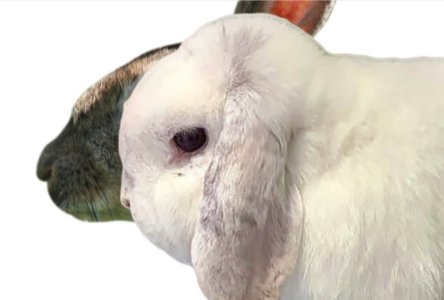
Pedigree cats exposed

As I understand it cats are not very tolerant of inbreeding - the litters just aren't viable most of the time - so the extreme traits that are seen in dog breeds now just can't happen in cats. The Scottish Fold is one of the few that have an abnormality that people like to breed for and the litters survive, otherwise cats are almost all roughly the same size and shape.
 
As I understand it cats are not very tolerant of inbreeding - the litters just aren't viable most of the time - so the extreme traits that are seen in dog breeds now just can't happen in cats. The Scottish Fold is one of the few that have an abnormality that people like to breed for and the litters survive, otherwise cats are almost all roughly the same size and shape.

I've rehomed two pedigree British Short Hairs of dubious breeding, both diagnosed with arthritis aged 3, lost the boy to a further congenital heart condition at 4. His sister has permanently watery eyes and snores, as her face is short, so they may not be such huge issues but issues still the same.
 
As I understand it cats are not very tolerant of inbreeding - the litters just aren't viable most of the time - so the extreme traits that are seen in dog breeds now just can't happen in cats. The Scottish Fold is one of the few that have an abnormality that people like to breed for and the litters survive, otherwise cats are almost all roughly the same size and shape.
Hmm a lot seem pretty extreme to me these days
 
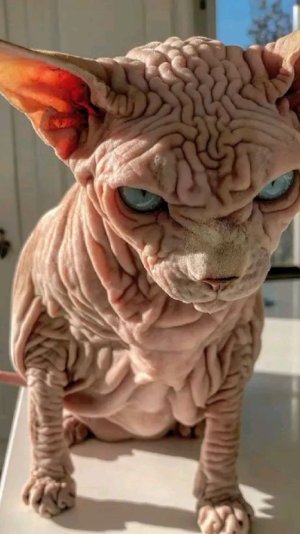
That's interesting about the British short hairs but in some ways supports the idea about viability - those cats were presumably very like every other cat in terms of size etc and yet they had extreme problems very quickly. Those pictures are horrible but I think these are exceptions (who in their right mind would want one?) rather than the rule and again it would be interesting to know how long they live and whether they are fertile. If you look at dogs their sizes vary by orders of magnitude and some have features that are horribly exaggerated but considered 'normal' e.g. pugs which are common and fashionable.
 
The Scottish Fold. The film doesn't mention that the condition affecting it's ears is osteochondroplasia, an abnormality which affects cartilage and bone development throughout the body.

It is illegal to breed Scottish Fold cats in Sweden, and I know that it has happened at least once that a couple was sentenced in court for having bred their two cats which both carried the Scottish Fold gene/genes. But they weren't sentenced as in going to prison for it, without they had to pay fines for it. Sadly that doesn't mean that there's not others who manage to get away with it, because it still happens that such cats/kittens are for sale here in Sweden.

Though presumably much less often, than if they'd been legal.


I like pedigree cats, and would gladly have bought one again, maybe another Cornish Rex like my Berta who died 2020. But I just couldn't justify how much even average purebred cats have increased in price. Only getting a kitten/cat without pedigree often costs enough these days, regardless if I looked at rescues, or private sellers before buying Fröjdis in 2022, and Essy in 2023.
 
As I understand it cats are not very tolerant of inbreeding - the litters just aren't viable most of the time - so the extreme traits that are seen in dog breeds now just can't happen in cats. The Scottish Fold is one of the few that have an abnormality that people like to breed for and the litters survive, otherwise cats are almost all roughly the same size and shape.
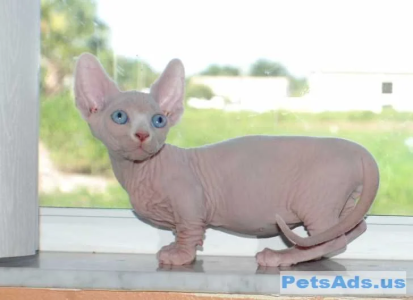
A quick google search came up with this link, showing examples of extreme cat breeds.

Interestingly, the same variation as in dogs results in the same issues. Teacup cats (miniatures about a third the size of a "normal" cat) have teeth issues. Maine Coons, very large cats are prone to hip displasia. The link has a very good comparison of an "old" persian versus a modern extreme version. As a friend once said to me, stop and think if its normal to have the tip of your nose above your eyes.

I think these types of cat are not seen as much as the extreme dog forms simply because if you're paying a fortune for a delicate cat, it is likely to be kept inside and most people don't walk their cats in the street or the park. Just because you don't see them often, doesn't mean they don't exist. We are unfortunately seeing more and more extreme versions in many species like horses (seahorse headed arabs, bodybuilding type halter quarter horses...), rabbits, chickens, etc... Some people like the unusual and the bizarre, anything to stand out on social media.
 
I adore the British Shorthairs but my pure bred one only lived until 10. I'd love another, but the cost and the short lifespan is off-putting.

I really don't like the very extreme cats, why breed something with such obvious deformities?
 
An old colleague of mine had several Persians she adored and they are bizarre shaped cats even the spine and shoulders were off.
 
I bred Orientals and Burmese cats for over 20 years. I stopped when the breed societies altered the breed standards to accommodate poor quality animals. At least that is how I saw it. In my view the animal in question needed to be able to fend for itself and feed itself in the case of dire emergency. (IE, if it got out and couldn't be found and was on it's own, type of scenario) It needs to be of a reasonable size and weight to do that efficiently. All of sudden the breed standard included smaller and smaller cats. Inbreeding seemed to be the order of the day and litters got smaller and birthing was more problematic. It must be said, however, that GCCF made a point of making rules for cats with flat faces, to ensure that those animals that had breathing problems and eye problems were not rewarded. I can't recall the parameters now but that seemed a step in the right direction. I've been out of it now for about 20 years so no idea what the current situation is. I'm not sorry I stopped when I did. This craze for designer everything does nothing for me.
 
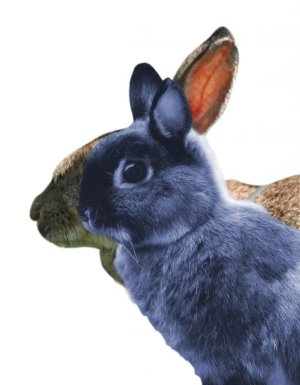
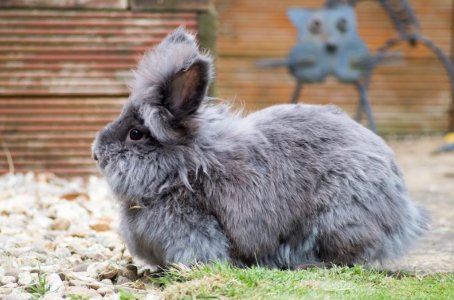
very much seeing the same issues with brachycephaly in rabbits now too
I have an 8.5yo lionhead doe who 'squeaks' when her head falls too low on her dewlap when she is sleeping,a lot of lops have issues with eyes/hearing and the 'popular' breeds are a lot more likely to develop malocclusion
(images from interwebz)Mar24_Brachy-rabbits_MAIN-798x1024.jpgMar24_Brachy-rabbits_Fotolia-jinzha-Bloodrose_MAIN-1024x678.jpg
screenshot-20210714-193740-instagram_orig.jpg
 
And the fish that can't swim, like the Demekin, Oranda and Fantail and OMG the poor Bubble Eye.

People should be ashamed.
Just googled some of these, I had no idea extreme fish morphs had been selected for, though I suppose I shouldn't be surprised.


it gets worse than them - mousehead/golfball pearlscales 🤮 they are disgusting.

fantails aren't that bad though by comparison bearing in mind the eggshaped body is a natural mutation, 'fantail' itself technically refers to the SNP in the homeobox controlling the development of the caudle peduncle during embryogenesis that duplicates it. That produces a wakin. Combine that with the egg shaped body that appeared by chance in 16th cent monastery bonds in japan and you have fantails as a variety. I don't like them much though, not sure why we had to perpetuate sentient swimming baubles when lovely wakins and wild type prussian carp exist. The short body stuff can't even eat a normal diet - naturally they would be generalist omnivores that sift sand for tasty morsels of anything and everything but their bodies are so compressed if you feed them too much animal protein the hind gut swells, ends up compressing the swim bladder, then you end up with floaty fish that cant pass the gas or regulate their own buoyancy. Or just the swim bladder has no space to work properly, or if its a female that swells up with roe.......

Short body mutations are grotesquely popular in other species as well though - things like balloon mollies and guppies - and they are effectively inbred forms of scoliosis so it 'breeds true'. It's awful. And they live so much shorter lives but everyone goes 'ooooh look at that one, isn't it funny, isn't it cute....' 🙄or bettas with such long fins it's basically a foregone conclusion they will rip them and get fin rot......in some of the betta shows in other countries people actually trim the fish's fins with razors to get the 'desired shape'.
OK yeah I could go on but basically - humans' selfishness to push and change animals physiology as if they are plasticene because it 'looks nice' to some of us, with no thought of what it is going to do to the poor animal, isn't constrained by species boundaries :( :( :(

good article here on one very popular manmade fish https://www.practicalfishkeeping.co.uk/fishkeeping-news/what-have-we-done-the-parrot-cichlid

Gimme a goodeid any day....it absolutely boggles the mind that healthy wild species are going extinct whilst these inbred monstrosities are produced en masse for the trade. I can't give some of my goodeids away (literally) because there is just no interest. There is a bit more interest in the wakins and watonai as pond fish but not enough. My old manager **refused** to even get them in .... My oldest wakin is approaching 6-7 now and still a young fish whereas fancies (not fantails actually) are lucky to make it to 5.
 
Last edited:
it gets worse than them - mousehead/golfball pearlscales 🤮 they are disgusting.

fantails aren't that bad though by comparison bearing in mind the eggshaped body is a natural mutation, 'fantail' itself technically refers to the SNP in the homeobox controlling the development of the caudle peduncle during embryogenesis that duplicates it. That produces a wakin. Combine that with the egg shaped body that appeared by chance in 16th cent monastery bonds in japan and you have fantails as a variety. I don't like them much though, not sure why we had to perpetuate sentient swimming baubles when lovely wakins and wild type prussian carp exist. The short body stuff can't even eat a normal diet - naturally they would be generalist omnivores that sift sand for tasty morsels of anything and everything but their bodies are so compressed if you feed them too much animal protein the hind gut swells, ends up compressing the swim bladder, then you end up with floaty fish that cant pass the gas or regulate their own buoyancy. Or just the swim bladder has no space to work properly, or if its a female that swells up with roe.......

Short body mutations are grotesquely popular in other species as well though - things like balloon mollies and guppies - and they are effectively inbred forms of scoliosis so it 'breeds true'. It's awful. And they live so much shorter lives but everyone goes 'ooooh look at that one, isn't it funny, isn't it cute....' 🙄or bettas with such long fins it's basically a foregone conclusion they will rip them and get fin rot......in some of the betta shows in other countries people actually trim the fish's fins with razors to get the 'desired shape'.
OK yeah I could go on but basically - humans' selfishness to push and change animals physiology as if they are plasticene because it 'looks nice' to some of us, with no thought of what it is going to do to the poor animal, isn't constrained by species boundaries :( :( :(

good article here on one very popular manmade fish https://www.practicalfishkeeping.co.uk/fishkeeping-news/what-have-we-done-the-parrot-cichlid

Gimme a goodeid any day....it absolutely boggles the mind that healthy wild species are going extinct whilst these inbred monstrosities are produced en masse for the trade. I can't give some of my goodeids away (literally) because there is just no interest. There is a bit more interest in the wakins and watonai as pond fish but not enough. My old manager **refused** to even get them in .... My oldest wakin is approaching 6-7 now and still a young fish whereas fancies (not fantails actually) are lucky to make it to 5.
I've just found out how much I don't know about fish! I won't be getting any anytime soon...
 
Didn't you have bettas and fancy goldfish?
I do still have fancy goldfish, I have a tank of rescues people asked me to take in, but have never purchased any because it's fundamentally supporting a trade in what the Germans call torture breeding.... That I don't agree with. And now I have no space, lol. It's a tank of sad stories, like a ranchu with no eyes because it's former owner kept it in a 30 litre with a koi that ate them, then put them on FB marketplace free


I had "fancy" Bettas for a bit before I knew better (they were the first "tropicals" I kept) but got fed up of the constant fin rot, then kept wilds (splendens complex only though nothing really rare, though it would be lovely to have mahachaiensis again) but didn't get anymore when they died due to the costs of heating. They all need 27-28c water + air that's the same temp so it was just ££££ I didn't really have.
 
I do very much wish we'd put torture breeding laws in place too but there's too much money involved in breeding the deformed popular things of all species
 
Top