Pics pre-farrier

MasterBenedict

Well-Known Member
Joined
12 February 2013
Messages
625
Location
Essex
Visit site
Following on from my previous thread, I have taken some pics of Zebadee's feet today to compare after the farrier has been and (hopefully) when we decide to go barefoot.

Please feel free to give your opinions on these, the more the merrier! I'm planning to update this thread accordingly over the next few weeks/months/years as his feet progress. Apologies for the white powder, he had very gunky smelly feet when he arrived so I've been using NT Dry - I impressed with the results after just one week they have completely dried out and no more gunk/smell :)

Near fore (his 'problem' leg) -

b608ba82291945d4cddfc19900d00d25_zpsrflrwp01.jpg


8a881f19ffffec86433f0dc891cbc63f_zpsc1kvf55f.jpg


2470b749f69ba61bb6bcb812490eeab0_zpsrutz8lvw.jpg


664172fbd3f93d35d7e7fb6a3a63694f_zpstchqezu5.jpg


6142e40c04306966645849faa3feb2a9_zpso5pkh7in.jpg
 
Oooh hoof pics :D

Well I think it is pretty obvious which one is worse even without you saying which one is lame. It is tall, under run, bull nosed (it would be interesting to see where the pedal bone is sitting on an xray) and shoe looks quite short to me which won't be helping where the force is going down through the foot.

I think hinds will sort themselves out ;).
 
Oooh hoof pics :D

Well I think it is pretty obvious which one is worse even without you saying which one is lame. It is tall, under run, bull nosed (it would be interesting to see where the pedal bone is sitting on an xray) and shoe looks quite short to me which won't be helping where the force is going down through the foot.

I think hinds will sort themselves out ;).

Glad I'm not the only one that likes a good set of hoof pics XD

He has had X-rays done previously, I'm just waiting to receive these and get my vets to have a look and interpret them for me :)

Interestingly, I have done some slow-mo vids of him walking and he does appear to be landing heel first.
 
I think bar shoes tend to do that, did you see norman's footage on rockley (he belongs to stencilface on here) he was heel first in his bar shoes but it doesn't look quite 'right'.
 
Does he tend to weight bare more on the off fore and near hind as it looks this way from the pics ( could just be the way he's standing at the time though)? just thinking lamness issue could be diagonal from near fore and off hind. As to why his front shoes are different i'd guess that the egg barr type shoe gives more support for the off fore as the pastern appears more dropped compared the other limb. could just be that the farrier didnt have the matching pair though :)
 
Yes, me too. I can see effects in the soft tissue above from it as well. He very much needs to be balanced. He's definitely due for a trim, which is a good thing, cause it will give the farrier something to work with. There is a negative palmer angle going with the some of his feet, mostly the near fore. Remediation will have to be slow, to allow the pull off the DDFT in the back and get into good working order again. (see the straight line of pull coming into the top of the heel bulb) then the overhang of the heel bulb itself. The heel is long, but pulled forward, so height-wise, its short and low, but it doesn't need to be pulled back that much either and the breakover is not horrific either. It's the tall toe wall that is jacking P3's nose upward, that pulls the tendons and the overhang in the back. If you look at his leg going up, you'll see that he is weighting his toes to relieve the tendon pull at the back so there's a jamming up force happening at the front toe wall as well. (loading his toes) If you run your finger up the front of the hoof wall, where it meets the band, you'll feel a ledge-like lump at the connection and where that ruffed up hair is. Should be smooth. That front jamming force increases as it goes up the hoof wall, jams into the band, the front of the fetlock and on up to smash into the front of the knee caps and beyond. The tendons in the back are pulling down. It's like putting a 2x4 under the front of your foot and walking that way. How many steps could you take before you felt the jam up the front and pull down the back and start hurting? That's this foot. So balance needs to be achieved in the trim to alleviate all the grinding and pulling and jamming going on above it. Keep fighting thrush. It's a war. The hind frogs look pretty good, but the front ones will need re-building and that won't happen if thrush is eating the hoof away at the same time. Yes, do keep taking pictures. I have a thousand hoof diaries and when I think things are not progressing, I go back and look at those pics and every time, I end up confident of the positive changes. Take them the same way every time and when you take a side shot on the ground, don't bring the hoof forward, let it stand straight to ground..better to evaluate. Best wishes! You're making the right move! I just noticed the 4 clones in the background, lol!
P.S. when you get the rads and vets analysis, take them straight away and put them in the trimmers hands when he comes...another really good move for this kind of pathology.
 
Last edited:
Pics after farrier, comments welcomed :) unfortunately no sole shots but wow, there was lots of growth to trim back, looks so much better now. Back in normal shoes as although my farrier bought bar shoes with him, he was not 100% happy with the fit. Vet due to come out Monday and he is coping very well in normal shoes so far.

Near fore -

df78f40082585955b6d06d506c80226d_zpsv3yk6mzq.jpg


Off fore -

784cd0300e07e0451ca49b379277afa3_zpsbahfmv58.jpg


Near hind -

c22746d9c276b6f4566c172de386940e_zpskg3sauss.jpg


Off hind -

c253c6096b65bb16346ec97e813dd965_zpsxitk6bov.jpg
 
Yes, me too. I can see effects in the soft tissue above from it as well. He very much needs to be balanced. He's definitely due for a trim, which is a good thing, cause it will give the farrier something to work with. There is a negative palmer angle going with the some of his feet, mostly the near fore. Remediation will have to be slow, to allow the pull off the DDFT in the back and get into good working order again. (see the straight line of pull coming into the top of the heel bulb) then the overhang of the heel bulb itself. The heel is long, but pulled forward, so height-wise, its short and low, but it doesn't need to be pulled back that much either and the breakover is not horrific either. It's the tall toe wall that is jacking P3's nose upward, that pulls the tendons and the overhang in the back. If you look at his leg going up, you'll see that he is weighting his toes to relieve the tendon pull at the back so there's a jamming up force happening at the front toe wall as well. (loading his toes) If you run your finger up the front of the hoof wall, where it meets the band, you'll feel a ledge-like lump at the connection and where that ruffed up hair is. Should be smooth. That front jamming force increases as it goes up the hoof wall, jams into the band, the front of the fetlock and on up to smash into the front of the knee caps and beyond. The tendons in the back are pulling down. It's like putting a 2x4 under the front of your foot and walking that way. How many steps could you take before you felt the jam up the front and pull down the back and start hurting? That's this foot. So balance needs to be achieved in the trim to alleviate all the grinding and pulling and jamming going on above it. Keep fighting thrush. It's a war. The hind frogs look pretty good, but the front ones will need re-building and that won't happen if thrush is eating the hoof away at the same time. Yes, do keep taking pictures. I have a thousand hoof diaries and when I think things are not progressing, I go back and look at those pics and every time, I end up confident of the positive changes. Take them the same way every time and when you take a side shot on the ground, don't bring the hoof forward, let it stand straight to ground..better to evaluate. Best wishes! You're making the right move! I just noticed the 4 clones in the background, lol!
P.S. when you get the rads and vets analysis, take them straight away and put them in the trimmers hands when he comes...another really good move for this kind of pathology.

Thank you for your extremely in depth and informative post, not quite sure how I missed it before! Can I ask where you learned all this? Is it simply self taught or something more? I would love to look into learning more but not sure where to start as you can only find out so much on good old Google!
 
I thought the shoes were coming off?
I really don't like the new pictures, angle is worse, toes too high. Get the shoes off quick even if only for 6 months to give the feet a chance to recover.
 
I thought the shoes were coming off?
I really don't like the new pictures, angle is worse, toes too high. Get the shoes off quick even if only for 6 months to give the feet a chance to recover.

I thought the angles were better, the shoe is now fitted to give some heel support, which was lacking with the rather odd bar shoes, how can toes be too high? if you are going to make a criticism of the work it would help if you explained more clearly as from those photos it looks a good job with what were poor feet and very clearly bad angles, taking the shoes off at this stage may be a step too far for the horse and the OP who is still waiting for her vet to come out and assess.
 
I thought the shoes were coming off?
I really don't like the new pictures, angle is worse, toes too high. Get the shoes off quick even if only for 6 months to give the feet a chance to recover.

After a discussion with my farrier we decided shoes would stay on for now as vet is coming to tomorrow and I do not want any soreness from going immediately barefoot to impact on his lameness work up. All being well he will be having the shoes off in 5 weeks if not sooner. What do you mean my the toes being too high? I have not heard this expression before?

I thought the angles were better, the shoe is now fitted to give some heel support, which was lacking with the rather odd bar shoes, how can toes be too high? if you are going to make a criticism of the work it would help if you explained more clearly as from those photos it looks a good job with what were poor feet and very clearly bad angles, taking the shoes off at this stage may be a step too far for the horse and the OP who is still waiting for her vet to come out and assess.

I am actually pretty pleased with the change in angles, so after the above post I was very much doubting myself! Did a little picture to see the change so far -

16ecf8833d87844ee5147f4bde10087d_zpsdlyiw7tl.jpg


I'm rather put off by the hoof wall rasping tbh. especially on the bare hinds, just why!?

Urgh, don't! Not sure why, was done as a last 'tidy up' when I was otherwise occupied. Will be asking very nicely for him not to do it in future :)
 
I prefer the angles in the first photos. Remove the shoes and the foot would recover pretty well, the new angle puts the horse back on it's heels, the pastern angle is lower. I am seeing what's going on in the soft tissues and internally, the coffin bone angle which has been lowered caudally. All undesireable.

Remove the shoes at the first opportunity, lower the toe little by little and he'll feel much better.

It's just my view on it. There are plenty of other views.
 
I prefer the angles in the first photos. Remove the shoes and the foot would recover pretty well, the new angle puts the horse back on it's heels, the pastern angle is lower. I am seeing what's going on in the soft tissues and internally, the coffin bone angle which has been lowered caudally. All undesireable.

Remove the shoes at the first opportunity, lower the toe little by little and he'll feel much better.

It's just my view on it. There are plenty of other views.

What exactly do you mean by 'lower the toe?'. Sorry I just don't understand what you mean by this?

I appreciate all comments and views provided :)
 
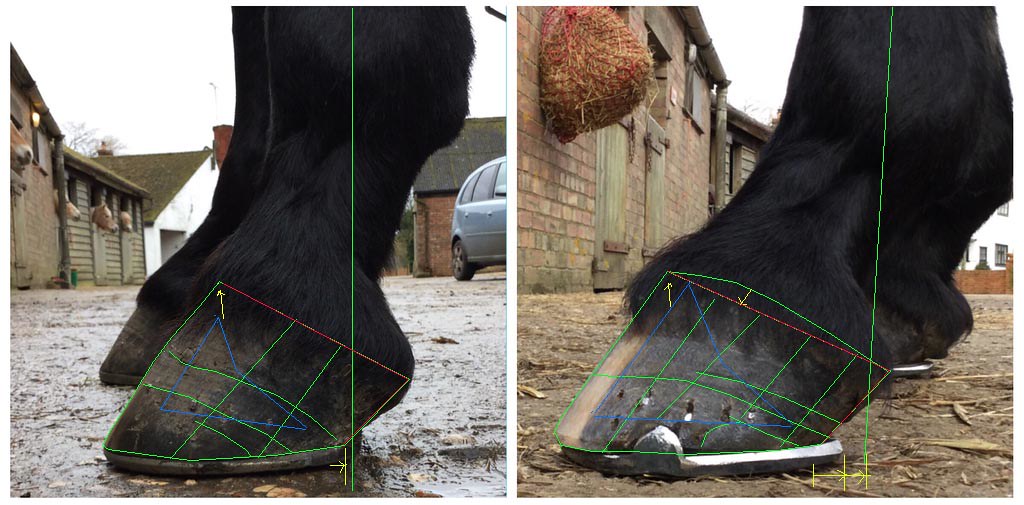
Right Front Before and After by missyclare, on Flickr

I hope this pic works. First time I've tried to post it here. I also titled it Right Front Before and After, but my internet is so slow, I wasn't going back to fix it, lol.

Yes, there is an improvement. If you just compare the pics overall, you can see that the hoof on the right has spread out, coronary band longer, hoofprint larger and no longer has that Geisha appearance. The heel angle has not changed, still same angle, same length, but the shoe extending out the back, has brought the heel back about half the distance it needs to go. he's weighting these heels and enjoying that extension and that's what you need for a heel first landing. He's getting more support closer to where his descending weight is, which is the long vertical line mid-cannon.
So the heel angle of the red tinged line has not changed, but the run of the band is not as steep, so yes, the toe has come down. Note the change in the shape of the line coming down 1" from the front band. Improvement. Stop at the bubble. That has been rasped off, which is a cosmetic faux pas in my book. Here's why. When the hoof is down in the back, the torque pulls P3 back away from the front wall, tearing the white line shown by the bubble. There is lost attachment to bone sitting all by itself halfway up the hoof. To rasp the bubble off, you're thinning the wall at a weak spot. I would have lived with that bubble, and as long as everything is right at the ground, would let it take care of itself and would be able to keep an eye on it in the meantime. You should not rasp the outside of the hoof more than 1/3rd up from the ground as well.
On the hoof on the right, I drew the coronary band straight in order to compare their angles, but the real truth on the shape of the band is the arched one above it. Whatever is not straight is jammed up thru the length of the hoof below it. So, the arch goes from stem to stern and its highest point of jam is directly above the toe pillar, or the clip. So, the toe needs to come down a bit more yet and the quarters need to be cleared so the line can relax straight. With the barefoot trim, I put just a couple of light strokes extra on the quarters to create the smallest of arches, that when you put the hoof on the ground, you can slide a credit card under there. That frees the arch (just like yours) and allows mechanism to begin...unlocks the heel and allows it to come back. When the heel is pulled forward, it invades the quarters, locks up, fills in and jams the band above it. But this shape can't be done with a shoe, the quarters are still flat and filled in, locked in by a heel that hasn't changed, still sitting in the quarter area and jamming up. The shape has had to be flat to fit the shoe. Note the striation lines going front to back, yes, better angle, more relaxed, but the striation shape shows the arch at its highest right above that clip again...go straight up to the band and it is mirrored the same way also.

The bottom line is that he was lame and now he's not, which is good. There has been a beginning for improvement, but the nails lock the shoe on and the hoof will grow exactly in the direction of the vertical striation lines on the hoof. Growth won't be correcting, which means, if the next trim doesn't happen for further correction in a timely manner, (4 weeks) then you're right back to the hoof on the left. You must stay on top of the trim to keep moving forward on getting rid of this pathology. Once its under control, (heels where they belong) then pull the shoes without expecting lameness and really move forward. A big help on that goal will be having a war on thrush in the meantime.
I got brave and drew P3 position in both hooves. (please bear with me) I figure the farrier has almost gotten the bone ground parallel and that's good, but still has farther to go. The first trim on a hoof like this is like being in a tight box. You have to preserve the heel height at all costs and use it as a fulcrum until you get the toe settled. If you pull the heel back to where your eye wants it to be, it would be so short that he'd be walking on his heel bulbs. The farrier has done the right move here in this respect and the extended heel helps to give him the support he needs in the meantime.....but stay on top of it.
 
Amazing - you can confidently identify P3 position without a radiograph.

Yes I do agree the bull nose points to a reverse rotation - wasn't going to mention it because didn't want to worry OP. Xray is the way to go.

Nothing that plenty of movement on variety of surfaces won't sort out - let the hoof adapt in its own timescale and ignore the trimming pseudo-science. Timescale means months, not weeks or days by the way.
 
FWIW, my thoughts on the "bull nose" were that in the photos from the front (initial post) it looks like the toe has been quite heavily rasped/dubbed. You can get an apparent bull nose if you rasp the lower wall heavily, then let it grow out a bit. I'd want to see x-rays to confirm a negative angle on P3 before shouting gloom and doom. Photos can be quite deceptive. Good luck with the rehab project!
 
I also suspect that P3 is reverse rotated, but that with time that will correct IME as I said I have no idea what the benefit of the high rasping is to anyone except to make the hoof look prettier and thin the hoof wall.

I have however just noticed all the mealy (haffy!?) muzzles hanging out the doors in the first pic ;).
 
Amazing - you can confidently identify P3 position without a radiograph.

Yes I do agree the bull nose points to a reverse rotation - wasn't going to mention it because didn't want to worry OP. Xray is the way to go.

Nothing that plenty of movement on variety of surfaces won't sort out - let the hoof adapt in its own timescale and ignore the trimming pseudo-science. Timescale means months, not weeks or days by the way.

Totally agree. Let it do its own thing and do it gradually and constantly ie without shoes or dramatic trimming. Rasping half its hoof wall off is never going to end well.
 
There really is no doom and gloom. Like any other pathology, all the parts and pieces just need to get back to where they belong.
Putting P3 in there was really just a hopeful guess and is showing how P3's position has improved with just one trim.....he's on his way. Xrays in the farrier's hands at the time, would have been ideal, but its all good. The only way I would look to xrays now, is if he's still lame or his progression has hit a wall down the road. Save the money for the shoes, if that's the route you're going.
Barefoot, things would happen faster and more complete because you'd have blood flow, mechanism and 24 hour access to the hoof to tweak and keep perfect all the time, but there's nothing wrong with shoes helping him get over the hump and making the transition to barefoot start out better. The real key to the cure is movement and comfort and willingness to do so.

I once had a rehab come out of a high end show barn that had this pathology, only much, much worse. If you put your arm out straight, palm down, then tilt your fingertips upward, then tilt your baby finger side downward, then turn your whole hand inward to be pidgeon toed, then that is how he arrived...all four feet. He had a body condition score of 3 from pain, stringhalt, riddled with ulcers from Bute already and bad teeth. In 4 months, he was of good weight, a different color and sound with a heel first landing, but what a journey! If I rated this horse's pathology at 100%, then by comparison, the horse on this thread only has 25% pathology and a piece of cake...as long as things continue to move forward. Hooves are really amazing...you must have faith.
 
Right Front Before and After by missyclare, on Flickr

I hope this pic works. First time I've tried to post it here. I also titled it Right Front Before and After, but my internet is so slow, I wasn't going back to fix it, lol.

Yes, there is an improvement. If you just compare the pics overall, you can see that the hoof on the right has spread out, coronary band longer, hoofprint larger and no longer has that Geisha appearance. The heel angle has not changed, still same angle, same length, but the shoe extending out the back, has brought the heel back about half the distance it needs to go. he's weighting these heels and enjoying that extension and that's what you need for a heel first landing. He's getting more support closer to where his descending weight is, which is the long vertical line mid-cannon.
So the heel angle of the red tinged line has not changed, but the run of the band is not as steep, so yes, the toe has come down. Note the change in the shape of the line coming down 1" from the front band. Improvement. Stop at the bubble. That has been rasped off, which is a cosmetic faux pas in my book. Here's why. When the hoof is down in the back, the torque pulls P3 back away from the front wall, tearing the white line shown by the bubble. There is lost attachment to bone sitting all by itself halfway up the hoof. To rasp the bubble off, you're thinning the wall at a weak spot. I would have lived with that bubble, and as long as everything is right at the ground, would let it take care of itself and would be able to keep an eye on it in the meantime. You should not rasp the outside of the hoof more than 1/3rd up from the ground as well.
On the hoof on the right, I drew the coronary band straight in order to compare their angles, but the real truth on the shape of the band is the arched one above it. Whatever is not straight is jammed up thru the length of the hoof below it. So, the arch goes from stem to stern and its highest point of jam is directly above the toe pillar, or the clip. So, the toe needs to come down a bit more yet and the quarters need to be cleared so the line can relax straight. With the barefoot trim, I put just a couple of light strokes extra on the quarters to create the smallest of arches, that when you put the hoof on the ground, you can slide a credit card under there. That frees the arch (just like yours) and allows mechanism to begin...unlocks the heel and allows it to come back. When the heel is pulled forward, it invades the quarters, locks up, fills in and jams the band above it. But this shape can't be done with a shoe, the quarters are still flat and filled in, locked in by a heel that hasn't changed, still sitting in the quarter area and jamming up. The shape has had to be flat to fit the shoe. Note the striation lines going front to back, yes, better angle, more relaxed, but the striation shape shows the arch at its highest right above that clip again...go straight up to the band and it is mirrored the same way also.

The bottom line is that he was lame and now he's not, which is good. There has been a beginning for improvement, but the nails lock the shoe on and the hoof will grow exactly in the direction of the vertical striation lines on the hoof. Growth won't be correcting, which means, if the next trim doesn't happen for further correction in a timely manner, (4 weeks) then you're right back to the hoof on the left. You must stay on top of the trim to keep moving forward on getting rid of this pathology. Once its under control, (heels where they belong) then pull the shoes without expecting lameness and really move forward. A big help on that goal will be having a war on thrush in the meantime.
I got brave and drew P3 position in both hooves. (please bear with me) I figure the farrier has almost gotten the bone ground parallel and that's good, but still has farther to go. The first trim on a hoof like this is like being in a tight box. You have to preserve the heel height at all costs and use it as a fulcrum until you get the toe settled. If you pull the heel back to where your eye wants it to be, it would be so short that he'd be walking on his heel bulbs. The farrier has done the right move here in this respect and the extended heel helps to give him the support he needs in the meantime.....but stay on top of it.

If you are a hoof care professional, it is unethical of you to go to this level of diagnosis from a foreign country of a horse you have never met under the care of another hoof care professional.

If you are not a hoof care professional you should not be making comments like this from a foreign country about a horse you have never met on the basis of a couple of two dimensional pictures.

Missyclare, we've fallen out over this before and no doubt will fall out over it again. I think you are out of order to the point of being potentially harmful with your diagnosis and trimming instructions for hooves that you post on this forum.

I understand that you are trying to help, but I'm afraid you go too far.

Are you a paid trimmer in Canada?


PS body condition score in this country is normally done out of five and three is perfect for most leisure horses, or slightly too well covered.
 
Last edited:
Top