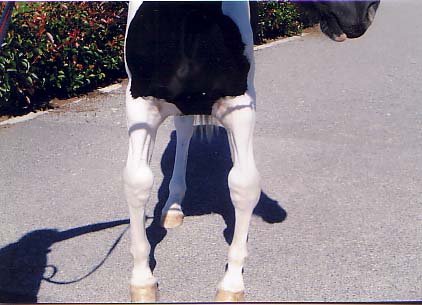
pigeon toed?

AlexC

Well-Known Member
Joined
10 November 2008
Messages
102
Visit site
hi there
i am just looking at horses for sale, and have come accross one that is really nice, but it says he is pigeon toed, i was just wondering if you read this would you stay clear? can it be fixed? i have only really heard of this condition so wanted to learn more on it
many thanks alex
 
It depends what you want to do with it but as a guide I have a pigeon-toed horse, she's evented to Novice, she'll do a smart test, loves to jump and has apparently (before we had her) been well placed at WH. She's now 14 and showing no signs of it affecting her in any way - and she's a heavier type of horse.
 
Hi,
As Jemima_too says, it depends what you want to do with them. Jasper is pigeon toed, but it doesn't affect him in his day to day life or what I do with him. My farrier has said he could "straighten him up" but at his age (9) it can cause more problems than it solves, and as it doesn't affect him I opted to leave well enough alone. How old is this prospective horse? You could ask your farrier to view him to see if it's "fixable"?
If he is the right horse in every other respect and you're not wanting to compete at a massively high level then I certainly wouldn't let it put you off.
Let us know how you get on!
 
Supreme Rock is pigeon toed, didn't stop him winning Badminton twice ;) My mare is quite pigeon toed, I did ask the vet what he thought at the vetting & he said the deviation wasn't enough to cause a problem in his view. She ticked all the boxes and passed the vetting so I bought her, gimpy feet & all. One thing I wouldn't try to do is 'straighten her up', by trimming her feet to throw her toes outward. The deviation in her legs is something she was born with and her feet have grown to adapt to it. It seems to work for her so I don't mess ;)
 
I would certainly agree that this heavily depends on what you want to be workload wise.

As the others posts alude to, I know many horses that have a degree of being turn in and are very good at their jobs. I also know there are situations where it has caused problems in the longer term.

Toed in can be a consequence of "varus" an angular limb deformity, which usually occurred during development (seen in foals/youngstock) or sometimes can be acquired from injury (older animals); or there can be an actual limb rotation.

Some are mild and may not cause issues. Some are more severe and come from higher up, e.g carpal varus
289505.jpg

Obviously this poor chap or chappess is possibly not destined for badminton!

Some horse appear to be toed in and can be markedly helped with good farriery. Taking xrays of horses with this conformation is a good starting point IMO, to help assess the degree of angle and where the imbalance is coming from e.g. poor hoof balance, or fetlock rotation, of joint varus.

This case belows shows that some cases can be improved dramatically by remedial farrier, usually those without joint imbalance/angle deviations.
Before showing toed in conformation. Notice the pastern and fetlock looks relative straight bute the hoof is longer on the outside than the inside
033009waco1.jpg


Next is the xray...this is helpful to show there is quite a bit of room to alter the balance of the hoof capsule. BUT there is some pinching or narrowing of the pastern joint at one side and already there are signs of arthritis
033009waco2.jpg


Finally post shoeing. Note the difference.
033009waco6.jpg


Please remember while this looks great, this horse is already showing signs of ringbone (pastern osteoarthritis). This will potentially be problem at some stage.

I would do to things. First if you are considering buying the horse - get it vetted. The vet will assess the horse based on what you want to do with it in the future and how severe it is. he will also be able to say whether there is a likely chance of improving this or not.

The second is make a decision understanding the consequences. even if this is correctable the horse is more predisposed to future problems arising from this conformational fault.

Based on this information, it is not a bad idea to discuss xrays as part of the vetting with your vet BEFORE he goes...it may save a lot of heartache in the future.

In my opinion, this is not a direct reason for failing a horse, provided that it is sound, not too severe and is not part of a combination of conformational problems and the purchaser understands the potential problems. Combination faults such as toed in from fetlock varus with long slack pasterns and offset knees are interpreted far more harshly in my hands.

Hope that information helps your decision a bit.
Imogen
 
Last edited:
My old girl is very pigeon toed and over at the knee, but we didn't acquire her to her late teens so nothing we could do, although farrier is very good at trimming her feet for her benefit. :)

She had major issues with Right canter because of her confirmation, and we did local level 80cm eventing in her late teens, but i've just had to retire her as she's becoming arthiritic she's 25+ though!!! I also found on the really cold days in winter she was a bit stiff etc. And she never looks 100% sound, as she moves very 'uniquely' although not 'lame' if that makes sense... :rolleyes:
So in my eyes would depend on severity of it, what you want to do and how old...
I certainly don't regret my decision as she was a bargain confidence giver, and both my mum learnt loads from her! :D
 

Wow! Look at those feet :eek:

Here's my mare - when she's being a gimp she stands like this (her feet are better balanced now)

P-3.jpg


When she's being ungimpy like this

DSCF3279.jpg


'Normal' for her is somewhat variable but it's somewhere inbetween! The vet didn't x-ray her but it was a 5 stage, he watched her trot up & down and saw her being ridden for a while before giving his opinion that it wouldn't be anything to worry about. She was only vetted for general recreational riding, RC stuff & low level eventing though.
 
It made mine get sidebone!!

It all depends if your main priority is a safe happy hacker then no it wouldn't put me off. If I wanted a young competition prospect then yes it would.

If I wanted a good allrounder and he ticked all the other boxes, had proven he could stay sound to the level I wanted to do and showed no sign of side or ring bone AND past a vetting, then yes I would buy for the right price

Sorry I know there are too many variables there
 
It all depends on the severity & how the horse copes with it. My horse is pigeon toed and it doesnt affect her way of going, passed the 5 stage no bother and tbh i think it makes her look rather cute?! - just make sure you tell the vet what you are planning on doing with this horse.
 
My horse is slightly pigeon toed and also dishes with one of his front legs. This does not affect him at all and he has quite nice paces. He does however have some degree of ringbone in both front legs, whether this is related i do not know. Apart from being a bit sore when ground is very hard it doesnt seem to affect him and we compete at riding club level at dressage, showjumping and cross country.

As long as you are sensible about what you want to do with the horse and are aware of the problems it could cause i wouldnt rule it out completely.
 
My pony is toe in on his off fore, more markedly than the other fore which is minimal. It was mentioned on his vetting certificate as bilateral pedalism (official terminology I guess) but passed. With my first insurer however his forelegs were excluded for any problem which would be due to that. I got my own vet to look at him and he is only pigeon-toed on standing, his action is perfectly straight and if I'd wanted she would have done a written report to try and get the insurers to lift the exclusion. I only notice how far in his offside toe points when I pick out that foot as it seems more noticeable then. Touch wood, so far we've had no problems, he's 14, I've had him for 6 years.
 
Our Friesian mare was 4 when we bought her, and slightly pigeon toed. When we got her home (we imported her direct from the stud in Holland) our farrier had a look at it, and now 3 years later, her feet have been corrected to the stage that it is not noticeable. In fairness, it has never really affected her performance; on the contrary. I do not know if it has made a difference that she goes barefoot and gets trimmed every 4 - 6 weeks.
As most people say, I suppose it depends on the workload and purpose you intend for the horse. We do medieval reenactment, :D which means, mainly straight runs. No dressage etc.
Hope it all works out well for you.
 
Top