Please help...choosing the right bit

fine_and_dandy

Well-Known Member
Joined
15 August 2005
Messages
2,795
Location
Hiding in the Cadbury Factory
Visit site
I've not posted in here before but think it is the right place to ask for some bit help!

I am currently teaching my youngster long reining and lunging. At the moment he is in a loose ring rubber straight bar, but he has pretty quickly got the idea that he can get his teeth on it and then pull.

He will start being ridden in Feb next year when my YO starts work and YO recommended a full cheek snaffle as it will help him with steering etc.

I am a little confused about the type of "link" full cheek to get. Someone said to get a normal single link snaffle, but someone else has said not to because of the nut cracker action. Someone else recommended a double joint with something like a peanut roller to help him mouth, but some one else said he may be confused by a double joint and to stick to a single joint. Someone else said get a copper bit, some one else said they can oxidise and perhaps get a sweet iron....I am so confused! YO said he normally rides them in a metal straight bar full cheek...but I'm not sure whether the straight bar would be right given he pulls on the current one, or whether he does that because it is rubber?

Please help! I don't want anything too strong going in for obvious reasons, so if anyone knows of a soft full cheek, please let me know :)
 
I break all mine in a Fulmer with a single joint and a drop noseband - if it is good enough for the Spanish Riding School it's more than good enough for me. The full cheeks help with steering and the rings being outside of the cheeks make the bit lovely and quiet so each instruction to the horse is very clear. The keepers hold the bit in place so that the action is clear and concise. The drop noseband fitted correctly allows the horse to relax it's jaaw but prevents it opening its mouth wide so it doesn't learn to evade the bit.

I'd be very inclined to get rid of the rubber snaffle - they can cause a lot of mouth problems as unless the horse has his mouth closed all the time the bit if it becomes dry will grab at the skin and make the mouth sore. This could be why he is getting hold of it with his teeth.

The Fulmer is fine to use for long reining.
 
as above. totally agree.
if, once ridden, the horse backs off taking a nice contact with the single-joint (some do find the nutcracker action a bit much) i'd change it to a lozenge-middled double jointed fulmer. Sprenger's are the nicest imho.
 
Sounds gd advice to me! Single jointed bits, as long as they are fitted correctly are fine in most case, if he doesn't get on with a single jointed then try a double jointed.
 
I would never ever start one of mine a single joint PERIOD

It backwards, but traditional so you get the "i've always done this". FYI Spanish riding school use a light contact, and not a traditional English one.

The norm sadly is to use a single joint, but then the horse is opening its mouth, generally because its tongue is being squished or every time you half halt you stab the poor thing in the roof of the mouth.

So answer - I'll shove a drop on the young 'un that'll learn him to open his mouth (you can see where I am going with this)

The shape of a horses mouth DOES NOT suit a single joint, so why the hell would you make that the first experience???
 
I would never ever start one of mine a single joint PERIOD

It backwards, but traditional so you get the "i've always done this". FYI Spanish riding school use a light contact, and not a traditional English one.

The norm sadly is to use a single joint, but then the horse is opening its mouth, generally because its tongue is being squished or every time you half halt you stab the poor thing in the roof of the mouth.

So answer - I'll shove a drop on the young 'un that'll learn him to open his mouth (you can see where I am going with this)

The shape of a horses mouth DOES NOT suit a single joint, so why the hell would you make that the first experience???

Bl**dy hell. Strong response much??

Ok ANSWER - I don't know why you would stick a single joint in, as you will see from my post and replies I asked because I was unsure. Instead of leaving your post with the criticism - not much of it constructive - how about you then say what you would start your youngsters in instead of leaving the post as though you have had a go at me, who is asking for advice because I do not know? If you read my post you will also see his first experience at the moment is in a rubber straight bar loose ring.

No wonder people hate posting when they are unsure, get your head bitten off. If you are responding to other users who have posted, perhaps direct your queries to them and ask in a less abrasive fashion?

To anyone that posted with recommendations, thank you.
 
Yes its a strong answer, and actually I got cut off before I could finish so posted what I had thus far

Why so strong and abrasive? Well I'm peed off with single joints, they are often used by 'professionals' with no thought to what they are trying to achieve, as that's how they've always done it and never had any problems.

Except - they have had problems and just mask it, plus there are lots of novice riders wondering why their horse throws their head up on a downward transition.

I think my most upsetting moment was seeing the black bruising on the inside of a TB's mouth (not mine), as they had been using a standard chunky eggbutt single joint snaffle (as that what came with it). Needless to say the owner was horrified when I pointed out the bruising (mainly palate)

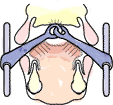
pferdemaul_einfachgebrochen.gif


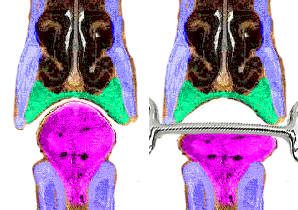
When you think about ergonomics the single joint does not work

snaffle_point_palate.gif


Anyway this is why I am passionate!

So what do I do? Well I start them in a nathe snaffle, which is more shaped and forgiving material than say a happy mouth.

From there it really depends on the horse, if more steering required then a full cheek, I'd probably pick a 16mm lozenge as not too thick or too thin.

The copper peanut ones are nice, but they are also quite thin, so I would prefer for something that was short of space, as its going to be a bit sharper on the bars.

Granted if having explored various options, the horse chose the single joint, then I would use it. However haven't had one that performed better in a single joint to date.
 
Yes its a strong answer, and actually I got cut off before I could finish so posted what I had thus far

Why so strong and abrasive? Well I'm peed off with single joints, they are often used by 'professionals' with no thought to what they are trying to achieve, as that's how they've always done it and never had any problems.

Except - they have had problems and just mask it, plus there are lots of novice riders wondering why their horse throws their head up on a downward transition.

I think my most upsetting moment was seeing the black bruising on the inside of a TB's mouth (not mine), as they had been using a standard chunky eggbutt single joint snaffle (as that what came with it). Needless to say the owner was horrified when I pointed out the bruising (mainly palate)

pferdemaul_einfachgebrochen.gif


When you think about ergonomics the single joint does not work

snaffle_point_palate.gif


Anyway this is why I am passionate!

So what do I do? Well I start them in a nathe snaffle, which is more shaped and forgiving material than say a happy mouth.

From there it really depends on the horse, if more steering required then a full cheek, I'd probably pick a 16mm lozenge as not too thick or too thin.

The copper peanut ones are nice, but they are also quite thin, so I would prefer for something that was short of space, as its going to be a bit sharper on the bars.

Granted if having explored various options, the horse chose the single joint, then I would use it. However haven't had one that performed better in a single joint to date.

I can understand if something would pee you off, but I haven't put my youngster in this bit and so perhaps did not deserve the strength of the response you gave.

However, thank you very much for the information you have given above. He does need more help with steering; at the moment it is where he seems to get a little more confused and so stops until he is certain of where he needs to go.

Can I ask what you mean by, "preferring something that was short of space as it is going to be sharper on the bars"? I'm not sure that I follow :)

Thank you :)
 
The mouthpiece is always a balance of what you can fit in the mouth. The smaller the bit diameter the sharper it is on the bars, which is why a lot of Germans used very thick bits to start off with (hence German snaffles), these are over 21mm and some up to 30mm, but flattened. However these have gone out of fashion, as they realised they were so fat that the horse couldn't close its mouth and the breeding has drifted toward a fatter tongued warmblood.

The idea is with a youngster to be soft, so the smaller the diameter the sharper the aid, which is want you want once they have learned the basics and are on to more advanced training.

Ref the copper roller peanut - shires went through a phase of making them quite thin, although there are thicker ones about which would be better for a baby. I think looking at the pictures Shires have now changed the mould and made them fatter.
 
fine_and_dandy, I really do not believe that the 'abrasive' response was directed at you at all!
Thanks for this information though Jen_Cots, afterall we only want what's best for our horses!
What about French link? I want to change Obie's bit, to a Myler which is shaped to fit their mouths.. what do you think?
 
The mouthpiece is always a balance of what you can fit in the mouth. The smaller the bit diameter the sharper it is on the bars, which is why a lot of Germans used very thick bits to start off with (hence German snaffles), these are over 21mm and some up to 30mm, but flattened. However these have gone out of fashion, as they realised they were so fat that the horse couldn't close its mouth and the breeding has drifted toward a fatter tongued warmblood.

The idea is with a youngster to be soft, so the smaller the diameter the sharper the aid, which is want you want once they have learned the basics and are on to more advanced training.

Ref the copper roller peanut - shires went through a phase of making them quite thin, although there are thicker ones about which would be better for a baby. I think looking at the pictures Shires have now changed the mould and made them fatter.

Ah I see, thank you :) Think I will pop down to tack shop tomorrow; they have a 5.5 inch (his size) full cheek peanut roller which is Shires so I will see if it is about the 16mm you suggested previously. Thank you for your help, it is appreciated :D

*spider* - it wasn't clear to me who the response was directed at hence my reply. However, Jen_Cots has been very helpful in explaining the differences :)

Whilst I remember Jen_Cots, what do you think of the straight bar full cheek? How does it differ to a double joint in strength etc? I am curious and do not know enough about it, so if you know I would be interested to hear :)
 
I would never ever start one of mine a single joint PERIOD

It backwards, but traditional so you get the "i've always done this". FYI Spanish riding school use a light contact, and not a traditional English one.

The norm sadly is to use a single joint, but then the horse is opening its mouth, generally because its tongue is being squished or every time you half halt you stab the poor thing in the roof of the mouth.

So answer - I'll shove a drop on the young 'un that'll learn him to open his mouth (you can see where I am going with this)

The shape of a horses mouth DOES NOT suit a single joint, so why the hell would you make that the first experience???


I'm not sure what you mean about the Spanish Riding School. The contact they look for is a classically correct one with the horse taking the contact but not leaning just like any good horseman. Finding the correct bit is a lot to do with educated guessing and trial and error. We cannot be dogmatic as some horses will go the same in any bit while others are more sensitive and fussy about what they like. Most of us have preconceived ideas of what we think our horse should like (my choice would normally involve a lozenge or a demi-anky) but we have to stay open minded and listen to the horses' reactions to find what THEY are most comfortable with. The same goes for nosebands. Our horses may have a different preference to us. Some go better in a cavesson while others are better when shown the way by suggesting their mouths stay more closed. Most horses are pretty accommodating so don't stress too much about your starting point as long as it fits and is a comfortable thickness, however a straight bit normally has less steering than a jointed one.
 
My rant was a mulled wine fuelled plain 'ol rant with no focus apart from single joints

French links - I think they move too much, so p*ss a lot of horses off which is probably why many people abandon the double jointed bits

Mylers are good bits, but thin generally around 10-12mm, so they would be something to consider for a made horse rather than a baby as they are just a bit too sharp

Straight bar - some horses love them, but they don't suit all mouths. In flexi materials they operate better, than metal, in that if you use one rein you affect the other side with metal (i.e. if you open the inside rein the outside of the straight bar is pulled forward)

With mouth shape - a straight bar will squish the tongue when a straight pull is applied:
gum_pressure.gif


Which is why most are mullen to allow more tongue relief.
 
With regard to the copper peanut bit, I have found them quite sharp. They are fairly thin and the roller in the middle can encourage them to play with their tongue. We have found it more valuable for horses that lean a little while galloping/jumping.
 
For what it's worth, I've started many (as in scores) of horses in full cheeks, single joint snaffles and don't use drops or flash nosebands (by preference, I don't generally school in cavessons but they're obligatory for competition so the horses have to learn to cope) and haven't produced a raft of horse running around with their mouths open, so hey ho. ;) I have also had a few horses that seem to be more comfortable in single jointed bits (vs the majority that don't seem to care, at least in the initial stages, either way and the ones that definitely prefer double jointed). I don't think it's the kiss of death to start a horse in a single jointed bit.

That said, I can see the objection and we have so many more options now, if you're going to go out and BUY a bit for starting a young horse it wouldn't be the first choice. I would go for a flat cheek (which basically means a full cheek here although many people prefer a D-ring in North America, which would probably be my choice for most horses, all things being equal) and a medium diameter (depending on the horse, of course) with a lozenge or chunky centre link. (I have a D ring with a copper link that's my bit of choice.) I'm not a huge fan of rollers or peanuts for "first bits" as I want as clear, unmuddied a signal as possible from my hand. Something like the NS Starter bit or equivalent is a good option.

To be honest, it's not the bit that is the most important part of "making" a horse's mouth, but that's a discussion for another day and it never hurts to use good tools.

I also don't longe or drive directly to the bit with a young horse. In my observation and experience, unless the horse is very strong, there is a real risk of doing damage to the mouth and neck if anything goes even a little bit wrong or, at the least, the horse developing a "mouth fault" that stays with it for life. I have a preferred set up with a snug, light headcollar with various options for connecting everything so I can work up from nose pressure to a combined nose and mouth pressure. I might drive a tiny bit off the mouth, just before I get on the first few times, but even then, more likely in hand than on long reins. I know many - maybe most - don't suffer any ill effects from a more traditional approach, but having seen some that definitely have, I prefer not to take the chance. I think the bit is important, for sure, but perhaps not more important than lots of other factors in play.

Another note . . .WHO is going to ride the horse is a factor as well. Bits are tools and people have their preferences, based in part on how they've been educated, what their system is, and how their feel has developed. If someone is making ridable horses with good mouths and relaxed, willing attitudes, that go on to work well, they can't be doing too much wrong. I'm not generally a fan of mullen mouth straight bar bits but perhaps that's because they're not what I'm used to so the the feel feels "odd" to me. It doesn't mean someone else might not be making good horses with them. If your YO is going to be doing the actual breaking and riding away, don't quickly discount his opinion for the words of others without an actual discussion.
 
Last edited:
I would never ever start one of mine a single joint PERIOD

It backwards, but traditional so you get the "i've always done this". FYI Spanish riding school use a light contact, and not a traditional English one.

The norm sadly is to use a single joint, but then the horse is opening its mouth, generally because its tongue is being squished or every time you half halt you stab the poor thing in the roof of the mouth.

So answer - I'll shove a drop on the young 'un that'll learn him to open his mouth (you can see where I am going with this)

The shape of a horses mouth DOES NOT suit a single joint, so why the hell would you make that the first experience???


I wonder how many you have started? I've only ever had one horse in a french ling and he hated it so went back to his Fulmer with a single joint. I can honestly say that I have never had a problem with horses in a single joint and I've started a good few over the years.

If the horse has been correctly mouthed then there should be no problem. I also believe that the Spanish Riding School have decades of history of producing the most beautiful athletic relaxed horses who have no problems with their bits. All are started in Fulmers - which is where the bit originated from. All with drop nosebands. As Prevention is better than cure it works every time. I use a Fulmer on all the horses I get off the track - all have gone well in it. Mine then go on to be ridden in a single jointed eggbutt with a cavesson noseband. I don't even own a flash.

Having trained with very 'Spanish Riding School' people that is rubbish to say that the English contact is not light - depends how you learned to ride! MAybe you need to change you instructor!
 
Last edited:
Yes its a strong answer, and actually I got cut off before I could finish so posted what I had thus far

Why so strong and abrasive? Well I'm peed off with single joints, they are often used by 'professionals' with no thought to what they are trying to achieve, as that's how they've always done it and never had any problems. As a professional I find this insulting, I always ensure that the horses I start are healthy, teeth, backs etc done, tack a good fit, I've not had problems with a single joint so why would I want to change? I also have a goal in mind - that of a well schooled, supple horse with no tension

Except - they have had problems and just mask it, plus there are lots of novice riders wondering why their horse throws their head up on a downward transition. This is not the bits fault - or the the horses, it is what happens when a novice riders fails to prepare for the transition properly or gets the aids out of cue.

I think my most upsetting moment was seeing the black bruising on the inside of a TB's mouth (not mine), as they had been using a standard chunky eggbutt single joint snaffle (as that what came with it). Needless to say the owner was horrified when I pointed out the bruising (mainly palate) Sure it was a bruise and not just the colouring of the palette?

pferdemaul_einfachgebrochen.gif


When you think about ergonomics the single joint does not work these diagrams are not correct in their action, When the bit is in the mouth it moves with the horse, it doesn't suddenly turn upwards when the horse drops it's nose - if it did we wouldn't see horses working so well in a snaffle.

snaffle_point_palate.gif


Anyway this is why I am passionate! Being passionate is fine but don't become obsessive

If single jointed bits were so terrible how come so many horses work like a dream in them, they work in high school movements with lightness and grace - AND the Spanish Riding School horses are heavier horses with thicker tongues. A well schooled horse doesn't throw it's head up in transitions unless the rider fails to prepare it properly. School the horse classically, ensure teeth, vertebrae & saddle are all OK and you should rarely have problems.

Fine_and_Dandy you sound like tyou are doing a great job on your young horse, it's very rewarding to bring on your own. One of mine is heading off in a few weeks to start his career with a young rider - he's home bred and broken and goes like a dream in his eggbutt and cavesson. His sister will be started soon in a Fulmer and drop - if it ain't broke don't try to fix it.
 
Last edited:
Evelyn - so the diagrams are wrong, and you've always done it like that so therefore any other view is wrong? Then a personal attack on how many horses I've started! Nice

As I've said above French links are responsible for putting many people off double joints.

This view of its traditional, I've always done it like this, is one reason why equestrianism as a whole seems stuck in a weird time warp.

OK ignore ergonomics and carry on as obviously it works for you, and clearly you aren't open to thinking about the shape of your horses mouth and the way the bit physically works.

Bear in mind the Spanish Riding School didn't admit women until 2008, so progressive they ain't!
 
Evelyn - so the diagrams are wrong, and you've always done it like that so therefore any other view is wrong?

I don't believe I ever said that any other view is wrong - I've just never needed to use any other type of bit, I've not had problems so why change something that works?

Then a personal attack on how many horses I've started! Nice
Not a personal attack on how many horses you've started - just wondering as your comments really don't make me feel that you have started many but that you are on a solo campaign to rid the world of single jointed bits

As I've said above French links are responsible for putting many people off double joints. Took my TB 40 mins to get his tongue over it and then a year trying to stop him trying. He had a slight head tilt so I gave the French link a try - this is the original type which is just a figure eight of metal - not the larger plate that you sometimes see sold - eventually we discovered the remnant of a wolf tooth under the gum, once that was gone no tilt.

This view of its traditional, I've always done it like this, is one reason why equestrianism as a whole seems stuck in a weird time warp. I'm a classical dressage person, trained by people who have been at the Spanish Riding School or their proteges, I school classically, I think classically and my horses go classically. I don't see much that I like in the 'modern way' I see tension, teeth bared, tails swishing, mouths jammed shut tight with overtightened nosebands, overbent, horses rushed through the basics and falling by the wayside when it all comes unstuck in the more advanced levels.

OK ignore ergonomics and carry on as obviously it works for you, and clearly you aren't open to thinking about the shape of your horses mouth and the way the bit physically works.
I do know the shape of the horses mouth and I do very much study the actions of different bits within the mouth, if I felt that the horse was not comfortable then I'd most certainly do something about it. I also feel that a multi jointed bit may not be as comfortable as believed, the palette is highest in the middle and gets lower towards the sides, therefore there is less room to accomodate the joints. Most horses don't really seem bothered by what they have in their mouths

Bear in mind the Spanish Riding School didn't admit women until 2008, so progressive they ain't! Why would they want to be more progressive? They have the proof of decades as to how good there trainning methods are. I certainly wouldn't want them to become progressive if it means they lose there amazing knowledge, their horses are wonderful, they work in harmony, light and soft and supple and obedient. Watching them work is spell binding. Since losing their government funding they have had to find ways of raising money - one of the reasons for admitting women

Sadly - bits, nosebands, saddle blankets, bling, breastplates - all these days are fashion statements - not there for a purpose, currently Waterfords are the trend! I guess I was raised and trained in an era when less was more and schooling was the key to success and a happy, tension free horse. I still ride without a saddle blanket and my horses don't have back problems, I don't own a flash noseband or a breastplate. I have many Fulmer snaffles in different sizes, drop nosebands and eggbutt snaffles too. I have one standing martingale that I use on the youngsters learning to jump, as I don't like the action a running has on the bit and the horses mouth, the moment the head goes up and a running comes into action, THEN the joint digs into the roof of the mouth, because the angle of the action of the reins has changed.
If you want to use multiple jointed bits on your horses then thats your choice, just as it is my choice to use single jointed bits.
 
Nobody has mentioned the basic serious problem with most (cheapish) single-joint bits - they are asymmetrical. if you hold one up by the link and you can see that one side is longer and thinner, the other is shorter and fatter. (obviously this problem is eradicated in lozenge etc type bits.) more expensive makes such as John Dewsbury are pretty-much symmetrical, however. These are the only single-joint ones i'll use, apart from Hippus, which have a hinge not a swivel-joint, so have very limited nutcracker action as well as being totally symmetrical. They're what I use for starting horses now, to the hand they feel like a cross between a mullen and a single-joint.
my trainer (classical, German) prefers single-joint to double-joint - he says that the communication with the horse is more precise, IF you are using your hands correctly and only using one hand at a time to send signals (the other hand being still). Whereas with a double-joint link you get a more vague movement on the horse's tongue, because of the additional joint which also moves.
 
Top