Quality Bone/ Good Flat Bone/ Common Bone

Orca

Well-Known Member
Joined
13 November 2015
Messages
994
Visit site
Within a discussion on bone recently, I came across these terms. I'm not a heavyweight aficionado (but fast becoming an enthusiast!), so as yet they mean little to me.

My 14hh-ish Trads canons measure at 12" below the knee. I understand this makes her a heavyweight but what defines her bone type? Her confirmation is nice, movement powerful yet surprisingly pleasant - something akin to a floating stream train �� but what differentiates between quality bone, good flat bone and common bone please?
 
So.... bone measurement is the circumference of the cannon bone just below the knee. So far as I would understand the terms......

Quality bone would be a term referring to thoroughbred type bone - light, slim, delicate looking - you would expect it to measure approx 8"-9"

Good flat bone - Flat bone looks broad from the front but when viewed from the side is substantially wider..... if you mentally cut a cross section of 'flat bone' and view it from above it would look something like the shape of a tear drop (tapering gradually from front to back). Flat bone is stronger and less porous than round bone

Common bone - not a generally used term that I have come across, but I would assume it meant that the animal it belonged to, was a less quality-type - cob rather than TB!
 
Ahh, thank you! Your teardrop description of 'Good flat bone' makes perfect sense. The discussion was specifically about HWs though (sorry, I should have contextualised), so 'common' must refer to another bone shape or type which heavies might have? Although if it's not a common term I suppose we can only guess ��
 
I had thought that the term 'flat bone' related to both the bone and the tendon that runs down the back of the cannon. If the tendon is squashed up against the cannon, it can make the leg look roundish (I'm sure I heard the term 'round bone' once in relation to this), but if the tendon is set back from the bone, then the leg is obviously wider when looking at it side-on side on, than it is from looking at the front. I was led to believe that 'flat bone' is the desirable leg conformation. Hopefully someone will come along and correct me if I've remembered any of this incorrectly. :)

All of my horses have an oblong-y cross section to their lower legs, so I've always assumed that this was the 'flat bone' type of leg. Their arab blood supposedly gives them strong, dense bones, but I wonder if anyone has actually tested this?

ETA - maybe 'common' is the same as 'round bone'?
 
Thanks Faracat, I'm now doubly intrigued!

I have just been reading that Arabs have one of the densest bone types and I suppose that matters more in terms of strength or at least stamina, than size?
 
You want a good strength for weight ratio I guess. Although they do have a lot of mane and tail hair which must weigh them down! :p

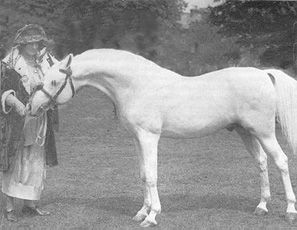
ETA - RE limb conformation, I have a thing about short cannons. I almost squealed with joy when I saw a photo of the long dead Skowroneck. OK, he had his faults, but boy, did he have super short cannons. :D

2a1e110b58641e11c87d127c06a55be1.jpg
 
Last edited:
It's all about the hair density!

Those are some seriously dinky canons ��. I'll have to put a photo or two up of Orca soon, for public dissection. She's only intended to be a non-competing family pony, so I can take the knocks on this occasion!
 
I have Arabian hunting hounds, bred to hunt in the desert, slim typical hound shape. We often talk about flat and bladed bone vs round bone. For speed strength and endurance we look for flat bone, well described above by tear drop shape in horizontal cross section.

This may help if you are dog familia; think of whippet front legs, versus the bone on the fore leg of a lab. The lab has what we would call round bone by comparison.
 
I have Arabian hunting hounds, bred to hunt in the desert, slim typical hound shape. We often talk about flat and bladed bone vs round bone. For speed strength and endurance we look for flat bone, well described above by tear drop shape in horizontal cross section.

This may help if you are dog familia; think of whippet front legs, versus the bone on the fore leg of a lab. The lab has what we would call round bone by comparison.

That does help, thanks. I wonder then if 'common bone' might have been in reference to round as opposed to good flat (and bladed) bone then, if one is more desirable than the other in HWs?
 
'Structural and cellular changes during bone growth in healthy children.?

That is the only 2000 paper he is first author on?

I'm also not aware of healthy bone ever being described as porous whatever it's shape, unless the subject has osteoporosis (porous bone).
 
Last edited:
I took "less porous" to be synonymous with 'more dense'? It's interesting that one structure might be more dense than another. I can see why a 'flat' shape would be stronger. Could the density of one bone type be increased with diet and exercise to the point that it equals the density of the first bone type or will it always be structurally disadvantaged? Is a naturally denser bone more desirable than a stressed and remodeled one? I assume so. Just pondering!
 
Here's a study (for anyone who's interested!) which found that bone mineral density and microarchitecture aren't affected by gender or breed. Assuming all bone types were included, it could mean that bone type isn't relevant to density maybe? It's not a large study though, so I don't suppose the conclusion is definitive and I don't think any heavy horses were included, which is a shame...

http://www.biomedcentral.com/1746-6148/4/3
 
I've always taken 'quality bone' and ' good flat bone' to be the same thing - bone appearing wider from the side than the front, with a good strong tendon running down the back. ' common bone' is more rounded without such a distinct tendon.
 
My 14hh-ish Trads canons measure at 12" below the knee. I understand this makes her a heavyweight but what defines her bone type? Her confirmation is nice, movement powerful yet surprisingly pleasant - something akin to a floating stream train ��
I'm impressed that your girl has got 12" of bone.

This lad, 15.3hh and 650kg of HW Irish cob, had 'only' 10.5" of bone, coupled with mahoosive feet. Also he had the most correct and elevated of paces.

image.jpg1_zpsoaccmlqe.jpg
 
Thanks Cobgoblin! That makes sense in the context of the discussion I read.

Tiddlypom, he's gawjuss! Orca is just wide all over. I haven't had success fitting her with a saddle yet! If we can pm pics on here I could send you one to see. I'm not putting it up publicly because it's a horrible pic otherwise!
 
Here's a study (for anyone who's interested!) which found that bone mineral density and microarchitecture aren't affected by gender or breed. Assuming all bone types were included, it could mean that bone type isn't relevant to density maybe? It's not a large study though, so I don't suppose the conclusion is definitive and I don't think any heavy horses were included, which is a shame...

http://www.biomedcentral.com/1746-6148/4/3

if there's any truth in a certain shape of bone being 'stronger' I should think it is purely the mechanics of the shape itself when subjected to concussive force, rather than having anything to do with the microstructure.
'flat bone' is thought to be good conformation, but I should think that is more likely to be to do with an some advantage this bone shape may have in terms of attachment/in mechanism with tendons and ligaments.
 
Top