Random question - has anyone been to Mongolia recently and seen the Przewalski's horses?

I have several photos of the herd. We drove to Whipsnade especially to see the horses and I am unlikely to have taken pictures of the wrong animals.
Nor would I confuse them with mules.I have ridden mules in USA and love them. My favourite who carried me safely down a precipice was called Mouse and I have two pics of her in our living room, one carrying me taken by a professional photographer for tourists to buy and the other after our ride.
 
We know they are not mules because the zoo pics show young with the adults and mules are infertile.
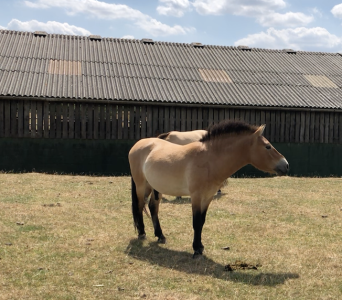
They're not mules; they're not Przewalski's horses; they're onagers (aka Asiatic wild asses). Although also equids, onagers are a completely different species to donkeys, horses, kiangs, Przewalski's horses, or zebras.

For comparison, this is a picture I took of Przewalski's horses at Whipsnade. Notice the dark legs, like a dun and unlike the onager in your photo, and the small ears, reminscient of the primitive horse type and not of the Asinus subgenus, of which the onager is a member.

Screenshot 2025-08-31 at 16.42.00.png
 
Brilliant!
They are supposedly fearless (as well as being surly!), probably ideal hacks for today’s roads....
Thanks!
 
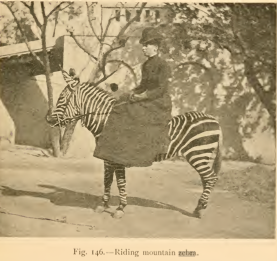
There are plenty of photos of the German colonial forces experimenting with zebra as pack, draft and ridden animals.

The thinking behind it was that horses were susceptible to diseases (especially those spread by tsetse fly) whereas zebra were resistant. Zebra-horse crosses were also tried.

And a few Europeans had zebra in harness, (I've seen photos of singles, pairs, threes or sixes). One of the Rothschilds regularly drive a zebra-pulled gig in London.
Yes, those are the zebroids, horse/zebra crosses, and yes, do both ridden and draught work in east Africa.
That’s what my parents were told: horses fall foul of all sorts of African bush hazards and conditions, but the zebroids are tough as old boots, or immune.
Apparently there was one at the station that had been attacked by a big cat, had a lot of knarly scars and a kinked leg which had been broken - still going about several years later. Parents were shown photos of the injuries, and also the shot cat.
 
Top