Retiring a young horse

moon_and_spoon

Active Member
Joined
1 June 2021
Messages
30
Visit site
Hi everyone. I have an 11 y/o tb who was diagnosed with kissing spines last year. She is the type to suck things up and get on with it. Incredibly polite, would never complain. More manifests as spookiness and a pain face.

Her kissing spines are so severe and have began remodelling. I know she wouldn't let me know outright if it was hurting her to be ridden, but I can take notice of the little signs and ultimately decided to retire her. I believe she also has ulcers and that the KS is not the whole story.

I had suspected something had been going on for a while... since I've had her in fact. She's always been tricky to ride & stressy when asked to do anything other than walk. Especially canter, in the three years I've had her I've not had one 'normal' canter, which of course is synonymous with her diagnosis.

In 2024 I decided not to push it anymore and to just walk. She was still the spooky type going solo, so we just walked around the farm with someone on the ground with us and it was great. She was fab and I loved it. It reached the point however when I thought about doing more than just 15 minute strolls, and decided to get her X-rayed.

Following her horrific X-rays I stopped riding her. I could not imagine sitting on this spine. Surgery was presented as a viable option, but I do not have the time, money or knowledge to rehab her, and based on nerve blocks and the fact that I am quite tall for her (5'11' on a 15.3) I know that I would probably rehab her just to sell her on for someone else to ride. Guttingly, the plan was always to sell her this year as I am moving away. And now selling her has become a rather dangerous option. She is uninsured. I can't seem to justify spending thousands and then never seeing her again. On the other hand I will end up spending thousands to give her a retired life for possibly the next 20+ years.

I am filled with guilt every day, because my own wishes to ride, require more money than I have if keeping her.

I'm not sure how happy she is at the mo. She's certainly not getting much attention. But she is living and hopefully comfortable. She's a wired tb though. Chilled in the field and on the ground but built to work really. It seems that since she's been retired everything has just slipped downhill. Mud fever, abscesses, chronically gunky eyes. I am not sure I am cut out to give her the life she deserves at all for years.

When do I say enough?
 
You say enough is enough when it is right for YOU to say enough. You are entitled to remove the never-ending, grinding stress of worrying about her from your life, before we even think about the cost in money.

There's are no welfare issues for a horse who is PTS humanely and with dignity.

Look after yourself, so many of us have been in your shoes.
.
 
Last edited:
You say enough when it is right for YOU to say enough. You are entitled to remove the stress of worrying about her from your life, before we even think about the cost in money.
My response would have been similar, but nowhere near as well put as @ycbm has phrased it. I had a vet tell me this once and it really stuck with me.

I also think that when you put the question out there, you usually already know the answer.

Your post comes across as balanced and rational, and I’m sure you’ll do whatever you decide is best for you and your mare. Whatever that is, be kind to yourself.
 
I've got one in my field that I retired at the same age 4 years ago (although she'd been a constant rehab for another 2-3)

I need a 3rd so I can take one of the others out and I have my own land. She's also not in pain unridden but she does have EMS and I was only saying to the vet this evening that I'll manage that to a certain extent (muzzle, drugs) but she needs to live with her friends & if the EMS stops allowing that then her life won't be happy.

If you can't manage a happy retirement for both of you then it's OK to call time. A dignified, pain free death is always preferable to months or even years of pain & discomfort in a field. I feel for you xx
 
You say enough is enough when it is right for YOU to say enough. You are entitled to remove the never-ending, grinding stress of worrying about her from your life, before we even think about the cost in money.

There's are no welfare issues for a horse who is PTS humanely and with dignity.

Look after yourself, so many of us have been in your shoes.
.
This all day long xx
 
I'm another who thinks that pts in familiar surroundings is never wrong for a horse, who for whatever reason can't be passed on.
If you are moving away, you would either have to send her to retirement livery near where she is now and trust them to look after her without your being able to visit her regularly, or take her with you and find grass/ retirement livery in your new location, both of which could be stressful moves for her. If she has a number of other issues, which require regular human input, thise have to be taken into account, too.
You have probably done all that you can for her realistically but you can do her one last kindness.
 
You say enough is enough when it is right for YOU to say enough. You are entitled to remove the never-ending, grinding stress of worrying about her from your life, before we even think about the cost in money.

There's are no welfare issues for a horse who is PTS humanely and with dignity.

Look after yourself, so many of us have been in your shoes.
.
This!
 
I’ve not read all the replies. But I put down a 12yo TB with KS and lots of vet history. Lovely horse, great nature, and I loved him dearly. I let him go after a hot week, fat and happy. The problem is KS can make the sore even without riding imo, it can also give compensatory issues. I used him as a nanny as I could afford it.

BUT

I will hand on heart say with the wisdom of time and distance, if I could go back I would move that decision to be a lot sooner. He experienced discomfort that he didn’t need to. They can be high maintenance, and often stoic. We don’t always realise the horse out grazing are in pain until they are really in pain I think.

If you decide to give your horse a peaceful and pain free exit, you are more then justified. There will be a segment of people who believe nothing should ever be put down, ignore them if that’s your decision. Big hugs. It’s not an easy decision. 🫂
 
Your post is very rational.

Another spin on this, even if you did keep your mare going I truly don’t believe that most retirement livery set ups (as you said you are moving away) will catch early enough when enough is enough with a complicated one.

I only knew with mine because I watched him, really watched him, every day twice a day. The first time I saw the smallest of signs I called the vet to PTS. But that would have been missed by anyone else, because he was so stoic and to anyone else he looked like a normal horse.

I think with these complicated ones it’s so hard to get the timing right, and it truly is better a day too early than late.

Very sorry you are in this position but know that it’s the best thing for your horse.
 
Having been in your heartbreaking position I sympathise. I waited too long out of guilt and false hope. You've done your best. She's almost certainly in low grade pain all the time. Unfortunately money does matter whether we admit it or not. PTS is not the worst thing that could happen to her by a long shot. Her future will be secure and you can move forward when you're ready.x
 
Hi I was facing a very similar decision a month ago and had decided to PTS. The only reason I didn't is that a very trusted friend of a friend offered an alternative home as companion/ light hack. The horse with the correct ongoing treatment should be able to enjoy a walk around the woods/ village once or twice a week. The horse is also somewhere we can see her on a regular basis. If her medical needs increase or this person's personal circumstances change the horse will be PTS. I entirely agree with what ycbm said about it being enough when you say it is enough. I fully appreciate how hard this decision is to make. Be kind to yourself.
 
Agree with the others, I have retired previous horses for a long time 10+years but thats because they seemed well and happy and needed no extra support. For all, issues in winter inc abscesses and eye issues signaled the end for them. I think its often a sign that somthing deeper is going on and its time to let them go.
 
I have retired my 8 yr old, also with spinal problems, not even capable of carrying a rider. He is currently living his best life in the field, but I am starting to look for another and I am not sure I can cope with 2. I have the opportunity to turn him away with others but is that best? A field ornament for 10 years or so.
You have to follow your head not heart, as others have said there is no shame in PTS only in dumping the problem somewhere else to the detriment of the animal.
 
I have recently retired my 17 yr old coblet following 12 months of surgery and subsequent rehab, I’ve also recently moved him off his stabled livery yard to a field to live out 24/7 with 3 other geldings (2 ridden, 1 also retired) he’s field sound at best on 1 Bute/day and appears happy enough and relaxed but at the slightest hint of pain or decline I’m reconciled to the decision to have him PTS. In fact I may do before the weather turns in the autumn anyway knowing that he’s had a lovely summer out chilling and eating grass with some mates. I’ve had surgery last week and want the summer to rehab me!! But are also tentatively looking for another at some point. It’s so sad but the final act of kindness I believe.
 
Retiring a horse to live out 24/7 that has previously been stabled and led a pampered life is a huge adaptation and an assault to it's body. Taking shoes off and roughing it off takes time for it to adapt. Not only is it contending with a new way of living, it is also contending with living out and poor weather conditions and competing for a food source i.e hay.

Sheer volume of horses create a mud bath during the winter and bingo; horses are suddenly more predisposed to getting abscesses mud fever and other related conditions. They don't have to have cushings in order for this to happen.

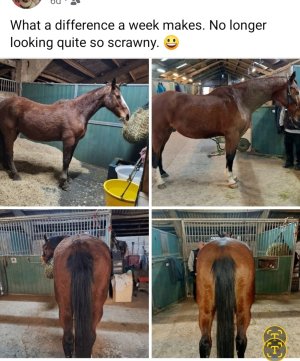
If people don't believe me have a look at these photos taken one week apart.

A horse that has lived out 24/7 in retirement and a week of coming home and being turned out during the day and stabled at night.

Like others have said at the end of the day the OP has to do what she feels is right and there is no right or wrong answer but we shouldn't automatically presume a horse has cushings because it's finding the adaptation difficult. We shouldn't also assume that all horses will cope with a life of retirement either.

I'm very sorry OP. I know the mental struggle you will be going through and understand especially when you want another horse so you can ride. Be kind to yourself whichever decision you make x
 

Attachments

  • Screenshot_20250423_142421_Gallery.jpg
    Screenshot_20250423_142421_Gallery.jpg
    811.5 KB · Views: 22
I had to retire my mare aged 9. She was a happy field ornament for a couple of years and then something about her that just didn't "feel happy" anymore and as she was retired, now uninsured and I'd already spent thousands I didn't feel I could justify spending anymore to investigate. She was pts quietly at home aged 11. The wait from making the booking was rough, but from the second she shut her eyes I just felt relieved. No regrets. I owed her a peaceful and dignified ending and that's what she had

I think if you're asking you already know what's right for your horse and your circumstances.
 
Top