Rider size limits enforced as part of new welfare rules

This is one of the areas I find parts of the equestrian community really disappointing to be honest. Riding horses is a privilege, not a right. If you are too heavy then you are too heavy end of story. No amount of excuses, ‘balanced riding’ or ‘I’m trying to lose the weight” makes a jot of difference to your horses welfare.

No it’s not easy, I’ve just worked my backside off to lose a stone as the menopausal pounds had crept on and I was over 70kg. I could tell I wasn’t doing my horses justice. I’ve got around another stone to go but I feel I’m comfortably within a reasonable weight for them to carry me and work well now, just not where I’d like to be for them to perform to their best.
 
I don’t accept the fat phobic thing. And I’d certainly never get on a pony that I weigh 30% of its body weight 😳

I am 5’6 and weight around 9.5 stone roughly but I’m quite a broad build.

Someone who is 5’ but a petite build with the same body fat % as me will be considerably lighter.

That’s got nothing to do with fat but an overall smaller person would not only be more comfortable for my horse but could ride much smaller horses than me. They weigh less than me and that’s all there is to it.
 
I think if people learned how to not fall onto their horses backs and sore them many would learn plenty of horses are perfectly comfortable and capable of long term carrying up to 30%. 20% is fine and reasonable for a weaker/unbalanced rider but studies are showing a for horse with well fitted tack and a balanced rider can carry up to 30% comfortably long term. Pony types especially were bred for carrying weight on long hauls. But more recent studies are showing there’s a lot of factors and it’s not cut and dry how to determine what a comfortable weight limit is and it’s very horse dependent, rider dependent and tack dependent.
I know a very high level western rider.He is a 6ft2" .Definitely not fat and very fit.He competes very successfully at international level.He must weigh at least 12 stone and western saddles weigh approx 2 stone.He rides quite fine 15 he ish quarter horses and they stay sound for a very long time.
 
I know a very high level western rider.He is a 6ft2" .Definitely not fat and very fit.He competes very successfully at international level.He must weigh at least 12 stone and western saddles weigh approx 2 stone.He rides quite fine 15 he ish quarter horses and they stay sound for a very long time.
If the QH weighed 550kg, then 20% would be 110kg which is 17.3 stone, so with your guesstimates of his weight (14 stone) he would come in at 16% inc tack.

If the QH weighed 500kg - he would be 17.6%
 
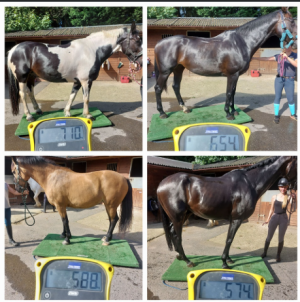
I think if they are going to do this they also need to start weighing horses. So many people (including Vets) have looked at my 13.2hh welshie and underestimated his weight, sometimes by up to 100kg.
Very Fit and as non flabby as a welshie ever gets (paint the stable green and he puts on weight) he still weighed more than most people expected. But he has 4 solid legs, not fine like a lot of modern types and he is suprisingly broad.

He is retired now so it wouldnt affect me now but its an example of how horses are decieving in thier weight too.
 
There's also some uncertainty in the term 'balanced rider'...are we talking about people who basically have pretty good core strength and stability, as well as being able to move their own bodies as effectively as possible when riding? Seems reasonable, but there are variables here and sometimes things are not as they seem. Our old cob has always had a natural movement that throws the rider off-centre over a period of time so in order to stay really balanced the rider needs to be aware of this.
I remember a talk by a physio who used videos to point out examples of horses/riders who looked OK but on closer inspection things were not as 'balanced' as they seemed. This is not just about the riders, although the body shape of some was apparently potentially more problematic than others; the conformation, movement, weight, muscle mass and fitness of the horse were also factors.

I suppose the point I'm making is that while it's clearly better to be as balanced as possible and work towards being the best riders we can, surely it's wise to stay on the 'safer' side when it comes to weight limits. Just because it might look 'balanced' it doesn't mean that it is - and it's definitely not an excuse for a much heavier load.
 
I don’t accept the fat phobic thing. And I’d certainly never get on a pony that I weigh 30% of its body weight 😳

I am 5’6 and weight around 9.5 stone roughly but I’m quite a broad build.

Someone who is 5’ but a petite build with the same body fat % as me will be considerably lighter.

That’s got nothing to do with fat but an overall smaller person would not only be more comfortable for my horse but could ride much smaller horses than me. They weigh less than me and that’s all there is to it.
Take a good look at the wrists (bit like considering bone in a horse!), thin delicate wrist bones coupled with spare tyre/ love handles, can easily weigh less than a lean but sturdy-built rider.
Which the horse will more happily carry, is another matter altogether.
 
@Floofball I would hypothesis that the variation of cannon bone within the population of horses doing the tevis would not vary enough to be able to make a statistical difference?? I will take a harder look.
"Cannon bone circumference
Mean cannon bone circumference measurements ± standard deviation among Group S and
Group U were 18.83 ±.66 cm and 18.88 ± .66 cm, respectively. Among Group U, mean cannon
bone circumferences among those pulled for lameness and those disqualified due to metabolic
factors were 18.85 ± .67 cm and 18.75 ± .71 cm, respectively. Cannon bone circumference had
no effect on completion rates among all horses, or on miles completed before elimination in
Group U (p>0.05)."

The cannon bone width only varied very slightly as most of the horses were Arab/Arab types so I think it would be difficult to draw too much of a conclusion from that what do you think?
I totally agree.

It would be great to have the same research on pool of similarly fit horses, but with varied bidy types. I suppose ot could be argured that the Arab does so well in Endurance BECAUSE of it's cannon bone width 🤣

I also remember the old saying " An ounce of blood is worth an inch of bone"
 
I know a very high level western rider.He is a 6ft2" .Definitely not fat and very fit.He competes very successfully at international level.He must weigh at least 12 stone and western saddles weigh approx 2 stone.He rides quite fine 15 he ish quarter horses and they stay sound for a very long time.

Not aimed at you particularly but I do think that statements like these aren’t very helpful in the overall debate and push for better horse welfare.

There are exceptions to every rule, and I think that we could debate the minutia of how one carries their weight forever. But until there are actually peer reviewed studies on this we have to air on the side of caution and say that the majority of horse and rider combinations are not pure muscle, “weight is weight”.

Ultimately for rider weight limits to be enforced a figure has to be chosen (ie. 15% of horse weight) and I think that the governing bodies across all equine disciplines should be actively working towards this.

30% is just insane regardless.
 
I think if they are going to do this they also need to start weighing horses. So many people (including Vets) have looked at my 13.2hh welshie and underestimated his weight, sometimes by up to 100kg.
Very Fit and as non flabby as a welshie ever gets (paint the stable green and he puts on weight) he still weighed more than most people expected. But he has 4 solid legs, not fine like a lot of modern types and he is suprisingly broad.

He is retired now so it wouldnt affect me now but its an example of how horses are decieving in thier weight too.
This is really important, not just for sizing up potential riders, but for safe travel, medications, feed etc, and is incredibly common for professionals - including vets - to get wildly wrong.
When it comes to ‘natives’, that 100kg error is not unknown!
Weigh tapes for worming, for example, can be misleading in the extreme, unlikely to assist anthelmintic resistance issues, never mind the horse.
Get it on a weighbridge!
 
I think if they are going to do this they also need to start weighing horses. So many people (including Vets) have looked at my 13.2hh welshie and underestimated his weight, sometimes by up to 100kg.
.
RoR will weigh AND condition score the horses, as well as weighing the rider with tack, before they give teh certificate. I think the condition scoring, by a properly trained person, is equally important as the weight.
 
Not aimed at you particularly but I do think that statements like these aren’t very helpful in the overall debate and push for better horse welfare.

There are exceptions to every rule, and I think that we could debate the minutia of how one carries their weight forever. But until there are actually peer reviewed studies on this we have to air on the side of caution and say that the majority of horse and rider combinations are not pure muscle, “weight is weight”.

Ultimately for rider weight limits to be enforced a figure has to be chosen (ie. 15% of horse weight) and I think that the governing bodies across all equine disciplines should be actively working towards this.

30% is just insane regardless.

Absolutely. And for every rider on the heavy side who's caused no apparent problem to their horse, there's likely to be at least one that has caused major issues.

One of the things about hunting that I wasn't keen on is that some people would be absolutely obsessive about appearance - eg, with one particular pack, some riders were reprimanded by a committee member because they didn't put hoof oil on their horses. Yet at the same meet I saw riders that were clearly too heavy for their horses and no-one would say a word.
I remember that one of these riders must have been a good 14 stone and was riding a 14.2 cob that was clearly unhappy; half way it was clear that the cob was struggling. There was also a very large child riding a tiny pony.
If we get to a stage where we can have open and honest discussions about riders and weight, in all horse-related competitions/activities, it can only be a good thing.
 
Even if there was research to fully evidence that 20% was fine and even up to 30% on a strong, well conditioned horse was acceptable, why on earth would any rider want to use that 'allowance' when we can clearly understand that horses are simply not designed to carry weight on their backs? That is surely unjustified? Not only that but at those ratios of weight carrying we can often see a visual mismatch between horse and rider which is simply unattractive at the very least. In the 21st century there can be no reason for a horse to be needed for that. I think every equestrian has a duty to pursue an ethical approach and that surely includes being as light as possible for the horses we choose to ride? And we should always aim to choose suitable, healthy horses or avoid riding at all. I can't see that riders at 20 or 30% of the horse's healthy bodyweight can gain anything at all from that...
I entirely agree, to be clear , I definitely wasn’t suggesting if even there is evidence that a strong well conditioned horse can carry 20-30%, then that’s fine, and we should make them carry that much. I’m just curious to see the “evidence”. Maybe a horse can carry that percentage for a short time, but in the long term it will cause damage.

Horses aren’t designed to carry people on their backs and ethically we owe them to minimise the damage that carrying us around does to their musculoskeletal system.
 
When considering straight weight, rather than a moving load like a rider, might be worth looking at what pack trains typically carried (and still do in parts of the world, various documentaries, clips on YouTube, elsewhere, including precipitous terrain where vehicles can’t).
Those equines (in UK, mules were rarely ever used) used to travel at speed, 4 pace walk / trotting, with a ‘bell horse’ to warn other route users they were coming. Some of them continued for many years, precisely because their route experience was valued.
 
Not aimed at you particularly but I do think that statements like these aren’t very helpful in the overall debate and push for better horse welfare.

There are exceptions to every rule, and I think that we could debate the minutia of how one carries their weight forever. But until there are actually peer reviewed studies on this we have to air on the side of caution and say that the majority of horse and rider combinations are not pure muscle, “weight is weight”.

Ultimately for rider weight limits to be enforced a figure has to be chosen (ie. 15% of horse weight) and I think that the governing bodies across all equine disciplines should be actively working towards this.

30% is just insane regardless.
I don't agree.There is a lot more to this.Lets start with the rushed backing of young horses.Some are done in about 3 weeks when their top lines are not developed enough for any weight of rider.
 
If the QH weighed 550kg, then 20% would be 110kg which is 17.3 stone, so with your guesstimates of his weight (14 stone) he would come in at 16% inc tack.

If the QH weighed 500kg - he would be 17.6%
My maths aren't good enough.His quarter horses are quite fine but as I say compete at international level and stay sound.IMHO there is a lot more to it than merely weight.
 
My maths aren't good enough.His quarter horses are quite fine but as I say compete at international level and stay sound.IMHO there is a lot more to it than merely weight.

I don't think anyone is saying that rider weight is the only factor - infact, I think most posters are saying the opposite and appreciating that there are multiple factors.

But we have to have some sort of guidance on rider weight, if only as a starting point for discussions.

It's not really practical for any sort of governing body to make decisions on weight carrying capacity that factor in how 'balanced' a rider is, or isn't, not just because there's an element of subjectivity in making a judgement on 'balance' but also because once it has been declared that the rider isn't sufficiently balanced to place their weight in an acceptable bracket for the horse, damage is actually being done (or even has been done).
 
This is really important, not just for sizing up potential riders, but for safe travel, medications, feed etc, and is incredibly common for professionals - including vets - to get wildly wrong.
When it comes to ‘natives’, that 100kg error is not unknown!
Weigh tapes for worming, for example, can be misleading in the extreme, unlikely to assist anthelmintic resistance issues, never mind the horse.
Get it on a weighbridge!

Posted by my local weigh bridge lady - all horses within 1hh-ish of each other I believe, so it shows just how variable it can be

1755772845843.png

30% is mental and would only ever be trotted out by people who are trying to self soothe about how they're too big for their animals, a spine is a spine irrespective of how much horse you have around it, and you are sat on 1.5ft of it at most.
30% of Dex's bodyweight (705kg) is 465lbs, or 33 stone!!
 
Last edited:
30%? So my 400kg NF could carry 120kg? I, her owner, feel I’m at the top end of her weight limit at HALF that.

Maybe I’m not sensitive about it because I’m not fat, but my horse’s welfare comes first.

My daughter’s pony is 12.2hh and vets were surprised she’s 355kg, she’s not fat but she is wide and wears a 5ft3 rug (although is also pretty happy in a 5ftt6).

I always pop mine on the scales when we’re at the vets and record the data on my phone to cross reference to the weigh tape at home.
 
Absolutely. And for every rider on the heavy side who's caused no apparent problem to their horse, there's likely to be at least one that has caused major issues.

One of the things about hunting that I wasn't keen on is that some people would be absolutely obsessive about appearance - eg, with one particular pack, some riders were reprimanded by a committee member because they didn't put hoof oil on their horses. Yet at the same meet I saw riders that were clearly too heavy for their horses and no-one would say a word.
I remember that one of these riders must have been a good 14 stone and was riding a 14.2 cob that was clearly unhappy; half way it was clear that the cob was struggling. There was also a very large child riding a tiny pony.
If we get to a stage where we can have open and honest discussions about riders and weight, in all horse-related competitions/activities, it can only be a good thing.
Is this hunting since the Ban?
Before, squeaky-perfect-traditional turnout was Opening Meet, and maybe a lawn meet at a prestigious venue. otherwise, hunts were very workmanlike indeed, had to be, and while I think everyone appreciated a bit of effort - mandatory hoof oil!?! First bit of ploughed field....
I don’t remember undersized horses, perhaps because if the combination was struggling they wouldn’t be likely to come out again, wouldn’t cope, and no one wants to get left in country they probably don’t know well.
Pre Ban, it wasn’t usual to have ‘non jumping’ fields, so you needed to be basically fit enough to keep up, leap on and off and deal with gates - to get out of places - if not wanting to jump.
Hunting, twenty years down the line, is rather different.
Certainly saw plenty of over-horsed riders though, more in temperament than size, in a bid to tire them out!
 
Is this hunting since the Ban?
Yes, I didn't start hunting until years post-ban.
The example was from one particular pack - a few of the 'senior' hunt people were ultra-fussy. (I agree totally about the hoof oil.)

I also agree that it was more common to see over-horsed riders (in terms of temperament) than overweight riders per se, but I just found it crazy that the aesthetic things, while an important part of hunt etiquette, would over-ride actual welfare concerns.
 
A horse that is a healthy weight, is well muscled, has good posture suitable for carrying a rider and moves without compensation...plus a stable, balanced rider who is loaded correctly onto the horse's back, may well be able to carry more than 20% of its weight. However, the number of those is in the single figure % sadly, so we stick with 15% for any level of compensation in the horse, and 20% for what appears a healthy horse.

We barely talk about the factors that move us from 15% to 20% and perhaps higher. Weight IS weight if all other things are equal, but they never are.
 
20% seems wildly generous to me and would suggest after taking off 6-7kg for tack, my horses could carry a 17 stone rider?! I absolutely would not put that on them, ever.

15% feels a little high tbh. I guess we need a general rule but have we really lost all common sense?!
 
@Floofball I would hypothesis that the variation of cannon bone within the population of horses doing the tevis would not vary enough to be able to make a statistical difference?? I will take a harder look.
"Cannon bone circumference
Mean cannon bone circumference measurements ± standard deviation among Group S and
Group U were 18.83 ±.66 cm and 18.88 ± .66 cm, respectively. Among Group U, mean cannon
bone circumferences among those pulled for lameness and those disqualified due to metabolic
factors were 18.85 ± .67 cm and 18.75 ± .71 cm, respectively. Cannon bone circumference had
no effect on completion rates among all horses, or on miles completed before elimination in
Group U (p>0.05)."

The cannon bone width only varied very slightly as most of the horses were Arab/Arab types so I think it would be difficult to draw too much of a conclusion from that what do you think?
Yep, I agree with your hypothesis. Just had to get a tape measure out and check, all between just over 7 1/4” and 7 1/2” bone (I can only visualise in old money 😂) I have a vague recollection of it being a belief that Arabs had super strong bones, hence being able to carry larger/male riders? Many many moons ago!
 
20% seems wildly generous to me and would suggest after taking off 6-7kg for tack, my horses could carry a 17 stone rider?! I absolutely would not put that on them, ever.

15% feels a little high tbh. I guess we need a general rule but have we really lost all common sense?!

Different breeds, types will sit at different places with how much weight they can carry. Smaller, knowingly "tougher" such as shorter backed Arabs will often be able to carry a bit more, but conversely might be affected more by leverage from a tall rider. Big drafts are absolutely not able to carry high %s.
 
I don’t accept the fat phobic thing. And I’d certainly never get on a pony that I weigh 30% of its body weight 😳

I am 5’6 and weight around 9.5 stone roughly but I’m quite a broad build.

Someone who is 5’ but a petite build with the same body fat % as me will be considerably lighter.

That’s got nothing to do with fat but an overall smaller person would not only be more comfortable for my horse but could ride much smaller horses than me. They weigh less than me and that’s all there is to it.
I must admit I wouldn't have bought my girl if I couldn't have fitted in a saddle that fitted her regardless of my weight being okay. I wouldn't want to be jammed in with my weight on the cantle but it's not unusual to see.
 
Top