
Riding in a double if you don't need a double.

So I am wrong that my horse should be working from behind, correctly, and holding himself correctly, and I should be holding him up all the time and constantly asking for a contact?

Dunno if we're just not understanding each other, but it was always my understanding that if you are holding the horse up the entire time, you're putting an awful lot of work into not very much. Plus all thats going to happen is you will tire yourself out from holding the horse together all of the time when you could be making him work for it.

There is some misunderstanding.

Here is an example of core strength. Nothing to do with 'holding' a horse together, it is not physically possible for a human to 'hold a horse up' and core strength has nothing to do with any type of bit.
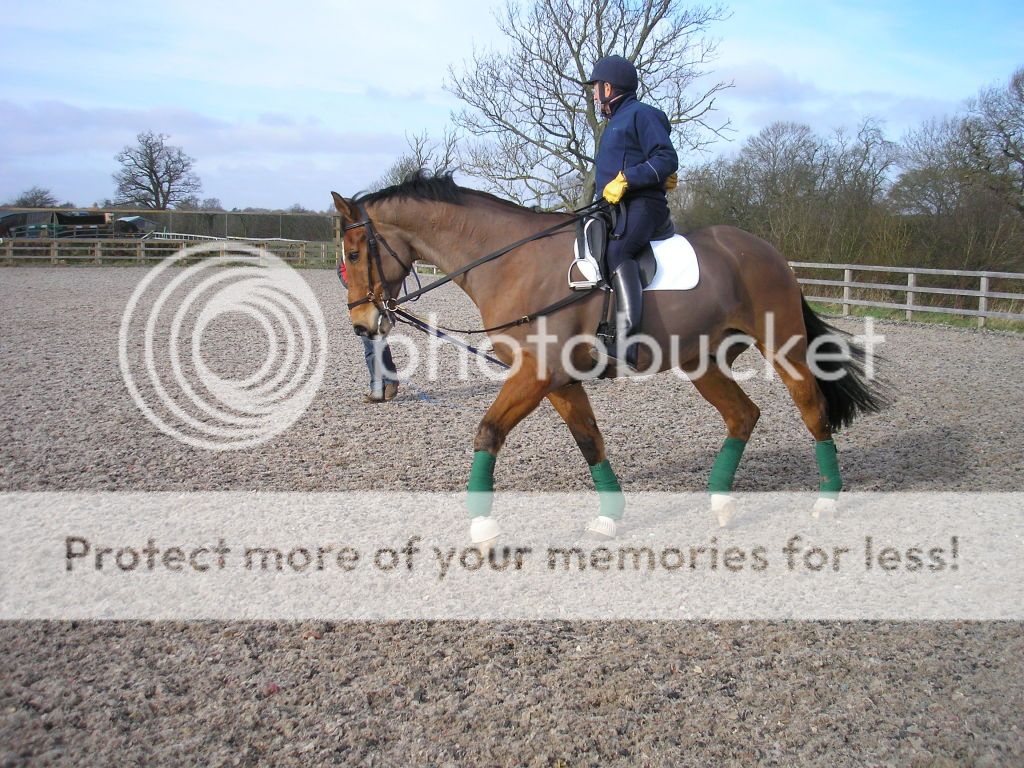
337.jpg


and here is an example of a horse in a double bridle being ridden with core strength into a soft hand, it is not good quality picture but it shows you the lightness of the forehand.

DSCF0698_zpsb79333fd.jpg


Try to forget the 'holding the front end' and think of allowing the horse to stretch forwards into a supporting hand.
 
I know that but AdorableAlice said if my horse is holding himself that is wrong. You have just said what I think is right that he should be holding himself. I never said that i get him working right then just drop the reins and leave him to it.

Think this has just been a miscommunication thing.

You said "So I am wrong that my horse should be working from behind, correctly, and holding himself correctly, and I should be holding him up all the time and constantly asking for a contact?"

Which reads as if you are not constantly keeping or asking him to remain on a contact, that as far as you are concerned that contact = holding the horse up, I cannot comment on how your horse is going on the flat but from your description it does sound as if you are aiming for next to nothing in your hand which for a green or young horse will be hard to achieve without it going behind the contact and btv which is not easy to correct, it can also hinder their jumping as most like some support from the hand as well as the leg and seat.
 
The quality of contact varies between horses and between the same horse in different stages of it's training .
A well trained horse in self carriage will retain a feeling of connection with the rider along the rien it's a feeling of elastic wieght within it you communicate with each other .
Of course that connection is maintained by all the aids the rider uses legs upper and lower and core the turning of the body etc etc .
To communicate the feeling of a good contact or connection is one of the hardest things to do .
There's a feeling security and of energy in the rien and elastic wieght .
It's a great feeling when you get it .
 
To be honest, he doesn't sound ready to compete.

I'm not sure at what point I have said that I am going to be sticking him in a double and turning up uninvited at HOYS, or piaffing into a PSG test? :D

He is not yet ready for a double but he is more than ready for me to have a bash at local if I fancy it, it was merely a question. His schooling has come on tremendously, and I am more than happy with the way it's all going and trust my instructor completely. Thank you all for the advice given, and those that actually answered my question :D

Jake no longer leans on my hands, ever. But I can feel him at all times, and he pushes forward into the contact. If I drop the contact he either goes nose first to look for it again, or I don't get any forward at all. By the sounds of everyone's descriptions it seems that that is 'correct'.
 
Last edited:
Jake no longer leans on my hands, ever. But I can feel him at all times, and he pushes forward into the contact. If I drop the contact he either goes nose first to look for it again, or I don't get any forward at all. By the sounds of everyone's descriptions it seems that that is 'correct'.


That sounds like you're both heading in the right direction - onwards and upwards!
 
Imo, a double is much better than using a pelham or other leverage type bit as the actual lerveage can in an affect be 'turned off' where as in a pelham using a convertor your always having some use of the leverage part. Personally I wouldn't use one and not every horse will like the double mouthpiece I don't think. If the user is knowledgeable on how to use the curb and snaffle reins separately and correctly then there in reality should be no ill affects on the horse.
 
Ashetlandbitmeonce: my friend rides her horse in a Waterford, he likes it, she likes it so win, win for both. If your horse is going well in it and your happy then I'd stick with it until you are at a stage in his training that you feel he needs the refinement. I don't show, I don't do dressage, but I do ride a lot with my friend and have never seen her lose control once yet if she rode in my horse's hanging cheek snaffle she'd be over the horizon. However he does have a very deep head and a large tongue so maybe this is why it suits him. I did notice today at Hickstead how many were in double bridles, not sure some of them should have been, but just my opinion.
Good luck whatever you decide.
 
Ashetlandbitmeonce: my friend rides her horse in a Waterford, he likes it, she likes it so win, win for both. If your horse is going well in it and your happy then I'd stick with it until you are at a stage in his training that you feel he needs the refinement. I don't show, I don't do dressage, but I do ride a lot with my friend and have never seen her lose control once yet if she rode in my horse's hanging cheek snaffle she'd be over the horizon. However he does have a very deep head and a large tongue so maybe this is why it suits him. I did notice today at Hickstead how many were in double bridles, not sure some of them should have been, but just my opinion.
Good luck whatever you decide.

Thank you for this response, it's reassuring to know that I am not some sort of monster after all :D He will remain in the Waterford for hacking definitely, I'll have a think an an explore re: schooling.
 
Top