Sarcoids and welfare

It’s susceptible horses which are at risk of developing sarcoids. Many horses will have a good level of natural immunity, others won’t.

Russian roulette.


And of course any horse can become susceptible if something knocks down its natural immunity, like age, illness or Cushings.

I'm really sorry, but I wouldn't have that horse as a borrowed companion near one of mine.
.
 
if its got ulcers its general health may not be the best

so i`d get that sorted

immunity probably plays a role in spontaneous remission in sarcoidosis, good health, lot of vits mins and whatever its guts need to boost immunity would be the way i`d go

and fly protection in prep for the summer, perhaps out at night?
 
I've read that it does happen, especially if the unaffected horse gets an open wound.

It's believed to be bovine papilloma virus spread by fly bite. I don't think I'd knowingly take a companion with the virus, and certainly not one that looks as if they could ulcerate and attract flies at any time. Having said that, I've had many horses with non-ulcerated sarcoids over the years and never seen them pass from one of my horses to another.
.

Unfortunately, I wasn’t told about them before she arrived. She’s not borrowed, I’m doing a favour for her owner in keeping her here because she was in such a poor situation before she arrived.

I would want to know the cause of the horse's lameness. Could it be caused by the sarcoid pulling as she moves? If not, I wouldn't call it a welfare issue atm but keep a close eye on it.

The lameness is not caused by the sarcoids, the horse has complex front foot lameness going on. I have seen the X-rays, vet is advising then owner. Not straightforward unfortunately.

My pony had one like that on his sheath, that my vet removed (cut it out) by standing sedation in his stable and sitched up the wound. I dont remember it getting infected, but he was on pain relief and antibiotics for a good week or 2. They did grow back slowly, but he was an older horse and was PTS for other reasons. Is there a reason it needs to be GA? I really dont remember my boys bleeding much.

I think there are many of them and they are very large margins. I haven’t questioned my vet on that.

What are the lameness issues? Is the horse likely to end up being pts because of those alone?

At the moment I would be listening to the advice of the vet, but tbh I would not be happy having that horse on my yard and potentially affecting my own horses. The one under her chin, for example, she could easily rub on a stable door or fence, and pass the virus that way. I never ever had problems with sarcoids until I moved to a farm which had had cattle on it for generations, but no horses since the 1930s. Practically everything sprouted sarcoids after that (the bonus was that worm counts were extraordinarily low) from fencing and buildings.

I’m not the owner so it isn’t really for me to comment on pts element but I would say that if it were my horse, I probably would be seriously considering it on the lameness alone.

She’ll remain separate from mine and her stable is on the other side of the yard, so she can see horses opposite but she doesn’t share anything with them. To be honest that’s actually more about general biosecurity than sarcoids but it would be a protection regardless.

I would be looking at alternatives to surgery. Have they looked at feeding radiance gold?

I’ll send her a link, thank you.

And of course any horse can become susceptible if something knocks down its natural immunity, like age, illness or Cushings.

I'm really sorry, but I wouldn't have that horse as a borrowed companion near one of mine.
.

It is a tricky one because I do feel like it is not the right for the horse to be moved in her current state.

if its got ulcers its general health may not be the best

so i`d get that sorted

immunity probably plays a role in spontaneous remission in sarcoidosis, good health, lot of vits mins and whatever its guts need to boost immunity would be the way i`d go

and fly protection in prep for the summer, perhaps out at night?

Her general health isn’t good so that is definitely the owners first concern.
 
I think it's best to speak to a vet about your concerns,preferably one treating the horse,talk through all your worries,the sarcoids, possible transmission to your own horses,the lameness and quality of life and your responsibilities as livery yard owner. Be guided by the vet.
 
I think it's best to speak to a vet about your concerns,preferably one treating the horse,talk through all your worries,the sarcoids, possible transmission to your own horses,the lameness and quality of life and your responsibilities as livery yard owner. Be guided by the vet.

I am in contact with the owner and the vet about this, and all of the other issues.

The reason I am asking about how other people gauge welfare with their ‘wait and see’ sarcoid horses is because the owner has gone against the vet’s medical advice re surgery - understandably, of course - so there isn’t a direct course of action or a clinical pathway of sorts that the horse is on. It is much more murky in terms of clear advice. My hope in asking about other people’s personal thresholds for their own horses would be to get a good framework together, and organise my thoughts around how we measure improvement or decline.

I’m not a livery yard owner - I’m not charging anything for the horse to be here, it’s purely a favour - but as she’s on my land, and here by my invitation, I know I do have a duty of care for it.
 
Hedgehog herbs 🤣.

Do look at the horse carefully as she moves and rolls, gets up and down etc as to whether that large midline sarcoid forward of the udders is being squashed at all. I made the mistake of presuming that my mare’s much smaller sarcoid in a similar area was causing her no bother as, when standing square, it was well clear.

It was a different story as she moved, though. She was so much happier when it was removed (banded). I’d put her grumpiness down to her other issues, and nearly called time on her for that.
 
How do you know ? You can’t tell if a horse is carrying the virus and at any point when the immune system becomes stressed up pops the sarcoid the outward sign of the virus .

They've not had any show up at least. Perhaps their immune systems were/are stronger so if they have had/do have it, it hasn't shown up. I don't even know how mine would have gotten it. He hasn't been in or around any horses that have had a sarcoid that I know of.
 
Yes, thank you so much. I’ve picked up the D&H hedgerow herbs (which autocorrect just tried to call hedgehog herbs!) and I’m going to order some rosemary too. Very useful thread, thanks for the link.

Definitely worth buying in bulk from wholefoods and mixing (cheaper option - just thyme, oregano, and rosemary does the trick)

(Hahaha hedgehog herbs!!!!!!)
 
How do you know ? You can’t tell if a horse is carrying the virus and at any point when the immune system becomes stressed up pops the sarcoid the outward sign of the virus .
That’s a fair point. But having liveried for many years on a yard and its 40 plus horses, one had very bad sarcoids and not one other did.
 
Last edited:
All really interesting debate and I will ask my vet about it.

We share the land with dairy cows so the horses do have relatively regular contact with cows. Mim has been on some larger livery yards before and Miri has clearly been moved around a lot as a young horse. They may well already have been exposed to Bovine Papilloma Virus in other settings. It is a well supported theory that the virus can cause sarcoids in horses who are genetically predisposed. There are a lot of factors to consider - the likelihood of the virus being spread, the likelihood of the horses it is spread to having that genetic predisposition, the likelihood of stress or illness triggering that sarcoid response in the horse... I wouldn’t have chosen it had I known but she’s here now, albeit turned out separately.
 
We had a horse come onto livery a few years back who was covered in them. Vet advice to owner was just to monitor and if any started to bleed or weep then to get them out. The one that caused the most issue was just inside the stifle on that soft skin they have there and I suspect it pulled a lot with general movement.

Photos are useful if you want to check they aren't changing / growing and will give you some useful hard facts to support any discussions with the owner if you think they are getting worse or causing problems.
 
My clued up equine vet advised me to keep my sarcoid affected mare’s grooming kit and rugs quite separate from my other 2.

Sarcoid can potentially spread to other susceptible horses.
Yes, that would be a worry for me. I bought a young horse who developed a sarcoid and it played a part in me not keeping him. My vet told me it could spread via flies to other horses in the right circumstances. Just to add, the buyer was made aware of the sarcoid and wasn't bothered by it - and I sold at a price that reflected the sarcoid.
 
I suspect the sarcoids are a symptom of the other issues.
I had one once years ago that started popping sarcoids all over his body.
Eventually we discovered he had a huge growth in his abdomen & he was pts.
I think I agree with the owner not currently treating the sarcoids, it's a painful process & chances are the other issues will result in pts anyway. Only observing the horse infront of you will make it clear if they are causing unnecessary comfort now.
It does sound like this horses days are numbered😪
On a positive, my horse was on a huge livery yard. Over a decade later no other horse at the yard has sprouted a sarcoid
 
Update post discussion with vet:

Vet thinks “fly - successful transmission of virus by fly - recipient horse having a genetic predisposition to sarcoids - horse having event to trigger sarcoid” is tenuous and fuzzy, and it’s unlikely we can quantify the risk of having a horse with a sarcoid in the field and my horse producing a sarcoid in any meaningful way.

She suggests to reduce exposure to flies as a precaution - perhaps turn out at night and use repellent in the stables. And use fly rugs. But doesn’t think it’s a serious risk.
 
I had a gelding with large sarcoids on his sheath which were successfully removed under GA- they were fed by arteries if I remember correctly, perhaps why the surgical option seems so expensive and potentially complex?

Has diet been considered? I know immunity targetted supplements can be successful in reducing/ eliminating sarcoids. Radiance gold is the one that I know about and have experience of, though there are many others. Radiance gold was developed initially as a gastric supplement, so would be benficial if ulcers are also present?
 
I had a gelding with large sarcoids on his sheath which were successfully removed under GA- they were fed by arteries if I remember correctly, perhaps why the surgical option seems so expensive and potentially complex?

Has diet been considered? I know immunity targetted supplements can be successful in reducing/ eliminating sarcoids. Radiance gold is the one that I know about and have experience of, though there are many others. Radiance gold was developed initially as a gastric supplement, so would be benficial if ulcers are also present?

Yes, we are feeding herbs and supplements, and the owner is looking into radiance gold. The vet is here weekly for the other issues so it’s not so much the management I am concerned about.

It’s that the vet has recommended an ideal course of action that can’t be taken due to financial constraints, which everyone (including me) totally understands.

So we are now managing a ‘wait and see’ and I need to get the young owner to a place where she can recognise what she’s waiting for, and see what needs to be seen.

It is about tracking and quantifying disease progression, when the end point isn’t going to be a surgery, it is probably going to have to be a pts decision.
 
Perhaps take photos once a week. And once a week take a stand back and look at her objectively. Is she moving round as normal, looking bright, eating, getting up and down etc. you could maybe mark each thing out of 5. Then add together and see if the trend stays the same or goes down/up.
 
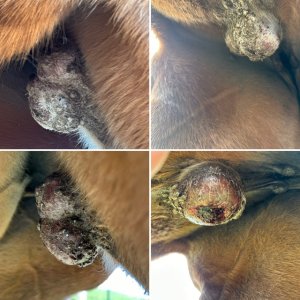
Just to update this, the sarcoids are bleeding and the horse has been kicking at them, and getting blood all over its white sock which is quite obvious. The flies are really bothering the horse too. I decided I had to be a bit firmer with the owner about vet intervention or long term plans, so the horse is being moved.

The new yard apparently doesn’t think that sarcoids are a problem at all and apparently they were surprised that the owner mentioned it. They didn’t think it was something the owner needed to make anyone aware of.

It sounds like a private yard with a small mixed herd of their own retired, ridden and young horses so it seems like the yard owner must be quite experienced.

That has made me wonder whether I am totally overreacting and whether I have been difficult about this. I’m feeling a bit silly really.
 
Last edited:
Perhaps take photos once a week. And once a week take a stand back and look at her objectively. Is she moving round as normal, looking bright, eating, getting up and down etc. you could maybe mark each thing out of 5. Then add together and see if the trend stays the same or goes down/up.

Thanks for this idea, I did once a month, and they have changed. The top are the original photos and the bottom are a month later.

CE4AB4B1-6D44-4D90-8228-4D367B9E5D0D.jpeg
 
Just to update this, the sarcoids are bleeding and the horse has been kicking at them, and getting blood all over its white sock which is quite obvious. The flies are really bothering the horse too. I’ve decided I had to be a bit firmer with the owner about vet intervention or long term plans, so the horse is being moved.

The new yard apparently doesn’t think that sarcoids are a problem at all and apparently they were surprised that the owner mentioned it. They didn’t think it was something the owner needed to make anyone aware of.

It sounds like a private yard with a small mixed herd of their own retired, ridden and young horses so it sounds like the yard owner must be quite experienced.

That has made me wonder whether I am totally overreacting and whether I have been difficult about this. I’m feeling a bit silly really.

It sounds like a major welfare issue. Leave out the word sarcoids and you have a horse which is bleeding. A lot. The bleeding source is not controlled and is only going to get worse. It must be painful or irritating else it wouldn’t kick.

There may be a risk of transmission to other horses.

Horses can be put down because the sarcoids get out of control.

I don’t think you over reacted at all.
 
I had one like the second one banded and it fell off. I imagine the vet didn’t think that a possibility? In any case, when I had a horse with sarcoids I went through tubs of Yellow Summer Fly Cream, just to keep my horse comfortable. I was also aware of the risk to flies passing them on, so it reduced that risk.
 
Some folk can be funny about sarcoids in general - in case their horses "catch" them. I'm guessing she's told the new yard she has to move because her yard owner is being funny about her horse having sarcoids and they've said oh it's no problem at all. As opposed to her yard owner thinks her horse being in pain and bleeding is an issue which would be more accurate
 
Top