
Seedy Toe

FairyLights

Well-Known Member
Joined
3 August 2010
Messages
4,070
Location
UK
Visit site
Your experiences please. My horse has been diagnosed with seedy toe and I am new to it. Looking for advice and reassurance and how it worked out for your horse.Treatment so far, the Farrier has trimmed away the infected area but there is an area behind the wall which I need to clean out daily to let the air get to the cavity.
 
All of mine live out 24/7 and a couple of years ago two joined the seedy toe club ! it was a question of applying iodine a couple of times a week down to once a week and ensuring their feet were rasped regularly to prevent long toes and they had free access to a mineral lick and a salt lick.

Movement is very important too and no rich food coated in that sticky stuff.

With all of this rain I was expecting seedy toe but was pleased to report all feet are good.
 
Last edited:
I can't post photos at the moment, but I think there are some of my boys hoof in my profile.
My tb had very bad seedy toe, eventually he had to have a large part of the hoof wall removed. He was lame for a long period and had multiple abscess's. It took about 9 months to grow a complete hoof wall and I had to keep him as clean and dry as possible. Not easy when they live out in winter.
I would clean it with either hydrogen peroxide or betadine and also put copper sulphate around the hoof wall.
My boy is now sound and you wouldn't know which hoof had been affected from looking at his feet now.
Kx
 
Your experiences please. My horse has been diagnosed with seedy toe and I am new to it. Looking for advice and reassurance and how it worked out for your horse.Treatment so far, the Farrier has trimmed away the infected area but there is an area behind the wall which I need to clean out daily to let the air get to the cavity.

Seedy toe is an infection to the white line.

The white line (which is actually grey :)) is the visible part of the laminae.
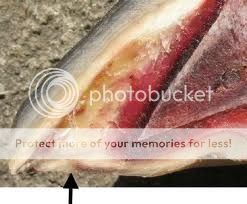
SolarConcavity.jpg


lamihoof.jpg


The WL should be tight and resistant to foreign bodies. But if it becomes stretched and weak - it is at risk of allowing grit/pathogens in and setting up with infection.
If the WL is thicker than a credit card - it means the laminae is stretched.

lamellarwedge.jpg


sinkersole.jpg


So treating the infection is one thing - but you need to look at WHY it has become infected in the first place. WHY it is stretched?

The most common reason is diet. You need to review the horse's diet as he is telling you there is a problem at the moment.
 
My mare had seedy toe just after she recovered from laminitis. I was told by my farrier to bathe in Epsom salts and twice a day to put on "Antibac", within 2 months it had disappeared completely.
 
My donkey gets this from time to time.

We do regular trims keep the foot clean with iodine also ,grooves it out a bit then I clean it. When at its worst we keep a dry poultice on turn her out as usual and it clears up. :)
 
Thank you for all the replies. I am packing the small cavity with Matrix from the Formula4Feet people at turnout. When I bring him in in the mornings I dig this out to let the air to it. Am awaiting and iodine solution from FarriersFormula to arrive in the post to use as a disinfectant. Horse seems ok at the moment and is not lame.
Diet---horse kept on old pasture of mixed grasses amd wild flowers. Hay made from same is fed all year round. Interestingly he received a handful of pony nuts on coming in in the mornings. He went onto a sprinkling of oats about 4 months ago as I dont "trust" nuts and mixes, cant see whats in them. OH pointed out that there is a small groove in the wall here the diet changed and that the seedy toe reaches only up to this line. Its plain old grasses and hay and a few oats if needed from now on.
 
My horse has had some of the hoof wall cut out by the farrier due to seedy toe and he gave me some iodine but now i have run out and can't seem to find it anywhere, where can i get iodine from?

Thanks, Sutcliaj03
 
My horse has seedy toe and i'm new to it. My farrier suggested bleach and water. Is that a good thing to put on it? if not what would anyone suggest? (the infection has been cut away also)
 
i get this sometimes - well, my horse not me! iodine is very good and can be bought rfom tack shops, feed merchants etcc. farrier has recommende both anti-bac and tea tree oil. never plug the hole though as this is the ideal nbvironment for the bugs to multiply
 
Seedy toe is an infection to the white line.

The white line (which is actually grey :)) is the visible part of the laminae.
SolarConcavity.jpg


lamihoof.jpg


The WL should be tight and resistant to foreign bodies. But if it becomes stretched and weak - it is at risk of allowing grit/pathogens in and setting up with infection.
If the WL is thicker than a credit card - it means the laminae is stretched.

lamellarwedge.jpg


sinkersole.jpg


So treating the infection is one thing - but you need to look at WHY it has become infected in the first place. WHY it is stretched?

The most common reason is diet. You need to review the horse's diet as he is telling you there is a problem at the moment.

So how would you trim a hoof like that one in the bottom picture?
 
Top