Shod to barefoot - where should the pressure should go on hoof landing

Widgeon

Well-Known Member
Joined
30 January 2017
Messages
4,647
Location
N Yorks
Visit site
Please excuse the quite basic questions - I'm only just starting to dig into this a bit more. And please no bashing of my farrier - he's a nice helpful man and if I ask him to trim in a particular way, I'm fairly sure he'll be happy to co operate. But I need to know what I'm looking at, and I probably need to be doing a little bit of between-visit rasping myself.

I took my horse's rear shoes off a couple of years ago. Scoot boots on for nine or ten months and after that he was comfortable and tidy barefoot (not much trimming needed). So that was easy - I guess largely because they were hinds. Although he does have nice straightforward feet anyway, which of course helps. Then my farrier had a baby so I had to find someone else.

I took his front shoes off back in October just before switching to the new farrier. Scoot boots on, we squelched through the winter ok, spring came....then the ground turned to concrete and his feet went from a bit thrushy (I was just getting on top of it when the hot weather arrived) to super dry. Now he's struggling (ridden) on hard rocky ground, which is....most of our ground right now. I have Scoot pads in the boots, but as they don't seem to be enough, I made some pads from those kids' interlocking foam mats. We test drove them this evening.

When I took the boots off the matting foam had acted like an impression pad, and I can see where the pressure is going on landing. It's very clear that a lot of it is going down through the back of the bars / where the wall meets the bulb (please correct me if I've got this wrong). I've attached photos of the pads just for interest. I don't expect any kind of detailed analysis off the back of this, but the critical question is, is this a normal distribution of pressure? Would you expect the weight to be landing where it is, or should it be more evenly distributed? I have done some reading around, including Pete Ramey's blog, but I am still slightly unclear.

If anyone is interested, I will get some photos of his feet - obviously they're still very much still in the "adapting" phase, and I think (for what little my opinion is worth) that he has a slightly broken back hoof-pastern axis in front (not behind) and probably needs his toes rasping.
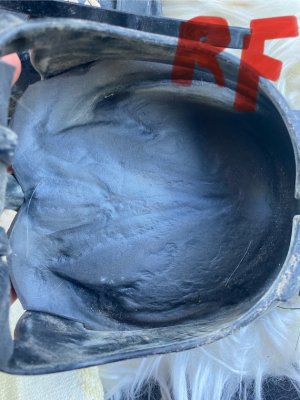
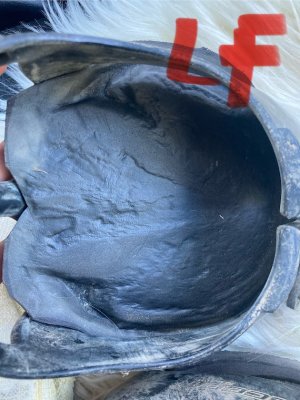
RF boot imprint.jpgLF boot imprint.jpg
 
I know this isn't exactly what you are asking but just thought I'd mention, if you need inspiration for pads for your boots; I use the lambswool which my mounjaro is parcelled in for when Lari gets a bit footy.

It's lambswool that is used for insulation and you can cut it to size.

It's great for padding and I got 12 squares from the last one! It's a completely natural product so makes sense to use it and its been washed as well prior to packaging.

I expect you will know someone on mounjaro that you can ask.
 
Last edited:
That's perfect. In the front feet you want a heel first landing, so the impression in a pad like that will be deeper at the back of the foot which initially takes all the weight of the footprint.

I hope he's a bit more comfortable soon.
.
 
That's perfect. In the front feet you want a heel first landing, so the impression in a pad like that will be deeper at the back of the foot which initially takes all the weight of the footprint.

I hope he's a bit more comfortable soon.
.
Thank you - I am so relieved to hear that! It's been a perfect storm of circumstances really - soggy winter, then suddenly overnight (more or less) it went rock hard. His poor feet just haven't had any chance to adapt. But it sounds like he is basically moving as he should so I think if I can keep him comfy, we'll keep pottering around and hopefully with time they will transition as well as the back ones did.
 
I know this isn't exactly what you are asking but just thought I'd mention, if you need inspiration for pads for your boots; I use the lambswool which my mounjaro is parcelled in for when Lari gets a bit footy.
Thanks! Yes I actually have a decent sized sheet of this from when I was sent a gift of Posh Cheese (the best form of gift). It's next on my list of things to try.
 
The pads look fine however it may be the case that the sole is not thick enough. Some boots eg scoots and flex have much thinner soles. Some eg renegades and gloves have much thicker soles and may offer more protection even without pads on hard, stoney type ground,
 
I would say not to be discouraged.

Rigs had shoes on when I got him in 2020. He had them for a few shoeings as he'd just had lami with rotation and he was recovering and I didn't want to rock the boat until I knew him.

Once the shoes were off, we started walking just 100 yds in hand. We built it up from there. It took over a year before he could walk 3km a few times a week under saddle. More than that and he would be sore.

Each year, he has got better and better. But, even so, it is this year that I now feel his hacking distance is limited by the rest of his body (he's 20 and small!) rather than his feet. His feet took years but they have simply got better and better. Proper rock crunching. Any surface. 2020 to 2025!

BH had his shoes off in 2022. Again, he has got better and better. At first, we started with the 100yds in hand but soon he could do the 3km ride a couple of times a week, but he needed booting for anything longer for well over a year. This year, he is the best yet. This week, we have hacked on the road and a stony track (old railway stones compacted), been to a country park and trotted on gravel tracks, then yesterday we went XC schooling on hard ground. We have a hunter trial on Sunday and his feet are amazing. But, it took years. I think it is over a year since he had boots. But that is 2022 to 2025. 2022 to 2024 before he could do longer rides without boots. His boots were the type with deep soles too. Flex boots or Easyboot gloves, or Explora Magic. I like the Explora magic ones best. The flex ones are easier to put on but slip on grass and mud.

I think people sometimes underestimate how long it takes to condition the insides of the feet. Until they are self supporting, you don't get true concavity, and they are vulnerable.

As to the part of the foot... initially, I leave wall on for the horse to primarily walk on. The soles are weak and the foot is conditioned to walk on that part of the foot.

Gradually, I increase the bevel back towards the line. I find the wear is best taken on the leathery bit between sensitive and insensitive parts of the foot. This is slightly different to the actual join most people call the white line. I bevel quite hard back, once the sole is strong, and there is concavity, but not before.

A couple of things stand out to me. Thrush is a really bad thing. Yes, you want a heel first landing, but they won't if the heel has thrush. I don't now trim my frogs but, if they are thrushy, I do, 45 degrees in the middle to open it up to the air and prevent stuff being caught. This is better than simply trying to apply potions the the thrush. I have used a Cleantrax soak before to get rid of persistent thrush. It has to be done with a boot though, and is a pain as it take 2 bottles for each horse and takes time.

Diet. Lami friendly diet for even non lami horses. Also a good supplement. I use Pro Hoof Platinum by Progressive Earth.

Lami. If your horse is sore, even in boots, I would suspect mild lami. The grass is growing, even though the fields are always looking bare. I know this as I'm having to work the boys harder to stop them looking like elephants. Is your horse skinny or fatter?

Lastly, I don't think it is easy at all to transition if relying on a farrier only, however good they are. When first transitioning, the foot changes so quickly, I trim a few times a week, a little at a time. They go out of balance so quickly. A slight tidy up every other day is so much more beneficial, and quite addictive, as you can see the foot re-sculpting. My farrier taught me and even gave me my first rasp/knife. He would supervise every 6 weeks with the first horse I transitioned, and make sure I was keeping it all in balance.

Both of mine would really benefit from once a week slide round with a rasp, but it is more like once a fortnight because, well, life happens 🤣. I have no idea how people manage on once every 6 weeks. Mine are kind of self trimming, but the edges bevelling and slight balance adjustment, is still needed. I would ask your farrier for guidance to keep tidy between trims.

I was initially scared to trim but had the encouragement of a good farrier. Now, it all kind of comes together. My new boyfriend has taken over the trimming as he is stronger than me and better with tools (he is a craftsman). He asked for an angle grinder and I was initially horrified that it was for use on the hooves. In practice though, it is a disc made of flaps of sandpaper, so motorised sanding. The horses prefer it and it is quick and efficient. I can't handle the angle grinder so I bought a mini one which is not as good, but is still easier than a rasp.

I would take hoof photos, they would be interesting to post, but good to have for your own reference. They need to be taken with the camera ON the ground for side and front shots; a shot of sole and 3/4 back to sole shot is useful too.

I haven't taken any photos for a while and may do some more of H today. Either way, I know that what we are doing is working. I suspect his frogs won't be perfect as BF has hurt his shoulder and no knife has opened the frogs for about 6 months. I noticed that one of them is a little closed the other week and that would normally have been attended to straight away. If a tiny bit of thrush is there, they no longer load the frog and the frog no longer stays open and functioning. A tiny trim in time keeps the frog functioning and it opens like a flower, naturally.

Please note, I have taken 5 horses barefoot to the level they can hack and compete, but am no hoof expert or professional. I would ask your farrier for advice.
 
Have a look at the many barefoot web sites; Pete Ramey's Hoof Rehab is my personal favourite. Cavallo also have an online video of a barefoot trim taking place, with the trimmer pointing out what to file down and what should be left alone.
Are you able to post pictures of the actual feet? Bit difficult to tell from the pads whether the bars are a bit long.
 
The pads look fine however it may be the case that the sole is not thick enough. Some boots eg scoots and flex have much thinner soles. Some eg renegades and gloves have much thicker soles and may offer more protection even without pads on hard, stoney type ground,

You're right, I think this is probably true. However given how well the Scoots fit I'm keen to stick with them* if I can pad them out enough. From previous experience I think if I can get us through the summer comfortably then I shouldn't need pads for ever.

*not least for the sake of my sanity and bank balance
 
Thank you - I am so relieved to hear that! It's been a perfect storm of circumstances really - soggy winter, then suddenly overnight (more or less) it went rock hard. His poor feet just haven't had any chance to adapt. But it sounds like he is basically moving as he should so I think if I can keep him comfy, we'll keep pottering around and hopefully with time they will transition as well as the back ones did.
100% agree. The ground has been incredibly hard and a course of a couple of bute over a two day period with 1/2 sachet twice daily works really well. His feet cracking and breaking off so I'm applying NAF Pro feet now.

I'm having to keep mine off the flinty track to and from the paddock and lead him to the top of his paddock so he doesn't bomb off in his excitement! 🙄 On thicker grass he's like a different horse, soon as he walks off the verge onto concrete he visibly slows down.

Your lad may have had a deep seated bruise like my farrier found with Lari. It's an incredibly common find apparently.

Good luck Widgeon! 😀
 
I would say not to be discouraged.
Thank you - I really appreciate you sharing all that, it's very helpful. I completely agree, they just need time. With the ground being so hard I had been wobbling over whether to put shoes back on the fronts, but I really don't want to because I am certain that the fronts will come as good as the backs with time.

I agree I can't rely solely on the farrier, I'm going to have to learn how to do regular tidy-ups myself so it's always good to hear what other people do.

He's not sore all the time, only on hard ground with big stones sticking out of it, and even then only after a few miles. Unfortunately - that is probably 60% of our ground at the moment! So we're having to go very slowly and carefully, and sometimes I get off and walk. He's not inclined to laminitis (by some miracle / metabolic freak) but he is a very good doer, so not riding isn't an option. It's the typical balancing act that most owners of slightly wonky (hock arthritis) middle aged horses have to perform.

I have been considering adding a good supplement to give his feet more of a fighting chance, so I will look up the Progressive Earth one. I seem to have won the battle against the winter thrush, but he could do with a Cleantrax soak just to be sure - unfortunately he *will not* tolerate standing in a bucket so I agree, I'd need poultice boots. Perhaps I can pick some up cheap second hand. He's also shedding bits of frog so that can't help.
 
I'm having to keep mine off the flinty track to and from the paddock and lead him to the top of his paddock so he doesn't bomb off in his excitement! 🙄 On thicker grass he's like a different horse, soon as he walks off the verge onto concrete he visibly slows down.

Your lad may have had a deep seated bruise like my farrier found with Lari. It's an incredibly common find apparently.

Good luck Widgeon! 😀

Mmm - bruising is an interesting theory. Mine is the same - marching along on grass, slower on tarmac, and really picking his way along on stoney tracks. I guess there's not much I can do about that except pad the boots and give it time.

And thank you :)
 
I find them horrible clumpy things but there's no getting away from the fact they do a brilliant job with rehabbing ouchy feet!

I bought some, tried them, hated them, sold them - I'm afraid! They rubbed something rotten and he kept falling over his feet (he is quite lazy and doesn't always pick them up as high as he should at the best of times). So they were no good for riding, which is what I need them for.
 
Whats his diet like? With the way the grass is at the minute lots of horses arent going to be getting much in the way of protein and you need that to make good feet, as well as the usual suspects of copper and zinc etc.
 
Whats his diet like? With the way the grass is at the minute lots of horses arent going to be getting much in the way of protein and you need that to make good feet, as well as the usual suspects of copper and zinc etc.

Yes this is a very good question and I'm sure I could improve on it. He gets straw chop, oats, linseed oil and salt (and boswellia for his arthritis). So he is getting some protein from the oats. He does have very good feet as a baseline, but they could use all the help they can get at the moment. I ought to do a proper look into some of the supplements available but it's such a nightmare I've been putting it off. @Red-1 mentioned Progressive Earth so I'll start there.
 
I used to either make my own or use the very basic progressive earth one once they were in a good place. If he's struggling I'd probably swallow the cost and put him on the forage plus/progressive earth top tier one, the ones with added vitamin e. Id do it for 2 or 3 months and then reassess. If its helping, great, if its not, either stop or drop back to one of the much cheaper basic ones. If his feet look good but he's still sore I'd be thinking he had thin soles, hence the pads helping, and that is just diet, work and time. Definitely keep going with the boots and pads. I'd be pleased with the hoof landing your getting so its just a case of getting everything else right now.
 
I used to either make my own or use the very basic progressive earth one once they were in a good place. If he's struggling I'd probably swallow the cost and put him on the forage plus/progressive earth top tier one, the ones with added vitamin e. Id do it for 2 or 3 months and then reassess. If its helping, great, if its not, either stop or drop back to one of the much cheaper basic ones.
Thank you very much, yes that's a sensible plan isn't it.....I'll do that. His feet do look pretty good really, so I think thin(ish) soles is probably a large part of the problem.
 
For once I'm not actually too worried about the arthritis, because that's behind and the footiness is in front. I know how he normally presents when the hock is bothering him and this isn't it - but equally I don't want to exacerbate it by having him not quite comfortable in front. We'll gt there, I think it's just going to take time and some really thick, durable boot pads! And probably a good dietary supplement.
 
It's yet more money but you could consider analysing his forage (whatever makes up the pargest proportion of his diet). Some grasses/hays do come out with very odd balances that can be fairly easily corrected with supplementation. You can get carbs, protein and minerals tested if required.
 
For once I'm not actually too worried about the arthritis, because that's behind and the footiness is in front. I know how he normally presents when the hock is bothering him and this isn't it - but equally I don't want to exacerbate it by having him not quite comfortable in front. We'll gt there, I think it's just going to take time and some really thick, durable boot pads! And probably a good dietary supplement.
problem is riding boots ie scoots, gloves, vipers etc take a 6mm pad. One would be very hard pressed to get a thicker pad in the performance boots so you are relying on the thickness of the boot sole as the 6mm pad will squish down very quickly as yours has done
 
Just from my knowledge of materials is it worth trying a really dense woollen pad to see if it makes him more comfortable? It might, and not expensive. There seem to be a couple of suppliers around.
 
Just from my knowledge of materials is it worth trying a really dense woollen pad to see if it makes him more comfortable? It might, and not expensive. There seem to be a couple of suppliers around.

Yes - there was a lady in the US selling some old Edix pad inserts and I think they would be ideal! However I will not be chopping mine up 😆 I might see if I can find some old ones cheap online in the UK. I'm not convinced by the special sheep's wool boot pads unfortunately - they might be ok for really sore horses going from the field to the stable but I can't imagine they'll stand up to even steady medium distance hacking.
 
Yes - there was a lady in the US selling some old Edix pad inserts and I think they would be ideal! However I will not be chopping mine up 😆 I might see if I can find some old ones cheap online in the UK. I'm not convinced by the special sheep's wool boot pads unfortunately - they might be ok for really sore horses going from the field to the stable but I can't imagine they'll stand up to even steady medium distance hacking.

I guess it depends on the price and how often they'd need replacing, I just know the physical properties will be different to the foam. I'm going to be playing with some felts but not just yet.
 
Just popping in to say, that if you like the Scoots, the new Therarides are fantastic. The pad they come with is excellent, it provides support and protection. Might be worth looking into?
 
Top