
You are using an out of date browser. It may not display this or other websites correctly.
You should upgrade or use an alternative browser.
You should upgrade or use an alternative browser.
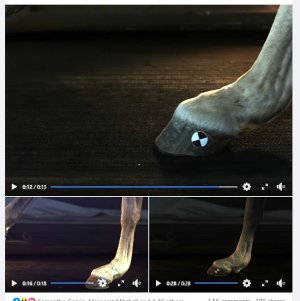
Video shod vs plastic shoes vs barefoot
- Thread starter [153312]
- Start date

ycbm
Overwhelmed
Fantastic video. Depth of sink of the fetlock appears to correlate with the shoe, assuming it's the same horse, taken after a similar amount of warm up. Strongly suggests that no shoe and then plastic shoe stop forces being transferred up to the fetlock.
.
.

sbloom
Well-Known Member
Mark Johnson has some good stuff on plastic shoes too https://www.facebook.com/markjfarrier
[153312]
...
from what i could find it's a 9yo arabian endurance stallion in all the videosFantastic video. Depth of sink of the fetlock appears to correlate with the shoe, assuming it's the same horse, taken after a similar amount of warm up. Strongly suggests that no shoe and then plastic shoe stop forces being transferred up to the fetlock.
.

tallyho!
Following a strict mediterranean diet...
Hard to really see the difference tbh... the metal shoe distributes force that would otherwise be absorbed in the heel bulbs forward in the form of a shunt but that was the only thing I thought to be interesting.
I don't like seeing things out of context - which is the control?
I don't like seeing things out of context - which is the control?
ycbm
Overwhelmed
How does a rigid metal shoe distribute force?
If you mean it prevents the heel bulbs taking the load that they are designed to take, that's true.
What "control" are you looking for?
.
If you mean it prevents the heel bulbs taking the load that they are designed to take, that's true.
What "control" are you looking for?
.
sbloom
Well-Known Member
Hard to really see the difference tbh... the metal shoe distributes force that would otherwise be absorbed in the heel bulbs forward in the form of a shunt but that was the only thing I thought to be interesting.
I don't like seeing things out of context - which is the control?
There is a bit of difference, see below (they're aligned in shot slightly differently so hard to get completely the same moment). I'd also ask what sort of control? There are seldom controls in this sort of work, and with so many variables reducing things too much with horses leaves us with a tiny amount of significant data that we can do diddly squat with as it's not real world.
ycbm
Overwhelmed
What do either of you mean by "control".
Control usually means a group left out of an experiment, I don't understand what you are asking for.
.
Control usually means a group left out of an experiment, I don't understand what you are asking for.
.

JBM
Well-Known Member
I would assume the barefoot horse would be classes as the control as the hoof is normal? Nothing man made added
tallyho!
Following a strict mediterranean diet...
The "control" absolutely must be left in any experiment it cannot be left out. That group is what any experimental/active groups are measured against. It would usually be the accepted standard - in this case - which is it? The shod hoof? The unshod hoof? A wild hoof? A pathological hoof? And which part of the hoof?What do either of you mean by "control".
Control usually means a group left out of an experiment, I don't understand what you are asking for.
.
A metal shoe absolutely can distribute force/energy - or else bells would not exist, nor would electricity. It does not absorb energy.
ycbm
Overwhelmed
What control are you asking for? There is one horse with a bare foot, a plastic shoe and a metal shoe on the same foot. What "control" do you think is possible, I don't understand what you want here.
In other experiments, things are done to a group and there is another group, the control group, that nothing is done to so the results of the two can be compared. How is that relevant to this?
.
A bell won't ring if it's closely attached to living tissue, it transfers the forces to the living tissue. I don't understand the point about electricity at all.
.
In other experiments, things are done to a group and there is another group, the control group, that nothing is done to so the results of the two can be compared. How is that relevant to this?
.
A metal shoe absolutely can distribute force/energy - or else bells would not exist, nor would electricity.
A bell won't ring if it's closely attached to living tissue, it transfers the forces to the living tissue. I don't understand the point about electricity at all.
.
tallyho!
Following a strict mediterranean diet...
Sorry to be so disagreeable. I'm glad the videos exist as it must have taken a lot of effort to go to all that trouble to set it up, apply the changes and use such amazing equipment to get the horse to canter on a treadmill (I assume)!) I honestly am in awe, I could not have done it so I do feel bad that I have detracted or diminished the work by asking for more context. If I were to use them to convince someone to go barefoot, I 'm not sure I would be able to effectively unless I knew exactly what I was trying to show.
A control is the chosen standard/unchanged state of something before the experiment was started - if indeed this was an experiment - and included as a comparator ad stated as such. If it's just an observation perhaps saying that would be fine but as an observer I have no idea what the videos are trying to show and which video I'm supposed to be comparing? If it's all three, well I can't as all three are filmed a bit differently.
Going back to metal and transferrence of energy... so when metal is attached to anything else, it will distribute its energy as it is a fantastic conductor (energy, heat, electricity, sound etc) as it is an amplifier if you like - the complete opposite of plastic or wood which are dampeners.
In the case of hooves - the metal will transfer its energy which is why I observed how the force of landing was distributed throughout the whole hoof, not in the heels as the barefoot hoof.
This is the reason I believe metal is a terrible idea for hooves - they distribute force/energy in ways the hoof was not meant to withstand. I can however understand that its other qualities were chosen to protect hooves that worked very hard in times gone by.
A control is the chosen standard/unchanged state of something before the experiment was started - if indeed this was an experiment - and included as a comparator ad stated as such. If it's just an observation perhaps saying that would be fine but as an observer I have no idea what the videos are trying to show and which video I'm supposed to be comparing? If it's all three, well I can't as all three are filmed a bit differently.
Going back to metal and transferrence of energy... so when metal is attached to anything else, it will distribute its energy as it is a fantastic conductor (energy, heat, electricity, sound etc) as it is an amplifier if you like - the complete opposite of plastic or wood which are dampeners.
In the case of hooves - the metal will transfer its energy which is why I observed how the force of landing was distributed throughout the whole hoof, not in the heels as the barefoot hoof.
This is the reason I believe metal is a terrible idea for hooves - they distribute force/energy in ways the hoof was not meant to withstand. I can however understand that its other qualities were chosen to protect hooves that worked very hard in times gone by.
ycbm
Overwhelmed
I don't think you're being disagreeable, I just don't understand what control group you think is possible. I still don't. It's not an experiment where a control group has any meaning.
Yes it would be nice if the video had been done more precisely and with more horses. We can live in hope.
I think you aren't making enough allowance for the way a barefoot hoof lands. A shod hoof usually lands flat, smacking the forces all at once straight up the leg. A barefoot hoof rolls. The first point of contact is spongy heels/frog, but it rolls rapidly forwards and the movement of the foot will disperse forces in a completely different way from shoes. The heels do not take the entire force of the foot landing all at once like a shoe.
.
Yes it would be nice if the video had been done more precisely and with more horses. We can live in hope.
In the case of hooves - the metal will transfer its energy which is why I observed how the force of landing was distributed throughout the whole hoof, not in the heels as the barefoot hoof.
I think you aren't making enough allowance for the way a barefoot hoof lands. A shod hoof usually lands flat, smacking the forces all at once straight up the leg. A barefoot hoof rolls. The first point of contact is spongy heels/frog, but it rolls rapidly forwards and the movement of the foot will disperse forces in a completely different way from shoes. The heels do not take the entire force of the foot landing all at once like a shoe.
.
Jambarissa
Well-Known Member
I can see that these all look very different. But which one is 'best'? What are we looking for?
I'd assume it's to show barefoot is best, but then since these experiments cost money it's logically more likely to have been sponsored by the plastic shoes people (and so unlikely to be released unless it looks good).
I'd assume it's to show barefoot is best, but then since these experiments cost money it's logically more likely to have been sponsored by the plastic shoes people (and so unlikely to be released unless it looks good).
tristar
Well-Known Member
perhaps the weight of the metal makes the hoof throw forwards more, hence why some use shoes to make horses throw their legs out more
and the way the shod foot slaps the ground is why its not a good idea to trot and canter on a very hard surface so say many of the old school now we see why
not quantifiable data, ha, that is funny
and the way the shod foot slaps the ground is why its not a good idea to trot and canter on a very hard surface so say many of the old school now we see why
not quantifiable data, ha, that is funny