Testing for Insulin resistance

Thank you all so much for replies especially Imogen, cptrayes and brucea who as always proivde excellent information. AndySpooner - I have come round to this way of thinking totally now along with all the knowledge I have gained recently about grass etc. Hence I had fenced all the way along the edge of the field about 24ft wide under the trees / hedge line where the sparser ranker shaded and frankly pretty scrubby grass was and was extending this length about 4 foot every other day. Was just starting to feel that I was managing it well as she was doing really well on it (has been much less footy over the last 5 days of so) and I am much happier with her weight than I was 4 weeks ago.

However mare decided otherwise and jumped out!!!! So now have to spend more money and get some more 5 ft electric posts - argghhhhhhh. She has always been on grazing fenced off by electric fencing and never tried it before so I can only assume that she wants to get to the better tasting sweeter grass which I guess is good as it means the stuff she is on isnt.......

Anyway, I will continue to treat her as a mild IR/laminitic case and see how that goes, thanks again
 
OOoooooooo :eek:

I think as a rule I'd speak for most vets to say the mainstay of our consultations especially at the start of laminitis in a new case revolves around adjusting the patients current management system to try and get a quicker recovery time and prevent future relapse of this horrid horrid disease.

Sadly it'd not always that easy as yards aren't always in a position to allow strip grazing or bringing in/out at odd times in the day; some won't allow night turn out.... Owners often hate the thought of a grazing muzzle and so management alterations are limited indeed.

I think it's a little unfair to say we're covering up or just treating symptoms. Sure we treat symptoms...we have to - that's why you ring us, because there's a symptom - mainly pain in these cases. There are a great number of us who are pushing to find out underlying causes - but sadly this costs money and time and testing, and often for many reasons, owners do not want to put horses/ponies through this. We are then is the position you describe. Sometimes we try very hard and are STILL unable to find underlying causes or explanations. I think you may not appreciate how frustrating all these situations can be for a vet.

Vets become vets mainly because we like to cure things. It's often selfish to say, but it makes me feel good to help your horse get better. There are many reasons why I can't do this in certain cases....but that never means I'm trying to cover up causes for a condition.

Management, particularly of grazing, is known not to be the largest cause of laminitis from years of research...but it IS still a large causal factor without doubt. It is also crucial to consider and often in chronic cases the mainstay of successful treatment.

Rant possibly over, depending on subsequent replies ;)

Imogen

I think perhaps that I have expressed myself badly in my post when I refered to vets 'covering up' the symptoms, by this I did not mean that vets, were somehow underhand in treating syptoms like lameness or pain, and whilst I understand that any horse or pet owner, farmer or whatever, does not want to see an animal in pain, that pain very often serves a purpose.

By this I mean that if a horse may aggrivate the problem by over exercising itself, pain in the foot for example will stop this. By the liberal use of pain killers this natural protection is taken away, the horse feels little or no pain and so behaves like a horse and gallops about. To stop this, we box rest, thereby relieving one symptom and causing more problems, through box rest and stress.

Just because a horse is not kicking the door of a box doesn't mean that it is not showing signs of stress, the horse which shuts down and stands immobile for hours is just as stressed.

Owners hateing grazing muzzles is an anthropomophic, reaction, which is not a good reason not to use them.

Yard owners should be providing safe grazing for their clients, considering the cost of livery. The diversification of farmers into livery, appears to be encouraging the wrong sort of grazing for horses, by the fixation with green unpoached fields, and restricted turnout.

The welfare of the horse is paramount in all this but I do feel that this often comes second due to a basic lack of understanding and an unwillingness to understand the horses specific requirements.
 
I think perhaps that I have expressed myself badly in my post when I refered to vets 'covering up' the symptoms, by this I did not mean that vets, were somehow underhand in treating syptoms like lameness or pain, and whilst I understand that any horse or pet owner, farmer or whatever, does not want to see an animal in pain, that pain very often serves a purpose.

By this I mean that if a horse may aggrivate the problem by over exercising itself, pain in the foot for example will stop this. By the liberal use of pain killers this natural protection is taken away, the horse feels little or no pain and so behaves like a horse and gallops about. To stop this, we box rest, thereby relieving one symptom and causing more problems, through box rest and stress.
I agree with this logic but there is a halfway house here. Painkillers aren't just given liberally for stopping pain. That sounds a bit odd, but they are anti-inflammatories which is the reason they are given primarily. If ongoing inflammation is not stopped this will encourage loosening of the vital laminar junction, encouraging and allowing pedal bone rotation. Pain itself sets off a vicious cycle of inflammatory mediators in a cascade of events which culminate in steroid hormone and others exerting an effect on the laminae in the foot....(far to complicated for me to remember all their fancy names off the top of my head;)!!)

The "keeping the horse able to feel the pain" argument is actually far outweighed now by these negative effects of inflammatory mediators.

Plus TBH IME or treating WAYYYYYYY too many active aggressive laminitics, I'd be quite happy to say, 'bute's good, but it's not that good.

Just because a horse is not kicking the door of a box doesn't mean that it is not showing signs of stress, the horse which shuts down and stands immobile for hours is just as stressed.
While this is very true, especially in the early phases it is a necessary evil...the walking is the thing which is really painful, but also encourage rotation of the pedal bone due to the biomechanics (gravity pushing down; Laminar inflammation pushing the pedal bone round at the toe; and the pull of the DDFT on the back of the pedal bone also causing rotation).:o

Owners hateing grazing muzzles is an anthropomophic, reaction, which is not a good reason not to use them.
Yup. Totally, but I can't persuade some people at all!:mad:

Yard owners should be providing safe grazing for their clients, considering the cost of livery. The diversification of farmers into livery, appears to be encouraging the wrong sort of grazing for horses, by the fixation with green unpoached fields, and restricted turnout.

The welfare of the horse is paramount in all this but I do feel that this often comes second due to a basic lack of understanding and an unwillingness to understand the horses specific requirements.

I'd love this to be the attitude in all yard and adopted by all owner's managers, but it's not.:( Don't know why, I've never understood it. I just often have to work with what I have...:o
 
I agree with this logic but there is a halfway house here. Painkillers aren't just given liberally for stopping pain. That sounds a bit odd, but they are anti-inflammatories which is the reason they are given primarily. If ongoing inflammation is not stopped this will encourage loosening of the vital laminar junction, encouraging and allowing pedal bone rotation. Pain itself sets off a vicious cycle of inflammatory mediators in a cascade of events which culminate in steroid hormone and others exerting an effect on the laminae in the foot....(far to complicated for me to remember all their fancy names off the top of my head;)!!)

The "keeping the horse able to feel the pain" argument is actually far outweighed now by these negative effects of inflammatory mediators.

Plus TBH IME or treating WAYYYYYYY too many active aggressive laminitics, I'd be quite happy to say, 'bute's good, but it's not that good. [QUOTE


By the time the attack is acute the damage to the laminar junction is massive. If the horse is flat out nothing should be done to encourage the horse to stand, which will increase rotation of the pedal bone.

The metabolic disruption within the horse's body should be allowed to stabalize, which will in turn allow the interupted blood flow back into the hoof, reducing the inflamation.

Attempting to treat the inflamation in the hoof, which is a syptom of the illness, is detrimental to the recovery of the horse in the initial stages of the attack and will hinder the reversal of rotation and re attachment of the pedal bone in the long term.
 
Sadly grazing muzzles are as much a curse as they are a blessing.

The problem is that ponies (mostly ponies) get very good at removing them, so you turn them out thinking that they're safe and then come back to hunt around the field for them several hours later when pony has porky-pigged himself and is lying with four feet up in the air!

Also I have seen cobs have a real temper fit and basically beat up other horses to try ot initiate grooming to remove them

MNot to forget the real risks of turning ponies out wiht any kind of headcollar device with shoes on - does not bear thinking about

I gave up on using them when our lami pony ran straight out, up to the cob, who promptly just pulled it off!
 
By the time the attack is acute the damage to the laminar junction is massive. If the horse is flat out nothing should be done to encourage the horse to stand, which will increase rotation of the pedal bone.

The metabolic disruption within the horse's body should be allowed to stabalize, which will in turn allow the interupted blood flow back into the hoof, reducing the inflamation.

Attempting to treat the inflamation in the hoof, which is a syptom of the illness, is detrimental to the recovery of the horse in the initial stages of the attack and will hinder the reversal of rotation and re attachment of the pedal bone in the long term.

:eek: Oooofff. This is a line of action I'm afraid I would disagree with.

So to clarify you're saying no anti-inflammatories in severe, acute laminitis?
Really? No pain relief....or would you give pain relief, just not NSAIDs?

wow. I'd like you to do two things before reposting to answer me please.
First, imagine turning up to a client with a horse in this state (down, sweating, raised heart rate, acutely painful, possiblilty of secondary stress colic) and tell them you are going to give nothing to relieve the pain....and play out that conversation in your head.
Second, imagine how you'd justify to the Royal College of Veterinary Surgeons and Veterinary defence Society just how you got to the conclusion that withholding pain relief/anti-inflammatories was not only ok but in the interest of the patient.

I would not support this argument, no matter what the underlying science you use to defend it. My job is to prioritise the welfare of the horse. I hope I've misunderstood your post as this wouldn't not be in the horse's welfare how ever you dress it up.

Regards
Imogen
 
When my professional laminitic was down, as opposed to the one who does it just for a hobby...

He got quite large doses of antinflamatories when the vet came out immediately the problem became apparent, and we had him on danilon twice a day, and he got ACP's injected and as tablets. He was already barefoot.

That lot completely chilled him out and he spent his first 10 days mostly lying down in a deep straw bed, we took his food and water close to him, and he only got up to relieve himself in a bed at the back of the stables. He's an obsessively clean little guy. When he was able to get up, he actually recovered to the point where he could walk the fifty yards to the outdoor dry lot in about 2 weeks, where he had waiting for him a 5 ton pile of sand to lie in and a pea gravel area.

Three months after that he was out walking booted behind us on gentle hacks, within the year he was back into his driving job, doing 10 miles at a time booted up with 12mm pads. Now he is tromping round the tracks in the woods across pretty sharp rough tracks, unbooted, no trouble at all.

It is entirely possible to have a really successful laminitic rehabilitation if you recognise the problem, intervene as early as possible, take the vet's medications, work through to the real root cause, and use a hoofcare professional who has experience of laminitic rehabilitation and can steer you in the right direction.

What I don't do though, is give the other one Danilon if he is "just a little bit footy" as a result of having a bit too much grass. We prefer to remove the aggravating factor (the grass) and then see how he progresses for a few days. If we give him Danilon at that point we won't see whether we have simply masked the problem or we are solving it. But there is a very clear cut off where we think "this is not OK" and we need to get intervention here.

It's never ethically acceptable to leave them in pain.
 
:eek: Oooofff. This is a line of action I'm afraid I would disagree with.

So to clarify you're saying no anti-inflammatories in severe, acute laminitis?
Really? No pain relief....or would you give pain relief, just not NSAIDs?

wow. I'd like you to do two things before reposting to answer me please.
First, imagine turning up to a client with a horse in this state (down, sweating, raised heart rate, acutely painful, possiblilty of secondary stress colic) and tell them you are going to give nothing to relieve the pain....and play out that conversation in your head.
Second, imagine how you'd justify to the Royal College of Veterinary Surgeons and Veterinary defence Society just how you got to the conclusion that withholding pain relief/anti-inflammatories was not only ok but in the interest of the patient.

I would not support this argument, no matter what the underlying science you use to defend it. My job is to prioritise the welfare of the horse. I hope I've misunderstood your post as this wouldn't not be in the horse's welfare how ever you dress it up.

Regards
Imogen

Well Imogen, what you describe is an absolute train crash, even though the goal posts have moved a bit, I'll go with it. Lol.

Firstly you cannot not provide some pain relief, in the circumstances you describe.

Not really in favour of NSAIDS as inflammatory phase may be critical to successful healing because the chemical signals released during inflammation may be essential in sustaining the healing cascade.

However, what I am really talking about is the desire many have to get the horse up too soon.

Failure to address the primary cause of the attack, eg. 'my horse is lamanitic, but, I cannot stop feeding sugar, because she loves it.'

The overall medicalization of badly managed horses.

Regards

Andy
 
Well Imogen, what you describe is an absolute train crash, even though the goal posts have moved a bit, I'll go with it. Lol.

:)

Firstly you cannot not provide some pain relief, in the circumstances you describe.
Phew:p

Not really in favour of NSAIDS as inflammatory phase may be critical to successful healing because the chemical signals released during inflammation may be essential in sustaining the healing cascade.

This is quite a good description of the phases of laminitis and also treatments. http://www.completerider.com/futireartices/Laminitis - Page 2.htm
I get what you're trying to achieve by protecting the inflammatory mediators for their good...:rolleyes:, so what pain relief would you provide if not NSAIDs?

However, what I am really talking about is the desire many have to get the horse up too soon.
This is also agree with - people are very stressed when the horse is down and I often say that the more time the horse spends down initially (as long as it'd not down from uncontrolled pain;)) the better - least amount of weight possible going through the feet can only be good. BUT the horse should be able to rise is required...:o

Failure to address the primary cause of the attack, eg. 'my horse is lamanitic, but, I cannot stop feeding sugar, because she loves it.'

The overall medicalization of badly managed horses.

Regards

Andy

Yes, I struggle with the feeding comment....;)

I think ultimately we are going to agree on one point - medical treatment areNOT and should not be ever in anyway a substitute for obtaining the correct underlying cause and removal and/or treatment of that.:D

I'm going to be very interested about one further thing though.

NSAIDs in the horse are usually and combined block of all the COX enzymes (cyclo-oxygenase 1 and 2) which control the inflammatory cascade. http://osteoarthritis.about.com/od/osteoarthritismedications/a/cyclooxygenase.htm
There has recently been the release of a specific COX2 inhibiting NSAID - Equioxx http://equioxx.us.merial.com/about.asp
This should minimise side effects seen with the other NSAIDs (although in my hands not common;)) and also note the bit where it says the clinical relevance has yet to be determined!:p

I wonder where this is going to fit in for laminitis treatment...if at all.:rolleyes:

All the best :D
Imogen
 
Hi Imogen,

In truth 'bute' is what I have and would use, though I do get a bit concerned about the high levels often prescribed for laminitics and the duration of administration.

I think that it is early days yet as far as equioxx is concerned, but, if inhibiting COX 2 only is achievable with no ill effects then it may well have a role in the treatment of laminitus.

I believe that AQHA are constantly looking for a drug which will enhance the training and performance of reining horses, but thats a whole other can of worms.

Anecdotally, there appears to be a rise in the level of gastric ulcers reported in equines which leads me to wonder about the level of NSAIDS being prescribed generally.

Andy
 
Hi Imogen,

In truth 'bute' is what I have and would use, though I do get a bit concerned about the high levels often prescribed for laminitics and the duration of administration.

I think that it is early days yet as far as equioxx is concerned, but, if inhibiting COX 2 only is achievable with no ill effects then it may well have a role in the treatment of laminitus.

I believe that AQHA are constantly looking for a drug which will enhance the training and performance of reining horses, but thats a whole other can of worms.

Anecdotally, there appears to be a rise in the level of gastric ulcers reported in equines which leads me to wonder about the level of NSAIDS being prescribed generally.

Andy

Hi Andy,

There has been so much work into the side effects of using both long term lower doses of PBZ and higher doses in the short term.

This and my experience of using both of these strategies in practice would support evidence of little or no side effects being created. Sure they can happen but I have generally only seen them from high dose usage in sick, dehydrated foals - often in the form a kidney disease and usually when a foal has been on concurrent gentamycin which is also likely to hammer the kidneys (and has probably actually been the main problem).:o

Often people seem to worry really hard about the gastric ulceration and link this to NSAID use in the horse. The thing is inflammation and ulceration in the gastrointestinal tract due to NSAID use is most commonly found in the right dorsal colon, especially in ponies, and that in itself is uncommon. Kidney effects are next up in line, but again the horse probably has to have a significant degree of dehydration or pre-existing kidney disease concurrently or prior to the treatment.

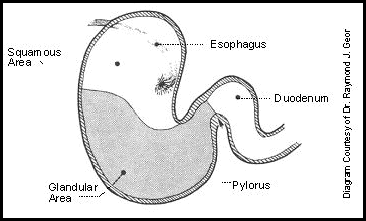
Lastly gastric ulceration can occur from the NSAID use, but is rare. It is also in a different location within the stomach in comparison to the ulcers forming from EGUS from other causes. EGUS cases tend to have ulcers predominantly located around and on the margo plicatus which is the distinct band around the stomach dividing the glandular and non-glandular areas of the lining or running up into the non-glandular area.
gut360.gif

whereas the NSAID induced ulcers generally sit low down in the glandular portion. This is unusual in EGUS.

I honestly believe that EGUS is more commonly diagnosed, not due to incidence increasing, but due to awareness and ease of diagnosis, increase insurance to pick up the cost and possibly the shift in management of other breeds, rather than just the thoroughbred into a more indorr, concentrate based diet type of system.

Hope that might allay a few fears.
Imogen
 
Top