There is hope!

I remember someone asking Ramey a similar question in 2005 when he was over here and he was commenting about vets and the cases he had treated. The answer was along the lines that vets didn't consider the 99 cases that had been resolved only the 1 case that had failed.
This is another major problem to progress! Vets, training institutions etc. have no desire or will to look into other whole horse options! The horse world is stuck in Traditions and practices that are outdated and the horses really aren't getting what they deserve ie. horse centred care! They are getting what humans think is best without consulting the horse!
 
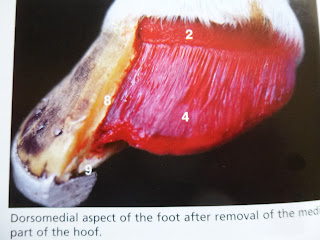
I'm sure that Nic at Rockley was rather shocked by the veterinary textbook that included a horseshoe as part of the horse's anatomy. But this does demonstrate how welded into veterinary training the idea that horses need shoes is.

This debate has been going on a long, long time (15 years is a fraction of it) and the evidence has been dismissed/ignored by many vets and many farriers for an equally absurd length of time.

Bracy Clark (1771 - 1860) was a vet who became despondent after his research into shoeing and the negative effect it had on horse hooves was dismissed out of hand. He said 'they have uttered their absurd Dogmas with all the confidence of well-ascertained truths and afterwards, though plainly confuted, have persisted through pride in maintaining them... and what is worse, when the truth in clearest evidence lay before them, instead of embracing it joyfully, they have tried in every way to stifle her.'
 
Of course that is preposterous.

Vets and farriers are using treatments they are taught to use. This is where part of the problem lies imho.

We have had threads discussing research for treatments and protocols and there has been little linked to suggest shoeing is successful. So it appears to me there is no research to back up shoeing options as long term and successful treatment options.

To me there appears to be a fundamental difference in understanding. Shoeing options support and protect the hoof and (good) BF options support the hoof and encourage the hoof to strengthen and build soft structures. Protecting and supporting the hoof in a system that doesn't allow gradual bio-mechanically correct exercize of the hoof soft tissues to strengthen them allows that soft tissue to become even weaker. Use it or lose it comes into play.

Actually totally agree with you! Which is the main reason I decided to take one of mine barefoot. When I got her I inherited a lot of poor foot care problems. Mainly weakness in the back of the foot. To me she looked like a navicular case waiting to happen so decided to go barefoot to try to combat this before it became an issue not after. It has been a learning curve! And there can be a difference in her feet one day to the next. And although currently lame :-( her feet are vastly improved but still have a long way to go!!! I reckon it'll take a good 12 months to get them to where I want them to be.
If people haven't guessed I am a vet although only deal with small animals these days. But like most vets I love to learn and learning never stops! I think most of us are open to new ideas and often do have to think outside the box. If something isn't working you have to have a rethink! I think the veterinary profession is more open to ideas than people think. But often there isn't enough communication going on between all the relevant people! I get bombarded on social networking sites re peoples animals which would be far better directed to the vet in charge of the animals care for example. When I did large animal work there seemed to be poor communication between vets and farriers although I think this is vastly improved these days to back then. I think what I'm trying to say is if things aren't going right then it always pays to go back and discuss this frankly with the vet/farrier/physio/whoever and ask what they think. We all give free advice over the phone. If your vet isn't prepared to discuss options then maybe they aren't the right vet???
But I'd also agree little was discussed re hoof balance when I was at uni (>20 yrs ago eek) other than hoof angles. Also this was before the advent of MRI and everything with caudal heel pain was lumped in the navicular bracket. Obviously understanding and diagnostics have moved light years in this time and things are changing. As I said previously I would love to attend some sort of lecture re foot balance/shoeing/barefoot options and am sure I'm not alone!!!
 
I'm sure that Nic at Rockley was rather shocked by the veterinary textbook that included a horseshoe as part of the horse's anatomy. But this does demonstrate how welded into veterinary training the idea that horses need shoes is.

This debate has been going on a long, long time (15 years is a fraction of it) and the evidence has been dismissed/ignored by many vets and many farriers for an equally absurd length of time.

Bracy Clark (1771 - 1860) was a vet who became despondent after his research into shoeing and the negative effect it had on horse hooves was dismissed out of hand. He said 'they have uttered their absurd Dogmas with all the confidence of well-ascertained truths and afterwards, though plainly confuted, have persisted through pride in maintaining them... and what is worse, when the truth in clearest evidence lay before them, instead of embracing it joyfully, they have tried in every way to stifle her.'

What text book was this lol! Can't say I've ever owned an anatomy text book that included a shoe!!!
 
although vets don't get paid for the remedial shoeing they do get more money when the horse then comes back for more work up/medical input if still lame. - that and joint injections/tildren/adequan you prob wouldn't do if only intending a barefoot option.

very cynical of me though!
 
Not terribly good for business though is it if you never successfully treated anything haha! Don't think if use a vet that never managed to cure anything!!!
 
Lol good point, I suppose as no one ever expects a cure for navicular, only management they might get away with it for that though. (I don't actually think that is true though btw! just musing)
 
What text book was this lol! Can't say I've ever owned an anatomy text book that included a shoe!!!

"The Equine Distal Limb" by Jean-Marie Denoix

P1000962.JPG


Even more bizarrely, the shoe is numbered and labelled as another part of the hoof(!).

http://rockleyfarm.blogspot.co.uk/2010/06/how-some-peoples-minds-work.html
 
Not terribly good for business though is it if you never successfully treated anything haha! Don't think if use a vet that never managed to cure anything!!!

So many people believe that navicular is irreversible, indeed they are told by professionals that that is unfortunately the case. Why would you change Vets if they can't solve a condition that you believe is degenerative?
 
Ha! How bizarre! And must have taken some doing to cut that shoe in half for the pic!
Its a long time since I've done any equine practice but back in the day anything that nerve blocked to the back of the hoof was given the blanket navicular diagnosis. Then probably x-rayed and given something like warfarin with variable/poor results. With the advent of mri and being able to more accurately diagnose what's going on in the back of the hoof the prognosis should be better or more workable. Genuine cases of navicular do exist, but some cases are ligament strains within the hoof or joint issues etc. Some of these issues undoubtably occur secondarily to poor foot balance and correcting that either with a barefoot rehab or corrective shoeing has got to be part of the approach to treatment. As to which to go for I think is highly dependant on the vet in charge of the case and previous success rates. Personally if I see something I've treated successfully in a certain way before I will definitely go for the same approach in the future. If that doesn't work, I will either ask myself why, have I missed something... do I need to do more diagnostics or simply change medication etc. I think because traditionally we have gone down the shoeing route its likely to be the first port of call until a barefoot route has become more established. I read the Rockley blog and find it fascinating, but it needs to be more established I think before any changes occur. For us oldies, that's going to be years in the future I'm afraid! Which is why I think lectures and education is the key!
For me personally with Dee, I couldn't see the logic of putting more ironwork over the weakest part of her foot as I couldn't see how that would encourage it to bulk up and improve. But I was only looking to improve her general foot balance to prevent future issues not treat something that was already established and there. Although I can also see how temporarily lifting the heels could relieve stress on the flexor tendons if damaged.... but not as a long term thing if you know what I mean. Education is the key for vets, owners and farriers alike. Barefoot doesn't work for everything however just as sometimes corrective shoeing does. Its a case of treating every case on its merits and if something isn't working then back to the drawing board and have a rethink!
 
Last edited:
But I'd also agree little was discussed re hoof balance when I was at uni (>20 yrs ago eek) other than hoof angles. Also this was before the advent of MRI and everything with caudal heel pain was lumped in the navicular bracket. Obviously understanding and diagnostics have moved light years in this time and things are changing. As I said previously I would love to attend some sort of lecture re foot balance/shoeing/barefoot options and am sure I'm not alone!!!
Pete Ramey reckons one of the major problems is hoof balance etc. is considered when the horse is standing still on concrete when the horse in motion is the critical element. He says something like a horse isn't going to hurt itself just standing around.
Personally I highly recommend his 10 disc DVD series Under the horse as a starter pack if you haven't seen it. It includes discussion on Rooney's research from the 1970's (which has been ignored by vet community apparently) about the damaging effects of persistent toe first landing leading to navicular diagnosis and causes of toe first landing. Research from Bowker and Pollitt is also sighted in the lecture discs. It becomes clear how hoof health and strength (development) along with diet are all part of the picture.
.I have only had sight of his book 'care and Rehabilitation of the equine foot', it's pretty technical but aimed at vets and farriers.
http://www.hoofrehab.com/
 
I started this thread to give hope to some owners who feel they are on there own when it comes to treating a lame horse.
My first approach always was, and still is to assess any horse’s conformation in relation to motion.
I am afraid some farriers are still being taught that the influence they have on a foot can be used to create a balance that does not necessary coincide with action.
Of course owners want to know more, it is just a shame that they feel they have to.
 
Of course owners want to know more, it is just a shame that they feel they have to.

sorry but it has gone way beyond that by now. We don't feel we have to know more. Some of us are far too interested and curious and WANT to know more.
 
sorry but it has gone way beyond that by now. We don't feel we have to know more. Some of us are far too interested and curious and WANT to know more.
I agree and also we really do have to know the basics at least, otherwise how can we judge how the professional is doing and question? Even if standards are raised there will always be variety in practical skill level of professionals.
 
Top