
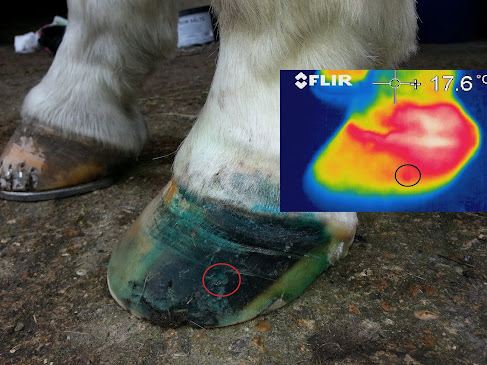
Thermal images of my horse's feet taken today

star

Well-Known Member
Joined
22 August 2001
Messages
6,781
Location
Woking, Surrey
Visit site
Following on from previous post with photos of his feet and xrays, today we got some thermal images of his feet. I think they clarify my previous thoughts on the cause of his acute lameness. Thought people might be interested.

https://www.facebook.com/media/set/?set=a.10151621415100522.1073741828.591150521&type=1&l=dc6e418750

for those who cant do facebook think this might work:
https://plus.google.com/u/0/photos/...lbums/5866390450161574305/5866408182168430530

photo showing red circle around high nail hole with superimposed thermal image view with black circle around red hot nail hole.
left+fore+with+thermal+image+superimposed.jpg
 
i have these done regularly of my dogs ad horse! :)


will be having my youngster done too this year before she starts to be ridden :)


this is of my previous horse :)

thermopony_zps381c1933.jpg
[/URL]


i cant believe more people dont know about this!!! totally non invasive and cost effective!
 
Could anyone do this, as my husband has the use of a thermal imaging camera and I wondered if we could take some pictures and forward them to my vet?
Mind you my boy probably has so many hot spots, he might just be one big red blob!!!:rolleyes:
 
possibly - it wasn't very difficult to do but I think it's quite easy to create artefacts and I'm not sure I'd feel so confident scanning anything more difficult than feet although might give the rest of him a go while I've got it.
 
I had some done of my horse feet because he was footy, and he had similar areas over his back,(new better fitting saddle has helped the way he works) as well as heat in his achilles tendons and the soles of both front feet. (Claire who did it then did some laser treatment of the affected areas to relax various muscles). It was very interesting but when I spoke to my vet's wife about arranging some follow up she was very dismissive and said the veterinary profession don't think it is reliable. Any basis in truth or professional jealousy do you think?
 
i dont really see how it's not reliable. it quite clearly shows heat tracking from a nail hole to the area where my horse is painful on palpation. cant really argue with that. I'm sure it's open to interpretation in many cases but I think it's a useful tool.
 
My vet uses it alongside all the usual diagnostics, so certainly not all vets are dismissive. I'd certainly use it for a 'where's the root of this lameness' prob... Every tool helps provided you are both thorough and open-minded in my view :)
 
I had some done of my horse feet because he was footy, and he had similar areas over his back,(new better fitting saddle has helped the way he works) as well as heat in his achilles tendons and the soles of both front feet. (Claire who did it then did some laser treatment of the affected areas to relax various muscles). It was very interesting but when I spoke to my vet's wife about arranging some follow up she was very dismissive and said the veterinary profession don't think it is reliable. Any basis in truth or professional jealousy do you think?

I use Claire from The Inner Picture (not sure if same Claire?) I'd had my girl to vet twice for lameness assessments and each time was told she was fine. I knew she wasn't quite right so didn't feel comfortable keep riding as normal. Arranged for Claire to visit without telling her anything about my mare, she did a full body scan and found heat in her heels. Rang vet who's a good old fashioned vet and let him know what I'd had done and what they had shown. Went back to vet with images and they used them as a starting point. About a month later after nerve blocking and an MRI she was diagnosed with navicular.

Not the answer I wanted although, at least I knew what I was dealing with.
 
This is something that never occurred to me before, but those photos really show a lot! I can't understand now why vets don't use this more often in diagnostics.

Noodle, may I ask how much it cost to have the horse's back done?
 
Wow, those are seriously impressive! Rossdales have the equipment in-house now I believe, I think it will become more mainstream as time goes on. Hope you get Monty sorted asap :)
 
Alf was thermal imaged all over last year, and the hot spots corresponded exactly with the areas where we had diagnoses of PSD and DJD, so I was really interested in the other hot spots that showed up on his second thigh, and over his backside. His regular physio appointments, and a recent visit from Pennie Hooper have revealed that the muscle on his second thigh is very tight, and he is sore over the SI area - so I am very much a fan of thermal imaging as a diagnostic tool!!
 
Just re-bumping this old thread.
A friend is having this done at the weekend. I am tempted to have my cob done too as it may shed some light on why she is so one sided, have the physio coming out too end of jan so maybe useful for her to see what it brings up.
Completley new to it but reading things about it
 
Have just logged on here for the first time, and saw this thread. I am a veterinary thermal imager, and can answer a few of the questions asked:

- no it isn't possible for anyone with a thermal camera to just perform the scans. We have a lot of pre-requisites to ensure that there are no artifacts present, but not every company does. This is one of the main reasons that vets do not trust the technology - some people are performing scans with no training, and what they are describing as 'hotspots' etc. are actually artifacts. Certification of the imagers as well as the reporters (not always the same person) is vital if we're to bring this tool into everyday use.

- the training involved with processing and interpreting the images takes a long time to learn, on order to become certified, and to be sure it's being done correctly. The main certification comes from the US from a couple of vets over there who've been doing this for a long time. Google Dr Tracy Turner if interested.

- I do not know why it's not more widely accepted. I know I'm biased :-P, but everyone that has seen this technology in action (and seen the reports) is convinced that it's the way forward. Physios, bodyworkers, chiropractors, etc. are all totally on-board with it - it's just vets we need to convince. However, if owners keep asking for the scans , and we keep sending reports through (that are useful to them), then eventually I'd hope they would begin to accept it has it's place alongside other modalities. It is not a replacement tool, and we do not diagnose, but we can be very useful in identifying the root of problems.

If anyone has any questions, I'm more than happy to answer them...
 
Last edited:
Have just logged on here for the first time, and saw this thread. I am a veterinary thermal imager, and can answer a few of the questions asked:

- no it isn't possible for anyone with a thermal camera to just perform the scans. We have a lot of pre-requisites to ensure that there are no artifacts present, but not every company does. This is one of the main reasons that vets do not trust the technology - some people are performing scans with no training, and what they are describing as 'hotspots' etc. are actually artifacts. Certification of the imagers as well as the reporters (not always the same person) is vital if we're to bring this tool into everyday use.

- the training involved with processing and interpreting the images takes a long time to learn, on order to become certified, and to be sure it's being done correctly. The main certification comes from the US from a couple of vets over there who've been doing this for a long time. Google Dr Tracy Turner if interested.

- I do not know why it's not more widely accepted. I know I'm biased :-P, but everyone that has seen this technology in action (and seen the reports) is convinced that it's the way forward. Physios, bodyworkers, chiropractors, etc. are all totally on-board with it - it's just vets we need to convince. However, if owners keep asking for the scans , and we keep sending reports through (that are useful to them), then eventually I'd hope they would begin to accept it has it's place alongside other modalities. It is not a replacement tool, and we do not diagnose, but we can be very useful in identifying the root of problems.

If anyone has any questions, I'm more than happy to answer them...


Great post. Can you please tell us how to find properly trained thermal imagers? Is there a register we can access somewhere? If not, what should we be looking out for?

I am very disappointed in the reactions of many vets to new ideas, especially when they mean less intervention and not more.
 
I had my horse done when he had a sore back. Also had his feet done just out of interest. His back showed he was very sore. I don't know how to post pictures anymore. My photobucket doesn't seem to want to play the game.
 
Top