Topline - ART2Ride

Horsekaren

Well-Known Member
Joined
8 March 2017
Messages
1,300
Visit site
I am researching ways to improve build topline besides, poles, hill work and transitions and stumbled across this video-
I'm pretty fascinated by the idea of schooling in this manor, what are peoples thoughts on this type of schooling? It all seems very relaxed but seems to work really well from the videos.
 
I like to be able to work everything in this way, long low stretching forward onto a long, not loose, rein, for part of each schooling session, usually during the warm up/ cool down or as a break at other times, it is far more difficult to achieve than it appears as the horse, and rider, have to really understand how to work from leg to contact if it is to be done well otherwise it can just be an inactive horse slopping along, on it's forehand, on a loose rein which will not be having much impact on topline or anything else.

I haven't watched much of the video, and had the sound off, I would prefer to see the nose a little more forward than it is at times and the poll higher when it comes back up but the horse is swinging along from behind on a great rhythm with a soft back in what I did watch, if you can get your boy going in the same direction you would be doing well OP.
 
I work mine for some of the time like this too. I like that the horse is still soft in the contact and reaching forwards. I see many horses who have lost the reach, usually through riders trying to enforce a particular outline. They present as light in the contact but do not draw forwards.

This has a totally different feel to one poking its nose. When ridden like this there is the elasticity, the horse stays raised in the back, engaged in the abs and quarters.

I don't to more than about 10 minutes at a time, as I also want to be able to influence the shape by shortening the rein, but in doing so keep this feel on the bit, as in the horse elastic and reaching.

Currently I have a young horse, so the stretch happens at the end of the session, when she is worked ;-)

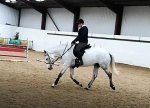
I just took 2 pictures from a video from Sunday, it was right at the end so she is somewhat on the forehand, but certainly still working into the bit... You will have to excuse my riding, I haven't done much at all for 4 years, and this was the first time riding since Xmas as I have had other stuff happening in life! This is also the reason I didn't let her right out, we did a mid way stretch as she has been just lunged or walked out as have not been in the right frame of mind to ride. I like that I can determine the length of rein though, short, mid or out, and she will simply seek the contact and work within the space I give her. I also like that I bundled her into the box, hired an arena that she had never been to and pretty much got on with it.Stretch.JPGStretch 2.JPG

And in a more normal contact...

7.JPG
 
Last edited:
Easier said than done properly but is worth doing if you can get it right. Horses without much topline and particularly those with that dip just in front of the whither, often find it hard to work like this especially at the beginning of a session. I've found it helps to get the horse working correctly from behind (trans, trans, trans) and use this as a cooling off exercise or at least later in the schooling session. I haven't watched all of the video, sorry, but the little I watched the horse was working correctly from behind, had his shoulders up and was working to the contact. It is very easy to let the horse drop onto the forehand and lose the connection from behind, but I'm no expert. It's something I use as part of a schooling session but isn't the aim of the session.
 
Some people have a lot of issues with the art2ride thing and it’s true that just putting the horses neck forward and down can put the horse on its front pulling along with its forehand they need to learn to stretch over the back and raise the core muscles and thus raise the back and then develop the balance and strength to raise the wither and seek take more of the balance onto the hind leg etc etc .
I get all the that but the emphasis on steady slow development of the horse is something that’s worth thinking about .There’s a lot of art2ride YouTube stuff worth watching and thinking about personaly I don’t subscribe to the view it’s good to keep horses down like for months of training it’s unnatural for them but if you can’t easily work your horse in a frame like that you ought to be asking why .
The full stretch in the canter in a great test of balance and carriage and it’s something we all should be working towards in an age apporiate stage apporiate way all the time .
I watched all the art2ride stuff some time ago and I think there’s much good that we can take from it .
Do I think it’s the training nirvana some think no I don’t but I think you will get to think through some important stuff watching the videos .
 
There's some things I like about it and some things I don't.

I do like my horse to spend some time forward, down and out at the start of the ride and at the end to warm up / cool down and also after completing certain exercises so with my young horse we might spend a bit of time doing shoulder in or a little basic collection work and then frequently give him a short break and extend the neck before moving on to the other rein

what I don't like about the video, or horses trained in LDR (even the ones that look soft) is that the horses noses are BTV and therefore the underside of the neck has to be contracted. I want my horse to lift his wither and stretch forward and down with the mane approximately horizontal with the nose very slightly IFV or on the vertical.
 
To be clear I am not some sort of art2ride warrior but while completely accepting that on many of the art2ride clips you will see horses btv ( and on the forehand for that matter ) you need to put that in context horses who have had incorrect training will go btv when you put them low in the neck they are weak in the neck at the top quarter and the underside of their neck can be extremely weak .it can take considerable time for horses to take the nose forward while they work low .
Many of the horses in the art2ride clips have had a lot of issues and the clips are not showing perfect stretches it’s not the point the stretch develops through training it takes time for horses to gain strength and balance and necks can take ages to develop especially when the work before has been incorrect .
OP can use these clips to train her eye and think all these thing through I use Facebook all the time for this .
Jumping dressage all sorts of things on there you can play with .
 
They are less likely to go BTV if the neck only goes as far as the horizontal plane IMHO but yes, it all takes time to build etc no matter what you are trying to teach or re-teach
 
I cannot watch!! That poor horse can hardly move under that rider, he is so on his forehand and leans to the right side, the rider is constantly having to shove himself left!!! Ouch ouch ouch!! He want's to push the rider off his shoulder but he keeps being forced forward and down! Never come across this before, and hope never to again.
 
I don't see a comfortable horse in that video. From the OP's original point of view, it is worth being mindful that the conformation of some horses will make long and low more difficult and/or uncomfortable than for others. Some cob types are naturally down hill and being allowed or encouraged to work as in the video will just result in an even more downhill, trippy and ploughing a furrow way of going. Their forehands are often already loaded due to their physique.

There is no shortcut to building top line on a horse even with very correct conformation and if the horse is conformationally challenged you can only work with what you have got. Incremental work, many transitions both within the pace and between the paces will result in self carriage and balance, that will build top line, along with a rider that can feel when the horse is in balance and if it is not in balance be quick to correct it. Both of my cobs find it virtually impossible to keep their balance in the long and low frame for more than a few steps. Neither are built downhill, but both have massive heads, thick gullets and huge crests. The mare can't be bothered to try, the gelding tries and gives the feeling of a runaway overloaded wheelbarrow to his rider.
 
You can call art2ride many things but it’s definatly not a shortcut AA.
People will spend a year walking their horses on the lunge .
As I said it’s not my system but it does make you examine stuff there are some very good clips of horses trained in the this system and some of horses doing polework in an enviable way .
It’s a bit culty for me no matter what the system I don’t do gurus .
 
The range of responses on this thread are quite interesting. I am working on the presumption that this is an "unfinished" horse, presumably a re-school which has come with a history and its own issues - rather than a final "product" of the system. I don't think it's an especially uncomfortable video in that context - far less uncomfortable than some of the finished products you see at the highest levels of competitive dressage (and yes, you may say at GP they're not "finished" but if they're scoring 8/9+ at the Olympics, I'm not sure that's defensible!). And I'd certainly rather see a horse working like that, than forced into rollkur with draw reins and heavy contact, or even in some of the awkward, uncomfortable, extreme elevations you see from certain schools. If a horse is not yet balanced, not yet even, it's going to show, whatever school you're working in.

It's certainly not an "end product" which is desirable, but I do think a good, well schooled horse should be able to work down into a low frame without falling on its face, losing balance or bogging off. It's not an easy alternative though - if you already have balance, timing, softness and skill, and a well trained horse, it's easy enough to change the balance and maintain some quality of movement. That's completely different to a novice trying to learn it all, while also trying to follow a very specific school of thought.
 
i think the commentary explains everything and i am also interested in some of the responses. For me I don't see or hear anything that seems undesirable or unpleasant, the start of the vid explains the background to the young horse that has been cacked up physically and mentally by its early training with a previous trainer, over use of draw reins causing the horse to be fearful of the contact and the work that has been done to get the horse back to a state where it's ready to work. it's very clear that this is a work in progress. I think the concept of changing postures regularly to build strength in a weak horse is entirely appropriate. I liked the quiet and relaxed approach and i also appreciated his comments on nervous horses, it's something that is well timed for me as one of mine is in a bit of a tricky place right now. Thanks for sharing OP, I have to agree with GS that there is lots of positive stuff to think of and play with here.
 
I payed about with this a few months ago, if you look closely you can see him actually fall almost on his face a few seconds in.
I know most of this is no good but are there points where he does engage properly or is he just bumbling around on his front.
i know the contact is wrong ect, i'm toying with the idea of maybe trying to do a bit more to see if it forces him to engage and sit more on his hind. Just looking for little ideas to try for a few mins to see if i can aide the muscles.
You can see at 21 / 22 seconds in he thinks about cantering where he is trying to find his balance, he is doing this a lot at the moment, so i wondered if perhaps long and low might help?
Video one - lose and long


I quiet like the ART 2 Ride videos, at the very least it is so clear to see when the horse is working over its back.
 
Last edited:
I agree hes needs to be more forward and you can see his lack of lateral bend which gets shown up very clearly when you put the horse down like that .
He’s a cob and he has a weak core not bred for their canters they often do.
OP , Adding some pole work would be good and teaching the horse leg yield at this stage will help .
You don’t need to do a great sweeping leg yield like a young warmblood will do just get him reacting correctly to the leg beginning to step under with the side leg .
You can also do this on the lunge ( you will find lots of art2ride you tube stuff on lunging if you are interested .
I would be making sure I kept him snappy in his mind and ride him forward more and do lots of transitions .
He might be a horse where you take him fresh into the school after a short hack to limber up do twenty minutes or even less and then bring out of the school and walk him off away from the school .
Enjoy yourself and don’t be afraid of using the internet to get ideas and coming on here to see what different people think it’s a good way to develop yourself and open up your mind and it’s free !
 
Last edited:
This is how my boy would ride- constantly. The OTT version of long and low. Nose dragging on the ground.
Certainly stops his temptation to lean.
No idea of how effective it is in a "proper" horse. But when in true work he build topline fairly quickly between this style of long and low and hill work. :)

It also prevents the unbalanced rider from holding on to the horses mouth. Having no horse head in front of you- you really need to find your own balance, which is fabulous for the core.
 
This is how my boy would ride- constantly. The OTT version of long and low. Nose dragging on the ground.
Certainly stops his temptation to lean.
No idea of how effective it is in a "proper" horse. But when in true work he build topline fairly quickly between this style of long and low and hill work. :)

It also prevents the unbalanced rider from holding on to the horses mouth. Having no horse head in front of you- you really need to find your own balance, which is fabulous for the core.


It does but true long and low is when you still have a contact with the horses mouth, if your reins have slack the contact us not there so the horse is then just running round with its head on the floor.
 
It does but true long and low is when you still have a contact with the horses mouth, if your reins have slack the contact us not there so the horse is then just running round with its head on the floor.
Indeed. This is what he does without the running, sniffs the ground like a giant dog whilst he is out hacking. What we do is far from "true" long and low it's more "extreme" long and low 🤣😂
 
It does but true long and low is when you still have a contact with the horses mouth, if your reins have slack the contact us not there so the horse is then just running round with its head on the floor.

Not necessarily - it is possible for a horse to work and keep its own shoulders up without a contact - though it's not often you see it in practice... There is a place for non-contact in training too.
 
TBH I had never heard of Art2Ride before this thread, but working them way down there is an exercise that I do.

The way I do it is different to HorseKaren's horse in that I still expect them to keep a contact. It is not about them going low but with some bobbing their heads up, it is about being able to be secure in the contact wherever that may be, low, high, in between, without getting tense. Being able to initiate bend down there without them resisting upwards.

My new mare likes the down a bit too much, so we only do it for a few minutes at the end of a session, as a stretch and relax. But, if she were not able to seek the contact down there we would be doing it more. She lunges on 2 reins like this too, long and low, and TBH lunges with no gadgets down there too, to a fault!

I will have a look at some of the videos as I had not idea this was a "thing" as in a separate method. I have just used it as an exercise to test contact and reach, to practice lengthening out and bringing back the frame without resistance. One of many tools.

I don't do it every time we ride either, we did it on the weekend because we had been lengthening and shortening the trot and she had dropped the contact a couple of times, so we finished with riding her back out in front seeking.
 
My horse is recovering from mild kissing spine. And I have done quite a bit of reading / video watching and thinking about it.

I totally agree IMO it is a means to maintain mobility, stretch and flexibility, not the whole end in itself.

I think all horses should be able to work with neck down and out and back up and lifted. But it is part of a wide range of things might ask a horse to do. You also need them (if looking to move well) to be able to shorten body and lift shoulders and come more uphill etc.

I use some of Simon Cocozza’s exercises as part of my ridden warm up
https://www.youtube.com/watch?v=XnewAkqbZvg
https://www.stretchyourhorse.com/blog/4-riding-exercises-to-help-kiss-kissing-spine-and-a-tight-back-good-bye-part-2-of-spinal-health-blog

https://www.viscontecocozza.com/

I think this is similar to the Art2Ride theory of long neck and back and stretching and movement.

With all these things, I think it is about the skill you do them with as well as what path you follow. And the idea of working to make horse flexible and supple. If your horse is already strung out, hollow and disconnected, I am not sure that staying disconnected and lowering the head works. I think you have to assess what you have and what you want to change, and what might do that.
 
Last edited:
TBH I had never heard of Art2Ride before this thread, but working them way down there is an exercise that I do.

The way I do it is different to HorseKaren's horse in that I still expect them to keep a contact. It is not about them going low but with some bobbing their heads up, it is about being able to be secure in the contact wherever that may be, low, high, in between, without getting tense. Being able to initiate bend down there without them resisting upwards.

My new mare likes the down a bit too much, so we only do it for a few minutes at the end of a session, as a stretch and relax. But, if she were not able to seek the contact down there we would be doing it more. She lunges on 2 reins like this too, long and low, and TBH lunges with no gadgets down there too, to a fault!

I will have a look at some of the videos as I had not idea this was a "thing" as in a separate method. I have just used it as an exercise to test contact and reach, to practice lengthening out and bringing back the frame without resistance. One of many tools.

I don't do it every time we ride either, we did it on the weekend because we had been lengthening and shortening the trot and she had dropped the contact a couple of times, so we finished with riding her back out in front seeking.

I think as you say it is only important if your horse struggles to do it. If can do it on a contact and in balance it is a small part of work, part of stretching, ensuring range of movement and suppleness. If your horse cannot do it, it is a stumbling block that needs to be addressed.
 
why anyone would put the horse down there for long periods is beyond me, the riders hands are two feet apart at certain points.

and your horse karen looks to need to find his balance he is trotting too fast for him to find his balance, thats why he is tripping , i only trot very slow until i feel the horse can offer more, and then when the horse is really well warmed up, at least 20 minutes, maybe more, i ask for more, this takes a long time to get with some horses months maybe,, and they need to learn to stretch out and forwards seeking the contact while maintaining their balance in the horizontal plane first not down that far and fall on the front end, the idea of stretching to the floor nearly is to prove the horses self carriage but your horse is not at that stage, or to invite him to take the contact forward as a relax for the muscles and prove that he is showing the inclination to seek the contact, but in walk! thats what is asked for in novice tests as its in line with the balance of a novice horse.

your arms are too straight and your hands are way too far apart, the horse needs soft relaxed shoulders, arms and hands that are not stopping him from moving forwards so he can stretch his spine longways seeking the contact, raise his back, then he will be able to step under the body mass raise his back freely and learn to sit

think trot rhythm 1------2 1------2 not the choppy 1-2 1-2 so he can organize his legs.
 
and this folks is why schooling is confusing ..................to so many horses


calm, straight, forward too simple for us to understand, so simple to a horse
 
Top