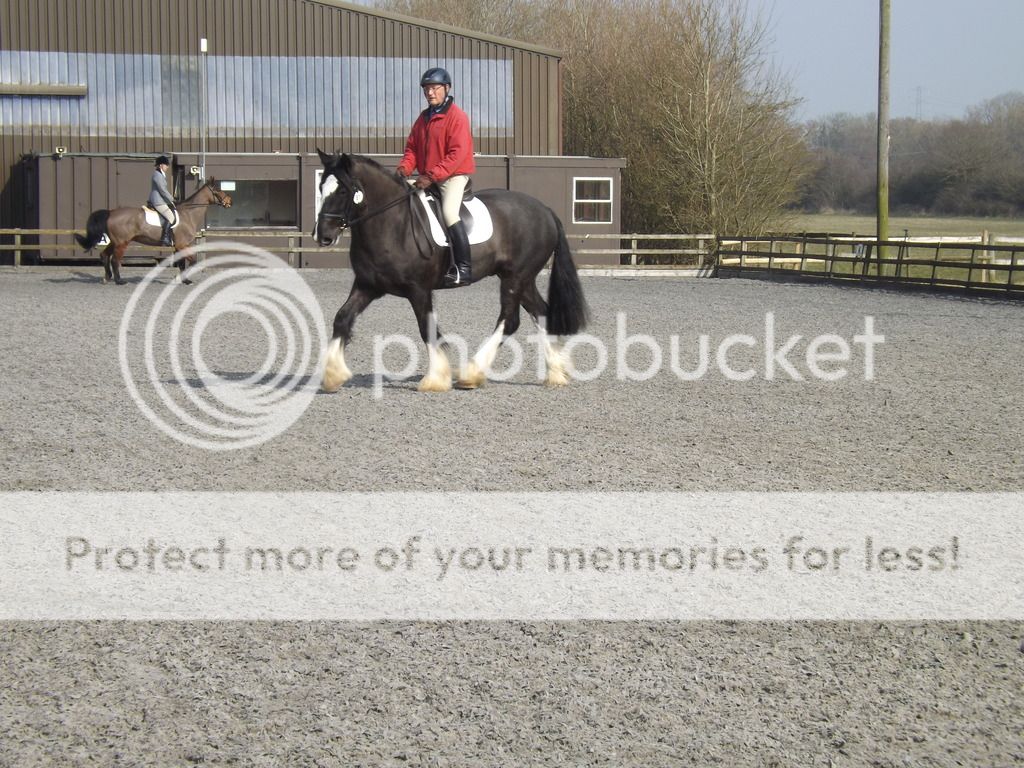
Training the over enthusiastic cart horse

AdorableAlice

Well-Known Member
Joined
24 October 2011
Messages
13,477
Visit site
Any thoughts or ideas please.

The boy is coming along very well with the most fabulous attitude to work. He really tries, listens intently and can get anxious very easily. He is highly intelligent and learns quickly being sharp but in a good way. Broken last summer and will be 5 in June this year. Despite looking big and strong he is weak. Work load is 2 x 20/30 minutes a week in the school and 2 x hacking for an hour. He is not lunged due to his anxiety issues and size. He has been out to baby dressage tests through the winter and is doing the walk/trot tests very successfully. The walk has all the gears in including sideways, super uphill halts and the trot is balanced and becoming uphill. His rider is balanced and has an independent seat.

And your problem is ? I hear you saying - Canter is the problem. Canter was introduced in an open environment on a uphill track following another steady horse. That was successful using a voice aid followed by the leg. In the school is another issue, canter can be obtained and the horse loves to canter but gets too forward, starts to rush and then gets anxious and unbalanced but not strong. Transitions create more anxiety but allowing the canter to rush also creates anxiety. There is not a 'no' or 'can't in this horse, he is very 'yes' and 'lets go' in his attitude.

Does anyone have any ideas regarding exercises to help balance the canter. Half halt is in the walk and trot. Maybe the horse is just not strong enough to canter in the school yet, maybe we should just canter in the open ? Is there a schooling tip that would help him engage the hind end and enable him to control the power he generates ?

We are so pleased with this horse so not at all disappointed with the canter problems, just getting this far is amazing given his well documented issues, and we are determined to get his education right.

Thank you.
 
I've found using the water treadmill weekly has really helped my draught to use his hind quarters and as a consequence he is stronger and the canter has improved enormously, but he is much older and more established than your boy.

What about introducing some pole work including canter poles so he has to focus on them rather than rushing off ? or would that create too much excitement ?

I hope Simon Bartram sees this post AA as he is always a mine of useful info and tips and very highly respected.
 
All I can tell you is my 7yrs old this year Welsh D (she has only been under saddle consistently since I bought her in June) could not canter at all at the start of this year. Cantering (let's call it cantering but what I mean is charging around in a fast Welsh trot doing the wall of death and celebrating if there were 3 canter strides joined together) in the school was a most unpleasant experience.

However we kept plugging away and 3 months later she can canter a 5m circle and round a course of jumps in a reasonably balanced and ordered fashion. She also has an absolutely massive powerful canter but was too weak to control her legs initially. There is still some way to go but I can see light at the end of the tunnel.

I did a lot of big circles in stubble fields/open spaces as well as straight lines. I don't have an arena so she only saw one for clinics but she was better every time. We did canter poles and grids in lessons, he's maybe a bit young for that but it helped her focus on the point of turning and straight lines!

I think with mine at least she needed to canter in whatever fashion, to get control of her legs. Once she was doing it without worrying about it, I started refining it.

He sounds like he will be great fun!
 
How big is your arena AA? I find the unbalanced ones much easier to teach on a bigger circle. The 18 hand Shirex I broke couldn't do a 20 m at five to save his life :)

Can he do walk to canter? If not, do you think he could learn it? I sometimes find that they find it easier not to go rushing off from a walk to canter, and it strengthens the hind end up really well.

He's of a breed to be likely to be EPSM. I would keep a check on his bum muscles for stiffness. My draftx developed symptoms after a year and a half in work, but in retrospect an unbalanced canter was his first sign. If in doubt, you could try bunging him on alcar and vitamin E for a few weeks.

PS surely Ted Is now an SUV, not a cart horse? :)
 
Last edited:
All I can tell you is my 7yrs old this year Welsh D (she has only been under saddle consistently since I bought her in June) could not canter at all at the start of this year. Cantering (let's call it cantering but what I mean is charging around in a fast Welsh trot doing the wall of death and celebrating if there were 3 canter strides joined together) in the school was a most unpleasant experience.

However we kept plugging away and 3 months later she can canter a 5m circle and round a course of jumps in a reasonably balanced and ordered fashion. She also has an absolutely massive powerful canter but was too weak to control her legs initially. There is still some way to go but I can see light at the end of the tunnel.

I did a lot of big circles in stubble fields/open spaces as well as straight lines. I don't have an arena so she only saw one for clinics but she was better every time. We did canter poles and grids in lessons, he's maybe a bit young for that but it helped her focus on the point of turning and straight lines!

I think with mine at least she needed to canter in whatever fashion, to get control of her legs. Once she was doing it without worrying about it, I started refining it.

He sounds like he will be great fun!

^^ My cob was the exact same last year. Now she has a really balanced, collectable canter, is starting her canter lateral work and is working towards changes. I also found that jumping, any-old-how has also helped, though I did start that freeschooling over grids rather than in the saddle because I like being alive!! (I had a sec D x TB that was also started late, years ago, who had the same issues and bounce grids sorted him :eek3:)

Getting control of the legs was the key for mine. Honestly she had the most appalling wall of death canter to start with, but then she figured out that she could stay upright, lost the anxiety and has come on so quickly ever since. Also found walk to canter helpful as YCBM says, as it meant we started the first stride upwards and in balance, rather than running out of balance.
 
I second the walk to canter. My Connie mare, (a lot) older but has been a brood mare, has a dreadful canter. When I first started riding her she was a 'go so fast until you fall into it' then 'motor around all bent the wrong way' sort. Being a Connie, she hauled herself around on her forehand and pulled like a train. My backside could not stay in the saddle. In truth, although not a tonne of carthorse, she was half a tonne of accident waiting to happen.

Last year, however, we managed to score a couple of 8s, a 7.5 for a counter canter and a handful of 7s for the medium. It took an age. Months of 3 - 4 times per week schooling. I was instructed to walk to canter to walk (even with 10 strides of trot for an aeon) with half halts before each transition. The canter was on an enormous circle (30 m - we had a huge school). She was allowed to go perhaps 15 strides maximum before we had to come back to walk - before that, fewer strides - barely 10. I had to really really sit in the saddle (difficult when you are being catapulted forward every stride) so removed my stirrups to make life easier. Each stride I had to physically lift her with both calves. Hands were to do nothing except assist the steer and ask for inside bend. It felt terribly unbalanced, and far faster than I would have considered a norm to start off with. Once she found her legs and responded to mine, we allowed her to complete a circle. In the end we were doing about 25 minutes of canter work in a 45 minute session. And it was done with a minimal of trot warm up so she wasn't tired.

She had a three months off where I was up North and she was still in P'borough, and it all fell apart. I've started again from scratch and am just about able to get a circle and half a long side out of her before we fall onto our forehand.

Hope this helps as an addition to the above advice.
 
Last edited:
third for the walk to canter transition, but another thing which helped mine another cart horse was serpentine's, cantering them. don't panic i am not talking the whole thing with a flying change, but cantering the curve from a walk transition, back to trot to walk then walk the curve and back to canter a curve and back to trot. this is small sections of canter, not enough to start to think i am unbalanced and therefore should do the wall of death. i also included spiral leg yields at walk to start with in from a 20 m to a 10 m and then back out again, really helped the balance.
 
My lad (18hh clydie) took years to gain any balance in canter in an arena. I got him at 6 1/2 from a trekking centre and he was great in open spaces but in the school it was just so hard for him. I found jumping and poles brilliant to help him, for a long while I could get the most beautiful canter if we were jumping but it wasn't seen in dressage until he was about 11! Again the walk to canters got better results than the trot to canters, if he is forward thinking it shouldn't be too hard to teach him these. Getting him bending through his body will help though, I swear we went through a phase where we changed the rein on every lap of the school! If he is a genuine cart horse don't forget they continue physically maturing until 8 years old so physically he's still young.
 
On training a selection of baby Police horses (min height 17hh, and often very carthorse in style - but with feathers clipped off and manes pulled) I have a few things that worked for us.

First was a lot of hacking, up and down hill, which strengthened them immensely. Then to improve the canter they have to... canter, so we did a fair bit of it in a field, so cantering a HUuuuuuge circle, and at it for a while.

In the school they often seemed unnerved when cantering, as I think they worried about how tight it was. We did a lot of walk to canter, even rein back to canter, as the first few strides are OK :-) and then back to walk. The walk does not allow them to be uptight, or if they do we just walked some more until they were not!

I found with the big babies that they would actually appreciate an exercise I christened the "repetitive loop" where we had a simple exercise, including a rein change, and we repeated it many times, just changing one thing each time. So, maybe, a simple one would be; a circle, change rein, circle, change rein. Then add one more thing in, such as; a halt at A, circle change rein, halt at C, circle then change rein. Each time repeating three times or so before changing the exercise. This could even start at all walk, and be part of the warm up.

By the end, after a few laps, by adding one move in at a time, they have something quite complicated such as halt at A, walk 1/4 circle, canter 1/2 circle, trot 1/4 circle, walk at 1/4 marker, change rein and repeat.

This does not seem to blow their minds, as it was a repetitive loop, and each new move was only added one at a time. They anticipate, and I would use the anticipation to my advantage, such as they will anticipate the canter and what was a torrid walk/canter trans would become OK!

Having said that we would never do more than 1/2 hour in the school, including a cool off at walk.

Once the canter was OK for the few strides after the walk/canter trans, then I would make the canter longer, but come back to trot before they had really lost their balance, and if they are dire on the downward make a halt ASAP.
 
Not a suggestion to help AA but just a thanks to those who have contributed so far to this thread. I find your posts really interesting and I am learning so much from your experience, thank you for sharing!
 
Our big elephant we didn't canter him in the school for a good six months as he just couldn't cope and didn't have ethereal balance.

We did our cantering out and about. Learning cantering round corners in big feilds then doing it in the smaller ones so he could learn to balance round them easily.


Hope that helps :)
 
Thank you so much for all the thoughts and ideas. A very big thank you to the advanced rider who Pm'ed me.

The furry fool is being sent to fairyland on Friday to have his mouth checked, I wonder if my blades are still sharp, those feathers need to go for the summer, but then he won't be a carthorse any more and could look even more common. Decisions decisions.

DSCF2334_zpsfv9hnemg.jpg
 
Could he do some schooling in the field AA? so bigger space but circles slowly introduced.
My only other thought would be canter the long side, praise, stop, change the subject to something else entirely?
lungeable so he doesn't worry about a person too?

I'm rather surprised you have left those feathers as long as you have, perhaps without he will be more aerodynamic anyway ;)
 
Could he do some schooling in the field AA? so bigger space but circles slowly introduced.
My only other thought would be canter the long side, praise, stop, change the subject to something else entirely?
lungeable so he doesn't worry about a person too?

I'm rather surprised you have left those feathers as long as you have, perhaps without he will be more aerodynamic anyway ;)

Our fields are drying at last. He lives out with access to a barn, so has been left furry for winter. His feathers are fine and silky rather than bog brush like. I expect they will go at some point though.
 
I feel quite let down!.I looked at the title of this post and thought"at last someone has written a training book for my horse".I was about to go on amazon and buy it. Darn!
 
I feel quite let down!.I looked at the title of this post and thought"at last someone has written a training book for my horse".I was about to go on amazon and buy it. Darn!

When you find it please buy me one. I thought carthorses were dopes on ropes !
 
The advice has been put into practice, cantering in the open as gone well and the school exercises have eased some of the anxiety.

The transition to canter is much improved although he still cannot maintain more than a few steps in the school and gets curled up quickly, out in the fields he is cantering away nicely with a nice open frame. In fact the one canter in the open was worthy of a grand prix dressage test - amazing how much cadence and elevation a horse can produce when a canal barge appears from behind the bushes !

Thank you for all the guidance.

P1010066_zpshv3ptjac.jpg
 
Nothing particularly useful to add but if you want to increase forward, cadence and elevation get your local friendly farmer to set up a gas gun crow scarer thingy next to your school. Worked a treat on my Highland pony this morning :0 Absolutely love your updates, all written with such good humour and common sense. Your horses are very lucky to have you x
 
Nothing particularly useful to add but if you want to increase forward, cadence and elevation get your local friendly farmer to set up a gas gun crow scarer thingy next to your school. Worked a treat on my Highland pony this morning :0 Absolutely love your updates, all written with such good humour and common sense. Your horses are very lucky to have you x

You are very kind.

We are surrounded by gas guns at home and they have all got used to them. We took the ginger ninja to Solihull last week for outdoor dressage. There is a gun club adjacent and it was in full flow, so many horses got upset and there were many ruined tests, our lad just got on with his job. Training by default !
 
Ted & Alice will be immune then. My poor pony thought he was in a bad episode of Carry on Cowboy, although it did prove to me that big boys can move when they need to :)
 
Very interesting thread. I have a 14.2hh cart pony who is currently at novice/elementary dressage. His canter has a tendency to go four-time so it's our main area for improvement. I'm finding walk to canter/canter to walk is helping me with balance and collection as well as forcing me to actually ride the canter (I occasionally freeze!). Raised trotting poles can be useful. My canter for jumping is loads better than my dressage canter so I need to try to ride all canter like that.

Your horse is beautiful! Feathers or no feathers :)
 
The advice has been put into practice, cantering in the open as gone well and the school exercises have eased some of the anxiety.

The transition to canter is much improved although he still cannot maintain more than a few steps in the school and gets curled up quickly, out in the fields he is cantering away nicely with a nice open frame. In fact the one canter in the open was worthy of a grand prix dressage test - amazing how much cadence and elevation a horse can produce when a canal barge appears from behind the bushes !

Thank you for all the guidance.

P1010066_zpshv3ptjac.jpg

Glad we could help.

The canter in the school will come on slowly. It took the elephant six months to be able to.canter in a 20 by 40 now our school is being made into a 60 by 60 so lots more room to canter in :D
 
Top