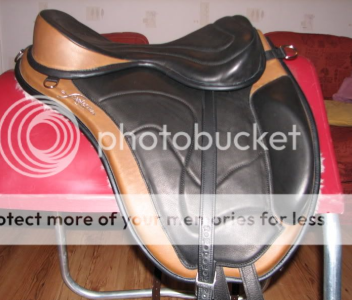
Treeless saddles and the horse's back

FieldOrnaments

Well-Known Member
Joined
29 June 2022
Messages
3,116
Visit site
I don't understand why this is eating me so much right now because it has precisely no relevance to my life whatsoever, but if the purpose of a tree is to spread the rider's weight evenly across the longissimus dorsi and keep it off the spine, how does a treeless saddle do it (in terms of mechanics)? And how do they differ in construction from a leather treed saddle?

This has been irking me ages like a really annoying terrier chewing your trouser leg whilst your leg is still inside 🙃🙃🙃🙃
 
I think the short answer is that it doesn't (in terms of mechanics).

It relies more on padding to spread the weight, and on the rider taking more responsibility to sit in a balanced position. I think.
In trying to compute this with what seems often like rather forward stirrups. I look at a lot of treeless saddles and though I like the idea of some flexibility versus the rigidity of a treed saddle it just seems like they would make the rider more inclined to chair seat
 
I have been riding in a Torsion saddle for many years and my pony's back is always found free of tension or sore areas by the physios. I do not believe treeless saddles distribute the rider's weight either, all I expect them to do is cushion any potential pressure points from my bones or the stirrup and girth attachments. Well developed back muscles in the horse and correct posture are key to a pain free back. Even a well fitting treed saddle will not guarantee a pain free back if this is missing.

As for a chair seat, customising the saddle to adjust its balance and the way it supports the rider's weight as well as good stirrup placement make all the difference. Either find a specialist fitter like sbloom to help with this or do it yourself as I have to do living in the south. And buy one of the makes which have proven themselves in endurance riding.
 
Not all treeless saddles are equal. A bodyworker friend of mine works at a yard where many ride in Solutions and almost without exception the horses are tight around their shoulders - although backs are fine.

Ghost seem very popular but need to be fitted properly otherwise they definitely lead to bad backs (£2k vet bill for someone i know whose horse started napping badly. New saddle fitter took away the Ghost and ta da horse improved)

I trialled a TCS unsuccessfully but they delete any negative posts which is why you rarely see them.
 
They are all very different and some marketed as treeless have a part tree at the front.
My horse has been in Smart saddles very comfortably for years, and the only soreness ever found is from ridiculous field antics! All of his body workers think he is in amazing shape. BUT I do have the saddle fit regularly checked by a brand recommended fitter.
 
I have been riding in a Torsion saddle for many years and my pony's back is always found free of tension or sore areas by the physios. I do not believe treeless saddles distribute the rider's weight either, all I expect them to do is cushion any potential pressure points from my bones or the stirrup and girth attachments. Well developed back muscles in the horse and correct posture are key to a pain free back. Even a well fitting treed saddle will not guarantee a pain free back if this is missing.

As for a chair seat, customising the saddle to adjust its balance and the way it supports the rider's weight as well as good stirrup placement make all the difference. Either find a specialist fitter like sbloom to help with this or do it yourself as I have to do living in the south. And buy one of the makes which have proven themselves in endurance riding.
I used both a Solution saddle and then a Torsion until I could find a treed saddle for my young horse who was very difficult to fit. The Solution gave him a sore back, the Torsion one didn't. The Torsion one put me in an armchair seat but it was better than not riding so I went with it. Finally found a treed saddle that fitted and good position returned.
 
I have an ansur on my 25 Yr old, and a deuber which suits a 16.2 hh

The ansur is the one I prefer, it's has no thigh or knee rolls, I think you need to be in control of your own body and poised, but the horse just goes so well in it that makes the whole experience come together, I use a prolite pad underneath, he really uses his back and feels very free and forwards

At the end if the day its how the horse goes that counts I ride a lot so that helps with maintaining posture
 
Treeless saddles vary as much as treed, and bear in mind that western, English, Wow, flexi panel, leather trees (arguably), changeable headplate etc etc all come under the treed banner.

Ghost uses a carbon fibre base, same material that a Wow tree is made from, which does spread weight, to an extent. However....English saddle fitting has an obsession with spreading weight above and beyond so many other important factors.

Here's a post of mine explaining why that can mislead us , and a video
which explains and demonstrates more about the principal of how to load the rider.

A treed saddle, especially a good, sympathetic fit for a wide horse, is MUCH more likely to put a rider in a chair seat than a well designed treeless with a twist, LIFTING the rider is often part of giving them a narrower base of support rather than the close contact approach of saddles for cobs which puts the rider right onto that very wide back. Think about pelvic shape and hip geometry and what might push the knees forwards....it's not just about stirrup bar position.

And yes, treeless saddles need to be fitted just as much as treed, selected carefully as suitable and them put in correct balance, as well as lot of other subtleties. The biggest difference is going forwards when they can be owner adjustable but again, unless you really have a feel for this, do it with the help of a fitter.
 
Centuries ago,when saddles were evolving and being developed the tree was designed and fitted. This had to be for a reason,it bejng more difficult to make a treed saddle than just slinging a padded blanket on the horse. They must have discovered that stirrups caused sore points and developed the tree to spread the pressure and help the back generally. I think this says it all. Treeless saddles were superceeded by something better.
 
Treeless saddles vary as much as treed, and bear in mind that western, English, Wow, flexi panel, leather trees (arguably), changeable headplate etc etc all come under the treed banner.

Ghost uses a carbon fibre base, same material that a Wow tree is made from, which does spread weight, to an extent. However....English saddle fitting has an obsession with spreading weight above and beyond so many other important factors.

Here's a post of mine explaining why that can mislead us , and a video
which explains and demonstrates more about the principal of how to load the rider.

A treed saddle, especially a good, sympathetic fit for a wide horse, is MUCH more likely to put a rider in a chair seat than a well designed treeless with a twist, LIFTING the rider is often part of giving them a narrower base of support rather than the close contact approach of saddles for cobs which puts the rider right onto that very wide back. Think about pelvic shape and hip geometry and what might push the knees forwards....it's not just about stirrup bar position.

And yes, treeless saddles need to be fitted just as much as treed, selected carefully as suitable and them put in correct balance, as well as lot of other subtleties. The biggest difference is going forwards when they can be owner adjustable but again, unless you really have a feel for this, do it with the help of a fitter.
I use a hip saver to give the Torsion the right twist for me. Without it my position would be (and feel) horrible.
 
I use a hip saver to give the Torsion the right twist for me. Without it my position would be (and feel) horrible.

Yep, twist width is one important factor, and there are other factors that also shift where a rider will sit in the seat, even if that saddle is in balance. I used to sit too far back as most twists were too narrow for comfort. And sitting back, with a rear set stirrup bar to compensate, isn't anywhere near as good for the horse as a saddle naturally sitting the rider forwards, at the base of the wither, with a more "normal" bar placement. The horse carries us more easily there. It's quite complex.
 
Centuries ago,when saddles were evolving and being developed the tree was designed and fitted. This had to be for a reason,it bejng more difficult to make a treed saddle than just slinging a padded blanket on the horse. They must have discovered that stirrups caused sore points and developed the tree to spread the pressure and help the back generally. I think this says it all. Treeless saddles were superceeded by something better.

I am far from an expert on the history of saddle design, and relatively new to fitting treeless, but it's more nuanced than that and there were many clever treeless designs that were much more than a folded blanket. Each culture has its own saddle history and it will at least in part relate to the discipline, the type of riding that's being done and the type of horse and rider (eg heavy armour). Every aspect of saddle fitting, just as with horse training, has its downside, so with a treed saddle we lose flexibility but gain stability, broadly. Modern designs do better, with less compromise, providing a good deal of stability in many cases.

Also remember that the English tree, from I believe De La Guiniere onwards, is the most recent of all saddle structures, and actually spreads weight the least compared to other solid tree types. The English tree is reasonably rare on longer distance endurance rides, for example, and many long riders and other devotees of more substantial saddles loathe the English saddle.
 
I am far from an expert on the history of saddle design, and relatively new to fitting treeless, but it's more nuanced than that and there were many clever treeless designs that were much more than a folded blanket. Each culture has its own saddle history and it will at least in part relate to the discipline, the type of riding that's being done and the type of horse and rider (eg heavy armour). Every aspect of saddle fitting, just as with horse training, has its downside, so with a treed saddle we lose flexibility but gain stability, broadly. Modern designs do better, with less compromise, providing a good deal of stability in many cases.

Also remember that the English tree, from I believe De La Guiniere onwards, is the most recent of all saddle structures, and actually spreads weight the least compared to other solid tree types. The English tree is reasonably rare on longer distance endurance rides, for example, and many long riders and other devotees of more substantial saddles loathe the English saddle.
Im retired from endurance riding now but loved my english treed saddle when I did compete. Horse went well in it and won several awards.I think saying devotees of endurace loathe the english tree is factually incorrect and too sweeping a statement. Some possibly do. This one certainly did not nor did my fellow team members and companions.
 
Im retired from endurance riding but loved my english treed saddle. Horse went well in it and won several awards.

I didn't say they weren't in the sport at all, but if you look at Tevis etc you'll see way more stock/western, specialist endurance and treeless. In northern Europe when someone says saddle we picture an English treed saddle but we are in the minority.
 
Ive been using a treeless saddle for about 20 years now.

I have only used the Barefoot Cheyenne and a Torsion. Prefer the Barefoot.

When in regular work, all of mine saw a physio and there was never anything negative to be found over the years.

I'm not weighty though, I guess. Usually floating between 9.5-10 stone.

I might look into other types actually. I only have a yearling now, so I might get something new and lush for him. How exciting.
 
When treed saddles were first invented, there were also treeless options (Native Americans, Spanish shepherds etc). They used materials we now know to spread pressure, to distribute weight. Mostly for long distances with little jumping. Eased the pressure from the seat bones on horse and rider.

In the modern evolution of treeless saddles, I think only the Solution/Ansur is really recommended for jumping and I personally have treed saddles for the kids to jump. I have had pressure tested treeless for myself and adult friends - Freeform (the actual expensive ones) and Torsion. I have popped logs and tiny x poles but not much more with those.

How do they work?
The pressure is spread in the Freeform by a fairly rigid foam construction which uses modern materials to spread pressure. That in itself makes it less flexible. Under that firmer foam base you can then either have the stuffed panels as in a treed saddle or a thick foam treeless pad.

Torsion: the pressure is again spread through the base- by a combination of materials - then again by the treeless pad underneath (made from pressure distributing materials).

Both of the above are so very very comfortable over long distances. Torsion the most in my experience.

We also have TCS saddles for the kids (and I now due to pony’s preference - I’m 9 stone) to hack/school. These rely entirely on what you put UNDER them to distribute the pressure. That makes them extremely customisable but does place the burden of knowledge on the owner. With a fair amount of experimentation and reading about the pressure distribution of various materials, we have setups that work well, give spinal clearance and happy ponies. I find these saddles particularly good for starting youngsters and for those who come to us with prior bad experiences with treed saddles. They look different. They feel different. They allow that bad association to be broken and trust to be built. We are very careful though and check each ride just as we would with any saddle, swapping out pads as weight changes through the year. All of ours eventually swap happily between treeless and treed, knowing that their treed saddle is for jumping so = fun exciting times!

I got into treeless because I have always had youngsters and the constant changes as they grew meant the saddle was constantly not right. In an adult horse, I’d be happy to have a treed saddle and stick with that. Given that we ride multiple horses daily, treeless is simply easier. I can take one saddle per person (with a girth or two and maybe an extra pad) to the yard not one per horse!
 
Last edited:
You need to source the correct saddle pads for the saddle, to give the correct profile and protection. And yes, the rider's weight in proportion to the horse probably does matter. Barefoot saddles used to be sold in dress sizes - size 1 was 10 - 12 and size 2 was 12 - 14 I think. Their instructions used to recommend a treed saddle for a heavier rider.
 
Some treeless have plenty of spinal clearance and padding for at least a well balanced rider, shorter rides etc, it really varies a lot. Many will need at least sheepskin or similar to give extra protection, and having a pad that can take shims can be useful. And again weight of rider can be variable, depending on how well the saddle sits them, their own balance and ability, the condition of the horse, and the work done.
 
Over the years, I rode mainly in treeless saddles and absolutely loathe my share horse's treed saddle. With the treeless saddles, I used the correct padding for each horse and saddle and regularly tested weight distribution with a Port Lewis Impression Pad which always showed a nice, even distribution. I also checked sweat patches on both horse and saddle pad after faster rides to make sure they were even. My ponies always had good, healthily muscled backs and no back issues were ever detected when they had physio/massage or vet visits. I did mainly hack with minimal jumping though (the jump in my avatar picture was about as big as I voluntarily jumped - as I'm a wimp, nothing to do with the saddle!)

I have owned a Fitform, two Freeforms, a Diddi Pad and a Libra Trec and have ridden in a Barefoot Cheyenne, a Ghost Quevis, a Heather Moffett Vogue and a Heather Moffett FlexEE (earliest model). Of all of these, the Freeform was by far my favourite and I'd have another in a heartbeat if I had a horse to wear it. I've always wanted a Sensation and if I found one at the right price I'd have it (even though I don't have a horse to put it on 😂 ).

A gratuitous photo of my favourite saddle ever - my second Freeform:
Screenshot 2026-03-20 14.43.30.png
 
Last edited:
I have only ridden in one and it was like princess and the pea. So much padding, I felt really unbalanced and far away. I think the same although I see loads of tcs promotion recently and I don't understand how they don't put too much pressure on the spine
Agree, I borrowed one when i was between saddles and wanted to keep my horse in work. The owner assurred me it was guarenteed to fot anything and I'd love it....
Awful, I was so happy to be back at home and safely on the floor!
I think the reason the terrier is chomping on your trouser leg is because there is no making sense of how a treeless saddle can do what a tree'd/treeed saddle is meant to do.

Tell the terrier he can rest now. He might be exhausted.
Nah, Its a terrier. They recharge as they go!
 
Agree, I borrowed one when i was between saddles and wanted to keep my horse in work. The owner assurred me it was guarenteed to fot anything and I'd love it....
Awful, I was so happy to be back at home and safely on the floor!

Nah, Its a terrier. They recharge as they go!
Can someone put this particular terrier in a kevlar crate and throw it in the Pacific Ocean, ta muchly
 
All the treeless I've felt very very far removed from the horse but not very stable or supported if I'm honest and just not comfortable
I'm not a good rider though and I do wonder does a treeless saddle demand a slightly different riding style than English treed- like you'd ride different in a stock saddle to a jumping saddle
 
As well as the type of saddle, I suppose it depends on the type of horse you have too - a tall, thin thoroughbred would need a lot more padding to achieve spine clearance in a treeless than a small, fat native pony, putting you further away from the horse than a treed saddle would. I've always felt closer to, wrapped around and in better balance with the horse treeless than treed, but that was on small native ponies who only needed minimal padding to achieve spine clearance and weight distribution.

The twist is basically a description of the width of the seat. I like a wide twist but lots of people prefer a narrow twist. I think it comes down to personal preference and pelvis width.
 
I rode in an Ansur (profesionally fitted and regularly checked) for years on my (now retired) horse. I loved it and he went better in it than anything else. My physio told me that she found horses didn't seem to have any issues with treeless when the rider felt comfortable, but treeless did cause issues when this wasn't the case. Maybe it's more to do with how the rider sits in the saddle than the actual saddle.

I've tried the saddle on my younger horse and don't get the same feeling at all. I don't feel as secure as in my treed and I feel as though I'm riding like a sack of sh!t. Horse certainly doesn't prefer it either. Shame as it was the comfiest saddle I've ever ridden in.
 
All the treeless I've felt very very far removed from the horse but not very stable or supported if I'm honest and just not comfortable
I'm not a good rider though and I do wonder does a treeless saddle demand a slightly different riding style than English treed- like you'd ride different in a stock saddle to a jumping saddle


The twist is towards the pommel at the front if the saddle, where the saddle decends into where you would sit, some saddles feel quite wide there and other are narrow

Some are actually stable feeling the ansur i was surprised sits solidly, and is fairly close contact i find, but if you are perhaps not riding a lot your posture may more difficult to maintain, its more effort for me to sit how i want, but the horse i am riding is very forward going in the ansur which i find helps, i can just think more how i am sitting than worry about motivating the horse

The deuber is a very strong and stable saddle
 
Top