Weight loss…which method??

And yet there's plenty of research out there, dating back a fair way, that shows that basic biology is far from simple, and weight loss is very different for everyone. It's why I direct everyone to Rebelfit because they look at what causes YOUR individual set point weight (the weight your mind and body will gravitate to, and there's not always too much you can do to avoid it) and help you deal first with that through mental health, environment etc. Then those choices, and that "basic biology" can START to apply to those people, with caution.
Everyone's mental attitude may be different but bodies are the same. Eating in a deficit results in weight loss.

Your body cannot gravitate to, or remain at, a higher weight without the calories to create, or sustain, it.
 
Everyone's mental attitude may be different but bodies are the same. Eating in a deficit results in weight loss.

Your body cannot gravitate to, or remain at, a higher weight without the calories to create, or sustain, it.

I despair. Read what I actually wrote. Eating a calorie deficit will work as long as you can maintain it. Why does Slimming World and WW leave most (all? There has been research done) heavier than they were before their first diet, long term? Just a random explainer post from Rebelfit.


And I don't believe that we still find that bodies ARE the same, we're finding all sorts of markers than mean bodies use food differently, down to, I think, calorie level. For instance https://www.healthwebmagazine.com/role-of-hormones-fat-storage-and-fat-burning
 
Eating a calorie deficit will work as long as you can maintain it.

That is exactly the point that you keep refuting. Eating in a deficit will result in weight loss. Someone's mental capacity/ability/willingness to make those better choices, to become a weight that is healthy for them, will differ person to person. That is not because their body is different.

It is very simple to use a free online TDEE calculator and learn how many calories are required daily. Losing weight means eating in a deficit. It is not as complicated as you keep trying to make it out to be.

That healthy weight may differ person to person but eating in a calorie deficit is how weight is reduced. There are no ifs and buts.
 
That is exactly the point that you keep refuting. Eating in a deficit will result in weight loss. Someone's mental capacity/ability/willingness to make those better choices, to become a weight that is healthy for them, will differ person to person. That is not because their body is different.

It is very simple to use a free online TDEE calculator and learn how many calories are required daily. Losing weight means eating in a deficit. It is not as complicated as you keep trying to make it out to be.

That healthy weight may differ person to person but eating in a calorie deficit is how weight is reduced. There are no ifs and buts.
Finally...... 👏👏👏
 
If it was that simple no-one, or vastly fewer numbers, would be overweight. If that's the only thing you keep telling people you just make those finding it much tougher than others really bad, and there are good reasons they are finding it much harder. Set point weight tackles that and helps people get to the place where they can start to achieve a calorie deficit in a healthy long term context.

The fact that SW "graduates" all put the weight back on, and often more weight, long term, evidences that it is NOT simple. Why do we applaud a message that helps only a minority of people to be healthy and maintain a healthy weight and dismiss science that says it's not that simple? I mean JUST on hormones, one factor in a plethora of biological, emotional and environmental factors, I will quote from the link I posted -

"Moreover, the interplay between genetics, lifestyle, and environmental factors adds additional layers of complexity to weight management. For instance, genetic predispositions can affect how hormones are produced and how effectively they function, influencing an individual’s propensity for gaining or losing weight. Lifestyle choices, including diet, exercise, sleep, and stress management, directly impact hormonal balance. Environmental factors, such as exposure to endocrine-disrupting chemicals, can further complicate the delicate hormonal equilibrium necessary for optimal fat metabolism."

Does it make some people feel better to tell other people that they're lazy, or some other reason for them not being able to maintain a calorie deficit? It's a bit like first wave feminists telling younger women that they managed the mysogyny so why shouldn't the younger women? Or perhaps someone dismissing clinical depression as someone being a bit blue, and they should go for a run when the person is barely functioning. I don't get why people do this.

I'd prefer some progress in the world, to learn from science as it emerges.
 
Last edited:
Excuse the copy and paste but I know a lot of people won’t follow a link. I think this excerpt from Harvard Health sums things up much better than I can:


Genetic influences​

To date, more than 400 different genes have been implicated in the causes of overweight or obesity, although only a handful appear to be major players. Genes contribute to the causes of obesity in many ways, by affecting appetite, satiety (the sense of fullness), metabolism, food cravings, body-fat distribution, and the tendency to use eating as a way to cope with stress.

The strength of the genetic influence on weight disorders varies quite a bit from person to person. Research suggests that for some people, genes account for just 25% of the predisposition to be overweight, while for others the genetic influence is as high as 70% to 80%. Having a rough idea of how large a role genes play in your weight may be helpful in terms of treating your weight problems.

How much of your weight depends on your genes?​

Genes are probably a significant contributor to your obesity if you have most or all of the following characteristics:

  • You have been overweight for much of your life.
  • One or both of your parents or several other blood relatives are significantly overweight. If both of your parents have obesity, your likelihood of developing obesity is as high as 80%.
  • You can't lose weight even when you increase your physical activity and stick to a low-calorie diet for many months.
Genes are probably a lower contributor for you if you have most or all of the following characteristics:

  • You are strongly influenced by the availability of food.
  • You are moderately overweight, but you can lose weight when you follow a reasonable diet and exercise program.
  • You regain lost weight during the holiday season, after changing your eating or exercise habits, or at times when you experience psychological or social problems.
These circumstances suggest that you have a genetic predisposition to be heavy, but it's not so great that you can't overcome it with some effort.

At the other end of the spectrum, you can assume that your genetic predisposition to obesity is modest if your weight is normal and doesn't increase even when you regularly indulge in high-calorie foods and rarely exercise.

People with only a moderate genetic predisposition to be overweight have a good chance of losing weight on their own by eating fewer calories and getting more vigorous exercise more often. These people are more likely to be able to maintain this lower weight.

What are thrifty genes?​

When the prey escaped or the crops failed, how did our ancestors survive? Those who could store body fat to live off during the lean times lived, and those who couldn't, perished. This evolutionary adaptation explains why most modern humans — about 85% of us — carry so-called thrifty genes, which help us conserve energy and store fat. Today, of course, these thrifty genes are a curse rather than a blessing. Not only is food readily available to us nearly around the clock, we don't even have to hunt or harvest it!

In contrast, people with a strong genetic predisposition to obesity may not be able to lose weight with the usual forms of diet and exercise therapy. Even if they lose weight, they are less likely to maintain the weight loss. For people with a very strong genetic predisposition, sheer willpower is ineffective in counteracting their tendency to be overweight. Typically, these people can maintain weight loss only under a doctor's guidance. They are also the most likely to require weight-loss drugs or surgery.”
 
That is exactly the point that you keep refuting. Eating in a deficit will result in weight loss. Someone's mental capacity/ability/willingness to make those better choices, to become a weight that is healthy for them, will differ person to person. That is not because their body is different.

It is very simple to use a free online TDEE calculator and learn how many calories are required daily. Losing weight means eating in a deficit. It is not as complicated as you keep trying to make it out to be.

That healthy weight may differ person to person but eating in a calorie deficit is how weight is reduced. There are no ifs and buts.
Your brain is a part of your body - you can't escape it by just deciding to.

And what different people's brains are able to cope with and sustain in terms of lifestyle and diet choices varies wildly. A lot of people struggle most fundamentally with finding what works for them overall, and sometimes considerable psychological intervention is required for people to find that. That is not because they are lazy, or stupid, or over-complicating the situation, it is because the brain part of their body is complicated and is being a hindrance to them making the choices they would like to make.
 
  • Like
Reactions: SEL
Your brain is a part of your body - you can't escape it by just deciding to.

And what different people's brains are able to cope with and sustain in terms of lifestyle and diet choices varies wildly. A lot of people struggle most fundamentally with finding what works for them overall, and sometimes considerable psychological intervention is required for people to find that. That is not because they are lazy, or stupid, or over-complicating the situation, it is because the brain part of their body is complicated and is being a hindrance to them making the choices they would like to make.
I completely agree with you.

The rule still stands that eating in a deficit [for that person] will result in weightloss.

There absolutely are mental aspects to weightloss and changing eating habits to enable them to eat in a deficit.

However, that does not change the fact that weighloss will occur when eating in a deficit, and don't have underlying medical issues or using medication that causes weight gain. There are many roads to Rome but the end point to weight loss is always going to be eating in a deficit (excluding liposuction).
 
It didn't apply to you so it can't apply to anyone else? You know that's not how science works. Clearly yours was hormonal, taking the pill increased your set point weight. Your family don't have the gene. A possibly over simplification of course but...

Why do we have to be so hard on people, even if you don't believe in the proven science? The main approach has been to bully people, fat shame them, tell them it's easy, it's simple, it's just a calorie deficit (or whatever wording we used in the past) and it's not exactly worked, has it?

It's just cruel and completely ignoring the science.
 
Last edited:
A bit of a light bulb moment for me was a radio 4 discussion a while ago. I cannot remember the ins and outs but at the end the nutritionist speaking quoted someone (I don't know who) and said if you want to keep it simple follow this..."eat, not too much, mainly plants". It just made things clearer.
 
It didn't apply to you so it can't apply to anyone else? You know that's not how science works. Clearly yours was hormonal, taking the pill increased your set point weight. Your family don't have the gene. A possibly over simplification of course but...

Why do we have to be so hard on people, even if you don't believe in the proven science? The main approach has been to bully people, fat shame them, tell them it's easy, it's simple, it's just a calorie deficit (or whatever wording we used in the past) and it's not exactly worked, has it?

It's just cruel and completely ignoring the science.
Wtf is that response meant to be!

I said I!! Clearly referring to me!! Or am I missing something???

No it wasnt hormonal because I came off the pill very shortly after that and still stayed fatter! I literally woke up one morning with 34DD and they just grew and grew. Could not lose it at all despite doing zumba 5 nights a week, swimming for 4. Riding. I was still a size 16 and weighed 13 stone although all muscle. It was very depressing !

IN MY EXPERIENCE GENES HAVE NOTHING TO DO WITH IT.

My mum is slim 5’9, my dad 5’10 and brother 6’2 and I am 5’2. Nothing in that even relates me to them 🤣
Everyone is different, Its your Donald Duck. My mother put me in the grow bag the wrong way round.

Anyway, I don’t really care, Im a size 12/14 now and have done what I wanted by myself 😀
I am also the last person in the world to fat shame anyone , I have been an 18 at my heaviest.
 
@Barton Bounty logically your experience in no way can be evidence that the influence of genes isn't real. That's all. Just because you don't fat shame doesn't mean that it isn't what so many people face, and saying that weight loss is simple and easy isn't too far from fat shaming, in its effect. It doesn't motivate people to lose weight.

Anyway I'm done here, the science is out there for anyone to find.
 
If it was that simple no-one, or vastly fewer numbers, would be overweight. If that's the only thing you keep telling people you just make those finding it much tougher than others really bad, and there are good reasons they are finding it much harder. Set point weight tackles that and helps people get to the place where they can start to achieve a calorie deficit in a healthy long term context.

Actually it is that simple, and there's a big majority of people that overeat both by volume and calorie intake but don't do enough burn it off hence why so many are overweight in the UK. Yes people will lose it over a different periods of time/in different ways, various stages of the lifecycle especially for women, (some may struggle due to underlying conditions), and it does require a level of discipline, which again varies between each person, but the basic in vs out equation is quite black and white.


I've just reduced my calorie intake and simulatenously upped my exercise - there's a noticeable change already!
 
Last edited:
Genes stop you losing weight. Doesn't mean they don't have an impact or cannot do that.

Simple example: my red mice are hungrier and consequently fatter than my non red mice. Identical diet.
Same gene (yep, just one - out of 25,000 in the human genome) affects people's propensity to obesity too.
https://www.jpeds.com/article/S0022-3476(01)68081-8/fulltext

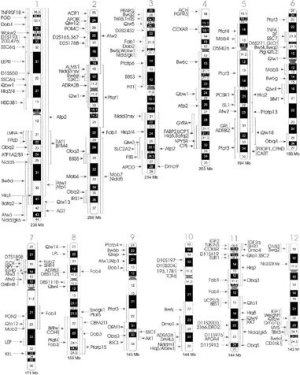
There's this beautiful thing called the human obesity gene map:
795.jpg
 
I completely agree with you.

The rule still stands that eating in a deficit [for that person] will result in weightloss.

There absolutely are mental aspects to weightloss and changing eating habits to enable them to eat in a deficit.

However, that does not change the fact that weighloss will occur when eating in a deficit, and don't have underlying medical issues or using medication that causes weight gain. There are many roads to Rome but the end point to weight loss is always going to be eating in a deficit (excluding liposuction).
Sure, I think often it's just that on this topic people are having separate conversations - some people are talking about the mechanism of how you lose weight, and others are talking about the reality of achieving that mechanism (which is often more about psychology than anything else, incl. the genetic, environmental and hormonal side of that psychology).

Excluding the psychological aspects though, there are also pretty interesting nuances to the mechanism. Like that calories expended through regular exercise are almost not worth counting - humans have an ability that is fairly unusual amongst mammals, to almost adjust out the effects of physical energy expenditure over time. People in hunter gatherer societies still consume about the same amount of calories per day as someone with a similar physique who spends most of their time sat at a desk. And that was a study that was repeated many times over by different researchers because they just couldn't believe that it was true.

And on the input side, calories are not all created equal. To work out the calorie value of food it is essentially incinerated to see how much energy it gives out, but that's not how a human body works - we don't get every calorie out of what we eat. If a human eats white granulated sugar their body can get out something like 99.5% of the calories in it, whereas for steak it is more like 70% of the calories in it that your body can use, cooking and processing things generally makes more calories available to us when we eat it that the same thing raw, etc etc.
 
Surely it’s just another addiction… when I smoked I always knew where my next cigarette was coming from.
It’s great that the jabs stop the addiction talking but at some point you need to address the addiction itself?
Probably too simplistic again but I needed to lose weight recently. I stopped all treats. It was hell but I’m over it. Just the same as giving up smoking.
 
Just an aside. A good few years ago a young GP I knew saw an overweight patient who declared that she could not lose weight no matter how little she ate.

GP replied with a then standard response ‘No fat people came out of Auschwitz’.

Patient replied ‘I was in Dachau’.

GP never used that analogy again.
 
Last edited:
I completely agree with you.

The rule still stands that eating in a deficit [for that person] will result in weightloss.

There absolutely are mental aspects to weightloss and changing eating habits to enable them to eat in a deficit.

However, that does not change the fact that weighloss will occur when eating in a deficit, and don't have underlying medical issues or using medication that causes weight gain. There are many roads to Rome but the end point to weight loss is always going to be eating in a deficit (excluding liposuction).
The fact that glp 1 are so effective suggest that actually hormone control has a LOT to do with weight gain… basically they stop you being as hungry … if it was only to do with education and “choice” then they simply wouldn’t work. Equally most people put on weight with steroids … even if they were thin before - this is because they increase hunger.

So basically it’s a fallacy to suggest that everyone’s body works the same when there are chemicals rushing around telling people,to eat more in some cases and not bother in others… this chemical signal is very strong it’s almost impossible to overcome by will power and this is why people put on weight after dieting… their will power does not last for ever…. Very very few people’s does
 
Considering PCOS can affect your fertility it is remarkable that the PCOS gene didn’t die out. However there is a train of thought that the struggle to lose weight helped women with PCOS during times of famine and the gene was able to be passed on when women who didn’t have a PCOS either died or lost so much weight they couldn’t have babies.
 
But put thirty people on bread and water for two months and some will lose 30lbs, some will lose 7. Etc.

🤷
But they still lost weight because they were eating in a deficit.

Same with the weightloss injections; they result in less calories in.

It does not matter what way you slice it; you need to be in a calorie deficit to lose weight. That change may be easier for some, some may require various types of assistance, but the change that is needed is always a calorie deficit.

Someone posted above about exercise and I agree with their information. You cannot out exercise a diet that is in excess of calories required [for weightloss].
 
I think it makes a difference where the calories come from. Eating something that is going to spike your blood glucose and release more insulin vs eating something which doesn't lead to a spike in blood glucose.

I also think it is a mistake to think of chocolate, sweets, cakes, etc as treats. They are not a treat if they are going to contribute to health problems and obesity. And if you think of them as a treat you will feel you are being deprived if you don't eat them.
 
Last edited:
Hormones, definitely. When I was pregnant I never felt full. Normally, I get full quite quickly and eat smaller meals (tasting menus are my dream!) but when I was pregnant I could eat loads and not feel sick. It was very strange.

Post children my weight stays pretty constant without much effort, even the nurses call me consistent when they weight me! 😁
 
Top