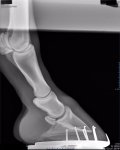
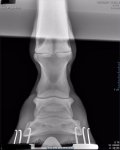
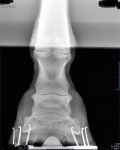
What do these X-Rays show… confused

sjdress

Well-Known Member
Joined
14 March 2010
Messages
610
Visit site
Having lameness issues with my horse on and off since 2021. feet x rayed summer 2021 and vet requested more heel support due to heel pain and coffin joint arthritis.
ive asked both vet and farrier to explain x rays to me but they have not been very clear with the findings. I know there are lots of knowledgable people on this forum who might be able to shed some light in more layman terms! Horse is in their 20‘s. Thanks for looking!30A57186-BE15-4E38-B5A1-E0018E540CDD.jpeg6A746A2C-3304-4FA8-B699-8D1C88CDCA74.jpegC6AB8CE4-72DF-4A56-AC83-59BB4B3B6EB7.jpegD55B1EBD-C02B-4496-981E-AA4C10B0BE95.jpeg
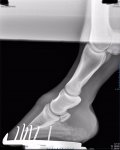
 
I'm thinking I see some pastern arthritis .
But if no reason for lameness has been found, I'd want more investigations.
Nerve blocks, MRI or bone scan ?
 
You have 1, if not 2(can’t make my mind up) negative palmar angles of the coffin bone. Normally that causes soft tissue damage and collapsed heels. Collapsed heel looks quite evident in the most obvious photo. It’s the one with the hoof facing right.

In my own experience in the long run if not corrected, can lead to a lot of leg problems especially with the ddft. There’s also the increased chance of navicular too. What are your vet’s plans going forward?
 
I love threads like this, thanks for posting. It gives us all the opportunity to learn something I think. I could see the same as the two posters above said, but I’ve no idea what the effects would be or how to correct, so no help, sorry.
 
I find it harder when they leave shoes on to x ray because without them the vets can pop a drawing pin into the hoof to get a point to measure to.

Have you got hoof photos? The one facing right on x ray looks massively under run, but I'm squinting at the other one and trying to work out if the x ray is slightly on the tilt.

When your vet asked for heel support what did the farrier put on?
 
I too love posts like this as I am absolutely rubbish with X rays.

The only one I can see an issue with would be photo no 2, where the angles look wrong and there doesn't look to be much heel. I love to hear what everyone else sees.

From what I see, I would think that a spell barefoot would improve this. It can be a long and tricky road when the foot is already compromised, but I also find it liberating when you can simply do them yourself and not rely on a farrier every month. My farrier trained me to trim, then a barefoot person refined me. I send photos to my farrier once a month for them to ensure I am on the right track. I have a very skilled farrier, but I prefer to take a tiny shave off twice a week so the feet are constantly evolving.

I have found that surgical/corrective shoeing can make an instant improvement in the way the horse goes, but taking it back to barefoot for a re-set is the way to go for long term soundness. It would likely mean going back to resting for a while, then walking out in hand.

I have done this with my BH this winter. I wanted him to have some time out as he had been in ever increasing work since backing. He had a couple of months off, hand walking, hacking in boots, and is now out hacking barefoot for up to an hour. His feet have changed massively, for the better. I am no barefoot total person, if we need shoes to do what i want this summer, he will have them. I am interested to see how far we can go with no shoes though.
 
So since x rays we nerve blocked and she came sound when nerve blocking the coffin joint, there is arthritis there so we injected the joint. She also had pads put on and wide webbed shoes. All was great until the hard ground hit last year and she went lame again. There was no joint inflammation this time but heel pain again so she now has backward facing shoes with a slight graduation. Vet has mentioned navicular but not confirmed this. She has just come sound after 5 months so I am slowly starting to bring her into work (light hacking) but really concerned that this will happen again if her feet aren’t right or if there is more going on. I’m pretty clueless when it comes to x rays sadly!
 
As others have said, collapsed heels, negative angle on one, but also lateral imbalance (the bottom of the bones are not parallel with the shoe).

Your best chance of correcting those things would be some time out of shoes. If they aren't corrected I wouldn't give you much of a chance of her staying sound I'm afraid.
.
 
Have a look at The Equine Documentalist and Progressive Equine Services on FB. Agree with negative HPA, this causes the ligaments around the back of the heel to be under tension, placing pressure on the navic bone and/or general heel pain. Lots of background on those two FB pages.
 
As others have said, collapsed heels, negative angle on one, but also lateral imbalance (the bottom of the bones are not parallel with the shoe).

Your best chance of correcting those things would be some time out of shoes. If they aren't corrected I wouldn't give you much of a chance of her staying sound I'm afraid.
.

I have considered taking her shoes off and have already taken off the backs, so halfway there! Vet doesn’t support the idea as of yet!
 
I have considered taking her shoes off and have already taken off the backs, so halfway there! Vet doesn’t support the idea as of yet!

I despair, I really do. We've known for a couple of decades now that the best way to manage problems like you have (though not necessarily the easiest for you! ) is often to take off the shoes. Yet there are still vets who don't believe it.

I hope you can keep her sound, but it's never too late to take off the shoes if you can't and your vet realises there's nowhere left to go.
.
 
I think with everything you’ve said in your second post and the various shoe combinations tried already, I would be inclined to take the shoes off. More of these cases are coming right by being barefoot. Previously or maybe currently, cases were treated with wedges and shoes amongst other shoeing concepts and in the long run it rarely works as it crushes the heels more.

We have one at the yard going through this at the moment. The hooves were a mess with no heels and I think it only took a matter of time until the horse went badly lame. It’s getting shod by one of the best remedial farriers around at the moment and to have 10months off. The feet look 100% better but I don’t know if it’s the answer in the long run. We’ll see.
 
Barefoot isn't always the quickest way of correcting negative HPA, hence the links I posted. I'm a BIG fan of barefoot but there are other options, you need a farrier to completely get on board though, I believe both the organisations I linked to will consult with other farriers.
 
I have considered taking her shoes off and have already taken off the backs, so halfway there! Vet doesn’t support the idea as of yet!

my vet and farrier both didnt agree with me taking shoes off for npa and coffin joint problems
I did my own research and told farrier to remove shoes . In 2 months already had 50% improvements in soundness which was only getting worse in remedial shoes
 
Those are not the happiest looking coffin joints, there is new bone deposited around the edges of the joint space both dorsally (at the front) and palmar (at the back) when you look at the lateromedial xrays. Compare the edges of the coffin joint (between the bottom two bones - P2 & P3) with those of the pastern joint (the joint space above) - the pastern joint is smoother edged without any bits jutting out, whereas the coffin joint less smooth, and there are little spiky bits (osteophytes) sat on the top of P3, forming the front of the cup of the joint. These are all consistent with coffin joint osteoarthritis. Hope that helps in terms of explaining bits - I would try and add arrows for you on the pictures but unfortunately I'm not technical enough to upload pictures to here!

There is also a broken back hoof pastern axis, a lack of heel support and a mild mediolateral imbalance, but given these xrays are 18m old then its hard to assess whether these are still an issue for the horse - you'd need a 'now' set of xrays to compare them to in order to see if progress has been made. However, the coffin joint OA definitely looks significant and has probably worsened a bit over time.

If she responded very well to having the joint medicated before (I'm assuming with steroids) and blocked out well to the coffin joint then you could discuss with your vet about having the coffin joints injected with polyacramid gel, which will last longer than steroids alone.
 
Definitely echo those about taking shoes off. Especially if arthritis or hints of arthritis. The reverbations of shoes on arthritic joints can sometimes be quite painful. I started with wedges and heart bars but horse was incredibly unhappy. I then went against vet advice and originally my farrier but after 2 shoeings, my farrier agreed to take shoes off as my horse just looked unbearably uncomfortable in shoes and wedges. Vet has been stunned at how much more comfortable horse has been since taking shoes off and farrier was commenting on how much better his feet were getting (over time of course)
 
Barefoot takes time but long term I'm certain its better. Mine had a similar problem when I bought her, farrier took all 4 shoes straight off saying she'd be better without them. It was 12 months before she was completely sound again but I think she was a lot more comfortably without the shoes on
 
If she responded very well to having the joint medicated before (I'm assuming with steroids) and blocked out well to the coffin joint then you could discuss with your vet about having the coffin joints injected with polyacramid gel, which will last longer than steroids alone.
Along with correcting the foot balance, I've had very good and long lasting results with polyacramid gel injections into both front coffins. We went straight to gel injections, didn't faff about with steroids first. This was for early arthritic changes due to poor (long toe/low heel) foot balance.
 
Top