What would you do with this horse?

I am. I also think I’ve given the hill thing a good shot, I’ve been at it for three months alongside a ton of groundwork and strengthening and his ability to trot through a raised set of cavelleti has improved x 100 but his way of walking up and down that hill has not changed.

Tbh I truly thought it was the sidebone and pain I was surprised he was so sound on a trot hard circle etc.

I don’t feel ready to give up quite yet though but that’s probably foolish.
 
I am. I also think I’ve given the hill thing a good shot, I’ve been at it for three months alongside a ton of groundwork and strengthening and his ability to trot through a raised set of cavelleti has improved x 100 but his way of walking up and down that hill has not changed.

Tbh I truly thought it was the sidebone and pain I was surprised he was so sound on a trot hard circle etc.

I don’t feel ready to give up quite yet though but that’s probably foolish.
No, not foolish.

See what you think of the other yard and go from there.
 
Yeah. The other place would give him herd turnout on large acerage and we are almost past the spring grass rush so it would be a problem for another year most likely. If it worked there I could just go up 3 or so times a week like I do now and do some in hand hacking or whatnot on the property and just remove all pressure and expense of his current fancy, and very expensive, set up. Not sure they would be enough to keep him trim and fit though but it would be really nice to still have some time with Atlas and be involved with him rather than him going to some far away barn. I guess I could see how the other weight thing goes.

Gosh I guess I’m giving up the idea of having a riding horse really. I suppose I haven’t properly had one anyway since 2023 when Boggle went wrong.. wow I can’t believe it’s been that long! Truly feel like the joy of horses has just been mostly sucked out of me at this point.

My OH (fiance omg!) came home and was so sweet and supportive and said I should go buy myself something awesome (honestly I just think he really doesn’t want me to ride Atlas and I totally get it) but I don’t even want to. I don’t want to spend the crazy money it takes in this country for something nice and reasonably finished, and just pour another load of cash down the drain. It makes me feel quite sick to think what I’ve “wasted” if you look at it on paper. Though, somehow I still don’t regret it which is completely stupid in itself.

Ah well. It’s horses eh. Can only do your best.
 
I think you are worrying unnecessarily at the moment. If there’d been no history of neuro issues, would the vet have still thought that one issue was neurological? I find it strange that a vet who said a horse has passed all the other neurological tests on a horse would suddenly declare something definitely neurological when it’s the same horse negotiating a steep slope.
I think it’s easy to put everything down to something once we become aware of it. It’s a very human trait. Sometimes you’ve got to step back and just look at things logically. Young horse+steep slope+ no signs of issue in any other test.
Personally I would carry on as normal and simply monitor the situation, but take into account that a horse negotiating steep slopes that he’s never had to before might show itself in a slightly odd gait.
I think we can over-analyse things sometimes (of which I am also guilty).
 
I’m going to stick my neck out (pun intended!) here and say something that I think plenty of people may disagree with.

I think you are massively overreacting and catastrophising. Get on and ride the sound horse.

I was trying to say it slightly more softly 😅
But I totally agree.
 
One of mine was a wobbler. I knew he was 'different' in his movement from the start. As he worked, he was fine, but I always knew if he rested he would fall apart.

I bought him to event, hoping to do Intermediates with him. I could feel, however, that downhill he was just not as surefooted as I would like to feel comfortable to progress. He too 'floated' a foot out downhill, but TBH I could also think that this was because he was a bit fancy. He also did the 'dig in' when going uphill, but then, he wasn't used to hills.

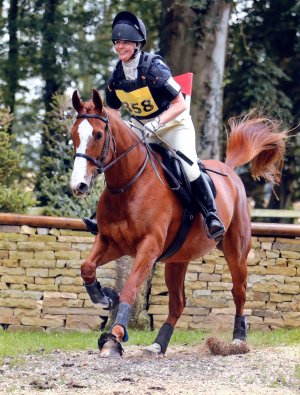
I evented him to BE100, but then lowered that back to 90 as I knew, heart of heart, that he was just less stable somehow. He could canter round a 90 for fun. In fact, this photo was at our 2nd to last event.
654216759_10233285173455359_1690281784382953353_n.jpg
What finished him was a small suspensory injury that occurred when our neighbour's dog got into his field and chased him. He got entangled in a fence in his efforts to escape and was slightly 'off' after that. The suspensory was a front and so minor, but needed rest to resolve. As he rested, the wobblers got worse and, although I tried to re-fitten him, the condition did then not improve.

I would not have missed our eventing times for the world, even if we did a lot less together than I originally planned. I did feel safe with the lesser work, but, once he had rested and his condition deteriorated, then I did very little, until he retired. Once retired, he deteriorated even faster and was eventually PTS.

What I am saying is that, while the movement discrepancy was so minor, I had a bunch of fun on him. I felt safe. We had great times.

Once I felt he was no longer stable, I retired him.

With yours, I would not buy him like that, but if he is navigating work well, then I wouldn't over think it, as long as you feel safe. My horse adapted to his way of going. I did what I felt comfortable with.

If you don't feel safe to ride him then that is different and I would not ride him. He passed a neuro exam in all but the final hill scramble, so he could do dressage or whatever, maybe loan him and have him back if he progress (either way actually, so if he gets worse or if he gets stronger and better and makes the horse you hoped for)? It may be weakness causing issues.

I'm not saying to deny the problems, I would be very aware of them. But I would also look at the horse in front of me and decide if he is up to the job you want from him now. And yes, I have brought on many baby horses and face planting was something they could do. I had one do a 20 yard trip because he mis-stepped a white line painted on the road! 20 yards of not being able to sort his legs out - Doh! I had another who was suspect of being neuro as he struggled to navigate the school, but who seemed to grow out of it when strengthened up and who lived a long and happy life. I have seen many horses who have the floating foot thing downhill, who are ridden normally.

I would take a lot of store by the fact that the vet thought he presented normally for everything except 1 situation. The scrambling on a hillside is not something he is enormously experienced with. I wonder if he'd negotiate the slope differently if loose as opposed to led or ridden? I find the floating leg thing doesn't happen when loose. It seems more common when horses have their pace dictated to them.

I would not ignore it and I would trust your instinct to stay safe, but it does seem, at present, to be a very minor idiosyncrasy, which may lessen still further as he matures.
 
So tough for you @Michen but if Atlas has very little experience of sorting his feet and legs out on the steep terrain whilst at the current barn, although there may be a neuro deficit it sounds like it only shows in this situation? As he has improved in soundness and every other way with the right management at his current barn, is it possible that learning to deal with terrain could be the last part of his recovery?

He's sound and tough and he's demonstrated his resilience and adaptability so far. I'd be minded to give him a chance to learn how to negotiate the extreme stuff and I would hack him out too. All other vets have found him neuro asymptomatic which is excellent considering how poorly he was. This may or may not resolve or improve sufficiently but he hasn't really had the chance to do do that work yet. And I'd take the fiance's advice as well! 🤣.
 
He’s still young, had a bit of a rough time but has continued to bounce back. He looks well and seems happy, presumably the trainers / yard staff would have commented if they felt he had a problem and wouldn’t have continued to work him. He’s maybe different to ride and always will be compared to other horses you’ve had but that’s often the nature of horses. If he’s happy where he is and things are going well as they seem to be, l would just bide time and review in six months. Rehab takes time and your vet is happy for him to be ridden. Put the past vet traumas behind you, enjoy your new life and stop worrying 😀
 
I think you are worrying unnecessarily at the moment. If there’d been no history of neuro issues, would the vet have still thought that one issue was neurological? I find it strange that a vet who said a horse has passed all the other neurological tests on a horse would suddenly declare something definitely neurological when it’s the same horse negotiating a steep slope.
I think it’s easy to put everything down to something once we become aware of it. It’s a very human trait. Sometimes you’ve got to step back and just look at things logically. Young horse+steep slope+ no signs of issue in any other test.
Personally I would carry on as normal and simply monitor the situation, but take into account that a horse negotiating steep slopes that he’s never had to before might show itself in a slightly odd gait.
I think we can over-analyse things sometimes (of which I am also guilty).
I was thinking exactly this last night.

I wish I could have shown you the hooligan as a 4/5 yo. Somewhere I still have a pair of expensive knee boots that I bought because I didn't want him to scar his knees if he tripped over on the roads. His stifles were sticky and his core was weak and occasionally he would forget how to operate 4 legs at the same time. He was never too tetchy going up hill but downhill he disliked and would often throw in little bucks. The vet agreed he had lax ligaments, especially in his stifles and basically told me to get him fit and keep him in work.

Last year was superb (as a 7yo) and I was doing so much hill work we got over the tetchy moments. This year due to weather and my health I haven't had him out so much and he was very cross at coming down a steep hill at the weekend. I could feel him crabbing sideways and there were a couple of tiny protest bucks.

3 months really isn't that long for Atlas and unless you are doing hills 4+ times a week then he really isn't going to be getting the exposure his neuro development needs. Not all horses traverse slopes the same way either. I was behind a horse in Chile who basically would sit down to go down a gravel slope. I get vertigo so was relieved my little mountain horse looked after me, but the guides were completely unbothered by the one sliding down on its bum - apparently it had always done it.

But it is understandable if the vet saying this has given your confidence a knock and you are now thinking 'what if'. Horses can trip over without neuro issues though.
 
Would a second opinion help? Could you get a video and send it to your vet over here to see what they think? (I think I’m right in Remembering they helped you with Bog and you trust them a lot?)
I’m not questioning your vets diagnosis but I think it might be helpful for you to get another set of eyes on him and see if they think the same.

But if you’re feeling a bit deflated and that you want a step back then trying him out on a hill sounds like a good idea too.
 
Gosh I don’t know the first thing about it!!!!


I was thinking driving but too scared to say, in fact if he was mine, id do everything i could think of with him, make his brain work hard to catch up with his body as it muscles

I would try trotting poles raised, on the lunge , just 3 i find it really makes them think about where they put their feet, helped my little rescue, he was a bit trippy at one point
 
I’m honestly so surprised at the reaction on here haha! I felt like there was such a hard line with neuro stuff. I kinda do wonder if you’d all feel the same if I took a video.. might try and get one this week. Also I also like the line of thinking so probably better not to change that 🤣

I am going to go look at this other barn as I do wonder if the herd, large turnout would help (other than always being preferred anyway) and they do have better hacking that may not involve such a hard hill to get anywhere.

Then I have to weigh up the risks of that vs where he is now where everything is very controlled. If I’m honest I have been finding it increasingly sad to see him in a little paddock turnout. But it’s been great for a sound horse and we needed a safe landing place for a bit.
 
I was thinking driving but too scared to say, in fact if he was mine, id do everything i could think of with him, make his brain work hard to catch up with his body as it muscles

I would try trotting poles raised, on the lunge , just 3 i find it really makes them think about where they put their feet, helped my little rescue, he was a bit trippy at one point
He does this! With his trainer on the long reins. A row of four thick raised caveletti. He could barely do it in walk at first and now he’s just starting it in trot and does very well.
 
Would a second opinion help? Could you get a video and send it to your vet over here to see what they think? (I think I’m right in Remembering they helped you with Bog and you trust them a lot?)
I’m not questioning your vets diagnosis but I think it might be helpful for you to get another set of eyes on him and see if they think the same.

But if you’re feeling a bit deflated and that you want a step back then trying him out on a hill sounds like a good idea too.

I thought about taking him to UC Davis which it doesn’t really get much better than, but apparently they don’t have much up a hill and I don’t think this will show up on a normal kinda hill.

But, I think I might that through with them and see what they say.

One thing I don’t want to do is start chasing diagnostics like neck x rays or a spinal tap for the EPM. Ultimately it doesn’t really change the treatment or outcome but it’s an easy trap to fall into for sure.
 
He does this! With his trainer on the long reins. A row of four thick raised caveletti. He could barely do it in walk at first and now he’s just starting it in trot and does very well.
See, this makes me believe there is still improvement being made and he will likely learn to use himself better in time. I remember yet another youngster who was weak and would trip and slide. One time he too did a 20 yard trip, on mud, and I can remember looking up at my companion horse's belly as we sunk down down down. He too matured well and became surefooted.

Yet another baby had to learn hills and needed bandages on his hinds as they flailed around and left him rubbed and sore from brushing. This was at walk on the road, but he was not used to steep hills and was gangly.

I do also wonder about the vet's point of view. They don't know you well. You ask for a neuro exam, they pass him. You object and want more and more tests, until they do see a horse going up and down hill in an awkward manner.

TBH, in these days of people being sued for being wrong, I think I would have proclaimed him as neuro and not to be ridden, for my own reputation.

I think there is a middle, safe, progressive, careful ground. Where you stop if you think it dangerous, but give Atlas the best chance to grow into himself and learn how to navigate unfamiliar terrain.
 
Another thing is jumping a small jump, 2 ft 6 ish on the lunge, they tend to get quite enthusiastic in a good way, as they get warmed up, it encourages switched on canter like they are sharpened up in their responses which is good to link body and brain, and gets them moving in a better posture

The actual jump is a thick straight pole with ground jumping pole either side

But using a lower jump if not done before to see if they can get off the ground successfully first not over doing these things perhaps 2 or 3 times a week mixed in with other stuff
 
Thank you. I do really appreciate all of your comments. And I’m always fully up for being told to snap the f*** out of being totally doomy about it even if it sometimes takes me a minute and a night of sleep to change my course of thinking.

I’m going to go see this other barn this morning and take it from there.
I guess the thing is that Atlas seems like a really great horse who has managed to overcome some serious problems. He's got spirit and resilience installed. You actually cannot buy those qualities in any horse but they are priceless.

You could retire him of course but he might still be a fab, fun riding horse and it might be worth just exploring that, particularly if you are not absolutely set on a particular competitive way forward. So many horses are compromised in one way or another but knowing how to manage that and when to retire them does mean their lives can be bigger, richer and still very, very rewarding for their humans.

I have to say that with many of ours over the years, I've thought they were hopeless for various reasons lol but out of 11 of them, only 2 really were, and one of those only clearly had issues after we sold her, having been a very happy, albeit slightly quirky childs pony for some years. I understand the worry too so however you decide won't be wrong. Atlas may still have work that can be done.
 
Yeah, to me that’s very acceptable. But 24/7 wear of a muzzle for months at a time I just don’t know.
I have 3 who wear a muzzle 24/7 from mid April to October. One is a mini Shetland, one is 17hh and t'other 16hh. All have survived just fine. They of course have safety headcollars on with fly mask over the top.
 
Don’t underestimate the value of undulating ‘acreage’ with herd company with regards to horses being prone to weight gain. They burn lots more calories as they are moving about so much more and it may also help him to find his feet so to speak. He will also be able to be a horse. I know there are risks, but there are always risks however we choose to keep our horses. It sounds like the hacking may be more suitable for him too. So much to be said for getting them out of the arena/off flat ground and using their bodies in different ways. He is currently sound and only struggling with very steep terrain but still showing improvement with what he’s being asked to do. I’d still be seeing how he goes before making full retirement decisions yet. Hope you find a path that sits well with you 🤞🏻
 
I guess the thing is that Atlas seems like a really great horse who has managed to overcome some serious problems. He's got spirit and resilience installed. You actually cannot buy those qualities in any horse but they are priceless.

You could retire him of course but he might still be a fab, fun riding horse and it might be worth just exploring that, particularly if you are not absolutely set on a particular competitive way forward. So many horses are compromised in one way or another but knowing how to manage that and when to retire them does mean their lives can be bigger, richer and still very, very rewarding for their humans.

I have to say that with many of ours over the years, I've thought they were hopeless for various reasons lol but out of 11 of them, only 2 really were, and one of those only clearly had issues after we sold her, having been a very happy, albeit slightly quirky childs pony for some years. I understand the worry too so however you decide won't be wrong. Atlas may still have work that can be done.


Its like finding the right key to a door
 
What was his upbringing like, before you got him? If he’s not grown up in a herd, navigating hills, tricky terrain and a range of surfaces then it can take an AGE to find their feet and confidence and build appropriate bone density and soft tissue development.

I have seen SO many horses who have only ever lived in small, carefully curated ‘safe’ paddocks struggle when they move here (uplands area of Scotland). It can take years - literally - for them to navigate the terrain with ease. Whereas those who are born on the side of a mountain find it all easy.
 
He went from CA to Minnesota where I bought him as one of a bunch of horses that were a semi rescue (seller fixed him up and started his groundwork extremely well) . I’m not sure where in California he was, and northern nvs southern is hugely different in terms of terrain. In Colorado my paddock was pretty undulating, with some sneaky mounds and banks etc. Arizona his field was very flat.
 
I think if I looked as carefully as you do at my horse, I’d find a lot of scary things. I say that with nothing but deep respect because you go above and beyond for your horses.

My horse is an arthritic almost 20 year old who has been cleared to do light work, but of course there is an additional risk now to riding her. I just have to weigh up the pros and cons.
 
Here’s the vet report I just got. I did think she had said that she was happy with his cross stepping and she felt it was acceptable but this reads a little different I guess.

Just toured the other barn. Very rustic, great pasture, very direct and straightforward French manager who would also be happy to do some ground work with him. It would be a third of the cost of my current board, certainly no frills. I’m thinking it could be a good half way house between a retirement home but somewhere still where I could do some things with him and see how he goes.


Exam

On examination, Atlas was bright and willing, with behavior consistent with a young, inexperienced horse. At the walk and during flat evaluation, there was mild right-sided stiffness on circles to the right, but no consistent lameness identified.

Neurologic exam revealed appropriate backing and tail pull responses after initial learning behavior. Tight circle work showed mild inconsistency with crossing behind, with occasional delayed or stilted steps that could represent a mild deficit versus training-related difficulty. When evaluated over poles, the horse demonstrated appropriate limb placement and awareness, with only occasional contact of rails. On hill work, abnormalities were more apparent and repeatable, including a short, “stabby” stride when moving uphill and a less coordinated, “floaty” gait with inconsistent foot placement when moving downhill. No clear evidence of foot soreness or primary lameness was identified.

Summary

Mild and somewhat inconsistent neurologic deficits are present, most notably exacerbated during incline and decline work. Examination on flat ground is largely within normal limits for a young horse, but the repeatable abnormalities on hills raise concern for residual neurologic dysfunction. The most likely etiology is residual deficits from prior Equine Protozoal M. Other differentials include cervical vertebral stenotic myelopathy, hindlimb mechanical issues such as stifle or hock dysfunction, or less likely foot pain. Given the timeline of approximately one year since treatment, prognosis for complete neurologic recovery is guarded.

Plan

Recommend continued conservative management with a focus on conditioning and strengthening, particularly with

controlled hill work on mild inclines, followed by reassessment for improvement or persistence of deficits. Additional diagnostics may be pursued depending on intended use and owner goals, including repeat EPM titers with or without CSF analysis, serum vitamin E levels, and cervical radiographs. Safety considerations for riding, especially on steep or uneven terrain, were discussed. A recheck examination is recommended in 2–3 months if the horse remains in work. Referral for a second opinion and advanced neurologic evaluation at UC Davis is available if desired. Long-term
management decisions, including suitability for intended use or alternative placement, should be considered based on progression and safety.
 
Top