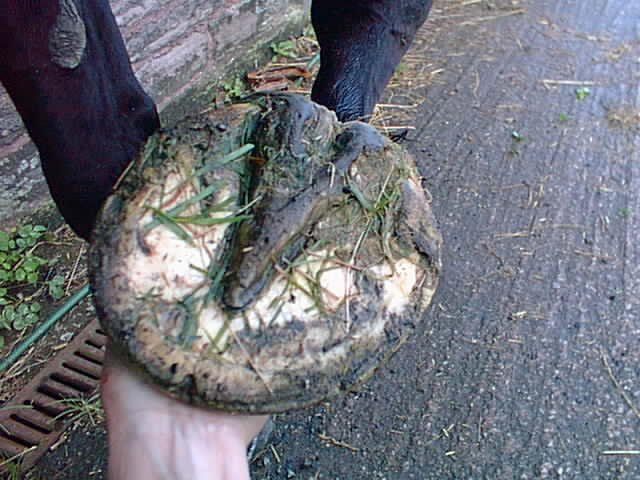
why are foot problems so common?

I suppose it also depends on if your horse is straight moving or not. My mare dishes and wears her front feet slightly off centre. If her feet aren't rebalanced her dish becomes much more pronounced as the medial toe quarter gets longer and longer.

I often wonder what hapens to Rockley horses when they go home and back to thier "normal" environment. I would guess most people who are on livery can't create a track system with the same surfaces as Rockley offer.
 
I do wonder about the rockley's self trimming when they get home and off the tracks, as even when I am doing a lot of roadwork I cannot keep up with Frank's growth - even on the side he wears most (lateral).

Currently trialling doing a little light rasping/roll of toe between trims as frankly the amount there after 6 weeks last time was ridiculous!

My horse is a rockley rehab, we are on a standard livery yard - he is kept on part livery with no access to tracks etc. His feet haven't been touched by human hand since Oct 2012 and he self trims perfectly adequately without doing hundreds of miles. The key is to increase and decrease work gradually, that way the feet can cope with changes and continue to self trim. In the summer he does 25-30 miles a week hacking plus schooling - he is eventing fit. In the winter his workload drops and he does 10-15 miles a week hacking plus schooling.
 
thanks Leg_end

I suppose the question is then, why doesn't mine who had an increase in work last october when he moved to live with me and has been in consistent medium work since hacking approx. 25-30 miles a week, schooling, occasional light hunting etc. - If you'd seen how long they were at last 6 week trim there would be no question that he needed doing quite badly at that point. I'd love nothing more than to save the trim money at the moment :D.

which brings me back to them perhaps all being different and that the relatively low numbers attending rockley don't cover all examples.
 
I've had barefoot horses in the past - one was almost self-trimming (haflinger) and the wb needed some work. Whilst I thought I knew an awful lot about bf (have done bf course) and am quite the advocate, I devoured Rockley's blog last night. I don't know why, but I assumed they trimmed almost every other day to achieve such results! I was really interested to read about their definitions of balance, deviation vs. flare etc. This in particular may well have helped my old mare - too late now! In addition, they had some great info about leaving the bars on (not all trimmers do, saying that it's an area which can cause great pain - but then, anything on the "sole" I suppose falls into this category) - which can act as natural studs and balance mechanisms - again, the bars appear to adjust themselves to the horses needs.

I do understand that most people don't have access to tracks, AND modern livery frequently does not support a more natural way - coupled with the "oh aren't we so lucky with all this lush grass in the UK?" thing. BUT, but, but - Rockley grads to appear to survive (and thrive) even when going home to normal yards.

I think the diet is so, so important and so often overlooked.

My boy is going barefoot tommorrow and I know I'll be a lot more "forgiving" about the "appearance" of the hoof as opposed to what is working for him.

Trim or self-trim - at least the message is getting out there that there's another way and we should all celebrate that!
 
I think bars and their functions/what they might do further into the foot if they are allowed to be left is quite interesting currently.
 
I wonder if the reason Rockly horses manage afterwards regardless of their terrain is to do with the fact that their hooves are at or on their way to being at the ideal for that horse and so are managing at a rate that now suits them instead of an unnatural rate due to regular trimming or shoeing?
 
I am sorry that you have misunderstood. He was doing all the trimming necessary to keep him sound and doing considerable mileage. It was just not conducive to good hoof care, IMHO total self trimming often isn't. Human intervention helps.

IMHO self trimming and "celery" is being pushed. Good trimmers/farriers should be pushed.

"I think it's ideal because the feet are constantly right," (sorry cannot get quotes to work)

what do you base that on? that the horse knows best. The big question is if the feet are "wrong" why???


No Paddy, I think it is you who is misunderstanding the concept of self trimming. Your horses feet were cracking and in bad condition, therefore by definition he was not adequately self trimming and required human intervention. There are plenty of horses like it, it cannot be achieved with all of them without the most perfect conditions.
 
I wonder if the reason Rockly horses manage afterwards regardless of their terrain is to do with the fact that their hooves are at or on their way to being at the ideal for that horse and so are managing at a rate that now suits them instead of an unnatural rate due to regular trimming or shoeing?

I think it's a good theory, which will maybe be confirmed with more time and more examples.
 
I think bars and their functions/what they might do further into the foot if they are allowed to be left is quite interesting currently.


Have you read Bowkers latest on this? He says that the sole is generated at the bar and grows forward to the toe. This is something you can verify any time you're horse has a hole or mark in the sole, it eventually runs off the front.

He reckons that trimming the bars will result in less stimulus for sole growth, and consequently a poorer quality sole.

I am very against trimming bars which extend up the frog, because my experience is that they are only produced by horses that need the bracing they provide and that they disappear as soon as the foot is stronger.

I never trim down height on my own, but I know that some trimmers think they cause bruising and cut them down to sole level.

I'd like to see some more evidence or research about bars, I don't think we currently have the full picture, but I am very swayed by the fact that Rockley do not trim bars, keep the horse's on stony tracks, and do not seem to suffer bruising from high bars result.
 
yes I have read the Bowker bit on bars, we have left them untrimmed previously but the bottom half does have a tendency to split and then start to overlay slightly. He is good on most surfaces but if gets a stone in just the wrong place thinks the world is ending - we just aren't entirely sure where the wrong place is. Essentially we decided to take them off a bit and if they come back he can keep them - which I think is likely!
 
really interesting ideas here, and i guess for me, as someone who has BF horses but equally wouldnt be bothered if they had to be shod in front at any point, its all about horses for courses.

IME (which is perhaps limited compared to some, 5 BF horses over the last 8 or so years) work is more important than diet.

Bruce is probably the best example, a fatty, and older (19) he would be prone to lammi and metabolic problems if not monitored closely. He is muzzled, fed soaked/double netted hay, gets a mineral supp in a handful of feed and is kept very slim.
When in work his feet look after themselves pretty well. he gets trimmed lightly every 5 weeks but doesnt need any attention in between. Not in work they go splat in a major way,WL runs away, cracks and flare spring in to action.

all he does work wise is walk and trot on the roads, an hour, 3 times a week buy god it makes a difference.

CS and Fig obv do less work on abrasive surfaces, CS does virtually none. They are lightly trimmed every 5 weeks and i re-roll toes weekly. They eat commercial feeds that would make most BF people faint, in particular CS's mash which is 38.6% starch, full of grain etc)

I have noticed as Fig does more and more highly collected work he is developing a higher heel and more concavity regardless of food or trim. To look at Cs's feet (schooling GP) he has a far higher heel than is textbook but is very sound. It looks like Fig is starting to follow suit as he is now schooling PSG +pi/pa.

I am great believer in letting horses grow the foot they need and just tidying it up as is needed, so a half way house i guess. I dont think any of mine could totally self trim, but neither do they need drastic trims at regular intervals.

In answer to the original Q, i think it stems from lack of knowledge-people dont know what healthy feet look like, and from a lack of good farrier-i see some horrendous feet at shows, on top horses even, that make me cringe. the current fashion seems to be long toes, but very high tight heels, so 18hh dressage horses have feet the width of 12.2hh ponies and strange squoval shaped shoes to fit this long narrow foot!
 
yes I have read the Bowker bit on bars, we have left them untrimmed previously but the bottom half does have a tendency to split and then start to overlay slightly. He is good on most surfaces but if gets a stone in just the wrong place thinks the world is ending - we just aren't entirely sure where the wrong place is. Essentially we decided to take them off a bit and if they come back he can keep them - which I think is likely!


I trim them on one of mine as they don't totally self trim even though he goes over 2 stoney tracks on an almost daily basis each time he goes out riding. I tried leaving them untrimmed but they seem to have the potential to trap small pieces of grit which concerned me that if I missed it then it could have the potential to abscess. He never has yet but no point in asking for trouble. They do come back but I don't see this as a reason not to trim them in this particular horse
Whilst he was not sore in any way with no trimming I found trimming produced just as good results and was potentially safer.
This is based BTW on my experience not on reading a blog or reading Bowker. Sometimes there can be a lot of theory. To me what actually works is more important.
 
the current fashion seems to be long toes, but very high tight heels, so 18hh dressage horses have feet the width of 12.2hh ponies and strange squoval shaped shoes to fit this long narrow foot!

d47e8a8e-e5b3-4173-9502-413344ea9800_zps3cd8d7ed.jpg


Like this? Sorry it's a small photo, but look at the OF especially as you can just see how contracted and tall it is.
 
Yuck! See a lot of feet like that round here and it amazes me people don't see the problem.

Interesting thread folks, I am following with interest. Not experienced enough to add anything useful though!
 
Looking at those hooves, the problems are man made IMO. I highly doubt that the horse was born with hooves shaped like that.

Is it inevitable that any horse shod for a number of years, without a break will end up with some sort of hoof pathology? Can anyone find the link to that study that found negative changes in horse hooves after 4 months of being shod?


PS - I hope your boy is doing better now. :)
 
Looking at those hooves, the problems are man made IMO. I highly doubt that the horse was born with hooves shaped like that.

Is it inevitable that any horse shod for a number of years, without a break will end up with some sort of hoof pathology? Can anyone find the link to that study that found negative changes in horse hooves after 4 months of being shod?


PS - I hope your boy is doing better now. :)

Early days Faracat . . . hind shoes have been off for 10 weeks or so now (but they've been off before for two years with no problems), fronts a different story . . . barefoot trimmer came today as part of his rehab for suspensory/navicular . . . we'll see how we go . . . but I can't believe I accepted his appalling feet for as long as I did without question . . .

P
 
Did your farrier ever mention that there was a problem though? When someone has trained for X number of years, they should know what a good hoof looks like and what a poor hoof looks like. I actually wonder if farriers have become too used to seeing shoe sick hooves too, so it's normal to them?
 
Did your farrier ever mention that there was a problem though? When someone has trained for X number of years, they should know what a good hoof looks like and what a poor hoof looks like. I actually wonder if farriers have become too used to seeing shoe sick hooves too, so it's normal to them?

One farrier - a very good one actually - noticed his club foot as he drove onto yard . . . but everyone else has just treated that foot like it was normal and I've NEVER had a farrier tell me his heels were contracted (which they are), that he has excessive wear on the inside of his two fore feet (which he does) or that he has weak soles (which he does).

P
 
really interesting ideas here, and i guess for me, as someone who has BF horses but equally wouldnt be bothered if they had to be shod in front at any point, its all about horses for courses.

IME (which is perhaps limited compared to some, 5 BF horses over the last 8 or so years) work is more important than diet.

Bruce is probably the best example, a fatty, and older (19) he would be prone to lammi and metabolic problems if not monitored closely. He is muzzled, fed soaked/double netted hay, gets a mineral supp in a handful of feed and is kept very slim.
When in work his feet look after themselves pretty well. he gets trimmed lightly every 5 weeks but doesnt need any attention in between. Not in work they go splat in a major way,WL runs away, cracks and flare spring in to action.

all he does work wise is walk and trot on the roads, an hour, 3 times a week buy god it makes a difference.

CS and Fig obv do less work on abrasive surfaces, CS does virtually none. They are lightly trimmed every 5 weeks and i re-roll toes weekly. They eat commercial feeds that would make most BF people faint, in particular CS's mash which is 38.6% starch, full of grain etc)

I have noticed as Fig does more and more highly collected work he is developing a higher heel and more concavity regardless of food or trim. To look at Cs's feet (schooling GP) he has a far higher heel than is textbook but is very sound. It looks like Fig is starting to follow suit as he is now schooling PSG +pi/pa.

I am great believer in letting horses grow the foot they need and just tidying it up as is needed, so a half way house i guess. I dont think any of mine could totally self trim, but neither do they need drastic trims at regular intervals.

In answer to the original Q, i think it stems from lack of knowledge-people dont know what healthy feet look like, and from a lack of good farrier-i see some horrendous feet at shows, on top horses even, that make me cringe. the current fashion seems to be long toes, but very high tight heels, so 18hh dressage horses have feet the width of 12.2hh ponies and strange squoval shaped shoes to fit this long narrow foot!

I completely agree that horses in hard work can eat commercial foods with far fewer problems. I use commercial, molassed, cubes and my fatty gets molassed chaff. And I have a field literally knee deep in grass. Too many horses simply don't sweat enough to use up food like that properly. (I do have to feed copper, but that's because my land and water are sky high in iron and manganese.)

I've read that before about horses working higher level dressage getting taller heels, PS, and I find it fascinating. Can you tell me whether the frog is still in contact with the floor, or is it lifted out of contact? I wonder if the whole development of the horse is what causes it, because it seems a big change for only a few hours a week of high level work to be directly affecting the foot conformation. Does that make sense to you?
 
Did your farrier ever mention that there was a problem though? When someone has trained for X number of years, they should know what a good hoof looks like and what a poor hoof looks like. I actually wonder if farriers have become too used to seeing shoe sick hooves too, so it's normal to them?

My first barefoot horse had only ever been shod by one farrier. I showed him one day how the horse's frog was much closer to one side of his foot than the other, and that he was standing with all his weight down the inside of the foot. He told me that he could not see what was wrong that I wanted corrected :(
 
My first barefoot horse had only ever been shod by one farrier. I showed him one day how the horse's frog was much closer to one side of his foot than the other, and that he was standing with all his weight down the inside of the foot. He told me that he could not see what was wrong that I wanted corrected :(
Shocking.
 
Shocking.

I bless the day it happened now. I could see the horse was unhappy and I figured I could hardly do a worse job if I took off his shoes and trimmed him myself, as there was only a blood-drawing Strasser trimmer in the area. The rest, as they say, is history.

This is the foot that he thought was fine, immediately after shoe removal:

17SEP006.JPG
 
Last edited:
I am not wholly convinced they are more common or even that common as internet sites will attract the unusual not the normal I have had both barefoot and shod horses for over 50 years and have rarely had any problems with their feet the odd abscess and the odd balance issue but foot soreness is a rare occurrence and the ponies mostly just work and eat I have always made sure that work was increased before an increase or change in diet/ If there is an increase in foot problems my persona opinion would be that the vast majority of horses are now more commonly over fed and underworked than when once they truly were expected to work
I would say 99% of leisure horses are underworked and overfed the idea of a leisure horse in hard work is ridiculous it is so rare
 
I have always presumed CS's taller feet are poss due to the surfaces he is worked on - am pretty sure J1ffy's andy (pocholo?) who was at rockley has taller feet having returned to spanish sandy riding??
 
I completely agree that horses in hard work can eat commercial foods with far fewer problems. I use commercial, molassed, cubes and my fatty gets molassed chaff. And I have a field literally knee deep in grass. Too many horses simply don't sweat enough to use up food like that properly. (I do have to feed copper, but that's because my land and water are sky high in iron and manganese.)

I've read that before about horses working higher level dressage getting taller heels, PS, and I find it fascinating. Can you tell me whether the frog is still in contact with the floor, or is it lifted out of contact? I wonder if the whole development of the horse is what causes it, because it seems a big change for only a few hours a week of high level work to be directly affecting the foot conformation. Does that make sense to you?

Massive lol at the sweating! That's exactly what I think causes so many probs....not enough good honest sweat!!!

Re frog, he has nice big healthy ones and I do get lovely heart shaped prints if he walks on concrete with wet feet :)

I would have said it was just him had I not seen figs feet too.

I have always presumed CS's taller feet are poss due to the surfaces he is worked on - am pretty sure J1ffy's andy (pocholo?) who was at rockley has taller feet having returned to spanish sandy riding??

Again, I would agree maybe its the mixture of highly collected work on a very soft and none abrasive surface? Would he show the same changes if he worked on grass? Hmmmmmm....or sharp gritty sand? More hmmmmmmm lol!!!
 
How interesting! I've heard a trimmer before say that he 'leaves' the heels higher on high level dressage horses. I didn't believe him, because my horses would just wear away anything they didn't want. And of course your experience is showing that he wasn't 'leaving' the heels higher, they are where horses working at that level put them for themselves. As long as the frog still contacts the floor, it must be right, and they must need them like that for some reason. I wonder why?
 
Top