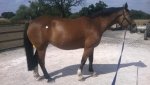
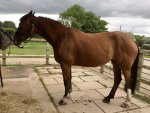
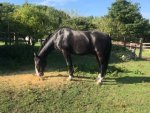
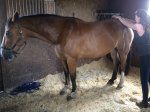
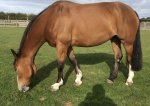
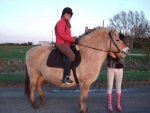
Why do so many people think its fine to have fat horses?

I tell you all these horses are having a lean winter that presentation has got me motivated we will be seeing ID ribs if it kills me .

The thing got me was her statement that weight of the endurance and event horse pictures she showed should be the norm not just for the super fit ,that really hit me .
 
I have a good doer native pony. Currently fatter than I would like, exercised daily, on soaked hay and now muzzled. I do feel mean that he can't have ad lib forage over night. Even ad lib soaked hay would pile on the pounds.

I think over the years there has been so much focus on ad lib hay and turnout to prevent ulcers that people feel bad about restricting either which may be needed for weight loss. We are lucky at our yard in that we have all year turnout on decent grass even in the winter but that does provide some challenges with the good doers. If you work full time especially in the winter when it is darker earlier it is hard to get the exercise levels up. Not all horse owners can do three hours rides before or after work and not all horses are able to do a lot of jumping and fast work especially if ground conditions are not good.

Although I love native ponies I don't think I would ever get a good doer again, managing his weight is so hard. Many people perhaps do not realise when they take on the native types the challenges of weight management.
 
Last edited:
The challenge is going to be how does the average owner of a native/cob get their horse eventing/endurance fit as to get them to that sort of weight level they will have to be in even more work than an eventer or endurance horse and I expect if they had wanted to do eventing or endurance they might have got a breed more suitable for the job.

I expect part of the problem is if you want a horse or pony with a suitable temperament for hacking and a bit of schooling without getting too fizzy after a few days off for an amateur then you are probably going to be looking at the cold blooded horses and ponies as the more sportier types tend to be more reactive and sharper. However weight wise this sort of routine is not really suitable for the good doer who needs to be in much heavier work to remain slim.

I tell you all these horses are having a lean winter that presentation has got me motivated we will be seeing ID ribs if it kills me .

The thing got me was her statement that weight of the endurance and event horse pictures she showed should be the norm not just for the super fit ,that really hit me .
 
The thing s there’s a difference between fit and fat .
The message was clear fat and doing athletic activities is a damaging time bomb .
A horse can be slim and not fit .
But that’s likely to be labour intensive to do well.
 
I completely agree the ulcer advice has played a role in fuelling the obesity crisis .
Horses do not need to eat all the time but some will Fatty would eat till he popped .
Modern horse ownership makes it hard to Trickle feed and there’s far more horses you see with hay during the day In the paddock that are stabled at night .
I have four horses not one of them can have free access to forage , and they are working I hope by Christmas Sky and H will be having almost ad-lib but Fatty won’t be and Blue certainly won’t be .
I have not had Blue down to the vets yet but I think it could be as much as 200 kilos ?he needs off .
 
Those pictures I have of my ponies that I found in Mums house where telling you don’t see many children’s ponies that slim now unless they are fei event ponies .
 
My 16.1 IDx was obese, but the difference between obese and slim for her was ‘only‘ 76kg, which was surprising.

695kg down to 619kg, according to the vets weighbridge.

Same with the Beast but on a weigh tape. 680 on the tape and she looks fat as you like but get down near 620 and she's pretty slim.

Talking to my vet about it before we moved up here, when she was going into winter closer to 680 than 620 and saying I was worried about her being without forage... he was pretty chilled about it. He said just give her her night ration and if she's stood without, she's stood without. Shrug. Basically. I've struggled to follow that advice to be honest but I think I'm going to have to be a mean meany this winter.
 
I have got over 150 kilos off Fatty since February
I am not sure how much more has gone since his last trip on the weight bridge .
Although he’s clearly slimmer there’s not such a visible difference as in TP ‘s horse .

To get the weight off we have had to throw money at vet to get him back into some sort of work ( he was retired ) and I was starving him as much as it was possible and him have any quality of life .
Work mainly walking has really helped and it’s cheered him up he always loved to work .I will to have the stifle jabbed again shortly this cannot go on for ever but I am glad I did it he’s loved being back ridden .
The depressing thing is I did not retire him and just let him graze he’s been restricted right through .
Its really hard work with good doers .
I had H looking good but he got gravel which niggled on so stopped us working him consistently for a month and bang he’s plump again again he was spending days inside and only out 12 hours in 24 in a not lush field .

With these good doing draughts it does not take much to get the job off track .
 
Last edited:
It is lack of knowledge and sometimes the problem is an inherited one. I bet half the fatties are those who have been overweight in their early years and developed EMS. So, much to the dismay and bafflement of their (current, newer) owners, they won't lose weight.

I am plain-spoken about these matters, which are actually life and death.
 
We are a bit in the same hole that we are in with people with our horses except if humans got an equivalent to laminitis it would concentrate our minds .
We need to move forwards to yards that are better set up for keeping horses slim and this is not easy .
You can’t put twenty shod horses of different types belonging to different people on a track it would be a ulcer inducing experience for yard owners .
The theres the cost of providing the track can a yard get enough people to pay them the extra costs in a higher fee per week of providing that track.
Yards need bare lots of earth , hard standings and probaly horse walkers .
This all costs money there’s no getting away from it .

We need to face up to the reality is the horses don’t need to ridden they are happy as field ornaments mantra is frankly untrue for many horses where additional exercise is a must if they are to maintain good health .

We need to ditch the slim enough to do a 90 attitude and get many low level eventers slimmer .You see far to many fat event horses at the lower levels .

And dressage horses need to look more like eventers some dressage horses are very fat for the athletic endeavours they are expected to do .

And showing want can I say I think I will leave it at don’t do it folks don’t let your eye get trained to believe that that is normal .

Vets need to nuance their ulcer management advice they have fuelled part of this problem and it was music to ears of those of us who love to feed their horses .

If a horse is fat that’s the thing they need to be targeting .
With yard owners with owners all the time .

Vets are making a great deal of money treating the orthopaedic issues caused by fat horses attempting athletic tasks .
Owners and riders need to wake up and smell the coffee .
We have got ourselves in a hole we need to get out of it .

Feeding a horse into ill health is not acceptable and that includes feeding grass which we are in charge of .
 
Looking back to the pics of my IDx, she had been diagnosed with PPID about 3 months before that pic was taken. She had lost condition and top line over the winter, so I got her tested. She went straight onto 1 prascend a day, and is still doing very well on that dose 3 years later.

The pic was taken at about the time I trialled an elevated dose of vit E as she was showing signs of PSSM. The vit E worked like a miracle. So if she looks a bit tucked up and tight in the pic, that was from the PSSM.

IMHO her ideal weight is about 625kg, 7 kg more than in that ‘after’ pic.

My vet comes from a racing background, she likes her horses to be slim, and she will advise weight loss without prompting if she thinks it’s necessary.

Keeping my neds at a good weight in the summer is much easier now I have set up an equicentral track and no longer strip graze until winter. They move about a lot more.
 
Idk, there is fit and then there is slim and homely looking. I guess this can happen when you want a slender horse but don't work them so their muscling isn't so great. I don't support keeping obese animals, but some of the "ideal weights" are not the way I would want my horses to look. But I do agree there are many that are way to heavy.

I also wish that riders would take their weight and fitness more seriously or as seriously as they take their horses. Blows my mind when they expect an animal to perform and be athletic, but have a low standard for themselves.
 
TP your picture is interesting because the weight has made a huge difference to how she looks verses what losing double has made to Fatty .
I wonder if that because He came into work and therefore has bulked up muscle more and that’s the difference
 
Idk, there is fit and then there is slim and homely looking. I guess this can happen when you want a slender horse but don't work them so their muscling isn't so great. I don't support keeping obese animals, but some of the "ideal weights" are not the way I would want my horses to look. But I do agree there are many that are way to heavy.

I also wish that riders would take their weight and fitness more seriously or as seriously as they take their horses. Blows my mind when they expect an animal to perform and be athletic, but have a low standard for themselves.

The riders have a choice the horses don’t .
But it is a horsey thing the fantastic looking horse managed by someone who spends no time on themselves .
For a horse too fat it is too fat it does not matter if you like the look of it or not .
 
TP your picture is interesting because the weight has made a huge difference to how she looks verses what losing double has made to Fatty .
I wonder if that because He came into work and therefore has bulked up muscle more and that’s the difference
I’ve found another pic taken two days before the ‘skinny’ pic, which does show her looking a lot healthier. She had lost muscle partly as she had been out of work due to me losing my riding mojo during and after my mother’s final illness and death.

455967FF-4C52-4FF2-BF98-4315AC51CF20.jpeg

And again two months later. She has just had her hocks jabbed for the first time, you can see the shaved area. She’ll have weighed about 625 kg in the second pic. Over the course of a few months she was diagnosed firstly with PPID, then PSSM, then bilateral hock arthritis (the latter very likely as a consequence of moving wonkily with the PSSM).

0AE8CB01-B510-433D-AB56-8829834F1228.jpeg

I did say to her at around this time ‘Look here, you’re supposed to be a stress buster, not a stress generator’, but that’s horses for you, eh.
 
Yes it’s very interesting pictures are deceptive .
I have not got a before of Fatty from February which is a shame .
hes 16.1 full draught and I think ok for him is 630 we have had him at 590 where he looked more like the horses SD says are correct in the presentation he was in his prime and hunting two to three days a week I don’t that is doable now he’s twenty and we have to be very careful with the work .
he was a just under 800 kilos in February I would have guessed 750
by August he was 650 .
 
I do think there is a fine and difficult balance to be had. Those types of horse that are pre disposed to be fat - the ID/cob and the like, are also not really physically built for true athletic work. Elite blood type horses frequently break down under the workload, what chance would a cob stand?? They are essentially designed for slower longer work. So you really do have to restrict food intake quite significantly whilst balancing adequate correct work.

Such a skill, and with the exponential rise in the leisure horse business it’s no real surprise that we see fat horses all around us (and I’m not excluding myself from that!).
 
I did say to her at around this time ‘Look here, you’re supposed to be a stress buster, not a stress generator’, but that’s horses for you, eh.

You ain't kidding! A "relaxing hobby" riiiiight.

This post reminded me that sometimes life can get in the way. Which made me wonder if we just have less time than we used to. Whether it is having to work longer hours, or that we've just become more consumed by various things as a society in general. I don't know. Many of us don't have time for these full day or even half say hacks that we used to do many years ago.

I so think pictures can be a bit deceiving too. So there is also that.

Its also much harder to manage a good doer that has a string of various ailments than it is to manage one that simply got fat and just needs to knock of some kilos.
 
We've had lots of horses and ponies over the years but the only fat ones we've had were companion ponies, one sect A and the current sect C. I've had the odd one "looking well" at the end of the summer but never coming out of winter. I could at least keep the sect A behind a substantial electric fence provided it was on the mains but the sect C will go through anything to get to better grazing. Perhaps the key is that I don't have suitable land for native ponies or cobs for that matter. I think you need bare scrub with the ability to make a track if needed and although I don't fertilise or have particularly lush grazing, it is just too much for some breeds and I think that is true for many of us. I, at least, keep my horses at home and am around so I can do more to restrict intake than someone on a livery yard who visits twice a day but it is still bloomin hard work.
 
all ours are ribby, except one who moves around a lot, but can feel the ribs easily and he he very fit.


i think for many finding the balance between feeding and movement is difficult

weight gain is a MEDICAL emergency for me, my friend manages some of them, he is not a horsey person, well until now, and he makes a great job of keeping some of them slim, and they are at grass.

movement , movement , movement, horses are meant to move, fibre four times a day, nutrition in moderation,

if its too fat cut its food down, get it moving every day, a variety of different activities, hard work does not have equal hammering the horse, and the ongoing ball will start to roll down the road of not so fat, fitter, more capable of working, and the fitness helps the slimming and the slimming helps the fitness

with all the nets and slow feeders today its not so hard, a lot of it involves upping your own game, getting your finger out and acting straight away
 
I remember seeing a pony rescued by WHW that was hugely obese, simply through being abandoned on lush grazing.

I think possibly, this is part of the problem- so much grazing in the UK is really too lush for horses. I don't know if there would be a way of reseeding it, or rewilding it to make it more horse friendly?
 
I agree natives and draught breeds cobs designed for pulling or carrying heavy loads at a slow pace for prolonged periods of time not galloping about jumping stuff. The work most of them do now is not the right sort of work to keep them slim.

I do think vets have a part to play in this and should mention weight if it is an issue when they see customers.

Everyone is obsessed with feeding ad lib forage and those who don't often face heavy criticism. I can see why people feel under pressure to feed in a way that can contribute to obesity. It can feel like if you do not feed ad lib you are the devil!

I do think there is a fine and difficult balance to be had. Those types of horse that are pre disposed to be fat - the ID/cob and the like, are also not really physically built for true athletic work. Elite blood type horses frequently break down under the workload, what chance would a cob stand?? They are essentially designed for slower longer work. So you really do have to restrict food intake quite significantly whilst balancing adequate correct work.

Such a skill, and with the exponential rise in the leisure horse business it’s no real surprise that we see fat horses all around us (and I’m not excluding myself from that!).
 
Top