Why the number 4 as show jumping penalties?

shayandbk

New User
Joined
23 April 2024
Messages
2
Visit site
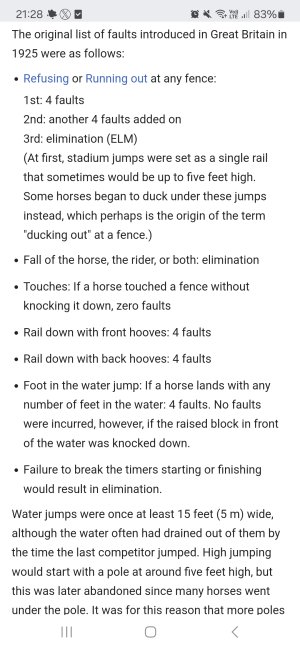
somebody asked me this question and I looked everywhere on the web for the answer to no avail, best thing I've found is that the horse has 4 legs and when they invented the first jumping rulebook in 1925 it mattered which legs knock the bar down, like 2 faults for hindlegs knocking it down and 4 for forelegs, but it turns out it actually is not the answer, anyone can elaborate what is the logic behind 4 faults for knocking down a fence or a refusal? why not 3, 5 or any other random number?
 
It used to be 3 for a stop but they changed that years ago. I guess it has to be enough to be a detriment to winning over time faults and is something probably historical and just developed from that.
 
Why any of them? 20 for XC, 11 for a frangible pin....

I guess it's worse than time fault so they just figured a knock down was 'worth' about 4 time faults?

I think the XC pens are too high. There is no coming back from any jumping XC faults, but perhaps that is the point - high enough to mean XC clears are essential for anyone hoping to be anywhere. Which I think is fair enough at the higher levels but for unaff at 50-80, as people are exploring the sport, maybe there could be more even emphasis on all 3 phases?
 
Why any of them? 20 for XC, 11 for a frangible pin....

I guess it's worse than time fault so they just figured a knock down was 'worth' about 4 time faults?

I think the XC pens are too high. There is no coming back from any jumping XC faults, but perhaps that is the point - high enough to mean XC clears are essential for anyone hoping to be anywhere. Which I think is fair enough at the higher levels but for unaff at 50-80, as people are exploring the sport, maybe there could be more even emphasis on all 3 phases?

they've been tweaked over the years to try and increase/reduce relative influence of the phases. Most people would argue the XC has too little influence - and certainly at the lower levels dressage continues to exert far too much influence.

When I started eventing SJ penalties were 5 for a pole down - clearly someone thought that was exerting too much influence and dropped it back to 4.
 
they've been tweaked over the years to try and increase/reduce relative influence of the phases. Most people would argue the XC has too little influence - and certainly at the lower levels dressage continues to exert far too much influence.

When I started eventing SJ penalties were 5 for a pole down - clearly someone thought that was exerting too much influence and dropped it back to 4.
I think it was to align with BS
 
they've been tweaked over the years to try and increase/reduce relative influence of the phases. Most people would argue the XC has too little influence - and certainly at the lower levels dressage continues to exert far too much influence.

When I started eventing SJ penalties were 5 for a pole down - clearly someone thought that was exerting too much influence and dropped it back to 4.

I guess it will never be perfect! I agree dressage is too influential. Personally XC pens being expensive suits me as Lottie is a fab XC horse. But a kid I know did her first BE80. Did a sweet dressage, clear SJ, a glance off a corner and some speeding points (the time seemed bizarrely easy to get) for over 50 pens. Nowhere.

She was beaten by a lot of people who had average dressage, the odd pole, too slow XC - but that crucial XC clear kept them above her. It does not really matter as in the end she will be very competitve if she goes clear XC. But it did seem a harsh score for such a great ride across all 3 phases.
 
I guess it will never be perfect! I agree dressage is too influential. Personally XC pens being expensive suits me as Lottie is a fab XC horse. But a kid I know did her first BE80. Did a sweet dressage, clear SJ, a glance off a corner and some speeding points (the time seemed bizarrely easy to get) for over 50 pens. Nowhere.

She was beaten by a lot of people who had average dressage, the odd pole, too slow XC - but that crucial XC clear kept them above her. It does not really matter as in the end she will be very competitve if she goes clear XC. But it did seem a harsh score for such a great ride across all 3 phases.
Have to say I don't think a rider with a stop XC should beat a rider that hasn't (and hasn't gone ridiculously slow either).
 
Have to say I don't think a rider with a stop XC should beat a rider that hasn't (and hasn't gone ridiculously slow either).

Fair enough! I just thought she had a better overall performance than many others. Is one XC stop really worth 5 SJ poles? I'm fine with the scoring as it is, but did make me think.
 
Fair enough! I just thought she had a better overall performance than many others. Is one XC stop really worth 5 SJ poles? I'm fine with the scoring as it is, but did make me think.
Many years ago pony club used to double the dressage penalties so 60% was 80 penalties, 70% was 60 penalties etc. My horse wasn't the best at dressage but brilliant jumper. My horse was one of only two to jump a double clear and no time penalties. I didn’t even place due to dressage penalties and the winner won with a stop XC as their dressage was so good! Madness 🤣
 
It's a forum where discussions happen. You asked for elaboration on a reason, people have suggested possible answers. If you've already looked everywhere on the web, you probably know more than anyone here.

The first two replies were direct responses to your question. Then the conversation developed, as they tend to do, on here, or in life, or in general.

I'm sorry that no one seems to have the definitive answer for you, but thank you for sharing your research with us - very interesting, I didn't know that. Welcome to the forum :)
 
Well I once read that the horse has 4 legs so "someone" decided that if they knocked it down with their forelegs then that was an error of all 4 legs (logic being the back legs didn't have a pole to clear any more) so 4 penalties. If they knocked with the back legs then 2 because the front legs cleared it.

I have just tried to Google that though and think it's probably garbage!!
 
Well I once read that the horse has 4 legs so "someone" decided that if they knocked it down with their forelegs then that was an error of all 4 legs (logic being the back legs didn't have a pole to clear any more) so 4 penalties. If they knocked with the back legs then 2 because the front legs cleared it.

I have just tried to Google that though and think it's probably garbage!!
Ties in with what the OP had found though, and logically it DOES make sense. I like it 🥰
 
It used to be 3 for a stop but they changed that years ago. I guess it has to be nough to be a detriment to winning over time faults and is something probably historical and just developed from that.
But 6 for the second stop.

It's interesting when you read old pony books like the Pullein Thompson sisters which started in the 40s and the scores for showjumping seem incredibly complicated. Even Hunter trials seemed to have complicated faults.

I did read somewhere that the 2 for hindlegs was because it was considered a less serious error than the last knocking it down with the forelegs but who knows.

I wonder what the scoring was in different countries at that time.
 
What on earth do you want? An encyclopedia?
Well google hasn’t thrown up the answer so hoping for a historical equestrian enthusiast to pipe up with the question answered directly, instead of discussing scoring as a general thematic.
 
But 6 for the second stop.

It's interesting when you read old pony books like the Pullein Thompson sisters which started in the 40s and the scores for showjumping seem incredibly complicated. Even Hunter trials seemed to have complicated faults.

I did read somewhere that the 2 for hindlegs was because it was considered a less serious error than the last knocking it down with the forelegs but who knows.

I wonder what the scoring was in different countries at that time.
I'm sure that in the Jill books, she got 2 faults for a fence down, don't think they mentioned which legs knocked the fence down though.
 
somebody asked me this question and I looked everywhere on the web for the answer to no avail, best thing I've found is that the horse has 4 legs and when they invented the first jumping rulebook in 1925 it mattered which legs knock the bar down, like 2 faults for hindlegs knocking it down and 4 for forelegs, but it turns out it actually is not the answer, anyone can elaborate what is the logic behind 4 faults for knocking down a fence or a refusal? why not 3, 5 or any other random number?
Hey! R you Persian?because of your name I wondered.cause recently a Persian equestrian has posted a video asking if someone knows the answer.thats why I asked.
 
somebody asked me this question and I looked everywhere on the web for the answer to no avail, best thing I've found is that the horse has 4 legs and when they invented the first jumping rulebook in 1925 it mattered which legs knock the bar down, like 2 faults for hindlegs knocking it down and 4 for forelegs, but it turns out it actually is not the answer, anyone can elaborate what is the logic behind 4 faults for knocking down a fence or a refusal? why not 3, 5 or any other random number?
My dad said in the olden days it was different penalties for which leg hit the pole but not sure if he was joking with me.
 
My dad said in the olden days it was different penalties for which leg hit the pole but not sure if he was joking with me.

It was, 2 and 4 faults depending on if it was front or hind legs although I can’t remember what way round it was. If you read some of the Jill books or similar, you’ll see it mentioned in the show sections.

Supposedly one was a worse fault than the other.

I can only imagine the arguments it caused!
 
Top