Worms - learn to live with them?

Yes you do and a waste licence from the EA to put down planning s!

Oh my god, really?? They are digging up the road along one side of the field in a couple of months time and I've just started conversing with the company on the hopes that I could convince them to chuck the road planings over the fence! Do I need this for normal aggregate or just road planings? So many people I know have done it that I never imagined there was so much red tape. Is it actually possible to get one of these licenses?
 
I've just started conversing with the company on the hopes that I could convince them to chuck the road planings over the fence!

Having just had our road resurfaced with old dug up road we bought from the road people - don't expect it to be free. 80 tonnes cost us about £500. ETA - and that was at 'cost' as my next door neighbour runs the company.
 
OP, do you use FECs? Have you tested for pinworm? Why on earth haven't your vets suggested resistance testing? If you think you have a pinworm problem, why are you using moxidectin and ivermectin?

In your shoes I'd FEC and test for tape and pinworm and worm accordingly and resistance test. Ideally move the horses off the field for at least 3 months (but not to a livery yard or in with other horses, that's just unfair, especially if you do have a pinworm problem). Borrow some sheep or cattle to graze your field while the horses are gone.
 
Having just had our road resurfaced with old dug up road we bought from the road people - don't expect it to be free. 80 tonnes cost us about £500. ETA - and that was at 'cost' as my next door neighbour runs the company.

Sounds cheap to me, my 5 tons was £250! How did it turn out? Are you happy with the surface?
 
Ideally move the horses off the field for at least 3 months (but not to a livery yard or in with other horses, that's just unfair, especially if you do have a pinworm problem). Borrow some sheep or cattle to graze your field while the horses are gone.[/QUOTE]

Blimey, you can tell you live up north! :-D There aren't many options round here - it's generally livery yards or livery yards. Places like mine are very rare. Perhaps the answer is to move to Yorkshire - sounds like a great excuse to me :-)
Thanks for your suggestions, all of which I've done/tried apart from cross grazing with sheep or cattle. I can't do that due to a complicated long term lease. My options are two horses or pigs. We do have a couple of pigs but they're only an option if I can plough afterwards!
 
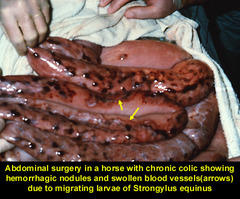
This - plus a high encysted red worm burden can cause perforation.

kELL1Yg4ECmMbDImv9F1Kg_m.jpg

Sorry, this isn't to do with the main question, just this bit of 'information' is annoying me. The picture is of a large redworm burden (large as in the species of worm, not the size of the burden), which migrate through blood vessels and so are extremely dangerous but thankfully now very rare. This is NOT the same as encysted small redworm!
 
Once you get the fence up, let them out on the track. That's where they live. The grass on the track will quickly succumb to the traffic...but the inner field gets to rest and rejuvenate. There won't be much grass on the track. Do you need a license to tote the occasional wheelbarrow? Just trying to get my horses out of the mud. It doesn't have to be a road. In gateways, loafing areas, a swath around the water trough. Even that makes a difference....it does. Do what you can and not what you can't. I've done what I can in small amounts for 20 years and its added up quite nicely despite the tight budget. I also have 2 horses and pick poo every day. My layout turned out differently, because of the landscape. I have a large holding area at the back door of the barn that has 5 gates on it that go to fields mostly 1/2 acre to 2 acres, so small size. No road. I rotate and they are not allowed to mark it up during wet weather cause I want to be able to mow it. Every time I rotate out of a field, I go and mow it. I put them out there when the grass is 6" high and off it when its 4 inches. It'll look like you don't need to mow, but what you're doing is knocking down the weeds that give the grass a hard time. Leveling the playing field. Picking up manure and spreading the rest by mowing will hurt worms A LOT. I think of them climbing up blades of grass in a 5' radius from one poo and waiting for a horse's mouth to come along...yeah, well not in the face of my mower, lol! The mower is my best tool against worms. It probably would be a year. before they saw the infield. A planted crop would establish fast and fool you, though, as its the ground that needs to settle with the roots and become resilient to a horse's descending weight. At my place, the gravel comes into play in the barn and the 60' round pen. Excellent drainage and even better traction. Just do what you can cause even the smallest changes start a cascade of good things that make your eyebrows go up.
 
In my view resistance testing is exactly what you need, to find out if the wormers are working and how long they are working for. At Westgate we are currently doing this for a yard where the horses constantly returned high counts. Some of the dosing gaps for moxidectin are getting scarily short at this yard where there is obvious resistance. It may only last eight weeks, not the thirteen you expect.

You should not have to settle for poor worm control. Please do ring the lab for some friendly help. We are all SQPs here and help people with all sorts of worming problems every day.

You also should not have to put up with some of the downright rude comments on this thread, quite uncalled for.
 
I agree. A worm monitoring system in place to stay on top of it. Another factor is that different horses have different shedding rates, so each is an individual. You also would get to know your horse in the face of it all.
My main goal would be to eliminate them, not just count them. I'm going to go after the environment, because I see it as the only way I can walk away and never have to look back on this problem. Resistance eased, worm counts low, thriving horses.
 
Top