
You are using an out of date browser. It may not display this or other websites correctly.
You should upgrade or use an alternative browser.
You should upgrade or use an alternative browser.
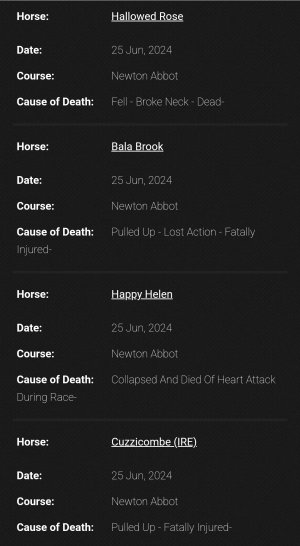
4 dead 2 injured
- Thread starter paddy555
- Start date

pistolpete
Well-Known Member
So sad.

Birker2020
Well-Known Member
Orangehorse
Well-Known Member
It is very sad, and must have been an awful atmosphere there.
The incidents that really worry me are the ones where they seem to break a leg on the flat, this is getting more common whereas years ago it was virtually unheard of. An injury from a fall, yes, a serious tendon injury yes - but not simply galloping over grass track.
Is it due to the surfaces they are trained on, compared to the grass surface? Or breeding? Or training methods or medication used in training?
I think that overall the statistics show that fatal injuries are getting fewer as a % of runners and there is never going to be anything involving horses galloping and jumping that will be 100% risk free, as many of us know to our cost.
But this was still an awful day.
The incidents that really worry me are the ones where they seem to break a leg on the flat, this is getting more common whereas years ago it was virtually unheard of. An injury from a fall, yes, a serious tendon injury yes - but not simply galloping over grass track.
Is it due to the surfaces they are trained on, compared to the grass surface? Or breeding? Or training methods or medication used in training?
I think that overall the statistics show that fatal injuries are getting fewer as a % of runners and there is never going to be anything involving horses galloping and jumping that will be 100% risk free, as many of us know to our cost.
But this was still an awful day.

meleeka
Well-Known Member
I wonder if the heat played a part? That level of loss is unacceptable imo. Can you imagine the outcry if Badminton had four deaths in a day, or Olympia?

SaddlePsych'D
Well-Known Member
Absolutely not acceptable.I wonder if the heat played a part? That level of loss is unacceptable imo. Can you imagine the outcry if Badminton had four deaths in a day, or Olympia?
I don't know if BE collate official data on eventing horse fatalities but found this article: https://clok.uclan.ac.uk/46016/9/Equine Veterinary Journal - 2023 - Cameron‐Whytock - Towards a safer sport Risk factors for cross‐country horse falls at.pdf
This is their source for '65 horse fatalities between 2007 and 2015': https://horsetalk.co.nz/2012/04/02/eventing-safety/
Not sure how comprehensive, accurate or up to date the data is but assuming it is correct, there's three horse fatalities for GB for all of 2023. All international level horses. Obviously without starter numbers I can't work out the percentage as compares to the BHA's 0.18% for last year (0.37% over jumps).
The FEI data doesn't seem to categorise horse fatalities and for riders it looks like 'serious and fatal' injuries data is combined in the table:
(This is just from a very quick Google search)
Orangehorse
Well-Known Member
Of course BE collate and investigate horse accidents.
You can't compare eventing and racing. Eventing is an individual going round the course. Racing is much faster and in company, and also more straightforward.
You can't compare eventing and racing. Eventing is an individual going round the course. Racing is much faster and in company, and also more straightforward.
SaddlePsych'D
Well-Known Member
I am aware that they collate data on rider falls (https://res.cloudinary.com/britishe...21149/files/2024-04/BE 2023 Season Report.pdf) but haven't found any available on horse fatalities. If anyone knows where to find it, do share if possible, it would be interesting reading.Of course BE collate and investigate horse accidents.
You can't compare eventing and racing. Eventing is an individual going round the course. Racing is much faster and in company, and also more straightforward.
I caveated the comparison with not having the horse fatality rate (as a percentage of starters) available for BE whereas the BHA figure was there in the article. All data has limitations, I still think it's interesting and can be useful to think about.
I am glad that BHA will be investigating what happened on Tuesday.

MiJodsR2BlinkinTite
Well-Known Member
I'm in Devon and Newton Abbot is about 30mins journey time away, so very much a "local" course really.
Just one equine fatality is bad enough but for pity's sake after the second, surely that was time to pack everyone up and send them home. The message thus given out was loud and clear that the racing hierarchy don't give a sh!te about the welfare of horses and oh dear we've had them dying on us all day but well never mind let's just crack on with making the money anyway.
Not exactly a good day for racing, and they certainly haven't done themselves any favours by this.
Just one equine fatality is bad enough but for pity's sake after the second, surely that was time to pack everyone up and send them home. The message thus given out was loud and clear that the racing hierarchy don't give a sh!te about the welfare of horses and oh dear we've had them dying on us all day but well never mind let's just crack on with making the money anyway.
Not exactly a good day for racing, and they certainly haven't done themselves any favours by this.

Clodagh
Rage, rage, against the dying of the light.
I was going to go on Tuesday, I’m so glad I didn’t.
One was a heart attack, which could happen anytime, and it wasn’t very hot here at all. Watered ground is a worry, is it ever going to be as safe as rained on?
Two broke down on the flat, but that just seems to happen all the time now, no jumps required.
One was a heart attack, which could happen anytime, and it wasn’t very hot here at all. Watered ground is a worry, is it ever going to be as safe as rained on?
Two broke down on the flat, but that just seems to happen all the time now, no jumps required.
Crazy_cat_lady
Well-Known Member
It is completely unacceptable, and like someone said after the second you'd say enough was a enough and cancel
Unfortunately the jockey was still pushing one of the horses despite not being in a challenging position, hope this is questioned also
I'm another who doesn't remember quite the level of catastrophic breakdowns on the flat/between jumps, and its absolutely sickening to watch when it happens
Why has summer jumping become a thing? At least flat races are usually shorter so not quite as draining in the heat
Unfortunately the jockey was still pushing one of the horses despite not being in a challenging position, hope this is questioned also
I'm another who doesn't remember quite the level of catastrophic breakdowns on the flat/between jumps, and its absolutely sickening to watch when it happens
Why has summer jumping become a thing? At least flat races are usually shorter so not quite as draining in the heat

ycbm
Overwhelmed
I wonder if the heat played a part? That level of loss is unacceptable imo. Can you imagine the outcry if Badminton had four deaths in a day, or Olympia?
At the level of loss of jump racing (1 in 270 starts) there would be more than one death for every 2 days of BE competition. Every weekend long fixture would feature at least 1 horse death.
BE would, imo, not continue with death rates that high.
.
Last edited:
equinerebel
Well-Known Member
It's unacceptable - end of.

myheartinahoofbeat
Well-Known Member
This is really shocking and obviously completely unacceptable, however in racing, it is seen as part of the sport.At the level of loss of jump racing (1 in 270 starts) there would be more than one death for every 2 days of BE competition. Every weekend long fixture would feature at least 1 horse death.
BE would, imo, not continue with death rates that high.
.
If it was happening in another country us Brits, famous as animal lovers would be outraged!
Watering can create false ground and jumps racing in the summer just never seems like a good idea. I appreciate some horses don’t run well in autumn/ winter conditions but some trainers like Venetia Williams specialise in it
Social licence is slowly turning against racing and the jockey club really need to start coming up with more than ‘we love our horses’ because the average person in the street thinks if you love them, why risk them other than for money.
Lauraback
Well-Known Member
Absolutely awful  something needs to change now, RIP beauties
something needs to change now, RIP beauties
Sanversera
Well-Known Member
Completely agreeI'm in Devon and Newton Abbot is about 30mins journey time away, so very much a "local" course really.
Just one equine fatality is bad enough but for pity's sake after the second, surely that was time to pack everyone up and send them home. The message thus given out was loud and clear that the racing hierarchy don't give a sh!te about the welfare of horses and oh dear we've had them dying on us all day but well never mind let's just crack on with making the money anyway.
Not exactly a good day for racing, and they certainly haven't done themselves any favours by this.
 . If the racing was abandoned after one fatality maybe steps would be taken to improve welfare.
Orangehorse
Well-Known Member
These flat breakdowns are becoming depressingly common. The horses are inspected by vets for soundness when they arrive at the racecourse.
Birker2020
Well-Known Member
Ages 7, 6, 3 and 9. The higher proportion of horses that die or are destroyed seem to be in the 6-8 Yr old bracket, I've noticed this a lot with the ages of the fatalities overall from looking at Racehorse Deathwatch.
No matter what people feel about 'Animal Aid' as a charity, their list is accurate and comprehensive. They need more research like the fabulous Sharon May Davis/William Nack report.

 www.espn.com.au
No matter what people feel about 'Animal Aid' as a charity, their list is accurate and comprehensive. They need more research like the fabulous Sharon May Davis/William Nack report.
Eight Belles' breakdown: a predictable tragedy
The real shame in Eight Belles' breakdown in the Kentucky Derby? Close watchers of bloodlines in thoroughbred breeding could have seen it coming, writes William Nack.
Last edited:

CorvusCorax
Deary me...
Unfortunately, no one has ever written about racing as well as Bill Nack did, in a way which is both hugely informative and drills down into the detail, but is also an interesting read to the layperson and comes from someone who is not an owner, a breeder or a jockey. And he was a hugely engaging talker on the subject too, he could read out the label on the back of a cigarette packet and have the audience hanging off his every word. The UK racing industry needs an advocate like him, now more than ever before, but sadly I don't think there is anyone who would fit the bill.
Clodagh
Rage, rage, against the dying of the light.
BHA update following Newton Abbot’s fixture on Tuesday 25 June | British Horseracing Authority

Gloi
Too little time, too much to read.
I'm sure I've read about a connection between this and ECVM.These flat breakdowns are becoming depressingly common. The horses are inspected by vets for soundness when they arrive at the racecourse.
Birker2020
Well-Known Member
I'm sure I've read about a connection between this and ECVM.
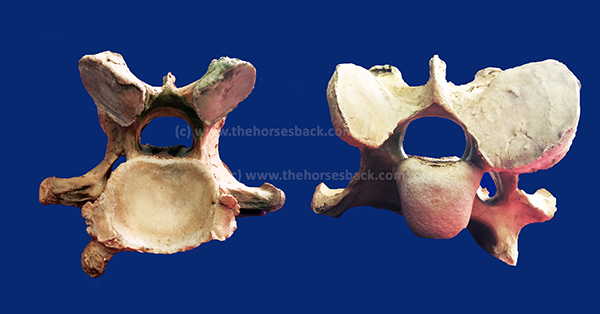
All You Need to Know About the Hidden C6-C7 Malformation That's Bringing Horses Down
What if you learned that your TB or TB-derived breed horse had an inherited skeletal problem that could directly lead to arthritis, instability, stumbles and falls?
 thehorsesback.com
paddy555
Well-Known Member
4 coincidences thenBHA update following Newton Abbot’s fixture on Tuesday 25 June | British Horseracing Authority
www.britishhorseracing.com

Birker2020
Well-Known Member
Quite4 coincidences then
Clodagh
Rage, rage, against the dying of the light.
I do t think the BHA would present a false report. If the four horses had died as a result if the sane injury then yes.4 coincidences then
In what way do you think they falsified it?
SilverLinings
Well-Known Member
Humans naturally try to identify patterns, but as these horses died as a result of different causes it does look like an unusual and very unfortunate coincidence. It doesn't make it 'right' or acceptable that four horses should die at one fixture, but it doesn't look like the racecourse or organisers could have prevented it by changing anything. The deaths appear to have been caused by falls, heart attacks and fatal injuries, which could have happened when they were tearing around a field at home, or undertaking another form of ridden work.
Racing does need to improve welfare but I'm not sure that the deaths at NA were avoidable if the horses hadn't raced. If it turns out that the falls and fatal injury were caused by the course then clearly that would need to be investigated and changes made, but it sounds as though the preliminary investigations have so far ruled this out (and I'm sure that the racecourse would rather identify a cause that they can fix rather than risk another day of deaths and bad press).
Racing does need to improve welfare but I'm not sure that the deaths at NA were avoidable if the horses hadn't raced. If it turns out that the falls and fatal injury were caused by the course then clearly that would need to be investigated and changes made, but it sounds as though the preliminary investigations have so far ruled this out (and I'm sure that the racecourse would rather identify a cause that they can fix rather than risk another day of deaths and bad press).
Snowfilly
Well-Known Member
Humans naturally try to identify patterns, but as these horses died as a result of different causes it does look like an unusual and very unfortunate coincidence. It doesn't make it 'right' or acceptable that four horses should die at one fixture, but it doesn't look like the racecourse or organisers could have prevented it by changing anything. The deaths appear to have been caused by falls, heart attacks and fatal injuries, which could have happened when they were tearing around a field at home, or undertaking another form of ridden work.
Racing does need to improve welfare but I'm not sure that the deaths at NA were avoidable if the horses hadn't raced. If it turns out that the falls and fatal injury were caused by the course then clearly that would need to be investigated and changes made, but it sounds as though the preliminary investigations have so far ruled this out (and I'm sure that the racecourse would rather identify a cause that they can fix rather than risk another day of deaths and bad press).
Agreed. My friend was there and saw the lot, sadly. It was two different places on the track for the breakdowns, the heart attack is always a wild card thing that could happen anywhere and the broken neck sounded like a bad landing from a fairly standard looking fall.
How do you link the four? It wasn’t a particularly hot day, these weren’t long distance staying chases with tired horses, the ground looked unremarkable.
I do wonder about issues with bloodlines and training causing these breakdowns - I don’t recall them happening so often years back, the cases like Ruffian and Black Gold were talked about and remembered for years and last summer there were several just in televised flat races in this country.
paddy555
Well-Known Member
I don't think it is falsified, I just think 4 deaths is too many at one race meeting and basically unacceptable for a sport IMHO.I do t think the BHA would present a false report. If the four horses had died as a result if the sane injury then yes.
In what way do you think they falsified it?
I do wonder about issues with bloodlines and training causing these breakdowns - I
SilverLinings
Well-Known Member
I definitely think that racing could improve welfare by being a lot more careful and scientific about breeding. We (generic) know now that line breeding (inbreeding) causes various genetic and physical weaknesses in all mammals, so that should stop. Consistent breakdowns in one breading line should be investigated and if found to be stemming from one stallion or mare then they should be removed from breeding programmes. Regarding conditions like ECVM that can cause breakdowns research should be carried out to determine whether screening breeding stock (particularly stallions as they produce more offspring) is viable, and if so then it should be introduced.I do wonder about issues with bloodlines and training causing these breakdowns - I don’t recall them happening so often years back, the cases like Ruffian and Black Gold were talked about and remembered for years and last summer there were several just in televised flat races in this country.
I haven't been involved in horse post mortems for 20yrs, but I used to work for a vet practice that covered all the local racecourses and as well as being on site on the day we would carry out PMs at the crematorium. PMs requested by the owner etc were surprisingly rare, and often the vet asked the owner for permission to do one out of professional curiosity. If this is still the case then surely it would be of some benefit to carry out PMs of horses who die on course/shortly after to determine the exact cause, for example did a neck break due to impact, or because of a serious malformation of the vertebrae.
PMs are fascinating and provide a lot of valuable information that is far more detailed and specific than the visual diagnosis when looking at the outside of the horse.
Clodagh
Rage, rage, against the dying of the light.
I had to love that as it is a fabulous post.I definitely think that racing could improve welfare by being a lot more careful and scientific about breeding. We (generic) know now that line breeding (inbreeding) causes various genetic and physical weaknesses in all mammals, so that should stop. Consistent breakdowns in one breading line should be investigated and if found to be stemming from one stallion or mare then they should be removed from breeding programmes. Regarding conditions like ECVM that can cause breakdowns research should be carried out to determine whether screening breeding stock (particularly stallions as they produce more offspring) is viable, and if so then it should be introduced.
I haven't been involved in horse post mortems for 20yrs, but I used to work for a vet practice that covered all the local racecourses and as well as being on site on the day we would carry out PMs at the crematorium. PMs requested by the owner etc were surprisingly rare, and often the vet asked the owner for permission to do one out of professional curiosity. If this is still the case then surely it would be of some benefit to carry out PMs of horses who die on course/shortly after to determine the exact cause, for example did a neck break due to impact, or because of a serious malformation of the vertebrae.
PMs are fascinating and provide a lot of valuable information that is far more detailed and specific than the visual diagnosis when looking at the outside of the horse.