A basic guide to horse colours

that's better :)

I'm pondering now because Enfys mare is a dunalino ;) :)

This is good, very simple to understand, especially with the good clear illustrations you have.

Yes, Juno (was, pts last October :( ) a dunalino, she looked like a palomino though, her sire was red dun and many of her dam line were palomino, I am not sure what colour her dam actually was.

You can't see her barring but this is an example of how much more red her legs were compared to a palomino:
104.jpg


Her dorsal stripe, again compared to a palomino (who may actually be champagne to confuse matters):
0ac2267e.jpg


52a4afff.jpg


I would have loved to have bred a foal, but Juno was barren, at least to Zeus:
1acf53b7.jpg


Oh, and please may I just add that chestnut dun is also known as red dun.
 
Last edited:
Finally how can it be that a bay can have both parents chestnut ? Not mine but a very well known stallion, I didn't think it was possible ?

There was a quite well-known Swedish New Forest stallion many years ago that had two chestnut parents on his pedigree paper, but he wasn't chestnut. As I recall it, some years after his death, the chestnut + chestnut = always chestnut foal "rule" was proven, all his descendants was moved into a special New Forest register, and they're not considered purebred New Forests anymore. I don't think they've managed to figure out who should have been listed as his father, but they're certain that it wasn't the chestnut stallion listed in his pedigree.

So, as already mentioned, either both the parents isn't genetically true chestnuts, without one/both maybe had a colour that could be mistaken for chestnut, or the mare has been out having some fun, that nobody knows about.
 
Cambrica your welshie would have been buckskin because welsh don't have the dun gene, so had cream instead.

Enfys I didn't realise you'd lost Juno :(
 
The chestnut plus chestnut always equals chestnut presumably is what makes all Haflingers chestnut. Tho often mistaken for palomino due to the flaxen mane and tail?

Sorry, but there is no such thing as "always" in genetics!

Except to say there is "always" the wild card of a mutation -- and genes not behaving as they are meant to do! It is a minefield. Just when you think you understand genetics, it will kick you in the backside!

If these things did not happen, all horses would be the same colour!;)

(And, yes, I learnt that the hard way -- after twenty years of breeding. Not all animals homozygous for a recessive will show up in the phenotype. I forget the name for it but one of the geneticist on here might be able to remind me!).
 
Well then his Mum was a very naughty girl :eek:
Joking of course but where would the wpcs go with this one ? and all his progeny ?
http://www.rainhillwelshcobs.com/profile.php?name=Thorneyside the Terminator

That's interesting. I've just been looking up the ponies in his pedigree. Nebo Black Magic was certainly black, I remember showing against him. Hwylog Briallen came from a line of buckskins though I can't find a picture of her.
Providing the pedigree is correct I would be suspicious of the dam's side as some of the ponies and closely related ones do seem to have signs of silver dapple and I would be interested to see if the mother tested for silver and isn't chestnut but silver bay and if so she could have a bay foal. If not then she's been playing away.
 
I think it is great, well done PMP. I have to ask a numpty question - on your dilution tile you describe the bottom right horse as champagne if I read the names in the right order but then he is illustrating cremello in a later tile?

Also, who is the brown horse? He looks a lot like my youngster!
 
Would grey be a black dilution ?

I thought the creme gene could mask grey :confused:

Grey is a modifier rather than a dilution. It is also dominant so only one copy is needed for the horse to grey out (a horse with two copies will also grey out). It works on both base colours but can be 'hidden' by double dilutes or true white horses.

This is where the difference between phenotype and genotype comes in. EG, a maximum chestnut based sabino with grey will look the same as a maximum chestnut based sabino without grey (they will both be white with pink skin) but genetically they are different (ie one also has grey).

this is fantastic and just answered a question i had in my head as i have a new horse who is brown in his passport but i said he was bay and he is bay

If anyone is wondering whether their horse is dark bay or Seal brown, the easiest time to tell is when the horse has it's winter coat (unclipped :p).

Is this mare dark bay or brown?


Her winter coat makes it obvious - she is seal brown.


Very interesting!
So Shaylee my Sec A (who was born Dun) is: Black base colour with Dun dilution and a grey modifier I assume as she is now dapple grey!

Any idea what brings the dapples out in a bay coat ? as Roberto is quite heavily dappled.

The most common colour mistake is confusing dun and buckskin. Neither Welshies or Connies carry the Dun gene but they do have Cream (so 'Duns' of these breeds are actually Buckskin). Highlands and Shetlands do have the Dun gene.

So Shaylee is Black + Agouti + Cream + Grey. Whether she is homozygous for black, agouti or grey I don't know, but she only has one cream gene.

Sooty causes dapples on both black and chestnut based colours.

Grey also can add black pigment (often in the form of dapples), hence why chestnut born greys can go through a dapple grey stage as the grey out
 
Sorry, but there is no such thing as "always" in genetics!

Except to say there is "always" the wild card of a mutation -- and genes not behaving as they are meant to do! It is a minefield. Just when you think you understand genetics, it will kick you in the backside!

If these things did not happen, all horses would be the same colour!;)

(And, yes, I learnt that the hard way -- after twenty years of breeding. Not all animals homozygous for a recessive will show up in the phenotype. I forget the name for it but one of the geneticist on here might be able to remind me!).

That's a good point, I wonder what happens when you get a Haffie with a mutation, mind you sometimes I think mine is a mutant without any genetic aspect :-DDDD
 
I assume the slides would usually accompany some sort of talk? As I really don't understand it...basically, most genes only act on black bases? And if not, which base plus which gene is what?

Actually, don't worry, I'm happy being ignorant and having a plain old ginger horse who shares a yard with a bay, a black and a grey pony ;) :D
 
The most common colour mistake is confusing dun and buckskin. Neither Welshies or Connies carry the Dun gene but they do have Cream (so 'Duns' of these breeds are actually Buckskin). Highlands and Shetlands do have the Dun gene.

That's really interesting, I had no idea that the 'dun' Connemaras were actually buckskin, in the breed standard it is listed as dun, perhaps time for a change. Interestingly enough, the breed standard does not allow blue-eyed creams (although it does allow dark-eyed), I wonder why? When I was hunting for mine (years ago now), I was aware that they weren't allowed even though when I went to view I was told by couple of sellers that they didn't have blue eyes :rolleyes: A shame because a couple were really nice types. Are blue-eyed creams prone to genetic defects, like white cats with blue eyes being prone to deafness?
 
I have a question. In the slide about cream dilution genes, the two base colours are shown as chestnut and bay. I know a bay is a black with an agouti gene, which on the slide it has then been shown the effects of an additional single or double cream gene. But what happens when the cream gene acts directly on a black base, ie a black horse (without the agouti gene) rather than a bay horse? Or does the cream gene only work in conjunction with the agouti gene when on a black base colour?
 
Another question, sorry! Faracat, why/how does the winter coat of that horse make it obvious its seal brown rather than bay? Perhaps its because I'm on my phone, but all I see is a brown body with black points? Though the extra brown bits by the flank and muzzle would make me suspect brown rather than bay. Unless I could see brown in the mane and tail though, I'd think the horse was bay. So what am I not understanding/seeing?
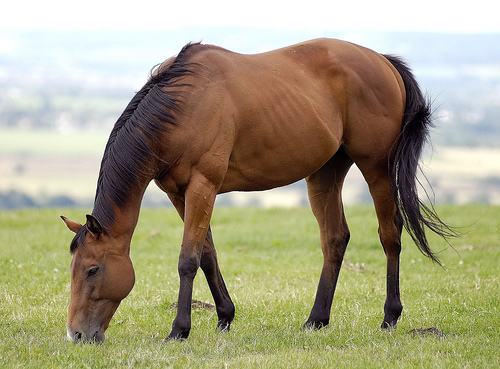
 
Grey also can add black pigment (often in the form of dapples), hence why chestnut born greys can go through a dapple grey stage as the grey out

Interesting . . . so is it fair for me to assume that as Kal's fleabites are more chestnut than black and he has chestnut in his tail that he was born chestnut, went dapple grey and now is greying out/going fleabitten?

P
 
I have a question. In the slide about cream dilution genes, the two base colours are shown as chestnut and bay. I know a bay is a black with an agouti gene, which on the slide it has then been shown the effects of an additional single or double cream gene. But what happens when the cream gene acts directly on a black base, ie a black horse (without the agouti gene) rather than a bay horse? Or does the cream gene only work in conjunction with the agouti gene when on a black base colour?

Smoky black. Or Smoky cream for a double dilute. :)
 
This is really interesting! SO easy to understand in this form too :)
1 question though. If the grey gene makes the coat de-pigment, how come you get fleabitten greys, and how come they get more fleabites as they age? My fleabitten grey gets more and more fleabites as she ages, and they are dark grey rather than chestnut.
Here's a photo of her at the age of 5 (the one on the right):


And here's her colour now at the age of 17 (as you can see from the big 'spots' her fleabites are dark grey rather than chestnut)


And another questions about a different horse. What colour is this horse?
We always referred to her as bay roan.
Summer coat:


Winter clipped coat:
 
Interestingly enough, the breed standard does not allow blue-eyed creams (although it does allow dark-eyed), I wonder why? When I was hunting for mine (years ago now), I was aware that they weren't allowed even though when I went to view I was told by couple of sellers that they didn't have blue eyes :rolleyes: A shame because a couple were really nice types. Are blue-eyed creams prone to genetic defects, like white cats with blue eyes being prone to deafness?

All double dilutes should have blue eyes - so the breed standard allowing brown eyes creams is irrelevant really. :p The main problem with double dilutes seems to be sunburn as they have pale skin. Being a double dilute with grey is bad as they are more even prone to melanomas.

Another question, sorry! Faracat, why/how does the winter coat of that horse make it obvious its seal brown rather than bay? Perhaps its because I'm on my phone, but all I see is a brown body with black points? Though the extra brown bits by the flank and muzzle would make me suspect brown rather than bay. Unless I could see brown in the mane and tail though, I'd think the horse was bay. So what am I not understanding/seeing?

Right - you start with a black horse and Agouti dilutes some of the coat to brown. Agouti comes in three forms A (bay), At (seal brown) and A+ (wild bay). They affect how the back coat is diluted differently.

Bay - The body and face are diluted, but the points (legs, ear tips, mane and tail) remain black.

bay-horse-2.jpg


afirechief_at_stud.jpg


Seal Brown - The muzzle, inside forearms, and flanks/inside thighs are diluted. The dilution can spread a bit further than this especially in the summer coat. The body can be dark brown rather than black, but around the nostrils, ear tips, legs, mane and tail will be black.

brown-horse.jpg


legolas-etalon09.jpg


Wild bay - This dilutes more of the black than seen in Bays and browns. The legs will mostly be brown, but some black pigment will remain on the joints (sometimes on the knees and hocks but definitely on the fetlocks and pasterns).

tumblr_m92ih4p6Lq1rzjxmao1_500.jpg

Interesting . . . so is it fair for me to assume that as Kal's fleabites are more chestnut than black and he has chestnut in his tail that he was born chestnut, went dapple grey and now is greying out/going fleabitten?

P

It's certainly possible. :)

Her stifle had become so bad that prognosis was not good even with an op, so she went with a belly full of grass and the sun on her back before winter set in :(

I'm very sorry to read that. :(
 
This is really interesting! SO easy to understand in this form too :)
1 question though. If the grey gene makes the coat de-pigment, how come you get fleabitten greys, and how come they get more fleabites as they age? My fleabitten grey gets more and more fleabites as she ages, and they are dark grey rather than chestnut.

Some things still aren't fully understood. I had read that it was thought that fleabitten greys were homozygous for grey, but this has been disproven as greys with one copy of grey can become fleabitten too. Grey can add black pigment as well as taking pigment away.


And another questions about a different horse. What colour is this horse?
We always referred to her as bay roan.

Does the horse have white flecks in her coat? Could you take a close up of her fur?

She looks brown based rather than bay based, but whether she has Roan or some other gene that causes 'flecking' I can't tell from those photos (sorry).
 
Here's more photos, I don't know if these are at all helpful though :)
If not, I will try get a close up of her fur.


(you can see how dark her legs are but then there's the light brown/chestnut fur on the insides on her legs at the top)


Thanks Faracat for the link. Unfortunately I've read all the links I can on the subject but it all merges into a mush for me :o hence I hoped this basic guide could help me understand. Other more normal colours I'm fine with understanding, just this one that (maybe I have a mind block) still confuses the life out of me.
 
This is awesome, I've always wanted one of those black with a silver mane and tail, but I thought they were a colour combination you only see in quarter horses or mustangs, so out of interest how would you breed one????
 
Top