Pictures Am I doing right? Lockdown management with previous lami

Love

Well-Known Member
Joined
9 August 2010
Messages
2,604
Location
Worcestershire
Visit site
Going to need to explain a bit of back story so please bare with me! So my boy is a 13yo fit and healthy Connemara. Before lockdown he was getting ridden approx 5 times a week which consisted of schooling, jumping and long hilly hacks with fast bits thrown in (and the occasional ditch and log to jump) at the weekends.

Since lockdown our yard has asked that we spend as little time as possible down there due to them living on site with high risk family members. Consequently they have closed the school and asked that we only come down to do essential horse care, so no riding/exercise/hacking - I totally respect their decision on this but here brings us to my worry...

Around 4 years ago whilst I was away at uni my boy was on full livery and got very very fat (I sat and cried when I got back and saw the size of him) and as an unsurprising result he ended up with laminitis. Luckily it was caught early before it got too bad so there was no rotation or lasting damage. Since then we have moved yards and I’ve worked hard to get him to a nice weight and keep it there and (touch wood) we’ve never had even a hint of laminitis since.

I think it’s great that he can have this time to just chill out and have a little holiday however in the 3 weeks that he has been off work and on the spring grass I have already noticed that he is putting weight on. I know this is obvious but it’s worrying me slightly. How would you manage him?

The majority of other horses are now living out as the yard owners kindly allowed us to turn out for summer early to make it easier to spend less time there if needed (during winter they are out in the day and in at night). I have however still been bringing him in at night to a double netted haynet and a small feed of TopSpec lite balancer and topchop zero. Am I worrying unnecessarily here? Would he be ok staying out with the others or am I doing the right thing by bringing him in? Does what I’m doing sound ok or do you think he should be muzzled in the day? Luckily he is very chilled and is more than happy to come in but with the weather being so lovely it seems a bit of a shame. At the moment he is going out at ~8am and coming in at ~6pm.

If he was still in full work I wouldn’t be worrying and doubting myself like this as I know with work I can manage his weight perfectly! But going from full work to absolutely nothing is making me flap (possibly unnecessarily?)

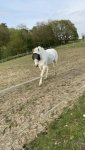
I have tried to upload a photo (hopefully it works) if that would help. Any reassurance/views/shake of the shoulders would be really appreciated right now! And I hope you are all coping ok in these strange and uncertain times.388D8B89-8547-43E9-BA40-7C1D6F572ABB.jpeg
 
In your shoes I would definitely muzzle him.
Is there a bare field he could go out in? Obviously I don't know your yard turnout setup but a trashed paddock from winter (i.e. one with little-no grass) might help.

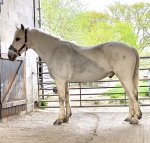
Thanks for your reply! Sorry should have mentioned - his field is pretty well grazed although the spring grass is undoubtedly coming through. It’s on a hill so although this top part looks very bare, down towards the bottom it is much less bare 94F904F2-9B8E-4007-91F1-993A5F458799.jpeg
 
i think Duck is right if you are bringing in day would be better than night if he will settle. I also need to add he looks spot on really fit not fat well done it is really hard with the ones that are good doer's.
 
The thing that jumps out at me from that photo is his feet, if he is at risk of laminitis they look very long in the toe and they are not going to help, he may be due to be shod in the next few days but they are still very long, unless he really will not cope I would take them off, give his feet a rest and that will also help you be really aware of any early warning signs, either way those toes need to be kept back to reduce the risk.
Otherwise he looks great but being the type he is could easily gain weight so you are right to be doing all you can before it becomes a real concern.
 
Having had a horse with laminitis last spring I would be muzzling. Mine is out on a bare paddock but every bit of grass is new growth. Mine is still coming in at night but I will probably switch to in during the day out at night in the next week or so.
 
Another that hates to mention it but his hooves are incorrect for a laminitic. Too long at he toe and not much heel support.

That aside, he looks good. I’d muzzle to be on the precautionary side, can you get up once a day to give him a break or bring him in?
 
Another one for switching his routine round to out at night. I would be doing this now anyway - lockdown or not. Are you able to sub-divide his field any more to strip graze slowly into the lusher grass ?
 
Thank you for all your replies, I really appreciate it!

In terms of his feet - I’ve owned him since a 4 year old and up until the point of him getting this bout of laminitis 4 years ago he was barefoot (he has lovely strong feet). The issue was however they flared to the inside as he was landing more heavily towards the outside of his foot. When were treating the laminitis we looked into this further and realised the issue was coming from his fetlocks - my vet mentioned it was likely something that could have been corrected as a foal but since it wasn’t that is how he now is and advised he be shod to prevent this imbalance putting excessive strain on tendons etc. I will however discuss with my farrier about his toes looking long - thank you to those who picked this up! He is shod every 6 weeks and was last done 5 weeks ago.

I have also fenced off his field to keep him out of the lusher grass for now and will see if he will settle by being out at night and in during the day

thanks again, my minds been put at rest that I wasn’t flapping for no reason and I should stick to my guns!
 
No I don’t think you are flapping. I made a huge mistake last year and as a result my horse got laminitis. He was too fat and I put him out 24/7 and within days he came down with laminitis. I was lucky in that he recovered quickly and no rotation/lasting damage.
He will now be coming in off grass one half of the day for the rest of his life - he just can’t manage on 24/7 grazing. He’s turned out on a winter paddock during the day from 8am and comes in around 3/4pm. He think comes in to 2kg soaked hay and then 8kg as a night net (this lasts him til morning). He’s in light work as if I didn’t work him he’d balloon even on this and I can’t feed him any less or slow him down anymore than I already am.
I would stick to what you are doing and keep a close eye on him.
I don’t have much experience with feet to comment (mine is now barefoot as I found with shoes he lost his heel which is barely there anyway and his frogs contracted, I did find them much easier than barefoot but my convenience vs his foot health was the deciding factor) mine is barefoot all except to hack as our drive is big rubble stones so I boot him.
 
You are definitely right to be flapping. My 2 have a 2 acre field that is growing while I watch. They are in a tiny well eaten down bit and this morning was the first time in a week they've been keen to come in for breakfast. The grass is growing fast.
 
Thank you for all your replies, I really appreciate it!

In terms of his feet - I’ve owned him since a 4 year old and up until the point of him getting this bout of laminitis 4 years ago he was barefoot (he has lovely strong feet). The issue was however they flared to the inside as he was landing more heavily towards the outside of his foot. When were treating the laminitis we looked into this further and realised the issue was coming from his fetlocks - my vet mentioned it was likely something that could have been corrected as a foal but since it wasn’t that is how he now is and advised he be shod to prevent this imbalance putting excessive strain on tendons etc. I will however discuss with my farrier about his toes looking long - thank you to those who picked this up! He is shod every 6 weeks and was last done 5 weeks ago.

I have also fenced off his field to keep him out of the lusher grass for now and will see if he will settle by being out at night and in during the day

thanks again, my minds been put at rest that I wasn’t flapping for no reason and I should stick to my guns!

It’s hard to see in the pics but it’s not just the toes, look at the heels. The two go hand in hand. Look at how much heel is “behind” where the shoe finishes. They are severely underrun from that photo and that will be putting huge strains on the soft tissue inside his hooves.

Re the landing I have the same issue with my Connemara. He lands outside first on one hoof, we cannot find any reason for it. What works best for him is periods of barefoot where he wears his feet how he wants and at that point lands he Lands pretty level. Then when he goes back in shoes (which he does need for certain levels of work) we follow what he’s done. It is never 100% but it’s about 95%.

Honestly those feet would really worry me as a potential navicular type issue waiting. I don’t mean to scare you but I’d have a serious chat with the farrier about why his heels are so bad. He can’t just take back the toes suddenly because there’s nothing there to support him, the horse would be crippled.

There are tons of posters on here far more knowledgable about feet than me, I’d take some pics and get some advice from them.
 
Last edited:
The lammi app was off the chart this morning, so its been ideal weather for it. You've caught it early though so its not the end of the workd. So a few days off the grass then you can introduce turnout with a muzzle on or on a bare patch.
 
The lammi app was off the chart this morning, so its been ideal weather for it. You've caught it early though so its not the end of the workd. So a few days off the grass then you can introduce turnout with a muzzle on or on a bare patch.

Thank you for your reply. He’s got a net soaking for the morning and will be in with soaked nets for a few days. I had started to muzzle but I guess not soon enough. Not lame just a bit of heat and pulses behind.

What is the app you are referring to? Is it the one I have attached a pic of? Would be more than happy to pay for it if it’s worth 943D4469-D53D-4B68-B72B-E8FC915BDB4E.pngit
 
Thats the one. This was it this morning for Northampton!

93293063_10157446316558667_742227596367888384_o.jpg
 
Sorry to bring this thread up again but I'm really unsure with which way to think with this situation and know there are some very experienced laminitis experts on here:

Since my last post (in which he had come in the night before with slight heat and pulses behind and then by morning his feet were cool and no pulses) - that evening there was slight heat and slightly raised pulses although he had been box walking. By morning they were cool and no raised pulses again. Was trotting up sound.

I've spoken to 2 vets from 2 different practices (by chance not choice although not complaining) and I have messaged my farrier today to get his view, just waiting for a repsonse. Both vets had very similar views which was reassuring. They advised to be safe rather than sorry and keep him in for a few days on soaked hay however both felt that this was not a case of metabolic laminitis as the heat and pulses would not be going over night and the one blip was likely from his box walking escapade. They advised after a couple of days in when I had a good few consecutive mornings of no heat or pulses he could go back out either with a muzzle or on a bare paddock.

The first few days after being out was after we had quite a bit of rain so the ground was nice and soft. No pulses when brought in so was very happy. The past few days however he has been coming in again with the same heat and pulses as before but in all 4 feet now. The ground is however back to being like concrete. I just really do not know what to think. He is still coming in to a 12h soaked haynet on a night. Vets were happy with his condition and scored him ~3/5.

Please can I have your views on this? Do you think it is the ground and hot weather causing this? His favourite spot to wait by the gate when coming in is very rutted and hard and is in direct sunlight. I also feel he will be moving around a lot more as his field really is extremely bare now I have fenced it off. Or is this the start of something more sinister?
 
No laminitis advice but I thought what a lovely looking pony when I opened the thread.

Hope you can get some advice and hes sorted soon. They sure like to keep us on our toes!
 
I'd be playing it very safe. Can you phone your yard owner to explain your problem and say that he really does need to exercise so you hope they'll be ok with you hacking him? I suspect that, once his pulses are gone, exercise will really help him. If the yard owner is still saying no riding even when it's a welfare issue I'm afraid I'd be looking for another yard.
 
I'd be playing it very safe. Can you phone your yard owner to explain your problem and say that he really does need to exercise so you hope they'll be ok with you hacking him? I suspect that, once his pulses are gone, exercise will really help him. If the yard owner is still saying no riding even when it's a welfare issue I'm afraid I'd be looking for another yard.

thanks for your reply - yard owner has said they are happy for me to use the school seeing as it’s for medical reasons and not just for a jolly. He was turned out this morning but I have just been to bring him in for the rest of today and take some pics for the farrier
 
I think my concern if he is coming in with pulses after being out at night would be potentially high levels of sugar in the grass during the day. Could you muzzle him, reduce his length of turnout or swap to night time turnout?
Mine had laminitis four years ago and I'm really strict about muzzling, bringing in for breaks off the grass, and checking the lami app and I've managed to never have a reoccurrence.
 
If he were mine I'd muzzle him at grass at night, stable him during the day with a soaked haynet or oat chaff, and ride every day. And totally agree with the decision to put a plan in place to sort those feet out. It's really bad that your farrier hasn't them with you already.
 
With any indication of laminitis he should be in on a deep bed for at least 30 days the damage takes that long to repair, soaked hay ad lib and as small a space as possible to prevent movement. It is movement that kills horses with laminitis not so much the fat. the 2 things you can do are restrict movement and soak hay the last thing he needs is exercise
he needs his shoes off and feet sorted too
 
farrier is calling tonight after I sent him photos today. Just to reiterate he is NOT currently in any work. Everything I have done so far (reintroducing to grazing etc) has been on vets advice

Thanks for advice
 
Last edited:
Top