
paddy555
Well-Known Member
,
admin have allowed my original thread to remain so there is a lot of info there but it is time to move on. The warning is there for anyone considering a trimmer or new to barefoot and that is do your research, that applies to any school of trimming, don't just accept comments on the internet as being correct but get references and go and look at horses to make sure you are going to be happy with your trimmer and their method.
The question of laminitis is a big one and an area where there is disagreement between some schools of trimming. This post below is a very timely offering on another group and discusses the causes of laminitis and track systems. There is permission to share it and, to my mind, it does come with provisos that firstly is your horse/pony going to thrive on a track system, secondly also for some of these very sad cases just because we can doesn't mean we should.
Barefoot rehab for laminitic/rotated feet was established way back in the early 2000's. It is nothing new, just now that track liveries have evolved with better facilities. Many people however have struggled along with their trimmer with their limited facilities and still been successful. Obviously not all cases are successful and if considering it for your horse then expect your trimmer to have had some failures, Some feet are not recoverable and there are sadly failures.
this is from the FB group equine scientia. An interesting group well worth a look especially the last few posts. .
QUOTE
I propose that renaming “laminitis” as LAMELLAR ATTACHMENT FAILURE (LAF).
This might actually help those who are currently under a spell of


to understand the

MULTIPLE
causes, the TWO major PATHOPHYSIOLOGICAL effects and why a TRACK SYSTEM is nearly always going to “REHAB”

.
LaminITIS is a misleading term since it implies there is always inflammation (ITIS Greek for inflammation) which is not true (see my image).
There is however ALWAYS LAF (to varying degrees of severity).
The key to REHAB is removing the CAUSE and appropriately trimming the feet to correct the EFFECTS of LAF.
LAF will present over time as a laminar wedge (damaged hoof growing out), reduced hoof wall growth and increased heal growth.
Mechanical overload (The “teachings” of some groups) is only ONE cause of LAF. And actually horses that have LAF from ANOTHER cause can end up in this category (Mechanical overload) if appropriate CORRECTIVE TRIMMING has not occurred.
However ALL causes of LAF can be “rehabbed” using a TRACK system. So this is why the OTHER CAUSES of LAMELLAR ATTACHMENT FAILURE can be presented as non existent (by some groups) and innocent people can be BRAINWASHED into believing these causes are “OLD SCIENCE”. Because regardless of the cause of LAF a track system combined with CORRECTIVE trimming will USUALLY result in “rehab”.
A CORRECTIVE trim, involves 1) (re)alignment of P3, 2) maintenance of normal amounts of heel, 3) preservation and development of sole and 4) reduction of lamellar wedge to prevent unnecessary overload stress to P3 and transmitted up to the coronary band. However failure to perform (4) in conjunction with 1, 2 and 3 will lead to prolonged recovery time, increased pain and abscesses even ON a TRACK system.
Help me share ALL causes of LAMELLAR ATTACHMENT FAILURE.
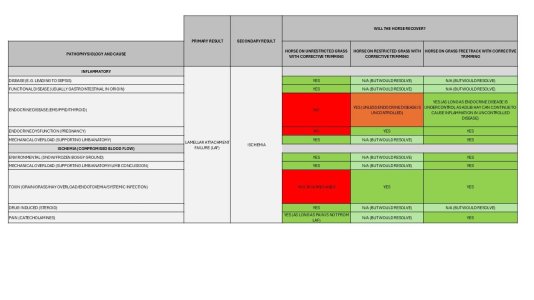
some schools of trimming are very vocal that laminitis/rotation is caused solely by poor trimming. It is easy to blame either the farrier or the barefoot trimmer but that is not always the case. We need to look back to the causes which are on the chart above to see what has been going on.
This is just the first post on a new thread which hopefully people can comment on. Admin would like our discussions to be general ones without specifically calling out individuals.
my understanding from admin is that they are happy for discussions on this topic to be ongoing but on a more general and non name calling basis
this post has been cleared by admin before posting. Please can we stick to the bold part above to avoid the thread being closed.
admin have allowed my original thread to remain so there is a lot of info there but it is time to move on. The warning is there for anyone considering a trimmer or new to barefoot and that is do your research, that applies to any school of trimming, don't just accept comments on the internet as being correct but get references and go and look at horses to make sure you are going to be happy with your trimmer and their method.
The question of laminitis is a big one and an area where there is disagreement between some schools of trimming. This post below is a very timely offering on another group and discusses the causes of laminitis and track systems. There is permission to share it and, to my mind, it does come with provisos that firstly is your horse/pony going to thrive on a track system, secondly also for some of these very sad cases just because we can doesn't mean we should.
Barefoot rehab for laminitic/rotated feet was established way back in the early 2000's. It is nothing new, just now that track liveries have evolved with better facilities. Many people however have struggled along with their trimmer with their limited facilities and still been successful. Obviously not all cases are successful and if considering it for your horse then expect your trimmer to have had some failures, Some feet are not recoverable and there are sadly failures.
this is from the FB group equine scientia. An interesting group well worth a look especially the last few posts. .
QUOTE
I propose that renaming “laminitis” as LAMELLAR ATTACHMENT FAILURE (LAF).
This might actually help those who are currently under a spell of
to understand the
MULTIPLE
causes, the TWO major PATHOPHYSIOLOGICAL effects and why a TRACK SYSTEM is nearly always going to “REHAB”
.
LaminITIS is a misleading term since it implies there is always inflammation (ITIS Greek for inflammation) which is not true (see my image).
There is however ALWAYS LAF (to varying degrees of severity).
The key to REHAB is removing the CAUSE and appropriately trimming the feet to correct the EFFECTS of LAF.
LAF will present over time as a laminar wedge (damaged hoof growing out), reduced hoof wall growth and increased heal growth.
Mechanical overload (The “teachings” of some groups) is only ONE cause of LAF. And actually horses that have LAF from ANOTHER cause can end up in this category (Mechanical overload) if appropriate CORRECTIVE TRIMMING has not occurred.
However ALL causes of LAF can be “rehabbed” using a TRACK system. So this is why the OTHER CAUSES of LAMELLAR ATTACHMENT FAILURE can be presented as non existent (by some groups) and innocent people can be BRAINWASHED into believing these causes are “OLD SCIENCE”. Because regardless of the cause of LAF a track system combined with CORRECTIVE trimming will USUALLY result in “rehab”.
A CORRECTIVE trim, involves 1) (re)alignment of P3, 2) maintenance of normal amounts of heel, 3) preservation and development of sole and 4) reduction of lamellar wedge to prevent unnecessary overload stress to P3 and transmitted up to the coronary band. However failure to perform (4) in conjunction with 1, 2 and 3 will lead to prolonged recovery time, increased pain and abscesses even ON a TRACK system.
Help me share ALL causes of LAMELLAR ATTACHMENT FAILURE.
some schools of trimming are very vocal that laminitis/rotation is caused solely by poor trimming. It is easy to blame either the farrier or the barefoot trimmer but that is not always the case. We need to look back to the causes which are on the chart above to see what has been going on.
This is just the first post on a new thread which hopefully people can comment on. Admin would like our discussions to be general ones without specifically calling out individuals.
my understanding from admin is that they are happy for discussions on this topic to be ongoing but on a more general and non name calling basis
this post has been cleared by admin before posting. Please can we stick to the bold part above to avoid the thread being closed.


