AShetlandBitMeOnce
Well-Known Member
Do we think there is more to this than it may initially seem?
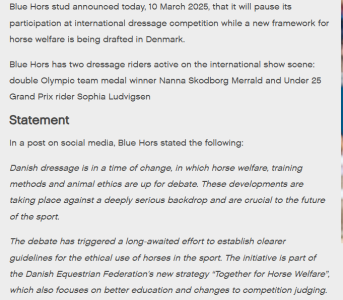



It is tragic what happened to Matiné.Blue Hors Matineè was my favourite horse of all time
She was a beautiful mare but the videos of her in competition are cringe-making. AH was obviously training the same way then as he does now.Blue Hors Matineè was my favourite horse of all time


 www.horseandhound.co.uk

Blue Hors Matineè was my favourite horse of all time
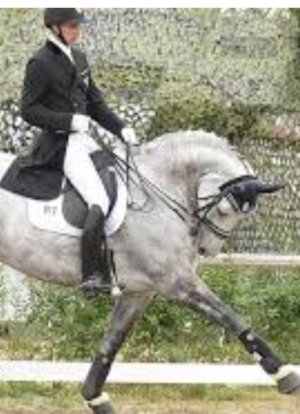
It isn't, that is Tørveslettens Stamina, ridden by the same cruel b@stard that is Helgstrand however


I think it's a wise thing to step back sometimes and look at where you are with training and evolution of what is acceptable as times change

Deleting - think my comment could be misconstrued/potentially libellous, which is wasn't intended to be - it was merely intended for discussion
Dropped back, poorly/incorrectly muscled neck and hindquarters, the signs are always there.
To me it looks like hypertrophy of the brachiocephalicus (sp?) as compensation for little hind limb activity while also being required to lift the forearm above the horizontal.In the interests of learning, what is incorrect muscling wise about her neck?
Not to mention the constantly wringing tail (before they'd worked out how to stop that, clearly; I remember that was a real feature of her tests but barely remarked upon at the time bar a few bunny huggers), tented eye and extended upper lip.Dropped back, poorly/incorrectly muscled neck and hindquarters, the signs are always there.

In the interests of learning, what is incorrect muscling wise about her neck?
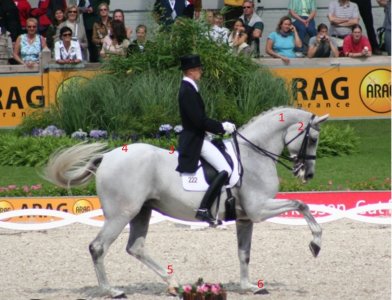
Do the rules still say that the poll should be the highest point in the neck? They never seem to be marked down when it isn't, and it very often (usually? ) isn't.
.
To me it looks like hypertrophy of the brachiocephalicus (sp?) as compensation for little hind limb activity while also being required to lift the forearm above the horizontal.
Thank you, it's good to have it explained in more detailView attachment 156374
1. Broken at C2-3, overdeveloped in upper neck, a compensation for working out of balance while compressed in the hand. That big diagonal shadow is incorrect, the neck should be more filled out at the base and no obvious bulge anywhere else. The crest of the neck should show an even curve and the poll the highest point
2. Squidged parotids, result of same
3. Dropped behind saddle, while in maxiumum collection where the push up from behind should lift all the way into the thoracic sling
4. Left hip looks very dropped instead of stable, irregular muscling, though as this is in movement it's harder to assess. HQs should have smooth muscling and topline.
5. Left hind joints not compressed instead swinging the leg forward, more evidence of the dropped hip
6. Dropping in the fetlocks, the horse unable to stabilise itself higher up so the fetlocks take the strain. Probably sign of hypermobility, again not stabilised through training.
I couldn't watch her and was quite upset at all the people lauding her performances, even before my saddle fit adjacent training I could see it was horribly incorrect, though I do understand that the flash appeals to people, and she had that floppy softness too...though of course that's in big part related to the musculo-skeletal instability.
They do, it's laughable.
Yep, though I like expressing it as the compensation for a horse falling forward, especially when asked to be round ie ridden in some degree of compression. The horse cannot control its pelvis and flex its hind joints to decelerate so continues to fall forward in movement and has to use anything it can to try and stop those forces. Underneck, lats, triceps all commonly used.
Well .... it all sounds plausible to me looking at all those things and thinking none of them look correct! The overall impression of these horses is (in the collected movements most obviously) that they are lumbering. It all looks *enormously* effortful. Because it is. No balance, so brute force is needed.Well, my interpretation of it, I'm sure some would disagree but I'd argue they've drunk the koolaid.
Well .... it all sounds plausible to me looking at all those things and thinking none of them look correct! The overall impression of these horses is (in the collected movements most obviously) that they are lumbering. It all looks *enormously* effortful. Because it is. No balance, so brute force is needed.
View attachment 156374
1. Broken at C2-3, overdeveloped in upper neck, a compensation for working out of balance while compressed in the hand. That big diagonal shadow is incorrect, the neck should be more filled out at the base and no obvious bulge anywhere else. The crest of the neck should show an even curve and the poll the highest point
2. Squidged parotids, result of same
3. Dropped behind saddle, while in maxiumum collection where the push up from behind should lift all the way into the thoracic sling
4. Left hip looks very dropped instead of stable, irregular muscling, though as this is in movement it's harder to assess. HQs should have smooth muscling and topline.
5. Left hind joints not compressed instead swinging the leg forward, more evidence of the dropped hip
6. Dropping in the fetlocks, the horse unable to stabilise itself higher up so the fetlocks take the strain. Probably sign of hypermobility, again not stabilised through training.
I couldn't watch her and was quite upset at all the people lauding her performances, even before my saddle fit adjacent training I could see it was horribly incorrect, though I do understand that the flash appeals to people, and she had that floppy softness too...though of course that's in big part related to the musculo-skeletal instability.