Calling Barefoot experts

Boots are very useful to make the horse comfortable and get him moving around. As change starts to happen (heel first/flat foot landing, heel development, better frogs) then start to increase the time without them. The ground contact will scour the false sole away, help the heels to build, and will put wear on the soles so that you can see where he is unbalanced and try to work out why. The angles are slightly different, but one has a more upright pastern. Is he laminitic?
Not laminitic. He’s been high low since I’ve gotten him 5 years ago.
Now that I’m doing the primary care on his feet, I’m trying to address it. (he’ll get professionally trimmed every 6-7 weeks but I have been maintaining them).
The low foot is definitely on the lower side so I’m trying to slowly go after the long toes to reduse the under run heels.

He’s been out of boots for a few days now and was been more active. He was trotting around the pasture yesterday and didn’t have a noticeable head bob which was great to see.
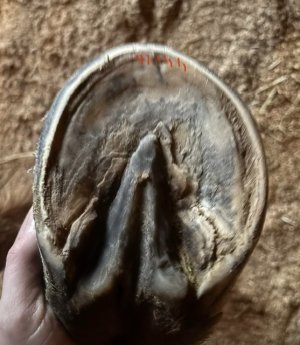
 
Text book progress. Well done!
On second thought - maybe he is laminitic?
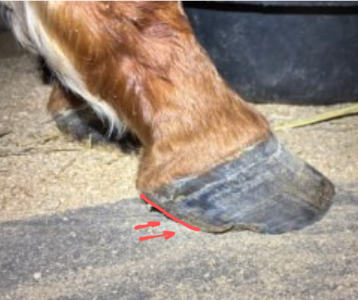
Something I noticed tonight (and have seen before) are some tiny red lines in the toe. Is it safe to assume those would be inflamed laminae?
I will try to get a picture taken on Saturday, but they are VERY small and you have to look hard to see them.
It’s not like the whole toe is red or bruised. See the picture - I drew red lines, but not to scale as you wouldn’t be able to see them!
 

Attachments

  • IMG_4909.jpeg
    IMG_4909.jpeg
    109.8 KB · Views: 64
It might be worth testing for Cushings, as that can lead to a host of foot related issues. Ask your trimmer if the hoof wall should be taken down a little more, and maybe trim the bars to get them bracing the back of the heel - ideally you want them to form triangle shapes where they meet the heels, so that the hoof has good support to allows the frog to 'kiss' the ground on impact. They also aid the horse when he comes to get up off the ground. The frog looks to be moving back into place, and the old remains of the pointy bit appears to be drying up.
 
David Landreville put a post on his FB page about this just yesterday
snap, I was just going to post that.
There are also some posts on the FB hoof group this week (and most weeks :)) about laminitis. One especially about rotation and what rotates.
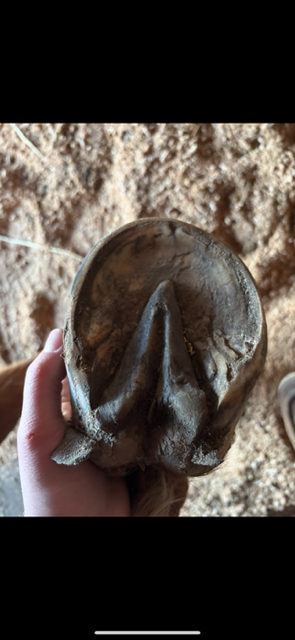
This group

 
I should also note two things :
1. It’s been VERY icy and hard ground here for the past week - could that contribute?

2. The tiny red laminae only showed after I swiped through with my rasp a few times. I’ve read that the laminae will display red when first opened to the air but will then change to normal color after.
I’m not seeing a long inflamed laminae line, i’m seeing what looks like a speck of red lines.
His diet is just mainly a bunch of hay, and a little ration balancer with no access to grass.
 
Hi all,
Wanted to post an update:
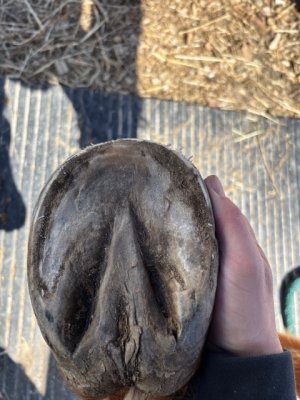
1. His frog is slowly closing up. He has been out of boots and pads for over a week. I’ve been treating the frog with a non caustic treatment.

2. His soles are definitely thin, but hopefully with the warmer weather now - he will start growing his hoof out.

3. I’ve added 15meter pea gravel run that goes directly to the water source.
At first I made it 5 inches deep but it seemed way too soft so I took about half of it out. It’s soft enough that he sinks a little - but firm enough that his whole hoof doesn’t disappear lol.

4. His landings are consistently flat footed which is better than toe first.
The unfortunate thing is he trotted across the pasture today and still had a head bob (on soft footing).

5. I am going to be installing a track system around our 3.5 acre property. Varied elevation as well. Going to vary the footing between pea gravel, dirt, and wood chips. I hope to have this completed in the next few weeks. I am hoping the pea gravel helps grow sole.

The head bob is discouraging but I need to remember he’s been on cold hard ground all winter so it’s possible the inflammation in his hoof hasn’t healed.

I purchased Pete Rameys dvd Under the Horse and it has been SUPER insightful. Lots of detailed explanations and trim videos.


Onward and upward!
 

Attachments

  • IMG_5012.jpeg
    IMG_5012.jpeg
    228.9 KB · Views: 53
  • IMG_5011.png
    IMG_5011.png
    622.8 KB · Views: 47
  • IMG_4991.jpeg
    IMG_4991.jpeg
    193.5 KB · Views: 47
  • IMG_4987.jpeg
    IMG_4987.jpeg
    137 KB · Views: 54
Still making progress! The frog is still weak and needs to grow some bulk from the base. Hopefully, this will start to build up as the internal changes continue. Can you check that the frog is not projecting past the hoof wall? If he if bearing his whole weight on the frog it will be very sensitive. Otherwise, carry on carrying on! As he bears more weight on the foot, and takes more weight at the heel, the frog will continue to grow out of the heel and start to move under the hoof into the correct alignment. Pete Ramey would be proud of you!
 
Good observation on the frog height in relation to the heels.
As of now, it is at the same level, or *just* below.
I rockered the heels a tiny bit to help with a heel first landing.
I did not make the correlation that if you want more back half comfort in the foot, you grow the heels a little longer to it can bear some of the weight.
I really like Pete's philosophy because it gives you general, similar tolerances to watch for (heel height, collateral groove depth, wall height).

Thank you for the encouragement - onward and upward!
 
Apparently I'm the only one, but I don't like the development of the sole or rather that there's almost no improvement at all.

It's been more than four months now since the shoes were taken off, with the right strategy plenty of time for improvement, yet the soles appear as thin as before. Therefore, I suggest you read this article by Pete Ramey (https://www.hoofrehab.com/DistalDescent.htm) and consider trimming as explained there. From my own experience this trim works fabulously and if you decide to give it a go you should see significant improvement after just a few weeks.
 
Thank you for passing that along - I’ve read that a couple times. It has a lot of info so it takes a little while to sink in.

Agreed on sole depth. It not is quite where it should be. But, he is coming out of winter and his feet have never grown in the winter. They grew like a weed in the fall when we pulled the shoes.

His front left (navic) has better sole depth and palmar angle than his front right which is his low hoof, and has minimal sole depth.
i can tell he is a little more comfortable on boots and pads.


I have been slowly keeping his toe length in check haven't touched his heels.
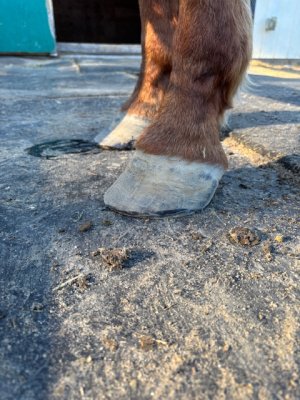
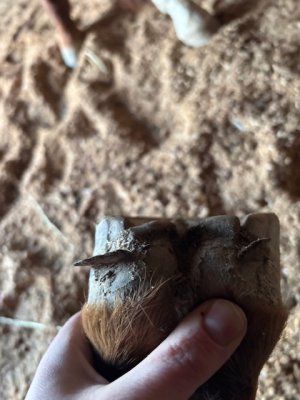
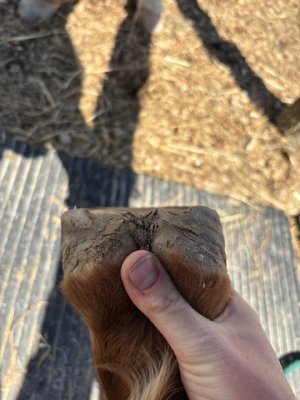
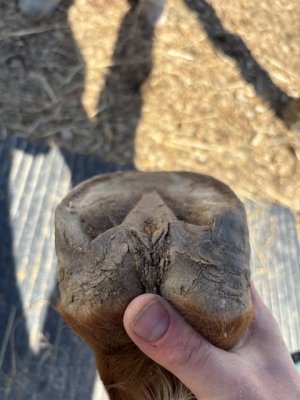
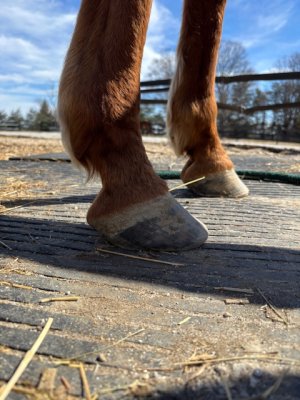
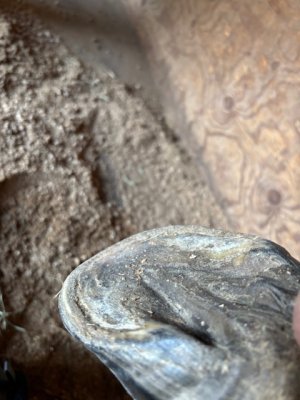
What approach do you find best for fixing under run heels with minimal heel length? Some people say bring the heel back, some say don’t touch the heels. First photo group is front left, second is front right.


EDIT* I am getting a server error when trying to post pictures. Will post as soon as I can.
 
Last edited:
Horse is landing flat footed at the walk and heel first at the trot. But, he still does have a head a slight head bob at the trot.
 

Attachments

  • IMG_5043.jpeg
    IMG_5043.jpeg
    166.3 KB · Views: 32
  • IMG_5044.jpeg
    IMG_5044.jpeg
    145.5 KB · Views: 31
  • IMG_5045.jpeg
    IMG_5045.jpeg
    140.6 KB · Views: 31
  • IMG_5048.jpeg
    IMG_5048.jpeg
    175.4 KB · Views: 27
  • IMG_5053.jpeg
    IMG_5053.jpeg
    134.6 KB · Views: 32
There are still changes taking place, and the foot needs time to grow into the shape it needs. The heels are starting to spread and drop - where your thumb is in the photos needs to fill out and grow down. For this to happen, the entire internal structure needs to realign itself to cope with the new angles. The more movement he can do, the stronger the resulting hoof will be. Hold your nerve, he is doing great.
 
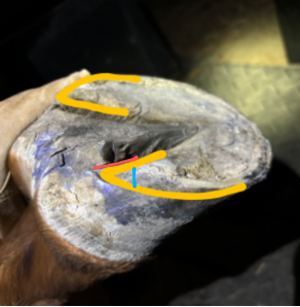
Underrun heels are always too long, and therefore too weak to support the hoof. Unfortunately, the longer they're left the stronger the leverage gets that forces them further under the hoof.
Screenshot_20250320-092657~3.png


When I say bring the heels back I mean trim the wall and bars according to the yellow line (picture below). There's also a difference between length and height. The red line shows what needs to be taken in length and the blue one what would be taken in height.
Screenshot_20250320-092504~4.png
 
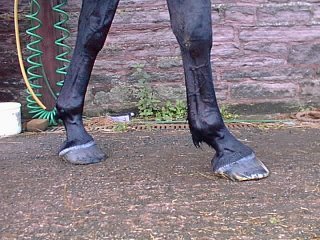
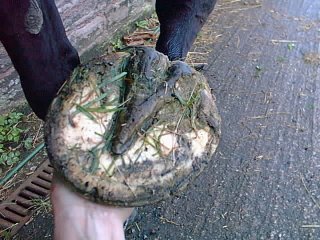
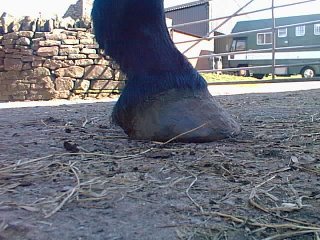
Horses can and do correct underrun heels without human intervention if they have enough slow work on abrasive surfaces.

I did not attempt to trim these heels into the right place because if I had, the pressure on his frog would have been so immense he would have abscessed. They came back all by themselves with work on tarmac. There is 7 months between these photos.


17SEP008.0.jpg


17SEP006.1.jpg0026.0.jpg
 
Last edited:
Before you think about balancing the hooves, however, your top priority should be to thicken up the soles.

Therefore, back to the linked article. I totally understand that it's a lot to wrap your head around. Read it again then, and again, until you really understand everything. Ask questions where you don't follow.

From your pictures I am very confident that your horse has a sunken P3. And the sole can't grow because of that more than anything else, regardless of the season or diet.

Imagine the P3 and everything inside the hoof capsule as a foot and the hoof capsule (wall and sole as a shoe). The foot and the shoe are attached to each other through a layer of velcro (the lamina). But the velcro is damaged and too weak to hold up the foot, so it sinks down in the shoe and compresses the sole. The lamina (velcro) can only be repaired from the coronet downward, like a one-way zipper that can be closed only in one direction.

Now PR's trim entirely eliminates all leverage to the wall which is what wall and lamina need to build a tight, strong connection again. As both grow downward the "zipper" is gradually closed, provided no new leverage is allowed to weaken the lamina during this process. This tight and strong connection between wall and lamina is what pushes or pulls the P3 up and in doing so allows the sole to thicken up and develop natural concavity again.
 
The foot is being rehabbed because of a navicular diagnosis. If you start taking too much off the heel, it will cause pain and cause the horse to throw weight onto the toe....and back to square 1. The hoof is starting to grow in some great angles, and the frog has already shifted back, which show clearly that changes are taking place. Once the new growth is three quarters of the way down the hoof, the old growth will start to crumble and chip and a period of soreness may sometimes be evident as the crossover between new soft growth and hard soon-to-be-discarded old growth kicks in. This is the time when the sole will start to thicken, to deal with correct movement. Agree with ycbm - patience is everything.
 
Now PR's trim entirely eliminates all leverage to the wall which is what wall and lamina need to build a tight, strong connection again. As both grow downward the "zipper" is gradually closed, provided no new leverage is allowed to weaken the lamina during this process. This tight and strong connection between wall and lamina is what pushes or pulls the P3 up and in doing so allows the sole to thicken up and develop natural concavity again.


And yet Rockley Farm's extensive photo blog shows that if the diet and movement on the right surfaces are correct that the laminae will strengthen and the toe come back without any trimming at all. Trimming of the toe, if the horse is landing flat or heel first is not a prerequisite of growing strong laminae down from the top. By the time the strong laminae are grown down far enough to encounter leverage at the toe, not only will the toe already be shortened but the laminate will also be strong enough to withstand the leverage. It's strong laminae at the top which suck the pedal bone up in the hoof capsule, not trimming at the bottom.
.
 
@Highmileagecob
It seems to me you read selectively?
The underrun heels are a comparatively minor issue that can be addressed later. I just gave my opinion to a question that happened to come up now.

What I am concerned about is the thin soles that haven't improved visibly in months! To walk a horse with thin soles barefoot on tarmac as suggested is torture for the horse and can severely damage the P3 as well.

It's strong laminae at the top which suck the pedal bone up in the hoof capsule, not trimming at the bottom.
.
Exactly my explanation! But the "bottom trim" is what initiates the rebuilding of the strong lamina at the top - if you decide to trim.

Natural abrasion (which also happens at the bottom) can do the same under perfect conditions, but far slower and not necessarily perfect either as you might have abrasion where you don't want it. But yes, it is an option, if the hooves are just not in good shape but the horse still comfortable walking on them.

The OP's horse however has been uncomfortable on his feet already long before the shoes came off 5 months ago. (My mare developed an about 1 cm thicker sole within 6 weeks after the first trim and she wasn't sore a single moment because of it. I only mention that to give you an idea how fast the sole can recover under the right circumstances - or with the right trim.)

Patience is a good thing but not always the best and only option. If there are ways to bring quick relief from pain, they should be at least thoroughly considered.
 
Hi All,
Thank you for the discussion.
I should note.
The hoof with navicular dx is the FL. The hoof's angles are better compared to the FR. The FR hoof has under run heels and shallow collateral groove depth.
My 1/4 mile track system is now finished. They will be walking through dirt, pea gravel, 1/2 inch limestone minus, and sand.
It has a couple strenuous hills so I am excited to see the results.

Stay tuned, I may take some more hoof photos tonight.
 
the "bottom trim" is what initiates the rebuilding of the strong lamina at the top - if you decide to trim


It isn't.

It's proper feeding that creates the strong laminae at the top. Most barefoot rehabs also have their feed regime adjusted. Weak laminae at the coronet are not caused by damaged laminae at the bottom.
.
 
Natural abrasion (which also happens at the bottom) can do the same under perfect conditions, but far slower and not necessarily perfect either as you might have abrasion where you don't want it. But yes, it is an option, if the hooves are just not in good shape but the horse still comfortable walking on them.

You may have abrasion where you don't want it but you get it, generally, where the horse wants it.


Patience is a good thing but not always the best and only option. If there are ways to bring quick relief from pain, they should be at least thoroughly considered.

I wasn't referring to horses in pain or keeping horses in pain when a trim would relieve it.
 
Not sure if Rockley Farm are still updating their blogs, but they had exactly that set up here in the UK, with good results for rehab. Do you think the RF is the cause of the head nod? LF seems to be progressing well.
They went dark and have not uploaded new blogs in years.
RF is not cause. Bob happens when LF is planting and pushing off.

Diet has been totally changed in last few months. Went from grain, to grain and balancer, then to one balancer, now to Timothy cubes with added copper zinc. Need to add some more minerals but haven’t done it yet.
 
I don't mean to be aggressive but I'm trying to understand your way of thinking, so please allow me some questions.
It's proper feeding that creates the strong laminae at the top. Most barefoot rehabs also have their feed regime adjusted. Weak laminae at the coronet are not caused by damaged laminae at the bottom.
.
Do you think that all damages to the lamina are always caused by a poor diet or metabolic issues? Do you think that a perfect diet makes the lamina so strong that it can withstand all mechanical wear and tear unharmed?

You may have abrasion where you don't want it but you get it, generally, where the horse wants it.
Can you really say that abrasion happens where the horse "wants" it? Is the wear pattern not just the result of the horse's movement patterns in general and in particular of the leg above? And if so, is this a one-way road (top to bottom) or does it work in both directions, i.e. is the shape of the hoof one of several factors that influence how the horse moves as well, for better or worse?
 
Do you think that all damages to the lamina are always caused by a poor diet or metabolic issues? Do you think that a perfect diet makes the lamina so strong that it can withstand all mechanical wear and tear unharmed?

Happy to have a civilised discussion any time .

I think that lamina and indeed whole foot strength comes from the metabolism but that in some horses that can be extremely difficult to get right.


Can you really say that abrasion happens where the horse "wants" it?

yes of course you can. The horse may not be operating in is own best interests, but it is putting the wear where its own movement wants it to. You're often better off sorting out the bad movement rather than trying to trim in a perfect foot. And letting the changes in the foot inform you that you've got improvement in the movement.

There are also an awful lot of lame horses around with feet that have been made symmetric by people who think horses feet should look that way, who would be sound if they were allowed to sort the foot balance to fit the leg bones above the foot that they were born with.

Is the wear pattern not just the result of the horse's movement patterns in general and in particular of the leg above? And if so, is this a one-way road (top to bottom) or does it work in both directions, i.e. is the shape of the hoof one of several factors that influence how the horse moves as well, for better or worse?

I think the horse is a system with influences in both directions but that in general the urge to interfere help is too strong in many professional trimmers.
.
 
Top