Calling Barefoot experts

cthorseman

Active Member
Joined
17 October 2024
Messages
49
Visit site
Hello H&H community.
I come from across the pond looking for guidance.
10 year old gelding was recently diagnosed with Navicular after months of lameness on the front left. MRI was performed. Horse is ridden for pleasure, usually in a sand arena
Findings were:
- Chronic navicular bursitis with significant adhesion formation
- moderate left fore navicular bone inflammation
- inflammation of the distal aspect of P3
- no issues with DDFT.

Injections were done on same day as MRI. Hyvisc and other anti inflammatory was injected into coffin joint and navicular bursa region.
Horse was shod 4 days later and put in an egg bar shoe with a rocker toe. Despite these interventions - one month later he is actually less sound than he was when he got the MRI.
He did run stomp around on the pavement for 45 minutes getting back into the trailer after the MRI with no shoes on - then broke off a cross tie the day he was shod and galloped around the arena for 5 minutes (he was on 5 months of box rest and was a time bomb).

Vet came out yesterday and gave Osphos and we will begin him on Equioxx. After discussion with the vet - we agreed maybe pulling his shoes may help. Clearly his current shoeing setup isn't doing it for him. The Vet was also surprised at the no improvement as his MRI did not look terrible compared to what she has seen in the past.

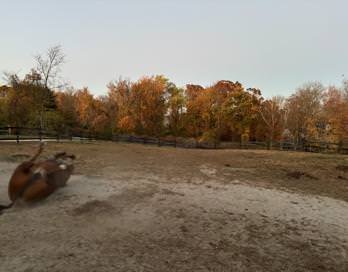
His current freedom includes turnout at 5:00 after he is fed. He has access to back into his stall overnight. He usually wanders back in there at some point. We put him on opposite turnout schedule as his pasture mate because they were playing too much and I didn't want to make his injury any worse. He has access to a 1/2 acre, very short grass field with varying minor elevation changes, and a full sand arena. The 1/2 acre pasture also has a section of wood chips to walk on and compacted dirt. We have about 4 acres fenced in total, but those are tall grass pastures so we don't want to let them in there with winter coming. We own this property so we have flexibility in how we can modify it. I also have access to asphalt to walk on, and crushed limestone 3/4 rock mixed with sand.

When the farrier pulls his shoes, I want set him up for success the best I can, but I have zero experience with barefoot horses. I found going barefoot as a possible remedy through Rockley farm. It seems to be quite remarkable what they can do with their program. Granted, I cannot directly replicate their program, track system or footing.

As far as dietary changes, I have added in a mineral rich hoof supplement into his grain. It may not be much, but it was something he wasn't getting before.

Questions I have:
1. Should I keep in his in out (12x12 stall with attached 16x16 rubber matted outdoor space) for a specific amount of time after his shoes are pulled?
2. If I do keep him confined, how often should I hand walk him and for how long?
3. If I don't confine him - can I turn him out on his normal nightly turnout schedule? He does walk around a fair amount and move around the property.
I plan on taking weekly photos of his feet as well as slow motion video of movement.

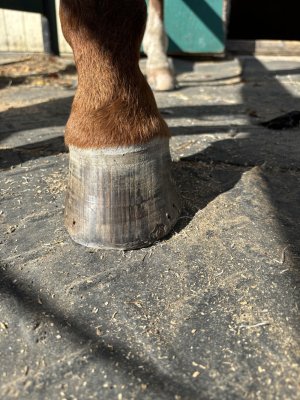
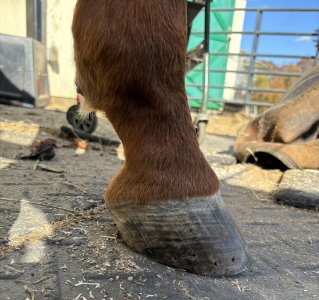
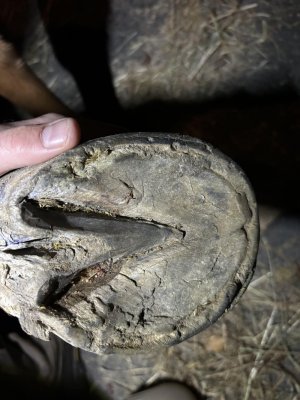
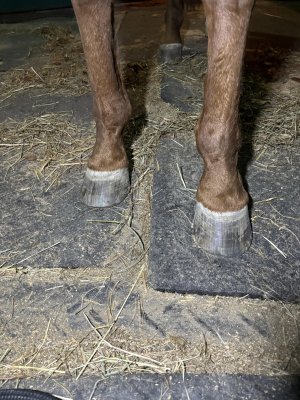
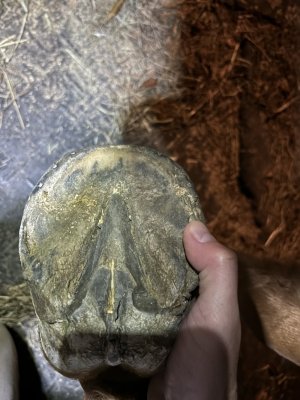
Lastly, attached are pictures of his feet. Thank you for any tips or tricks.

https://postimg.cc/gallery/DKJwwpd
 
The back of the hoof looks weak and contracted, not surprisingly.
He does want as much movement as possible but needs to be comfortable to do so, no point in movement that is hurting , so you will almost certainly need some boots for a while. The saddlery shop
And the hoof boutique
Will both help you find the most suitable boots for him.
 
Please try and read up as much as you can about barefoot rehab. Pete Ramey's Hoof Rehab, Jamie Jackson, The Hoof Geek, Rockley Farm etc.. Are you able to see how your horse is landing the foot? It should be placed either flat to the ground, or heel first depending on how fast he is moving. If he is pushing weight forward on to his toes, or walking like a ballerina and landing toe first, then boots and pads will help to put gentle pressure on the frog and start to initiate change. Please do not allow your farrier to trim the hoof into balance to make him walk correctly - allow at least six months or longer to get the correct balance, taking the heels down a smidge at a time and leaving the sole and frogs alone. Good luck, I hope you start to see changes for the better. Keep us updated!
 
it sounds like you can design the perfect set up for him. i have a similar set up in mine and I transition them first using boots and pads and have them moving as much as possible. but its amazing how quickly they adapt. you can tell how they are feeling by what surfaces they chose to walk on. best of luck with it!
 
I wouldn't plan to confine him. The movement is what's going to stimulate the hoof and reducing it will slow down the growth and recovery period.
Obviously he will be more sensitive but it depends on the individual.
My tb was on 2 bute a day for 2 weeks to be comfortable on grass when I took his fronts off.
My old Welshie had shoes off and went on a roadwork hack the next day like she hadn't even noticed they were gone.

Your best bet will be to have several plans but listen to your horse, he'll tell you soon enough what and where his comfort levels are and how quickly you can make progress.

Best of luck with it all, it can be a long road but I've never regretted it with any of mine.
 
I would take those shoes off and slowly get the toes back and just turn out in a field as much as you can.

I have both of mine barefoot now because foot issues and I wouldn't put shoes back on either of them.

I've gone against vet advice but don't regret it.
 
I have transitioned several horses to barefoot and would not confine the horse.

I have found that walking is the key to the feet changing and strengthening.

Mine usually have a month with just turnout on a soft surface then start walking on roads. Just 100yds to start and build from there. I gauge it by if they take a footy step. 2 ouchey steps and we turn back. The ouchey steps are usually caused by a stone or whatever on the road. So, we may get 5 ouches in a day, but caused by a stone rather than because the horse is uncomfortable on the road.

I just remain vigilant that the horse is striding out.

Make sure there is no crack or thrush in the frog.

You may need to alter the rehab because of a specific injury as mine were going barefoot through preference rather than as a rehab to injury.

I find that cleanliness is everything, as is a barefoot friendly diet and vitamins. I also put topical treatment if the hoof is compromised. I like soaking with Cleantrax as a one off and coating with Hoof Doctor every day. The Hoof Doctor was bought on a whim but the foot I used it on had the fastest rehab ever and the horn quality was rubbish when I started, so it has a place in my heart even if it is supposedly not special!
 
To add to the above, be aware of what you're feeding. Avoid sugar/molasses, alfalfa, cheap fillers, garlic and seaweed. Look at Agrobs, Thunderbrooks, Speedibeet, Pink mash, micronised linseed and Coolstance Copra (depending on whether good-dooer or not).
 
Hey All,
Thank you very much for all of the helpful information.
For diet - I should be more specific. He is currently on 1/2 quart of grain, and 1/2 quart of ration balancer + a Dumor hoof care supplement, and about 5-6 flakes of hay scattered throughout the day and night.
As far as pea gravel - is this something I should incorporate in some spots? Should they be in more high traffic areas that he has to walk through? (for example when exiting and entering his in out stall from the paddock).
As far as a movement pattern, he is definitely landing toe first. He has not really pointed his toe at all much at rest however.
I am hoping that his hoof inflammation will be helped by the removal of shoes, the Osphos, and the Equioxx.

Regarding boots, how long do you recommend them being on? Any specific times - or just when he is foot sore? Just for turnout during the day? His current shod setup, he has pads so he has not had direct frog stimulation in multiple years.

The significant lesions in in the Bursa do make me very uncomfortable - I am hoping there have been other cases of horses with adhesions that have heeled and come back to soundness.
Ideally, we can get him back to a riding state, but if not, I just want him to be comfortable putsing around.
 
Does he actually need the grain? Or could it be replaced with a forage based feed?
Pea gravel is just a free draining medium that can stimulate the frog and heels into use. Not essential.
Boots are for walking out in hand, or walking under saddle, depending on your vet's advice.
When the shoes come off, you may see that he is more footsore than usual, probably because his foot is not working the way it should, and it all takes time to change and remodel internally.
Can you see any sign of thrush around the frogs, or a contracted frog, that may be contributing to heel pain? Any chance of posting pictures of the soles of his feet?
I'm not an expert by any means, but have an interest in hooves and hoof care!
 
He doesn’t actually need the grain - I am going to take the grain out fully as he doesn’t need the extra energy.
I am thinking of upping his ration balancer diet to 3 lbs per day - between that and hay I think it will be enough calories.
If anyone has any feed regimen recommendation, I am all ears.

I can’t get to his frog yet due to the pads.
As soon as his shoes are pulled this weekend or next, I will post pictures and video of him walking.
 
I am by no means an expert. I've transitioned one horse with issues blocking to the caudal hoof successfully back to low level endurance and kept various others barefoot in work using boots to greater and lesser extents depending on the horse. In the absence of other more knowledgeable posters I will venture few comments.

As previously mentioned from what can be seen of the hooves at present they seem long, contracted at the heel and generally weak in that area. I would hope to see them shorten over a period of time and also expect to see a change of angle in the new growth. A lot of advice will depend on your horses comfort levels once his shoes are off so can't really be given before hand unfortunately.

I personally prefer not to trim at all in the early stages of transition until I can see how successfully the horse will wear the hoof itself. That of course depends on how much COMFORTABLE movement it can take. Which of course depends on how it is once the shoes are off.

If this were my horse I would prepare before shoe removal by starting a low sugar/starch and high fibre diet preferably for at least a couple of weeks even better a month given you are likely to need to change gradually to a new feed. I struggle to understand exactly what's in your feed balancer because you are from across the pond 😊 but be aware not all balancers are created equally when it comes to barefoot. A quick bit of research on here using the search function will bring up several threads recommending good balancers in this country. You will then either need to see if you are able to source them yourself or look at the ingredients and try to find something similar. Equally there is forage and forage when it comes to barefoot. There's a whole debate about hay v haylage that I'm not going into, mainly because I have to use hay anyway for other reasons so the debate doesn't really affect me! A rough rule of thumb I use is to avoid anything with rye grass where possible, meadow hay or Timothy tends to be lower in sugar I think though happy to stand corrected.

The second thing I would do to prepare is to have hoof boots and pads before the shoes came off. Something very forgiving in fit like cavallos are really useful in this situation and take pads well.

Once the shoes are off then it's a case of monitoring how your horse copes. Gentle COMFORTABLE movement is key. How much you use boots depends on how the horse is doing. Is he comfortable turned out without boots? If so great, if not use boots and pads for turnout baring in mind to constantly monitor for rubs or other issues being caused by prolonged use.

If you need to use boots for turnout then your horse won't be able to wear their feet naturally so will need more trimming but make sure not to overdo any trimming especially at the start. Only movement will build the digital cushion and strengthen the feet, you are very unlikely to trim your way to good feet if they haven't been strengthened from within first in my opinion.

Above all have patience. Good feet aren't built in weeks. Monitor frequently (constantly!) to pick up issues and photos are great to see the gradual changes.

Issues that can impact hoof comfort;
1) injury
2) diet
3) hormones (don't know how old your horse is but if it struggles barefoot I have often found a Cushing's/Ems check useful)
4) thrush

I'm in a rush I'm sure others will be able to add more. I have never regretted removing shoes from a horse but do remember everything can be temporary so don't stress too much you can always put shoes back on if you need to! Equally don't expect enormous changes instantly.

The most important thing in all this is your horses comfort. Long gone are the days of forcing exercise in footy horses to 'toughen the feet up'. Comfortable movement is hugely beneficial and will build stronger hooves. Uncomfortable movement will result in the horse moving wrongly, holding it's body wrongly and not benefitting. So aim for comfort first and movement second building up as strength and comfort improves.

Hopefully someone with more experience than I comes along shortly and can give you further advice or correct any nonsense I've spoken. Unfortunately one of our more experienced posters is taking some time out from the forum at the moment hence my doing my best meantime 🙂 Good luck 🙂
 
Good decision to take the shoes off!

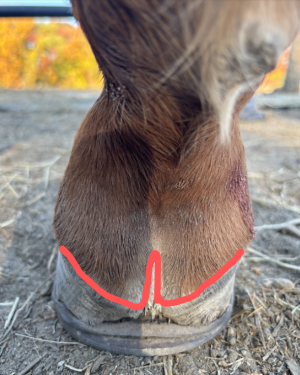
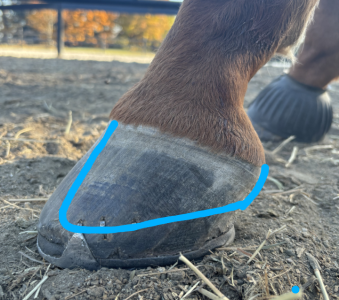
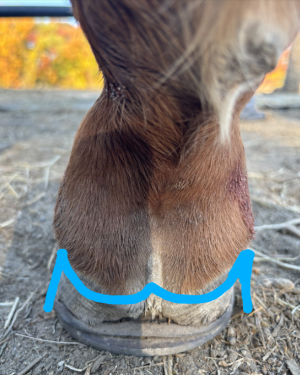
This hoof looks extremely uncomfortable. It's too long, the heels contracted and the frog cleft squeezed together and full of thrush. This is painful! No wonder he lands toe first.Screenshot_20241023-122234~3.png

The blue lines is it what I'd be aiming for although it'll take time. Just to give you an idea how out of shape this hoof is.
Screenshot_20241023-122028~4.png
Screenshot_20241023-122234~4.png
 
Hi All,
Thank you for the helpful information.

This is the RB he currently is on
I will definitely be playing the waiting game over the coming weeks, but luckily I am not in any rush.

I have a set of boots right now that fit with the exception of a little heel rub. I think when his shoes come off, and he is trimmed a little they will fit well...Until his feet actually begin to grow!
Luckily I have a couple of local tack shops that carry various size Cavallo boots.

I am going to put some pea gravel down this week and will take some pictures of the space and footing.
 
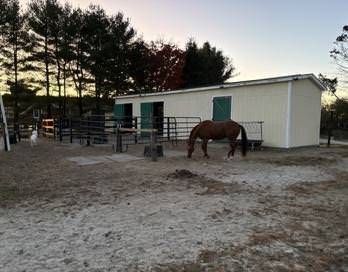
This is what his main area looks like. He is the stall on the right and can walk in and out at night for turnout. I have wood chips by his in/out gate, then it transitions to very short grass and dirt/sand. Then it is short grass as it goes down the hill. I will probably replace the area by the hitching postwith pea gravel. He also has a full sand arena just to the left of the white dog out of frame.
Feedback is welcome!
IMG_4400.thumbnail.jpgIMG_4401.thumbnail.jpg
 
My trimmer doesn't like pea gravel because it gets stuck in the feet (and can also be a source of pinpoint pressure when it gets kicked around). I guess if you are in a dry area and can contain it it might be fine?
 
Pea gravel is not a bad idea but it needs to be thick enough that the hooves can sink in. I guess a layer of 5 inches is necessary which means you need a border as well.

However it's only worth the effort, if the horse frequently uses this area. Looks like he can easily walk around, if he wants.
 
If I make it big enough, he wont have a choice!
We haven't had rain in about 5 weeks so the ground is super dry. As soon as it rains it will definitely cause some mud. Pea gravel it is.
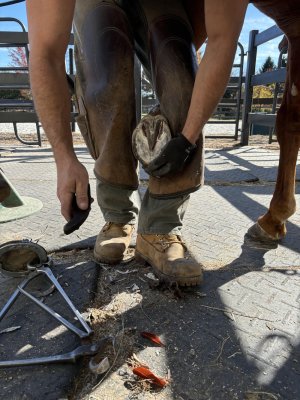
Front shoes came off today. I will post weekly updates with pictures.
 

Attachments

  • 1.jpg
    1.jpg
    573.9 KB · Views: 50
  • unnamed (1) (1).jpg
    unnamed (1) (1).jpg
    327 KB · Views: 57
  • 3 (1).jpg
    3 (1).jpg
    554.1 KB · Views: 59
Sounds like a neat set up! In photo 1, the deep crease down the frog should not be there, and the aim is to open it out, encourage the heels to build some substance, and get the back of the foot working to take weight and absorb shock. Not a bad looking foot by any means, I have seen a lot worse. Pete Ramey's soaking routine helps my old boy when the folds and creases start to occur, and gentle exercise to encourage movement. Good luck with him!
 
Thank you for the resource. As terrible as navicular is, the only blessing I realize is that I now know more about hoof care and management.
He doesn’t seem uncomfortable really.
I can’t tell if it’s just me but I think I even see a minor minor minor change in how he is walking even in just 24 hours (it may just be my eyes).
I am going to take some proper video in a couple days to really see.
My farrier mentioned he can stop by in a couple weeks too as well to check on him.
Please god I hope this works because the injections and remedial shoeing did not !
😩.

Although he gets turnout at night I may hand walk him in a few times a week through the various surfaces just for extra stimulation.
Additionally, he will be going on Equioxx to - hopefully that helps if he gets a little footy.
 
I would leave those hooves to settle for a while but you have done the right thing getting those shoes off.

My Arab had navicular changes and soft tissue damage at 14 years old so I took front shoes off left him out for 3 months and he was sound so slowly started work, his 19 now and his been fine I still school him mainly and he hacks out occasionally.
 
We are coming up on the one week update. We have been lucky with very dry weather for the past 5 weeks. There is not a drop of water to be found in the Northeast of the USA right now.

Any comments are welcome!

2.jpg
1 (1).jpg

IMG_4448 (1) (1).jpg
 
Hmmm. In my humble opinion, Photo 1 shows a deep crease in the centre of the frog that shouldn't be there. Soak the foot in a solution of Dettol/Lysol and use your thrush treatment of choice. Photo 3 appears to show the frog almost completely contracted into the hoof. Again, treat for thrush, and boots and pads to put gentle pressure on the frogs to kick start the circulation. The heel area behind the frog should start to stretch and widen, and the heel bulbs should start to build some beef and become more like the shock absorbers they were designed for. Actively prevent your farrier from slicing off the frog, and ask for no more than a whisker off the heels and a general tidy up of the hoof wall. It isn't clear on photo 1 whether there are overlaid bars, or false sole, but a combination of pea gravel and dry weather will help to shed any false sole. If you can take photos of the soles every month or so it will allow you to compare notes and see changes. The goal is to get the back of the hoof working and bearing weight. Good luck, and keep us updated - we like a success story!
 
As expected very weak caudal hoof and long toe. As highmileagecob said treat for thrush.

Don't be in too much of a rush, these hooves need to strengthen through gentle comfortable movement and you already know you have injuries within the hoof capsule that needs to heal before they can strengthen, that's why the horse was lame in the first place. If there's ligaments involved they can easily take 3 months or more to heal. When I tore my ligaments my ankle took 6 months to get back to 90% and 4 or 5 years until I no longer had an occasional twinge. Add onto that the need to strengthen the hoof and the fact it takes 9 months minimum to regrow a new reshaped hoof capsule and you can see this is a long term project. Patience will be your friend in this! Hopefully it will be very worthwhile for you both.

Edited to clarify I didn't mean it will take 4 or 5 years before you can ride again, I was just trying to explain how long full healing of some soft tissue can take. I'm now grateful for getting my injury as it has made me reassess my expectations when dealing with animal injuries just how long they sometimes need to 'come right' and how patient I need to be!
 
Last edited:
Looks like the heels and central frog cleft are already widening up, excellent! Tamponade that area to give it a bit of constant pressure and change daily.

Do you trim yourself in between farrier visits?
 
Top