ester
Not slacking multitasking
what do you mean random untestable white spotting pattern isn't sufficient for youAnd adjacently I will die on the hill of Clydesdales being roan until someone gives me another decent word for it.

 .
.
what do you mean random untestable white spotting pattern isn't sufficient for youAnd adjacently I will die on the hill of Clydesdales being roan until someone gives me another decent word for it.
.
"Oh, which are your horses?"what do you mean random untestable white spotting pattern isn't sufficient for you
not duns but buckskinsThey are lovely, but all buckskin, not dun.

While we are at it what is Blagdon genetically?And adjacently I will die on the hill of Clydesdales being roan until someone gives me another decent word for it.
It isn't just Irish and didn't refer to gold body with black points but rather a brownish colour the Old English dunn "dingy brown; dark-colored," probably came Celtic (compare Old Irish donn "dark;" Gaelic donn "dull; dark brown; dark;" Welsh dwnn "brownish"), The term buckskin and doeskin went out from the UK with our language to the USA when the settlers went out it applies to both rabbits and deer skin and as their colour was goldenish it was used to describe any horse that was that colour. It is not an Americanism it was a Finnish group who discovered the gene for dun and separated it from cream and named the Dun dilution Dun and Cream dilutions cream, the Americans started using them before we did however my friends tell me they had the opposite problem of buckskins being referred to as duns but they were ahead of us using smoky cream, perlino etc. My friend family stud had a Sec A registered in the 1960s as Buckskin Bach so buckskin is not new or unknown in the UK just that dun went from being used for actual duns but for buckskins and/or both instead. One thing I find very odd is that in native breeds like Shetlands and Highlands if you ask someone the colour they will correctly say dun but in other breeds they don't seem to recognise that buckskins are not dun and the duns are duns. Dun and the word dun has been around for far longer than the cream names and as the dun gene is far older than the cream gene for me it makes sense to give it the older name, I am pretty sure people do not look at a cave painting of a dun horse and think buckskin.I think you are missing where the confusion in language comes from.
The term dun comes from Ireland and in yesteryear was generally a term that meant creamy tinge to coat and dark points. People would then preface the word Dun with other descriptive terms - chocolate dun, mouse dun, blue run, red dun, yellow dun, golden dun etc. Yes, what we now describe as buckskin being described as golden/yellow dun was normal, but there were also smokey blacks described as Duns, liver chestnuts described as Duns, nd1 bays described as Duns, early stage greys described as blue Duns etc.
Personally I think it is unfortunate that when genetic understanding came around to naming the genes involved, that the cream gene wasn't called dun and the dun gene called something else, or the name dun was not used at all. The names falling as they have has caused confusion and no small amount of irritation ref Irish horses now suddenly not being able to be accurately described using the Irish-origin term for a particular coat colour that is prevalent in the Irish breeds.
But it's not that people don't realise that Dun can be on any base coat colour. They generally either don't care/don't know about the genetic terms or they do know but find it irritating on principle, so they continue using the colloquial terms that they grew up with.
It's kind of like what might have happened if the name Roan had been given to the Lp gene, rather than the roan gene. I don't think for one second that would have stopped people describing their horses with white ticking and stronger/darker points as generically roan.
found themI love the ear bars will see if I can find a pic of mine

I think you are missing where the confusion in language comes from.
The term dun comes from Ireland and in yesteryear was generally a term that meant creamy tinge to coat and dark points. People would then preface the word Dun with other descriptive terms - chocolate dun, mouse dun, blue run, red dun, yellow dun, golden dun etc. Yes, what we now describe as buckskin being described as golden/yellow dun was normal, but there were also smokey blacks described as Duns, liver chestnuts described as Duns, nd1 bays described as Duns, early stage greys described as blue Duns etc.
Personally I think it is unfortunate that when genetic understanding came around to naming the genes involved, that the cream gene wasn't called dun and the dun gene called something else, or the name dun was not used at all. The names falling as they have has caused confusion and no small amount of irritation ref Irish horses now suddenly not being able to be accurately described using the Irish-origin term for a particular coat colour that is prevalent in the Irish breeds.
But it's not that people don't realise that Dun can be on any base coat colour. They generally either don't care/don't know about the genetic terms or they do know but find it irritating on principle, so they continue using the colloquial terms that they grew up with.
It's kind of like what might have happened if the name Roan had been given to the Lp gene, rather than the roan gene. I don't think for one second that would have stopped people describing their horses with white ticking and stronger/darker points as generically roan.

?? Which is what I had saidnot duns but buckskins

Budge up, I’m joining you on that bench and there’s plenty of like minded belligerent folk like us!I'm that irritating belligerent person
.
Nobody said it was 'wrong' to use the correct terminology. You repeated, out of context, the same phrase that I have seen repeated several times on this thread "Dun can be on any base colour", and I then pondered why people keep repeating that phrase when it seems out of context to the question they were responding to. Your reply to my ponderance seemed to indicate that you thought that if only people would understand that dun can be on any base colour then all confusion would be removed and people would start using the "correct" terms. My point in my previous post was simply that I do not believe that not understanding that dun can be on any base colour is the reason people use the "wrong" term.It isn't just Irish and didn't refer to gold body with black points but rather a brownish colour the Old English dunn "dingy brown; dark-colored," probably came Celtic (compare Old Irish donn "dark;" Gaelic donn "dull; dark brown; dark;" Welsh dwnn "brownish"), The term buckskin and doeskin went out from the UK with our language to the USA when the settlers went out it applies to both rabbits and deer skin and as their colour was goldenish it was used to describe any horse that was that colour. It is not an Americanism it was a Finnish group who discovered the gene for dun and separated it from cream and named the Dun dilution Dun and Cream dilutions cream, the Americans started using them before we did however my friends tell me they had the opposite problem of buckskins being referred to as duns but they were ahead of us using smoky cream, perlino etc. My friend family stud had a Sec A registered in the 1960s as Buckskin Bach so buckskin is not new or unknown in the UK just that dun went from being used for actual duns but for buckskins and/or both instead. One thing I find very odd is that in native breeds like Shetlands and Highlands if you ask someone the colour they will correctly say dun but in other breeds they don't seem to recognise that buckskins are not dun and the duns are duns. Dun and the word dun has been around for far longer than the cream names and as the dun gene is far older than the cream gene for me it makes sense to give it the older name, I am pretty sure people do not look at a cave painting of a dun horse and think buckskin.
I am always surprised why it is wrong to use the correct terminology it is not hard people now call smoky blacks and double creams by their correct names when years ago there was just cream used for everything single and double creams. I suppose the issue is if the studbooks continue to use the wrong terminology or worse terminology for totally different colours like dun and buckskin people cannot be expected to realise which colour is which.
I personally don't care what people use it is entirely up to them but when talking in a post asking about the dun gene an explanation of the difference and correct terms will obviously come up as people have posted buckskins when the OP wanted to know about duns. The opening question for this post was does dun exist in Welsh ponies and the answer is yes it does but without recognition and preservation that might not be for much longer.
I don't think it's known. It's not Roan, and I think weird sabino effect has been ruled out now too, but I may be wrong on that.While we are at it what is Blagdon genetically?


Then there was the cremello part arab stallion....he bred some goldy coloured foals with dark legs and mane and tail but it was so long ago no one seemed to care in those days, well, about the commercial aspect of the colour
told you they were funI was looking at Icies one time and asked what colour the sire was of one. Answer I got was "dark white"

A (currently untestable / undiscovered) White Spotting mutation most likely on the KIT gene, very similar visually to Sabino (SB1) which is testable.While we are at it what is Blagdon genetically?
Not sure about no caring about colour in the past. High percentage Palomino part bred Arabs have been a thing since the 50s/60s and expensive. At the other end when I was young any coloured horse was the cheapest you could buy because no one wanted them.
But discussing colour in horses is fascinating. Genes in general are fascinating. This thread at times does my head in and I come and go a bit, with a cup of tea and a lie down inbetween.Was referring to the dun _ buckskin aspect
There was a fair few 7/8 bred Arabs in palomino around but did not appeal to me
Breeding for colour never appealed to me
But discussing colour in horses is fascinating. Genes in general are fascinating. This thread at times does my head in and I come and go a bit, with a cup of tea and a lie down inbetween.
Was talking about dun buckskin which seemed quite common at the time
Ah I see what you mean the phrase dun is on any base comes up a lot because it is only bay plus cream that gets mistaken for bay dun none of the other creams get mistaken for a bay dun, the whole thing is very confusing and yes I do think it would help if people at least knew the difference even if they continue to use whatever terms they like and it is not helped by the breed societies using incorrect terms but as I said I really don't mind what people use as long as they are correctly registered as it makes tracing true duns in a breed like Welshies incredibly hard and sadly they are incredibly rare.Nobody said it was 'wrong' to use the correct terminology. You repeated, out of context, the same phrase that I have seen repeated several times on this thread "Dun can be on any base colour", and I then pondered why people keep repeating that phrase when it seems out of context to the question they were responding to. Your reply to my ponderance seemed to indicate that you thought that if only people would understand that dun can be on any base colour then all confusion would be removed and people would start using the "correct" terms. My point in my previous post was simply that I do not believe that not understanding that dun can be on any base colour is the reason people use the "wrong" term.
I was not answering the thread question. I was answering your posts. And as part of that answer to you I was also making the point that you can tell the breeders of Connemaras and IDs that their horses are buckskin from now until the end of time and I guarantee you that they will continue using the word Dun regardless.
This is Pwllgwyn (R) jasper red dun welsh mountain stallion now living in France he has left 5 dun foals in Wales of varying coloursCan't find the stud page for the Welsh c but here is a dun Welsh a stallion View attachment 139735
It was a Finnish science group that discovered the Dun gene and named it Dun it is not American they just got on board with the new terminology quicker than we didWhy find a new word for dun? The word wasn't hijacked, it was just being used for 2 to describe 2 different things.
I think some people feel it's an unwanted us influence replacing the word dun but it's not really
Both UK and US are using the word dun for that gene and the bay dun colouring so makes sense to keep those in line however in the US they had another word for the cream/bay combo.
When people became aware here there was a difference, that's where a new word was useful and given in the US were already using Buckskin, no reason to create another word.
Mouse dun (black dun or grulla) is correct and common in Highlands who have a lot of dun.
Also red or chestnut dun as in Cloball's example.

Yes he is tested dunWas he dun though? He looks smoky black.(Black plus creme)
There is a Welsh silver and dun group on Facebook with some interesting ponies.
I guess my general thoughts with regards to how horse colours are registered is that if you want to make it accurate then horses would have to be fully tested for every known colour gene and then have them all listed. And in the case of horses not fully tested then the colour description should be straightforward terms for colour - e.g. brown body with black mane and tail and black points, orange body with darker orange mane and tail, brown coat with white flecks through it...etc...Ah I see what you mean the phrase dun is on any base comes up a lot because it is only bay plus cream that gets mistaken for bay dun none of the other creams get mistaken for a bay dun, the whole thing is very confusing and yes I do think it would help if people at least knew the difference even if they continue to use whatever terms they like and it is not helped by the breed societies using incorrect terms but as I said I really don't mind what people use as long as they are correctly registered as it makes tracing true duns in a breed like Welshies incredibly hard and sadly they are incredibly rare.
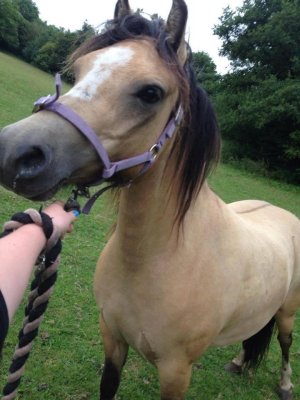
Aka dunskinfor the OP this is a buckskin dun Welsh pony