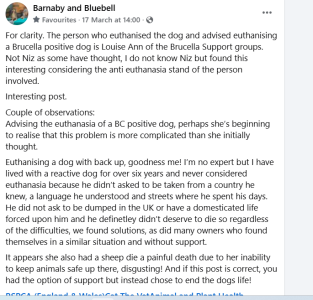
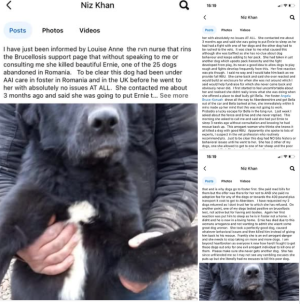
Can you believe it .............

I think that is what seems to concern people with an infected dog. They seem to be more worried that they might not be able to access vet treatment than they are about having a dog with a zoonotic disease and a risk to other canines
If Moti tests positive I will almost certainly have to PTS which is devastating for me and my family.. If I don't test him I can keep as long as I want. My issue is he's very likely negative but vets and kennels etc are becoming aware of risks and rightly have started to put protocols in place. If I can show he's negative I will not have to worry about accessing care. If he's positive I will regret testing him..... I'm trying to do the right thing.
 
It is up to the practice, and for young women of child bearing age would you be wanting to risk it.

If Moti tests positive I will almost certainly have to PTS which is devastating for me and my family.. If I don't test him I can keep as long as I want. My issue is he's very likely negative but vets and kennels etc are becoming aware of risks and rightly have started to put protocols in place. If I can show he's negative I will not have to worry about accessing care. If he's positive I will regret testing him..... I'm trying to do the right thing.
If your dog tests positive he has been in the Country for seven years, he hasn’t caused you to be ill, he is I assume not showing any symptoms of Brucella Canis, he is neutered and your Veterinary Practice is prepared to continue to care for him. There is no need for him to be pts.

If he tests positive then it would almost certainly only be on the iELISA which would show he has antibodies it wouldn’t show that he was currently infected or infectious.

He’s the same dog the day after the results as he was the the before the risk hasn’t changed only the label.
One of the bigger corporate Vets has implemented a serial system where by they test first with SAT only which shows whether the infection is live. If it is then they will test with the iELISA which is a much safer way of mitigating a possible false positive result.

I would discuss the option of just having the SAT with your Vet before agreeing to both.
 
If Moti tests positive I will almost certainly have to PTS which is devastating for me and my family.. If I don't test him I can keep as long as I want. My issue is he's very likely negative but vets and kennels etc are becoming aware of risks and rightly have started to put protocols in place. If I can show he's negative I will not have to worry about accessing care. If he's positive I will regret testing him..... I'm trying to do the right thing.
I wasn’t thinking of Moti. I was thinking of a Facebook page I visited and posts along those lines
 
Last edited:
If your dog tests positive he has been in the Country for seven years, he hasn’t caused you to be ill, he is I assume not showing any symptoms of Brucella Canis, he is neutered and your Veterinary Practice is prepared to continue to care for him. There is no need for him to be pts.

If he tests positive then it would almost certainly only be on the iELISA which would show he has antibodies it wouldn’t show that he was currently infected or infectious.

He’s the same dog the day after the results as he was the the before the risk hasn’t changed only the label.
One of the bigger corporate Vets has implemented a serial system where by they test first with SAT only which shows whether the infection is live. If it is then they will test with the iELISA which is a much safer way of mitigating a possible false positive result.

I would discuss the option of just having the SAT with your Vet before agreeing to both.
What’s your interest? Do you have dogs from Eastern Europe?
 
I wasn’t aiming my reply at you, more at BD who seems to feel vets should treat them at any risk to themselves.
On the contrary Clodagh, Veterinary staff should have a choice and as a client I wouldn’t want my dog treated by someone who felt coerced into treating them.

The majority of Veterinary Practices are very keen to protect their female staff of child bearing age, despite the fact there is no current evidence to support the theory that Brucella Canis causes infertility issues there is also not evidence to support that there is not.

It would seem a sensible approach to be cautious and allow those who feel that they may be at risk to be allowed to step aside and let others who are happy to treat the animal to do just that.

What we must however acknowledge that the latest HAIRS assessment considers the probability of infection for individuals with greater exposure to infectious material from B.Canis including veterinary staff to be low.

One would hope that most practices would regardless of the dogs status have sufficient biosecurity measures in place as standard practice.
 
One would hope that most practices would regardless of the dogs status have sufficient biosecurity measures in place as standard practice.
It is very hot and debilitating wearing full PPE all the working day (source - my brother who worked all through the Covid pandemic as a human breast cancer surgeon).

Are you suggesting that vets and vet nurses should be wearing full PPE as a matter of routine? On the off chance that they might encounter a foreign rescue dog infected with a transmissible infection?
 
It is very hot and debilitating wearing full PPE all the working day (source - my brother who worked all through the Covid pandemic as a human breast cancer surgeon).

Are you suggesting that vets and vet nurses should be wearing full PPE as a matter of routine? On the off chance that they might encounter a foreign rescue dog infected with a transmissible infection?
No as the risk is deemed low that is obviously not necessary as a matter of routine.
But for more invasive procedures such as surgery then if a dog is considered a possible risk then it would be sensible to use PPE.
 
Ian Wright, Vet Record. 2023

Analysis of exotic pathogens found in a large group of imported dogs following an animal welfare investigation​


"Conclusion
This study demonstrated a range of pathogens in UK dogs rescued from abroad, with L. infantum and H. canis having the greatest prevalence in the group. A high proportion of the dogs tested positive for one or more pathogens not confirmed to be currently endemic in the UK. The six exotic pathogens diagnosed carry health risks to the infected dogs, significant risk of establishment in the UK and, in the case of Br. canis, direct zoonotic risk. The group of dogs tested represents a very small proportion of the total number of dogs being rescued and imported into the UK each year, with no mandatory testing for exotic pathogens they may be carrying and no national reporting when these tests are performed. Studies such as this one are therefore essential to establish which pathogens may be entering the UK and in what numbers. Increasing both veterinary and public awareness of the likelihood of exotic pathogens being present in imported dogs is also vital, so they can be considered as differentials of disease and relevant screening tests can be performed. It would be useful to correlate clinical signs with specific infections. Although this was not possible in this study, patterns useful to practitioners may emerge in larger studies, making these of benefit in the future. Both improvements in legal checks on imported dogs entering the country and improved practices across all importing agencies are required with regard to testing for exotic pathogens. This will only be achieved with increased numbers of studies, demonstrating the need for cooperation between the veterinary industry, government and importing charities."

 
Last edited:
Odd that vets working in the countries where this is endemic are not dropping like flies and a wholesale extermination of dogs isn’t underway. People seem to be happy to own and care for these dogs and surely they know about it?

All seems a bit crazy to me.
 
It’s on the FB pages of the Brucella Canis support and advice group, wasn’t difficult.
I don’t follow the page Brucella Canis RVN on Facebook (Louise’s page, the vet nurse who posted on this thread) but when you made a comment about me on this thread on Saturday - which you later deleted, you reminded me about it.

The Brucella Canis support and advice group, I'm assuming that's a group for people whose dogs are infected with Brucella Canis. Is it a members only group or can anyone view their page?

ETA I've had a look on Facebook, there are several Brucella Canis support groups with similar names. Could you post a link please.
 
Last edited:
Odd that vets working in the countries where this is endemic are not dropping like flies and a wholesale extermination of dogs isn’t underway. People seem to be happy to own and care for these dogs and surely they know about it?

All seems a bit crazy to me.
Vets aren't dropping like flies because this isn't a killer disease, unless you are a foetus. It is however an unpleasant incurable disease that keeps recurring. I assume it behaves in the same way as the bovine version. This country went to huge lengths to get rid of bovine brucellosis and many famers lost their whole herds as unlike TB where only the reactors are culled any positive tests meant all the stock being culled. Happened twice to a friend of mine.
It is not a disease to be taken lightly and since it is not endemic here better to keep it that way.
 
Vets aren't dropping like flies because this isn't a killer disease, unless you are a foetus. It is however an unpleasant incurable disease that keeps recurring. I assume it behaves in the same way as the bovine version. This country went to huge lengths to get rid of bovine brucellosis and many famers lost their whole herds as unlike TB where only the reactors are culled any positive tests meant all the stock being culled. Happened twice to a friend of mine.
It is not a disease to be taken lightly and since it is not endemic here better to keep it that way.
With all due respect, Bovine TB and Brucella Canis aren’t anywhere in the same league. Brucellosis in cattle is also far more of a threat to humans than b.canis. Whilst I fully agree we need to keep these diseases in check, raise awareness and take steps to prevent spread, the literature and APHA advice to owners of positive dogs seems to suggest it’s of a very low risk of spreading to humans unless infected reproductive ‘products’ are involved. We’ve just had our cows TB tested. It’s a horrible time. Closed herd but with wildlife (deer and badgers) wandering about…
 
I don’t follow the page Brucella Canis RVN on Facebook (Louise’s page, the vet nurse who posted on this thread) but when you made a comment about me on this thread on Saturday - which you later deleted, you reminded me about it.

The Brucella Canis support and advice group, I'm assuming that's a group for people whose dogs are infected with Brucella Canis. Is it a members only group or can anyone view their page?

ETA I've had a look on Facebook, there are several Brucella Canis support groups with similar names. Could you post a link please.
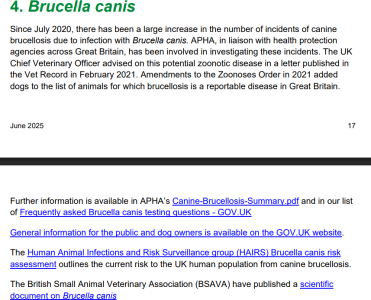
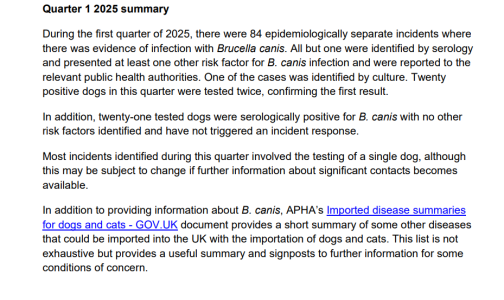
Yes, it’s that one and it’s for anyone with an imported dog or UK bred one which is taken abroad on holiday. Mostly correcting false and outdated information given to unsuspecting owners and finding alternative vet practices who are willing to treat untested, asymptomatic dogs/continue to treat BC positive ones. The disparity between practice policies is vast. Vets originating from Europe, not surprisingly, seem perfectly happy to deal with imported dogs as are some UK vets who have weighed up the risks. It’s still deemed a reportable, rather than notifiable, disease according to this updated information.

 
finding alternative vet practices who are willing to treat untested, asymptomatic dogs

Why the reluctance to test?

Dogs can be infected but asymptomatic and could be out in public shedding BC in urine and faeces.

Dogs can be infected through inhalation and we all know how dogs like to sniff other dogs' urine and faeces. It doesn't seem like a great idea to have potentially infected dogs weeing and pooing in areas where other dogs are likely to be walked.

I think it's rather selfish of owners not to test and to potentially put other dogs at risk.
 
Last edited:
A friend of a friend is having to spay and retire their very promising competition dog and medicate it for life because someone else brought a positive dog to a major event.
The FOAF's dog has tested positive four times, the owner of the dog suspected as being the source either refuses to test or will not disclose the results.
 
Last edited:
Top