soloequestrian
Well-Known Member
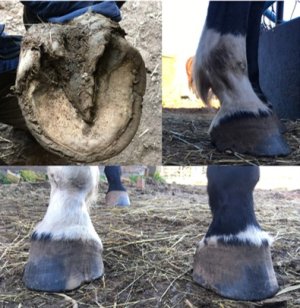
Finally had phone and horse in a suitable place for pictures.


in theory I agree and the interests of the horse are the most important. In this case I think the owner feels the horse has built the hooves she needs ie a self trimming horse but some trimmers would see areas that could be improved and work on correcting them. Two different approaches. I work on the WL by trimming but that would be at variance with what the poster believed in. I think that before one could comment on heel height you would need to see the horse. I've seen many pics of feet that possibly look to have high heels but when they are photographed with the camera on the ground it tells a different story.I sort of agree with paddy555 but sort of do not; when you bring in a professional to do anything with your horse, it should be a collaboration bringing together the owner's knowledge of the individual animal and the professional's knowledge of their craft. Owner and professional should be working together to achieve the best outcome for the welfare of the horse.

I can't really comment from those photos. The phone/camera really does need to be ON the ground and square on. The angles can look so different when the lens is floating above and at odd angles.Finally had phone and horse in a suitable place for pictures.
View attachment 174709

Unfortunately there is a wide range of competence both from barefoot trimmers and also with farriers.Nope, this was a fully qualified and still practising EPA full member, so ‘allegedly’ the modern gold standard qualification for barefoot trimmers.
A reminder of their handiwork before I sacked them. They dissed my vet’s suggestion that the toes were too long (I have that on record). They rejected my suggestion to get fresh x rays of the feet, saying that no matter what the x rays showed they would not trim these feet any differently.
Avoid, avoid.
View attachment 174576