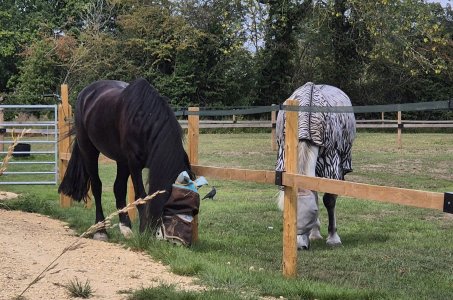
EMS management support/solidarity thread?

Does anybody use Horsehage instead of hay? I got a bale to try and my horse loves it, but I'm afraid she's going to wolf it down and then be hungry for the next couple of hours. It's meant to be low sugar and good for fatties.
Mine is out on a track in the day eating wetted normal hay but penned at night on a very small net of soaked hay and a bigger, tiny holed net of Timothy haylage or meadow haylage (Horsehage is too £££ for me). Last bloods showed normal insulin levels so it seems to be working for her.
 
Does anybody have any that live out 24/7? I have no stabling to bring anyone in. The bay boy came back negative on his bloods, but I'm not convinced. I posted another thread saying they all look well, so they could all do with managing the same to be honest. Upping work etc isn't an option for him or the other boy as they are damaged goods physically and mentally for riding (rescues), and the girl could cope with in hand walks only. This thread has been a valuable insight to see how others manage and has given me a lot to consider, so thank you all for sharing
 
I stabled mine and he itched himself raw within 48 hours so he is out in a pen maybe 4x a stable in size. He gets some hay and some Lami friendly haylage. Now wearing cloud hoof boots and walking really well. He also has a couple of mats in his pen to stand on.
 
Does anybody have any that live out 24/7? I have no stabling to bring anyone in. The bay boy came back negative on his bloods, but I'm not convinced. I posted another thread saying they all look well, so they could all do with managing the same to be honest. Upping work etc isn't an option for him or the other boy as they are damaged goods physically and mentally for riding (rescues), and the girl could cope with in hand walks only. This thread has been a valuable insight to see how others manage and has given me a lot to consider, so thank you all for sharing
Mine are out 24/7 on a bare paddock because Saus and Cob can’t be stabled for medical reasons. You might have to sacrifice some ground, let them eat it down to virtually nothing and provide hay in double-netted small-hole nets to ensure adequate fibre intake. Cob was overweight when she arrived and this system helped her shed the kilos.

If you want to avoid sacrificing ground, there’s the option of grazing muzzles.
 
Does anybody have any that live out 24/7? I have no stabling to bring anyone in. The bay boy came back negative on his bloods, but I'm not convinced. I posted another thread saying they all look well, so they could all do with managing the same to be honest. Upping work etc isn't an option for him or the other boy as they are damaged goods physically and mentally for riding (rescues), and the girl could cope with in hand walks only. This thread has been a valuable insight to see how others manage and has given me a lot to consider, so thank you all for sharing
Yes - the Appy is muzzled though and on steglatro.

She is also permanently broken so no option as regards exercise

Also has no off button.
 
Yes - the Appy is muzzled though and on steglatro.

She is also permanently broken so no option as regards exercise

Also has no off button.
It's my Appy cross who's actually looking the fattest out of them all. The boy who I thought was PPID has ribs visible, just always looks bloated. She's the least broken of the lot, so we started walking out again this afternoon. The boys are too broken mentally and physically to go out and about, so I'm really trying to manage them all the same. This heat stressed grass must be super sweet though. I may need to muzzle them all, her to stop munching so much, and the boys so they don't take her muzzle off!
 
Looking bloated and ribby is quite normal for EMS ponies. It doesn’t matter how slim DP is he still has what I call a straw belly. When on their track they have weighed meadow hay and tiny feeds twice daily to add protein/supplements which are essential for healthy hoof growth. Although the track looks bare their poos are still green so they are getting enough and I really think we over estimate just how much they really need. Neither of my boys are in work now and haven’t been for three years yet on the track they look fit and muscled. This year due to lack of cattle grazing they have been in the small orchard and I’m having to soak hay and muzzle ☹️ while they look shiny and are happy DP looks like a barrel on 4 legs.
 
Looking bloated and ribby is quite normal for EMS ponies. It doesn’t matter how slim DP is he still has what I call a straw belly. When on their track they have weighed meadow hay and tiny feeds twice daily to add protein/supplements which are essential for healthy hoof growth. Although the track looks bare their poos are still green so they are getting enough and I really think we over estimate just how much they really need. Neither of my boys are in work now and haven’t been for three years yet on the track they look fit and muscled. This year due to lack of cattle grazing they have been in the small orchard and I’m having to soak hay and muzzle ☹️ while they look shiny and are happy DP looks like a barrel on 4 legs.
I thought that was typical for EMS horses, but the vet said not to worry as his test came back negative for cushings (locum). Discussed with my usual vet and she recommended managing him as one, and it wouldn't really do the others any harm, so that will be the plan going forward. I should track the paddocks off in my rotations next year, currently cannot get a post in the ground! I wish I could turn the whole field into a dry lot and just feed hay, it would probably be so much easier for them and me
 
Does anybody use Horsehage instead of hay? I got a bale to try and my horse loves it, but I'm afraid she's going to wolf it down and then be hungry for the next couple of hours. It's meant to be low sugar and good for fatties.
yes I have moved to HH (devon haylage timothy or native grass w herbs) analysis of these are on their website.

one EMS/PPID and the other I have had to keep completely off grass (for another reason) plus he was overweight and probably close to EMS anyway.

love it. No way are we going back.

horses love it. They have been on it around 4 months or so and they have "regulated" their appetite. Sugar was the problem of the EMS'/PPID horse, hay with any amount of sugar made him very spooky to ride, low sugar hay was fine except it was also low protein. There was no way I could be sure I could get very low sugar hay.

They seem a bit like overweight people. People have a craving for sugar so they eat and eat to try and fill up. Visiit to the cake shop and they want the whole shop. Then they get off the sugar. No addiction and they don't even look at the cakes. Not interested. My horses have become like that. Both get 5kg (actual weight) at night netted. They are yarded so can move but no field access. They don't have access to grass at all 24/7. One even leaves bits in the morning and we have to put the other one in to clear up.

I weigh out 5kg for the day and give them handfuls as the day goes on. Very pleased they have both lost weight on it and no suffering whatsoever. Also no wolfing. In fact now they are "adjusted" to it just normal calm eating. One even walks away and comes back a while later. On higher sugar hay or grass he would pig out 24/7 with no appetite control.
 
I thought that was typical for EMS horses, but the vet said not to worry as his test came back negative for cushings (locum). Discussed with my usual vet and she recommended managing him as one, and it wouldn't really do the others any harm, so that will be the plan going forward. I should track the paddocks off in my rotations next year, currently cannot get a post in the ground! I wish I could turn the whole field into a dry lot and just feed hay, it would probably be so much easier for them and me
bear in mind that the ACTH test isn[t always that accurate. Mine tested negative twice within a week and was nearly dead with every clinical symptom of cushings.

Have you assessed your lad for every sign of cushings? there are lots of them so have a look at thelaminitissite.org go through every single symptom, I would be closely looking at ribby but bloated. If you think you have symptoms even with a negative test then you could either explain to the vet all the signs and ask for a pergolide trial for say 3 months or ask for a TRH test which may be a lot more accurate.

the grass has been a nightmare this year so the only choice is to restrict what goes in by fencing or a muzle. Bear in mind that we will shortly be moving into Autumn ie seasonal pastoral laminitis so restriction is needed for a long time yet.
 
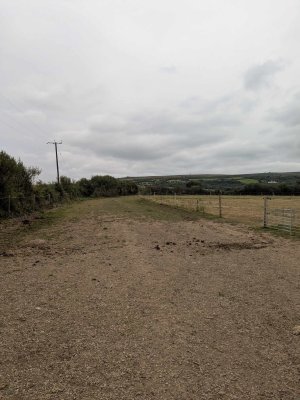
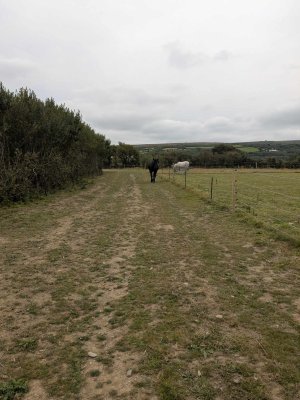
Thanks for that @paddy555, definitely will be looking into that. I think for now I am going to take them off the paddocks and pop them in the "lane", and feed them hay. I will be getting it analysed just for own interest. They will still have space to move around and I'll move the hay up the top so they have to walk to water etc, to try keep some movement going. Pictures of the lane below, I'm hoping the regular walking back and fore will kill off the little grass that is there (apologies for not poo picking before pictures!) I appreciate everyone taking the time to share advice here
 

Attachments

  • PXL_20250818_135557594.jpg
    PXL_20250818_135557594.jpg
    317.7 KB · Views: 18
  • PXL_20250818_135356828.jpg
    PXL_20250818_135356828.jpg
    326.2 KB · Views: 19
yes I have moved to HH (devon haylage timothy or native grass w herbs) analysis of these are on their website.

one EMS/PPID and the other I have had to keep completely off grass (for another reason) plus he was overweight and probably close to EMS anyway.

love it. No way are we going back.

horses love it. They have been on it around 4 months or so and they have "regulated" their appetite. Sugar was the problem of the EMS'/PPID horse, hay with any amount of sugar made him very spooky to ride, low sugar hay was fine except it was also low protein. There was no way I could be sure I could get very low sugar hay.

They seem a bit like overweight people. People have a craving for sugar so they eat and eat to try and fill up. Visiit to the cake shop and they want the whole shop. Then they get off the sugar. No addiction and they don't even look at the cakes. Not interested. My horses have become like that. Both get 5kg (actual weight) at night netted. They are yarded so can move but no field access. They don't have access to grass at all 24/7. One even leaves bits in the morning and we have to put the other one in to clear up.

I weigh out 5kg for the day and give them handfuls as the day goes on. Very pleased they have both lost weight on it and no suffering whatsoever. Also no wolfing. In fact now they are "adjusted" to it just normal calm eating. One even walks away and comes back a while later. On higher sugar hay or grass he would pig out 24/7 with no appetite control.
Thanks Paddy, that's very interesting. I've just ordered some more haylage and once my mare has switched over (doing it gradually) I'll put her into haylage only. Of course, it's more expensive.....
 
Late to the party but I'm another who has their first EMS/pot cushings horse.

There's a horse at my yard that used to have EMS. It was successfully reversed with weight loss and exercise and he's fit as a fiddle now (although not fat enough to be a successful coloured native anymore). I am just contributing a happy tale in support 😊
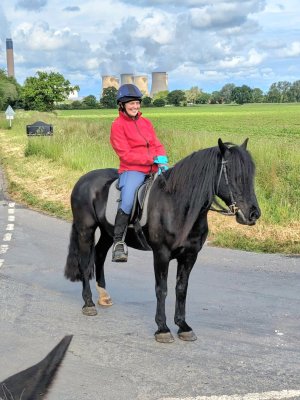
Rigs is another happy tale. He is now 20 yrs and in work, happy, looks fabulous and is living his best life.
499934106_10229834715196059_6711773788392200422_n (1).jpg
I bought him, aged 15, in 2020, knowing he was compromised. He was just finishing 3 months of box rest for lami, had an EMS score of 236 (from memory) and borderline cushings of 27.5. He was also asthmatic.

I didn't X ray as the farrier said that on the fronts, you could see how rotated his pedal bones were by the nasty bulge in the sole. He'd always been barefoot so thankfully had thick soles, but was wearing his first ever set of shoes, as per the vets orders, put on by the previous owners. I'm guessing that not walking on bulging pedal bones was more comfortable at the time. He was also stiff in his hocks, having been locked in a small stable for the three months.

Yes, I know I was daft to buy him 🤣but mum had dementia and I was in a bad way myself and needed a horse to simply care for, having sold the high octane one as she was too much risk, having dumped me twice in 3 weeks as my mind wasn't on horses!

The previous owner had done a good job of slimming him down in the three months. You could feel and faintly see a rib at the back.

I knew that I knew naff all about Lami, EMS and cushings, so called a vet out to have a conflab. My vet was from a large animal hospital and, sadly, I found he was more interested when I had expensive competition animals rather than a broken down old cob. So, I switched vets to an independent.

They sent a lovely vet who talked to me for over an hour, assessing and advising.

They advised he was still in a crucial stage and didn't do other than a resting test at the time, as he was going to be on a full regime anyway. He said that we could do drugs but, if I was on board, we could also try to reverse the EMS by drastic dieting. He also allowed shoe removal, as long as he was kept on a soft bed and turned out on the arena, which was literally carpeted. I got a specialist trimmer, at over £100 a throw, to start to re-balance his feet, and a body worked to address the tensions from him standing in a lami stance.

He was started with walking on the road only as far as comfortable. This initially was 100yds or so! He was ridden on the arena, for weight loss, only at walk to start with.

Dieting was savage! He was allowed 8kg of well soaked and rinsed hay a day. It was all weighed, and he was on non edible bedding. He had a small amount of speedy beet and molasses free chop to carry vitamins.

The vet asked me to undertake no grass for a year.

Did I say the dieting was savage? I kept having to call the vet out because, to me, he became far too thin. I was happy to see the last three ribs, but that was, apparently, not enough. The vet wanted to see ALL of his ribs. This was hard work for a chunky cob!

I tried to give some straw as a filler. The vet said that would make him more prone to colic, but I decided to risk it for his mental welfare and to hopefully stave off ulcers. I then felt stupid as he did colic, and nearly died. No more straw!

He lost the fat pads on his neck as he lost practically all fat on him! I had to call the vet out to say have I gone too far! The vet said no, keep the diet.

People said he was too thin and I was cruel. I got the vet to examine him and no, he was as he needed to be.

I would not have kept on this regime permanently, as I questioned his quality of life. But the vet said there was a good chance of reversing the condition, so I carried on.

That spring, we did the full fasting/sugar test.

He
Was
negative!

Very low score, normal! The vet and I were both laughing!

He started on a little grass, 20 minutes a day with a muzzle, and built it up from there. That summer, he made it to 4 hours a day, muzzled, usually in 2 X 2 hr blocks.

I find his wee is the best indicator of is he is having too much sugar. More wee means cutting back.
Does anybody use Horsehage instead of hay? I got a bale to try and my horse loves it, but I'm afraid she's going to wolf it down and then be hungry for the next couple of hours. It's meant to be low sugar and good for fatties.
Yes, the next winter I put him on high fibre Horsehage. He eats one bale every 2 days. It is expensive but I simply could not do another winter of intensive soaking.

He can have slightly less of that, and I was using the ridiculously small holed nets, and even then having to feed at 6am, 12.00 midday, 4pm and 9pm, just to spread it out. Even those nets would be gone in half an hour. He ate through some in frustration. It was a bind, being home every 4 hours day in day out.

Next spring, he was tested again. Cushings not any further an issue. EMS now better than before. He was on more grazing, muzzled, up to 8 hours a day, split into two. We also built him a patio from the back door of his stable, so he could have more time looking around. Weight was allowed back on, 3 ribs was enough, yay! I stopped having to cover him up with a rug! Yes, I was so ashamed of how he looked, despite it being under vets orders.

Sadly, Mr Red died suddenly and unexpectedly, in 2023. Since then, I have a new boyfriend, who happens to be a designer/inventor/manufacturer, with his own plastics fabrication business. He too found it frustrating that we had to be home every 4 hours. He designed and built Rigs a slow hay feeder.

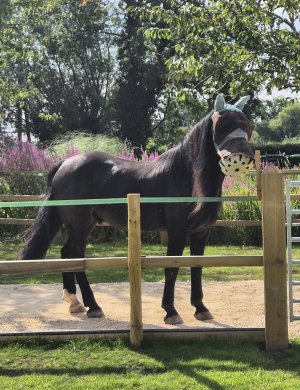
466492566_10227963598219304_8144914034040578768_n (1).jpg

This was fab as it keeps the haylage dry and takes him 2 hours to browse his way through the forage. It has a hopper shape inside to allow the haylage down. As he was sound, he was working more. He even taught the boyfriend to ride.

505931021_10230003456694491_2910790195028624116_n.jpg

Rigs had trouble with his asthma, needing an inhaler in summer, but my boyfriend designed and made a new muzzle that was better ventilated. He now shows no symptoms and is not medicated at all.

I wonder how much his seasonal asthma was related to the muzzles, as he was not so bad in winter. With this one, he is now grazing 16 hours a day straight.

528734596_1093832656217364_5390866724346517400_n.jpg

This year, I tried to book him in for more blood tests but the vet said not to bother. He has remained asymptomatic for EMS and Cushings, is fit and happy, rock crunching barefoot over any ground and generally behaving like a 20 yo should know better! He is keen to ride, but kind and responsive.

He is still on Horsehage and restricted grazing either by virtue of bare fields or muzzle. I would not feed dry hay, although BF also made an easy hay soaker if I do need to revert to hay instead of haylage. I watch his crest like a hawk, monitor he pee output. If either are not good, he is worked more rather than restricted.

I know it will always be a balancing act. The vet warned that there was never a 'cure' for EMS, it is more that he is in remission and we must always take care.

I like that he is having a normal horse life and we have balanced risk with quality of life. If, at 20 years old, I get the balance wrong, I can live with that as I do believe I pulled out all the stops to learn about something that was new to me. That is even if he has a relapse and is PTS.

He is on no medication. He is really easy to keep, only needing oil rubbing into the backs of his knees. He used to have filled legs and the start of CPL. The legs no longer fill and the CPL has not advanced further. his feet pretty much self-trim, but we do balance them ourselves, with an angle grinder LOL, which makes it quick and easy.


He is healthier at 20 than he has been since I've known him.

Dieting was savage, it felt cruel at times, but I trusted in the vet and it paid off. It was only for just less than a year for the reversal to happen. We don't plan on any further blood tests as he is on a regime that supports him and he is symptom free. He started casting his coat this year and looks fab. If he struggles, I will test again. But, I also decided that I would not go through the starving him again. If, on this regime he reverts to EMS/lami, then I have done my best and it is not to be. As a short term measure, stabling and starving was OK, as it has led to a long and healthy time. If it is not enough, then I feel that I did my best.

He doesn't half look and feel good on it though!
 
Last edited:
Late to the party but I'm another who has their first EMS/pot cushings horse.


Rigs is another happy tale. He is now 20 yrs and in work, happy, looks fabulous and is living his best life.
View attachment 165230
I bought him, aged 15, in 2020, knowing he was compromised. He was just finishing 3 months of box rest for lami, had an EMS score of 236 (from memory) and borderline cushings of 27.5. He was also asthmatic.

I didn't X ray as the farrier said that on the fronts, you could see how rotated his pedal bones were by the nasty bulge in the sole. He'd always been barefoot so thankfully had thick soles, but was wearing his first ever set of shoes, as per the vets orders, put on by the previous owners. I'm guessing that not walking on bulging pedal bones was more comfortable at the time. He was also stiff in his hocks, having been locked in a small stable for the three months.

Yes, I know I was daft to buy him 🤣but mum had dementia and I was in a bad way myself and needed a horse to simply care for, having sold the high octane one as she was too much risk, having dumped me twice in 3 weeks as my mind wasn't on horses!
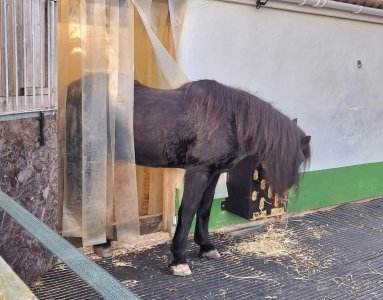
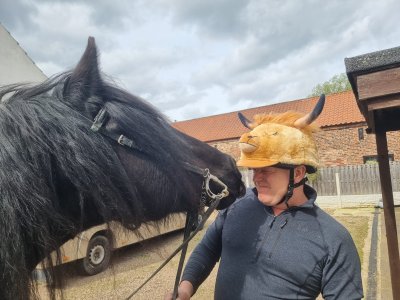
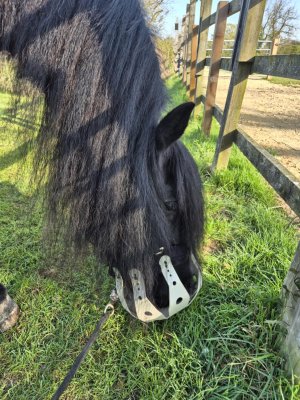
The previous owner had done a good job of slimming him down in the three months. You could feel and faintly see a rib at the back.

I knew that I knew naff all about Lami, EMS and cushings, so called a vet out to have a conflab. My vet was from a large animal hospital and, sadly, I found he was more interested when I had expensive competition animals rather than a broken down old cob. So, I switched vets to an independent.

They sent a lovely vet who talked to me for over an hour, assessing and advising.

They advised he was still in a crucial stage and didn't do other than a resting test at the time, as he was going to be on a full regime anyway. He said that we could do drugs but, if I was on board, we could also try to reverse the EMS by drastic dieting. He also allowed shoe removal, as long as he was kept on a soft bed and turned out on the arena, which was literally carpeted. I got a specialist trimmer, at over £100 a throw, to start to re-balance his feet, and a body worked to address the tensions from him standing in a lami stance.

He was started with walking on the road only as far as comfortable. This initially was 100yds or so! He was ridden on the arena, for weight loss, only at walk to start with.

Dieting was savage! He was allowed 8kg of well soaked and rinsed hay a day. It was all weighed, and he was on non edible bedding. He had a small amount of speedy beet and molasses free chop to carry vitamins.

The vet asked me to undertake no grass for a year.

Did I say the dieting was savage? I kept having to call the vet out because, to me, he became far too thin. I was happy to see the last three ribs, but that was, apparently, not enough. The vet wanted to see ALL of his ribs. This was hard work for a chunky cob!

I tried to give some straw as a filler. The vet said that would make him more prone to colic, but I decided to risk it for his mental welfare and to hopefully stave off ulcers. I then felt stupid as he did colic, and nearly died. No more straw!

He lost the fat pads on his neck as he lost practically all fat on him! I had to call the vet out to say have I gone too far! The vet said no, keep the diet.

People said he was too thin and I was cruel. I got the vet to examine him and no, he was as he needed to be.

I would not have kept on this regime permanently, as I questioned his quality of life. But the vet said there was a good chance of reversing the condition, so I carried on.

That spring, we did the full fasting/sugar test.

He
Was
negative!

Very low score, normal! The vet and I were both laughing!

He started on a little grass, 20 minutes a day with a muzzle, and built it up from there. That summer, he made it to 4 hours a day, muzzled, usually in 2 X 2 hr blocks.

I find his wee is the best indicator of is he is having too much sugar. More wee means cutting back.

Yes, the next winter I put him on high fibre Horsehage. He eats one bale every 2 days. It is expensive but I simply could not do another winter of intensive soaking.

He can have slightly less of that, and I was using the ridiculously small holed nets, and even then having to feed at 6am, 12.00 midday, 4pm and 9pm, just to spread it out. Even those nets would be gone in half an hour. He ate through some in frustration. It was a bind, being home every 4 hours day in day out.

Next spring, he was tested again. Cushings not any further an issue. EMS now better than before. He was on more grazing, muzzled, up to 8 hours a day, split into two. We also built him a patio from the back door of his stable, so he could have more time looking around. Weight was allowed back on, 3 ribs was enough, yay! I stopped having to cover him up with a rug! Yes, I was so ashamed of how he looked, despite it being under vets orders.

Sadly, Mr Red died suddenly and unexpectedly, in 2023. Since then, I have a new boyfriend, who happens to be a designer/inventor/manufacturer, with his own plastics fabrication business. He too found it frustrating that we had to be home every 4 hours. He designed and built Rigs a slow hay feeder.

View attachment 165232

This was fab as it keeps the haylage dry and takes him 2 hours to browse his way through the forage. It has a hopper shape inside to allow the haylage down. As he was sound, he was working more. He even taught the boyfriend to ride.

View attachment 165233

Rigs had trouble with his asthma, needing an inhaler in summer, but my boyfriend designed and made a new muzzle that was better ventilated. He now shows no symptoms and is not medicated at all.

I wonder how much his seasonal asthma was related to the muzzles, as he was not so bad in winter. With this one, he is now grazing 16 hours a day straight.

View attachment 165234

This year, I tried to book him in for more blood tests but the vet said not to bother. He has remained asymptomatic for EMS and Cushings, is fit and happy, rock crunching barefoot over any ground and generally behaving like a 20 yo should know better! He is keen to ride, but kind and responsive.

He is still on Horsehage and restricted grazing either by virtue of bare fields or muzzle. I would not feed dry hay, although BF also made an easy hay soaker if I do need to revert to hay instead of haylage. I watch his crest like a hawk, monitor he pee output. If either are not good, he is worked more rather than restricted.

I know it will always be a balancing act. The vet warned that there was never a 'cure' for EMS, it is more that he is in remission and we must always take care.

I like that he is having a normal horse life and we have balanced risk with quality of life. If, at 20 years old, I get the balance wrong, I can live with that as I do believe I pulled out all the stops to learn about something that was new to me. That is even if he has a relapse and is PTS.

He is on no medication. He is really easy to keep, only needing oil rubbing into the backs of his knees. He used to have filled legs and the start of CPL. The legs no longer fill and the CPL has not advanced further. his feet pretty much self-trim, but we do balance them ourselves, with an angle grinder LOL, which makes it quick and easy.


He is healthier at 20 than he has been since I've known him.

Dieting was savage, it felt cruel at times, but I trusted in the vet and it paid off. It was only for just less than a year for the reversal to happen. We don't plan on any further blood tests as he is on a regime that supports him and he is symptom free. He started casting his coat this year and looks fab. If he struggles, I will test again. But, I also decided that I would not go through the starving him again. If, on this regime he reverts to EMS/lami, then I have done my best and it is not to be. As a short term measure, stabling and starving was OK, as it has led to a long and healthy time. If it is not enough, then I feel that I did my best.

He doesn't half look and feel good on it though!


That is fabulous

There is a lot in there for people to make use of


Must try a grinder after seeing that, my 24 year old stallion has feet like concrete, super strong but so tough to trim and they grow a lot with the grass all the time cause he's not going out on the road
 
That is fabulous

There is a lot in there for people to make use of


Must try a grinder after seeing that, my 24 year old stallion has feet like concrete, super strong but so tough to trim and they grow a lot with the grass all the time cause he's not going out on the road
The one I have is a touch too big for my hands, but great for the boyfriend to use. I did buy a smaller one but it doesn't leave such a good finish.

Rigs is sound in his hocks now, but I think he feels it when required to stand on 3 legs for a long time. The grinder is so much quicker and doesn't pull backwards and forwards. He used to be awkward to trim, leaning and stamping his foot back down on the backs. He now stands like an angel for the grinder.
 
BTW, when I say that I wouldn't starve Rigs again, it is because I have done that and he is now on an optimal balance of quality of life and safety. I simply feel that I can't improve what he has without compromising quality of life.

I would absolutely do it again with a different horse, especially a young one with years of life ahead. As I understand it, the sooner they are aggressively dieted, the bigger the chance of them processing sugars again.

I was lucky as the previous owners had done a sterling job, and he had already lost a stack of weight. He'd got caught out during the Covid lockdown where the livery yard he was on turned them all out 24/7 and didn't allow owners to ride. There was nothing the owner could do, a perfect storm.

Once he was ill, he was on box rest. The owner was straight down the line. No claims of I can't get him to lose weight; he was stabled so she was in charge of what he ate 100%. I continued in this vein, with stable and arena turnout and as much walk work on carpet as he could manage. There was nothing to eat that I didn't provide and the vet gave me the safe minimum of food he should have.

I had to make a choice, and ulcers were less important than his EMS/lami at the time. I could only minimise ulcer risk. It was a pain feeding so often, with 2 small feeds, so 6 X a day he had a meal. Exhausting, especially with all of the soaking, especially through winter where my fingers froze.

He also had L94 and something else from Trinity consultants. I think that helped, but would not have been successful without the tight regime.

I was so scared the day of his first fasting/sugar test. I'd avoided sugar for so long, it was counter intuitive to deliberately syringe some into him 😨but I felt it had to be done as he needed a good result before he could have any grass at all.

Things are easier now!
 
Last edited:
Liverpool vet hospital had a programme on H&C TV back when it was free showing how thin horses need to get to reverse EMS - and it was 2/5 on the body score index before crests vanish.

I saw my first collapsed crest the other weekend. Pony was trim and doing dressage but I couldn't take my eyes off the odd shape of the neck. Being nosey I had a good look at it was strange lumpy crest collapse.
 
Liverpool vet hospital had a programme on H&C TV back when it was free showing how thin horses need to get to reverse EMS - and it was 2/5 on the body score index before crests vanish.

I saw my first collapsed crest the other weekend. Pony was trim and doing dressage but I couldn't take my eyes off the odd shape of the neck. Being nosey I had a good look at it was strange lumpy crest collapse.
Yes, Rigs went through an awful stage. Someone commented somewhere that he was so thin, that his head looked too large for his body. The said his face looked pinched. It did. His neck looked weird. His back also looked awful. You could see his spine and 2 strings each side. I felt awful riding him like that, but work made it more likely that we would be successful. That was the stage where I put a rug on him and only let people I trusted see him. Also when I wanted it noting on his vet record that I had been concerned that he was too thin and the vet supported me that he needed to continue the diet. I took photos the dates the vat came to prove myself in case someone called the RSPCA.

It was drastic, but so worth it now.

This year, I have allowed him to carry some weight. Yes, it is a risk. Yes, I am happy with that risk. It is about long term quality of life balance.

It was so hard to do, but I felt that it was the responsible and ethical thing to do. I felt that being a horse owner is sometimes ugly and unwanted things need to be done for the long term welfare of the horse.

This is the little podge last week...
531163367_10230712249573870_2714779864274633914_n.jpg
530628956_10230712252293938_4440954661293389872_n.jpg

Not even slim particularly now.

It is all a risk, and I fully accept that he may flare again. But I take comfort that he has regained the ability to process sugars so far. Yes, I could test repeatedly, but while he is symptom free and happy, I take that risk.
 
Liverpool vet hospital had a programme on H&C TV back when it was free showing how thin horses need to get to reverse EMS - and it was 2/5 on the body score index before crests vanish.

I saw my first collapsed crest the other weekend. Pony was trim and doing dressage but I couldn't take my eyes off the odd shape of the neck. Being nosey I had a good look at it was strange lumpy crest collapse.
not really about your post but I started googling crests after reading it especially about how to my mind they get hard very very quickly. I found this link and was going to quote but the whole article may be an interesting read for anyone interested in crests.

 
what brilliant posts Red.
I did want to pick up on 2 points you made. First wee. It took me a while to realise wee/sugar/frequency.

secondly cushings/PPID. MIne (20yo) was clearly PPID and mostly likely EMS by the end of last year. Very long coat and very hairy legs. Couldn't be tested but without any doubt PPID>

started on 1 pergoquin beg dec 2024. It didn't seem to be doing very much for him. Coat had grown over the summer and was becoming impossible and he was very difficult to clip, his legs and most areas back from the saddle were no go areas.
I struggled along with EMS until Mid March. Difficult in getting weight off and he didn't look very good when he lost some. Everyone started moulting early March and he was losing about 6 strands of hair a day. We were going to be here forever. Decided by end of March if no progress it was all going. That took a long time taking a cushings coat off bit by bit each day with a tiny pair of clippers. It got to the stage when he could no longer have an exercise sheet on which hid the "hacked mess" so everyone saw as he was ridden. :D

By the end of April got it all including his legs off.
By around April we were considering haylage. He was off grass. Now about 4 months further on he has not only not grown any coat back (last summer by this time he was becoming a Yak) his coat is back to being very thin and silky yellow. (he is dun) Legs haven't grown back. Grooming him I have loose hair coming out.

diet is no grass (or only what is around the edge of his track which is minimal) haylage, S/b and thunderbrooks chaff. and balancer, aimed for everything to be under 10%. It has made an amazing difference to the cushings. I am in fact totally gobsmacked at the improvement to his coat. I never dreamed that I would ever get the silky yellow coat of his youth back again.
I'll put her into haylage only. Of course, it's more expensive.....
I think that must be the understatement of the year. :eek::D:D:D:D
 
what brilliant posts Red.
I did want to pick up on 2 points you made. First wee. It took me a while to realise wee/sugar/frequency.

secondly cushings/PPID. MIne (20yo) was clearly PPID and mostly likely EMS by the end of last year. Very long coat and very hairy legs. Couldn't be tested but without any doubt PPID>

started on 1 pergoquin beg dec 2024. It didn't seem to be doing very much for him. Coat had grown over the summer and was becoming impossible and he was very difficult to clip, his legs and most areas back from the saddle were no go areas.
I struggled along with EMS until Mid March. Difficult in getting weight off and he didn't look very good when he lost some. Everyone started moulting early March and he was losing about 6 strands of hair a day. We were going to be here forever. Decided by end of March if no progress it was all going. That took a long time taking a cushings coat off bit by bit each day with a tiny pair of clippers. It got to the stage when he could no longer have an exercise sheet on which hid the "hacked mess" so everyone saw as he was ridden. :D

By the end of April got it all including his legs off.
By around April we were considering haylage. He was off grass. Now about 4 months further on he has not only not grown any coat back (last summer by this time he was becoming a Yak) his coat is back to being very thin and silky yellow. (he is dun) Legs haven't grown back. Grooming him I have loose hair coming out.

diet is no grass (or only what is around the edge of his track which is minimal) haylage, S/b and thunderbrooks chaff. and balancer, aimed for everything to be under 10%. It has made an amazing difference to the cushings. I am in fact totally gobsmacked at the improvement to his coat. I never dreamed that I would ever get the silky yellow coat of his youth back again.

I think that must be the understatement of the year. :eek::D:D:D:D
We will test for cushings again if his coat isn't as I would expect. I was doing a happy dance when both started to cast their coats at the same time last week!

Rigs has a partial clip in winter. He grows a cob coat, but not curly and it is very silky. It wouldn't be an issue except that the undersides are so fluffy, it catches in the girth and he gets very annoyed. At first, I thought it was ulcers or something as he started to scowl at the saddle and even lift a foot for the girth, but then I realised it was his long coat in the girth and he was fine when clipped.

As a by-product, it means he can eat a little more as it takes a bit more energy to stay warm!

As he has access to his stable and patio, I don't put a rug on him. In bad weather he tends to stay inside apart from eating from his outdoor slim grazer (haylage holder). The clip is just lower neck and lower shoulder, back past his tummy to a point on his sheath.
 
Late to the party but I'm another who has their first EMS/pot cushings horse.


Rigs is another happy tale. He is now 20 yrs and in work, happy, looks fabulous and is living his best life.
View attachment 165230
I bought him, aged 15, in 2020, knowing he was compromised. He was just finishing 3 months of box rest for lami, had an EMS score of 236 (from memory) and borderline cushings of 27.5. He was also asthmatic.

I didn't X ray as the farrier said that on the fronts, you could see how rotated his pedal bones were by the nasty bulge in the sole. He'd always been barefoot so thankfully had thick soles, but was wearing his first ever set of shoes, as per the vets orders, put on by the previous owners. I'm guessing that not walking on bulging pedal bones was more comfortable at the time. He was also stiff in his hocks, having been locked in a small stable for the three months.

Yes, I know I was daft to buy him 🤣but mum had dementia and I was in a bad way myself and needed a horse to simply care for, having sold the high octane one as she was too much risk, having dumped me twice in 3 weeks as my mind wasn't on horses!

The previous owner had done a good job of slimming him down in the three months. You could feel and faintly see a rib at the back.

I knew that I knew naff all about Lami, EMS and cushings, so called a vet out to have a conflab. My vet was from a large animal hospital and, sadly, I found he was more interested when I had expensive competition animals rather than a broken down old cob. So, I switched vets to an independent.

They sent a lovely vet who talked to me for over an hour, assessing and advising.

They advised he was still in a crucial stage and didn't do other than a resting test at the time, as he was going to be on a full regime anyway. He said that we could do drugs but, if I was on board, we could also try to reverse the EMS by drastic dieting. He also allowed shoe removal, as long as he was kept on a soft bed and turned out on the arena, which was literally carpeted. I got a specialist trimmer, at over £100 a throw, to start to re-balance his feet, and a body worked to address the tensions from him standing in a lami stance.

He was started with walking on the road only as far as comfortable. This initially was 100yds or so! He was ridden on the arena, for weight loss, only at walk to start with.

Dieting was savage! He was allowed 8kg of well soaked and rinsed hay a day. It was all weighed, and he was on non edible bedding. He had a small amount of speedy beet and molasses free chop to carry vitamins.

The vet asked me to undertake no grass for a year.

Did I say the dieting was savage? I kept having to call the vet out because, to me, he became far too thin. I was happy to see the last three ribs, but that was, apparently, not enough. The vet wanted to see ALL of his ribs. This was hard work for a chunky cob!

I tried to give some straw as a filler. The vet said that would make him more prone to colic, but I decided to risk it for his mental welfare and to hopefully stave off ulcers. I then felt stupid as he did colic, and nearly died. No more straw!

He lost the fat pads on his neck as he lost practically all fat on him! I had to call the vet out to say have I gone too far! The vet said no, keep the diet.

People said he was too thin and I was cruel. I got the vet to examine him and no, he was as he needed to be.

I would not have kept on this regime permanently, as I questioned his quality of life. But the vet said there was a good chance of reversing the condition, so I carried on.

That spring, we did the full fasting/sugar test.

He
Was
negative!

Very low score, normal! The vet and I were both laughing!

He started on a little grass, 20 minutes a day with a muzzle, and built it up from there. That summer, he made it to 4 hours a day, muzzled, usually in 2 X 2 hr blocks.

I find his wee is the best indicator of is he is having too much sugar. More wee means cutting back.

Yes, the next winter I put him on high fibre Horsehage. He eats one bale every 2 days. It is expensive but I simply could not do another winter of intensive soaking.

He can have slightly less of that, and I was using the ridiculously small holed nets, and even then having to feed at 6am, 12.00 midday, 4pm and 9pm, just to spread it out. Even those nets would be gone in half an hour. He ate through some in frustration. It was a bind, being home every 4 hours day in day out.

Next spring, he was tested again. Cushings not any further an issue. EMS now better than before. He was on more grazing, muzzled, up to 8 hours a day, split into two. We also built him a patio from the back door of his stable, so he could have more time looking around. Weight was allowed back on, 3 ribs was enough, yay! I stopped having to cover him up with a rug! Yes, I was so ashamed of how he looked, despite it being under vets orders.

Sadly, Mr Red died suddenly and unexpectedly, in 2023. Since then, I have a new boyfriend, who happens to be a designer/inventor/manufacturer, with his own plastics fabrication business. He too found it frustrating that we had to be home every 4 hours. He designed and built Rigs a slow hay feeder.

View attachment 165232

This was fab as it keeps the haylage dry and takes him 2 hours to browse his way through the forage. It has a hopper shape inside to allow the haylage down. As he was sound, he was working more. He even taught the boyfriend to ride.

View attachment 165233

Rigs had trouble with his asthma, needing an inhaler in summer, but my boyfriend designed and made a new muzzle that was better ventilated. He now shows no symptoms and is not medicated at all.

I wonder how much his seasonal asthma was related to the muzzles, as he was not so bad in winter. With this one, he is now grazing 16 hours a day straight.

View attachment 165234

This year, I tried to book him in for more blood tests but the vet said not to bother. He has remained asymptomatic for EMS and Cushings, is fit and happy, rock crunching barefoot over any ground and generally behaving like a 20 yo should know better! He is keen to ride, but kind and responsive.

He is still on Horsehage and restricted grazing either by virtue of bare fields or muzzle. I would not feed dry hay, although BF also made an easy hay soaker if I do need to revert to hay instead of haylage. I watch his crest like a hawk, monitor he pee output. If either are not good, he is worked more rather than restricted.

I know it will always be a balancing act. The vet warned that there was never a 'cure' for EMS, it is more that he is in remission and we must always take care.

I like that he is having a normal horse life and we have balanced risk with quality of life. If, at 20 years old, I get the balance wrong, I can live with that as I do believe I pulled out all the stops to learn about something that was new to me. That is even if he has a relapse and is PTS.

He is on no medication. He is really easy to keep, only needing oil rubbing into the backs of his knees. He used to have filled legs and the start of CPL. The legs no longer fill and the CPL has not advanced further. his feet pretty much self-trim, but we do balance them ourselves, with an angle grinder LOL, which makes it quick and easy.


He is healthier at 20 than he has been since I've known him.

Dieting was savage, it felt cruel at times, but I trusted in the vet and it paid off. It was only for just less than a year for the reversal to happen. We don't plan on any further blood tests as he is on a regime that supports him and he is symptom free. He started casting his coat this year and looks fab. If he struggles, I will test again. But, I also decided that I would not go through the starving him again. If, on this regime he reverts to EMS/lami, then I have done my best and it is not to be. As a short term measure, stabling and starving was OK, as it has led to a long and healthy time. If it is not enough, then I feel that I did my best.

He doesn't half look and feel good on it though!
Thank you SO MUCH for posting this, and give
huge well done for what you've done for the gorgeous Rigs. Can I message you please (nothing bad!)
 
so was I. It doesn't take much to make horse people happy. :D:D

good idea for a thread FO. I am learning lots. :D
So am I, and I really thought I knew a lot about EMS.
I'd been umming and ahhhing over making one for ages because I thought there'd be no interest and whilst it's not great so many people are in the same ugly boat, a place for collective brainstorming over what works and what doesn't is really useful
 
Does anybody feed theirs oily herbs? I remember reading the oily herbs thread and people noticing a marked difference for other issues, just wondering if they would be worth adding to feed for these kind of issues? Currently only adding salt and a tiny bit of ultimate oil for dry skin, but have stayed away from supplements really. Mainly because it's expensive with 3!
 
Does anybody feed theirs oily herbs? I remember reading the oily herbs thread and people noticing a marked difference for other issues, just wondering if they would be worth adding to feed for these kind of issues? Currently only adding salt and a tiny bit of ultimate oil for dry skin, but have stayed away from supplements really. Mainly because it's expensive with 3!
I do but sadly haven't seen any effect on blubber!
 
Does anybody feed theirs oily herbs? I remember reading the oily herbs thread and people noticing a marked difference for other issues, just wondering if they would be worth adding to feed for these kind of issues? Currently only adding salt and a tiny bit of ultimate oil for dry skin, but have stayed away from supplements really. Mainly because it's expensive with 3!
I did feed them to the EMS/PPID one before I realised that was what he was. I don't think looking back they made any difference and as SEL says certainly not to the blubber. :D:D

I think if one starts keeping a horse on restricted feedstuffs (hay etc) then I think you have to consider if a supplement is needed. Mine all get equimins AC except the EMS one who gets spillers balancer. All get Vit E. If you are going to restrict grass then they need vit E and even on grass and hay then vit e is very important in the winter.
 
Top