
Field shelter do and don’ts

geriponio

Member
Joined
18 June 2020
Messages
22
Visit site
Morning all!
I’m planning a field shelter.
Thinking 24’x12’, something like this⬇️I was thinking a large handstanding area to prevent poaching outside, though area is fairly well drained. Any opinion/recommendations on dos and donts/must haves?
(Matting down on hard standing? Timber or steel? Cement pad need planning?)0
I have 2 mucky mares I’m planning wintering out as much as possible.
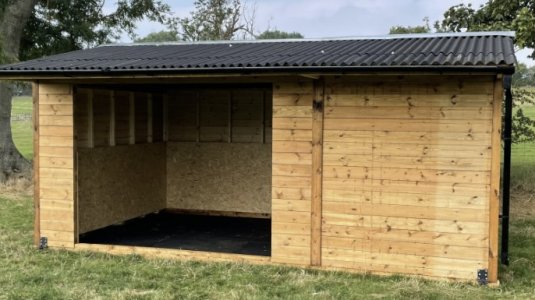
IMG_7276.jpeg
 
Put it on sleepers so won't move, have front section in middle so 2 exits, could also shut them in by dividing in 2 then. Hang hay at back so does not blow away. Mud control mats around front.
Hey Thankyou, why Dyo prefer the 2 opening type? I was considering that but thought more shelter just with the 1
 
I have one like that same design and size. It's proving to be a mistake. A horse can get trapped and bullied. Much better to have two front openings doorways.I cannot feed hay in the shelter as one horse stops the other going in and then can trap him in the corners. Wish I'd chosen a better design. I've now got no money to change it for a better one.
 
They will prob use it more to get out of sun than rain ... Enclosed bit means if split in half one pony enclosed,mainly it's the bullying thing especially where food involved, my little arthritic 14h pony moves my 16.1 hunter out of the way lol, he wouldn't risk getting trapped in there, if he did would prob take side of shelter off lol
 
consider where you are putting it. Obviously away from trees falling but where you want it ie it might look nice, be out of site, near to the gate or anything may not be where your horses want it. I have seen so many unused field shelters that horses don't like. If it is to be used in summer (the most important time) make sure it is in a suitable place. Study where the horses sheltered from the sun in the summer. In winter following the horses around, see where they stand in the rain etc to shelter. Look at it as if you were a horse. For example having it facing a hedge and quite close may seem good to you ie even more shelter. To a horse that would be dangerous ie could get trapped (not by another horse) but in it's mind it isn't a safe place.

I would also (having a 2 door one) have a swinging partition secured to the back wall you can swing over to split it in half and two gates (covered in marine ply) for the openings so you can shut them in separately. That may be useful with the weather and useful if one is ill, needs to be off the grass and mud etc.
Also the best overhang that you can get. To keep the rain off them if they are shut in and to provide a larger, less wet area in front.. Plus somewhere for the gutter water to go, there will be far too much for a water butt so the downpipe into a trap and then drained away underground to somewhere suitable.
 
Definitely open fronted, can always divide later if needed with 3 fence posts, a bar and if necessary 3 pallets lashed to the bar.
Do not place where front will be facing sun at its highest, they will bake in there.

Gold level purchase:
Have air vents in sides at top.
Overhang if you can afford it, plus grass mats to at least 2 horses length all round
Galvanised rounded metal skids are best option, tho most expensive option too.
 
Do check your ground anchors if you’re in a windy area. You will need them at least twice the recommended depth and if possible some means of keeping them in place otherwise you will be replacing again and again!
 
Just been through all this myself as took delivery recently & to echo what others have said, my must haves were . . . .
- Steel skids
- Overhang
- Wind gap at the back
- Open/wide front so nobody gets trapped
- Ground anchors! Good quality specialist heavy duty ones & make sure you check the loads they can take - the ones on Amazon as good as they sound are only suitable for sheds & trampolines once you've looked in to it!
- I've ordered mud mats for outside

Mine is in the middle of a very exposed field as the hedge line etc where you would naturally want it, is where water will pool & the wettest part, so we're at the highest point with back of the shelter to the prevailing wind & some beefy ground anchors!
 
Mine only has one entrance. But the small pony is a canny little thing and there is room for him to get away if the big one starts pushing him about. Generally they share it very nicely, it's only at feeding time that they don't, but it's easy enough for me to lure the big one into the yard while the small one makes his escape.
The other shelter I have is in a very windy field, which is why I wanted a shelter there. That one is bolted to concrete pads to keep it in place.
 
Ours is a permanent building, converted to an open-fronted shelter, open to the east (prevailing wind is westerly), floor slopes slightly to the front, flooring is mud control slabs over hardcore. We have a large apron of mud control slabs as hard standing to the front, guttering is at the back. We have gaps where the wind can blow through to try to prevent the roof lifting off, which is working so far (4 yrs). We have 2 mares who are best friends, although one pushes the other around but they can both get to the hay. They use it in all weathers.
 
Hey Thankyou, why Dyo prefer the 2 opening type? I was considering that but thought more shelter just with the 1
If the horses generally get on, two openings 6 feet wide towards the ends of the 24’ length is plenty, six feet in case the silly beggars decide to shoot out together… but will still allow shelter from wind directions which are not prevailing - last spring there was 2 months almost uninterrupted easterly winds (cold and dried out the usual growing conditions), which is unusual, but at least horses could get in behind some wooden walling. Overhang, a considered gutter and downpipe ( bearing in mind horses will probably rub their backsides on this), plenty of tie rings for hay nets if you use them. Creosote every year without fail!
Metal skids, heavy rubber mats inside, mud control mats around front / sides, get it backed into a wall or hedge away from prevailing wind, and thoroughly anchored.
If you want hard standing or concrete pad - check with local authority because that is no longer temporary, and probably needs planning permission.
Enjoy!
 
I had a 6x4m pole-barn-style shelter built from scratch - 6-inch earth-fast posts and a box profile roof, in a sheltered place with a hedge behind. Safe for grumpy ponies who would not share a conventional shelter but loved this and could often be found together flat out under it in the mornings. Provides shade without getting hot and stuffy. It's in a hardstanding yard (road planings, which I wouldn't use again). All needed planning.
 
I lost a 4 month old shelter in storms in Feb 22. We think a freak gust although wind speeds were around 80mph in places that day - it flew in pieces across 3 acres and I'm forever grateful the horses escaped unhurt.

Here's my lessons learnt.
- anchors will stop one tipping over but an air gap at the back is essential for storms.
- avoid metal roof panels. They left gouges 6 inch deep in the field and would have killed anyone in their path.
- this was a £2.5k shelter. The replacement is £1k dearer and shows in the quality.
- horses generally won't use them in storms so if you have a prevailing wind direction then make sure it'll blow away from horses if the worst happens

I agree on 2 entrances / exits. We've got overhangs out the front so if someone isnt allowed in they can still shelter. Guttering up which goes into a pipe feeding into a ground drain.

Make sure you understand the delivery T&Cs. I was looking at Chart but they would only deliver kerbside. I needed one that could be built.
 
I built ours using 8 foot half round fencing posts as a frame. I rammed them on to the ground and built a field shelter on that using mainly scrap wood I had laying around and it even has pvc windows. Cost me £100 for the roofing sheets, all the rest I was either given (guttering, down pipes, water barrel for collection, screws, nails etc)
It survived the hurricane we had this year. The floor is earth, been trodden down now and hard, dry as a bone in there.
 
Mud control slabs. To me these are an essential, you can use them both inside and outside the shelter, lift them up and move them easily when you realise that you did place the shelter in the wrong spot, the rain drains through them.

Back to the prevailing wind, far enough away from the boundary so that the rear can also be used as a wind break when the wind direction alters. Here the prevailing wind is usually South West, so no direct sun in summer and a good shelter away from flies. Our nasty weather is always from the East, sometimes North, but they prefer to stand outside the shelters in those gales. The wise donkey's scurry off to the stables before any really bad weather hits, even if their horse friends would rather stand outside.
 
Definitely anchors. My neighbours shelter lasted 2 days before it flipped over my hedge.... it did a lot of damage on its way down as well.
When they rebuilt the used straps with a full ibc on either side which seemed to work.
Guttering, they didn't and it was a soggy mess.
 
Top