Groundhog day - Vitamin E deficiency

BBP2

Well-Known Member
Joined
2 August 2025
Messages
169
Visit site
This isn't really looking for advice, more of an informational post for others with weird and wonderful horses who drive them stir crazy as they search for a cause.

I've posted a few times about my weird now-not-so-little Connemara - moves weirdly behind, flinches when touched, completely intolerant of training, won't move forwards, gets incredibly worried or explodes a bit then gets angry when he is moving, always a bit feral, but a lovely sweet kind honest horse and moves beautifully when he does move. 5 years old and barely any education due to the above. We have been tackling liver issues linked to liver fluke and elevated iron, plus copper deficiency, and although GGT has dropped from 1000 to just over 100, his symptoms all still remain. I also posted a lot about my last horse, the stunning bonkers black pony (BBP) who had a world of weird issues and who I devastatingly lost in 2024. Turns out they both have more in common than being weird black ponies. Before he died, BBP had a few blood tests showing him to be vitamin E deficient, despite significant supplementation with natural vitamin E. I did a few posts about it back in the day. Now blood serum vitamin E results are back for my big lad, and he is extremely deficient. I deliberately stopped his bonus supplemented Vitamin E 2 weeks before the blood was taken, to see where we were at on Pro-Earth Hay Boost balancer and strip grazed grazing in the day (with a muzzle) and hay/straw at night and to see if extra supplementation was actually necessary. These are the reference ranges I found proposed online.
  • Normal is considered above 2 ug/mL (200 ug/dL).
  • Marginally deficient is 1.5 ug/mL (150 ug/dL).
  • Severely deficient is 1 ug/mL (100 ug/dL) or below.
  • Recommended range for the average performance horse is 3 ug/mL to 5 ug/mL (300 ug/dL to 500 ug/dL).

I'm a bit shocked at how low his Vit E levels are. He is well below 1 ug/mL. Into the range that can lead to equine motor neurone disease. We think he must have an issue absorbing it, same as BBP, so will be gaining nutritionist advice on how to increase absorption (suspected possible gut issues due to redworm and liver fluke running riot before he came to me). The Pro-Earth hay boost balancer only contains 1,500iu but until 2 weeks ago he was probably on 5000iu a day. I have also just ordered the whole gamut of 'PSSM' testing, to see if there is a link, although I'm not a huge Equiseq fan.

As my sister says, this is now the next layer in the onion to unpeel in the journey to helping him feel better. So I have officially (in my head) renamed him Onion, and my many layered arab mare Charlotte (shallot, geddit?!). I'll get her vitamin E done next time vets are out to check if its just him or an issue across the board, but she gets more grass than him.

Here's to making some progress with Onion and Charlotte in 2026!
 
I'm relieved you've peeled off another layer but I'm wondering if there's something environmental which is blocking the uptake of E rather than you randomly having 2 deficient horses.

Although it could be very many deficient horses out there but you are just more observant!
My thoughts exactly.

I hope you get to the bottom of it, and keep us updated please- very interesting .
 
I'm relieved you've peeled off another layer but I'm wondering if there's something environmental which is blocking the uptake of E rather than you randomly having 2 deficient horses.

Although it could be very many deficient horses out there but you are just more observant!

It seems most likely to be either a fat absorption issue, or a lack of dietary fat inhibiting the absorption of vitamin e. Both horses were extremely good doers and because of various health issues weren’t in much work a lot of the time, meaning I never fed a lot of fat or fresh green grass to them, probably compounding any deficiency. They were largely on hay based diets, on track systems, and with a hay based diet. I always supplemented vitamin E because of this, but perhaps the lack of fat in the diet has been the problem?

In humans, liver disease can cause the malabsorption of fat. Both horses suffered from liver disease of varying levels (on two different properties). BBPs resolved when we moved to the current yard. The Connemaras was particularly bad this year, so he was pulled off grass completely for the summer as we thought the high iron content in the dry dusty soil was contributing to the liver issue. He was anlso found to be suffering from liver fluke, which we think he must have hosted adult fluke for several years, and picked them up as a foal in Ireland, as we don’t have conditions to spread fluke here. So his liver has probably been compromised for longer than I have had bloods for him (only started testing at 4). Again I made sure he had supplemental vitamin E but no extra fat. He’s now back on grass 12 hours a day but with a muzzle on.

So now I have to wait for the nutritionist and vet to advise (as we had all their diets analysed and overhauled this summer) to see if it’s safe and advisable to add fat to the diet of an overweight horse with a compromised (but improving liver) to potentially combat another life threatening condition.

I didn’t test selenium this time around, but have done so previously and with BBP and it has always been normal. I will test it next time vet is here.

I imagine there probably are plenty of deficient horses that cope. Plenty of horses with liver disease that have no vitamin e deficiency. And plenty that have both and maybe people don’t realise. I may have to invest in nano-E for a while as a boost and then go back to the natural acetate powder form.
 
Is your pony really still overweight despite strip grazing in a muzzle and hay & straw mixed? Cripes, that must be a real battle and pretty miserable all round.
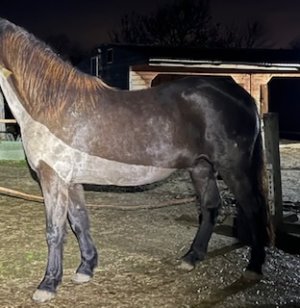
He’s actually slimmed down a lot over the last couple of weeks, but it felt like it took ages before I saw any changes. I’ve been soaking hay, giving straw and using the muzzle but he just seemed to stay big. But half his problem is he bloats behind his ribs and it makes him look fatter than he is.

Chopped his head off in below photo as it was blurry as he moved it whilst I took a photo in night mode. But you can see his current figure. He’s not huge, but the ribs are still hard to find.

IMG_8524.jpeg
 
Would it help to try something like Ertuglifozin? I believe it causes more sugar from the blood to be excreted, so might help with weight loss and also being able to safely add in more calories in the form of fats?
 
I spoke about it with the vets earlier this year and we decided we didn’t want to give his liver any extra work at that point, so were avoiding any medications if we could help it. They said they had seen some negative side effects reported so didn’t want to jump to it unless a last port of call. If progress stalls again I will have the conversation with them again.
 
I spoke about it with the vets earlier this year and we decided we didn’t want to give his liver any extra work at that point, so were avoiding any medications if we could help it. They said they had seen some negative side effects reported so didn’t want to jump to it unless a last port of call. If progress stalls again I will have the conversation with them again.
My vet said Ertugliflozen shouldn't be given to horses with kidney and/or liver issues, and my horse was tested to check function before it was given. It was miraculously quick to work ( I was grateful for this as it worked out at £10/day). Good luck, hope you get to the bottom of it all.
 
I will have my fingers tightly crossed that you get to the bottom of his many issues and that your 2026 is vet-free!

Out of curiosity, BBP, when you’ve blood tested him, what has his LDH been like? Just wondering because my understanding is that an elevated LDH (something that came up with my boy) can be, but isn’t necessarily, indicative of a Vit E deficiency.

On the Ertuglifozin note, I asked my vet about it earlier this year (very fat horse), and the opinion was that because of the impact it has on the liver and kidneys, and the fact that there’s not much research on its long term effect, they would only use it on a horse who really had no quality of life, as in a laminitic the minute it’s out of its stable sort.
 
I will have my fingers tightly crossed that you get to the bottom of his many issues and that your 2026 is vet-free!

Out of curiosity, BBP, when you’ve blood tested him, what has his LDH been like? Just wondering because my understanding is that an elevated LDH (something that came up with my boy) can be, but isn’t necessarily, indicative of a Vit E deficiency.

On the Ertuglifozin note, I asked my vet about it earlier this year (very fat horse), and the opinion was that because of the impact it has on the liver and kidneys, and the fact that there’s not much research on its long term effect, they would only use it on a horse who really had no quality of life, as in a laminitic the minute it’s out of its stable sort.
That’s the same sort of view my vet had, a last resort sort of thing. Just checked his bloods and we ran liver panels and then some specific extras (liver fluke, copper, iron and vitamin E) as I’ve asked for them. None of them include LDH (different to GLDH yes?).

I’m also hoping for a vet free 2026. I’m not sure I would know what that would look like!
 
That’s the same sort of view my vet had, a last resort sort of thing. Just checked his bloods and we ran liver panels and then some specific extras (liver fluke, copper, iron and vitamin E) as I’ve asked for them. None of them include LDH (different to GLDH yes?).
Yes different to GLDH - this is an enzyme that apparently appears in everything.

Now I'm wondering what the vet screened on my boy. The blood test where we found the elevated LDH was initially only supposed to check his liver.
 
Yes different to GLDH - this is an enzyme that apparently appears in everything.

Now I'm wondering what the vet screened on my boy. The blood test where we found the elevated LDH was initially only supposed to check his liver.
Maybe its on some vets liver panel but not others as it isn't specific to liver?

Did you test yours for vitamin E?
 
He’s actually slimmed down a lot over the last couple of weeks, but it felt like it took ages before I saw any changes. I’ve been soaking hay, giving straw and using the muzzle but he just seemed to stay big. But half his problem is he bloats behind his ribs and it makes him look fatter than he is.

Chopped his head off in below photo as it was blurry as he moved it whilst I took a photo in night mode. But you can see his current figure. He’s not huge, but the ribs are still hard to find.

View attachment 170048

I keep thinking about your poor pony, sorry, but that sounds like a very restricted diet. What is the reason for it? He looks great and I'd be quite pleased if mine looked like that going into winter. You don't say if he's laminitic or has EMS or PSSM so what is the reason for the continuing strict diet at this time of year? Does he have access to various herbs in the summer? Cow parsley, cleavers, nettles, willow, hawthorn, ash, briars? When I had lami ponies on restricted grazing they had access to all this and stuff that I picked for them, all safe for laminitics. Does he get any succulents like carrots or celery? Oily herbs? It just sounds like he has such a restricted diet that deficiencies would not be a surprise. And don't we all need a certain amount of fats in our diet to maintain our health? Is he hangry? Horses can and do get hangry and frustrated. Sounds like quite a miserable, frustrating existence to me but feel free to tell me to shut up and piss off.
 
I keep thinking about your poor pony, sorry, but that sounds like a very restricted diet. What is the reason for it? He looks great and I'd be quite pleased if mine looked like that going into winter. You don't say if he's laminitic or has EMS or PSSM so what is the reason for the continuing strict diet at this time of year? Does he have access to various herbs in the summer? Cow parsley, cleavers, nettles, willow, hawthorn, ash, briars? When I had lami ponies on restricted grazing they had access to all this and stuff that I picked for them, all safe for laminitics. Does he get any succulents like carrots or celery? Oily herbs? It just sounds like he has such a restricted diet that deficiencies would not be a surprise. And don't we all need a certain amount of fats in our diet to maintain our health? Is he hangry? Horses can and do get hangry and frustrated. Sounds like quite a miserable, frustrating existence to me but feel free to tell me to shut up and piss off.
It’s tempting to go on the defensive reading this, but I appreciate it’s coming from a place of concern. I’m not sure how grass (with a muzzle to allow me to give him more space rather than restrict the space he has to move in), ad-lib straw and ad lib (soaked) hay, plus a powdered balancer, is a miserable restrictive diet? Especially since it has all gone through a qualified nutritionist.

He has an area of hardstanding, sandpit and field shelter with his hay/straw and water on it, then a grass track that leads a few hundred meters down to his field so he can take himself back and forth. His field is being opened up each day with a new chunk of rough grass to create more space for him to move. The track and field are bordered on one side with mixed hedgerow of hawthorn, dogwood, field maple, wild roses, hazel, blackberry, dewberry, virburnum and hornbeam, and a few others I can’t remember. He can’t browse as much at the moment with the muzzle on, but I have seen him picking rosehips with it on, so I know he can do it.

Overnight they get access to the arena, hard standing and all weather track, with parallax feeders with herbs, rosehips, bits of carrot overnight, plus hay stations at different heights, some netted, some not, plus ash and willow logs to chew on. They also get a water buffet each week, plus various sources of salt.

Hands on, he feels fatter than he looks in that photo, but is significantly less fat on this regime than he was in October. It’s still above 10 degrees here during the day, so I’m still being very careful not to get complacent with him.

When he was pulled off grass completely in the summer it was on vets advice, and we were careful (we thought) to try to compensate for the lack of vitamins and minerals in the bulk of his diet. L

He gets enough thought put into his diet and management that I am genuinely surprised at the low vitamin E, as is my vet.
 
It’s tempting to go on the defensive reading this, but I appreciate it’s coming from a place of concern. I’m not sure how grass (with a muzzle to allow me to give him more space rather than restrict the space he has to move in), ad-lib straw and ad lib (soaked) hay, plus a powdered balancer, is a miserable restrictive diet? Especially since it has all gone through a qualified nutritionist.

He has an area of hardstanding, sandpit and field shelter with his hay/straw and water on it, then a grass track that leads a few hundred meters down to his field so he can take himself back and forth. His field is being opened up each day with a new chunk of rough grass to create more space for him to move. The track and field are bordered on one side with mixed hedgerow of hawthorn, dogwood, field maple, wild roses, hazel, blackberry, dewberry, virburnum and hornbeam, and a few others I can’t remember. He can’t browse as much at the moment with the muzzle on, but I have seen him picking rosehips with it on, so I know he can do it.

Overnight they get access to the arena, hard standing and all weather track, with parallax feeders with herbs, rosehips, bits of carrot overnight, plus hay stations at different heights, some netted, some not, plus ash and willow logs to chew on. They also get a water buffet each week, plus various sources of salt.

Hands on, he feels fatter than he looks in that photo, but is significantly less fat on this regime than he was in October. It’s still above 10 degrees here during the day, so I’m still being very careful not to get complacent with him.

When he was pulled off grass completely in the summer it was on vets advice, and we were careful (we thought) to try to compensate for the lack of vitamins and minerals in the bulk of his diet. L

He gets enough thought put into his diet and management that I am genuinely surprised at the low vitamin E, as is my vet.

Thanks for the reply, that does sound a lot better than how you first described his living & food situation.
 
Top